Black Panther: Wakanda Forever – Review

Cert – 12, Run-time – 2 hours 41 minutes, Director – Ryan Coogler

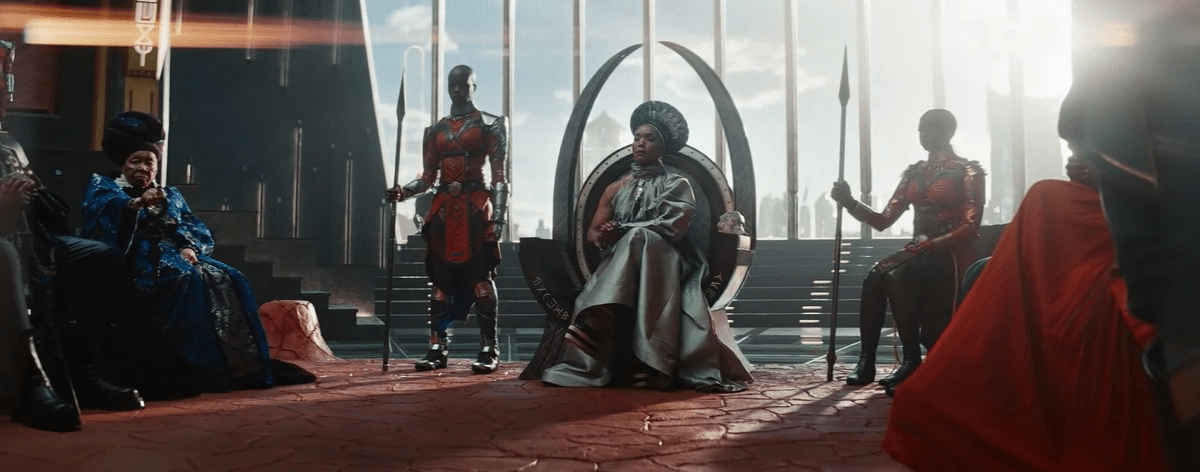
After suffering the death of King T’Challa, the Black Panther, the country of Wakanda finds itself weakened and vulnerable after opening up to the rest of the world and receiving threats of war from an underwater civilisation.

The authenticity of the fictional country of Wakanda was praised as a large team effort. The highly visceral style which was on display was reflected in the overall sound – which led to a handful of rightful Oscar wins for the film in the creative categories. Yet, Wakanda was also authentic because of its characters and the internal conflicts which could impact the outside world. Now the country has opened up to the rest of the world there’s a global want for vibranium, the rare, almost indestructible, metal only available in that part of the world. There are tensions rising with other countries, including the US, who all believe that the peaceful nation could use the metal for weapons of mass destruction. All while they try to recover from the death of King T’Challa – the opening scenes certainly create an emotional build-up and response in the wake of Chadwick Boseman’s passing.

Without the defence of the Black Panther Wakanda finds themselves at perhaps their most vulnerable and weakened state. Particularly when threatened with war by leader of the underwater Talokan civilisation Namor (Tenoch Huerta Mejía) who asks the grieving queen Ramonda (Angela Bassett) and princess Shuri (Letitia Wright) to find the scientist who created the drills that have invaded his land or else he will destroy Wakanda. However, it turns out that this scientist is college student Riri Williams (Dominique Thorne). It’s with this introduction that Wakanda Forever really starts to find its flow. It’s introduced most of its characters and set itself up, now it can truly get into its narrative.

There’s certainly still a lot to see and get through over the course of the nearly three hour run-time (which manage to go by rather quickly), but the generally flow of the film is rather good as your kept engaged throughout. It’s the aforementioned authenticity of the titular country which manages to do this. Not just visually and audibly but in terms of the way that those within the nation interact with others and prepare for battle against forces which they haven’t seen before – forces which feel grounded and believable in their reasoning for threats and attacks, perhaps adding further interest in various fight and battle sequences.


There are a number of undeniably ‘cool’ shots within a number of these scenes, including a handful which linger through co-writer (alongside Joe Robert Cole) and director Ryan Coogler. Add to that the visual flair brought about by the cinematography and there’s clearly a strong visual effort that’s been brought into play to further bring you in to the creativity of the world on display. It mixes well with the third act in particular where there’s an understated nature to the build-up and escalating action held within it.

Further propelled by what has come beforehand in terms of the film narratively taking a step outside of familiar surroundings, particularly for the central characters. Looking at how Wakanda interacts with the rest of the world now that it has opened up and finding themselves in an increasingly uncertain situation as everything seems to have disappeared from around them.

While there’s plenty of action what truly propels and engages within Wakanda Forever is the dramatic side of things. A nation still mourning and trying to recover while in an already uncertain situation. Something shown and developed among the more present supporting characters, not just the likes of Danai Gurira’s fierce yet effortlessly funny Okoye and Lupia Nyong’o’s Nakia, in instances such as discussions between the various tribal leaders of Wakanda – including Winston Duke’s returning M’Baku. The same goes for the way in which we see the oceanic world of Talokan and the people within it. It adds to Namor as a character and that new realm as a whole. Creating yet another villain within this particular franchise, after the first film’s Killmonger, where you can understand their motives and reasoning, but they certainly go the wrong way about resolving it.

That is where Wakanda, and indeed Wakanda Forever, succeeds the most. Once it properly delves into this point after a slightly lengthy set of introductions – somewhat lessened by the simple use of fade edits from one scene to another to avoid feeling jumpy and somehow less busy – it finds its stride and manages to run with it for most of the remaining run-time. There’s plenty of humour along the way amongst the action and dramatic stakes which are well grounded by Cole and Coogler and the entire cast of the film. All of whom you can tell are dedicated to telling this story about a country, a group of people, trying to prevail. And in the end it succeeds because of all the detail and effort that has been put into the various different aspects of making an authentic place and people, as grounded as possible (of course with a number of sci-fi, fantasy and action tints) within a world which further reflects that.

While the build-up might take a bit of time to introduce the various different characters there’s no denying that the pay-off of Black Panther: Wakanda Forever is successfully engaging because of the various believable dramas which push the authenticity of Wakanda and the world it’s opened up to, playing out amongst plenty of enjoyable action.

Rating: 4 out of 5.

Living – Review

Cert – 12, Run-time – 1 hour 42 minutes, Director – Oliver Hermanus

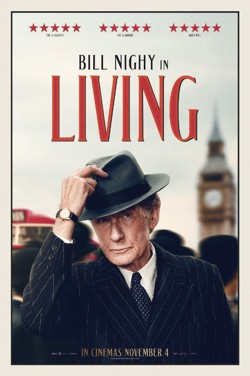
When told that he has only six months to live the head of a London council department (Bill Nighy) tries to make the most of his life.

There seems to be something about Akira Kurosawa’s Ikiru which appears to lend itself rather nicely to the backdrop of 1950s London. Kurosawa’s film itself was released in the 50s and while very much fitting of its time and Japanese culture and stylings undoubtedly has a sense of timeless universality. It’s brought into this English language remake with ease thanks to Kazuo Ishiguro’s screenplay and a fine capturing of traditional repressed British emotion under the guise of the stiff-upper-lip attitude. Much of this is conveyed through the leading performance of Bill Nighy as head of London Council’s Public Works department, Mr Williams.

While Williams is certainly the central focus of Living’s midsection he plays something of a supporting role in the stages which bookend the film. It’s here that while he certainly plays a prominent role and remains a central focus we see more of how other characters view him. Those who he works with in the quiet office filled with the sound of occasional paper filing alongside his distant son (Barney Fishwick) and daughter-in-law (Patsy Ferran). The difference in the bookends is the lease of life he finds in-between as, after being given six months to live, he tries to find a way to truly live.


Initially this takes him to other people’s interpretations of living, via a boozy seaside night with Tom Burke, before eventually finding it in that which was already around him. Simple cinema trips to see Cary Grant in I Was A Male War Bride with former employee Miss Harris (a rather charming Aimee Lou Wood) who he begins to form a friendship with. While Nighy’s performance throughout remains effectively quiet and restrained there’s a clear change in his character as the film gets through its moments rather quickly. Certainly the core change in attitude of the central figure feels condensed into a number of rather quick scenes which move from one to the other with a quicker pace than some of the other strands of the film. Time is still taken, but it feels slightly pacier as you can tell the film wants to reach a key point and development that will lead to the next big stage in the narrative.

In general little has changed from the original film, yet Living manages to get away with this and still makes for engaging viewing. There may be a sense of familiarity at times, but never too much to be bored or disengaged. Leaning more into the realms of faithful remake than a shot-for-shot one. Similarly tones and feelings are captured without feeling as if you might as well be watching the original. And much of this comes from Bill Nighy’s performance and the way that the film focuses on the effect that his character has in taking control of his life. Sometimes seen from the perspective of new-to-the-office Mr Wakeling (Alex Sharp), told to expect a stern, little-talking, punctual head of department before he fails to turn up multiple days in a row, after having to leave work early on the new employees first day.

As a whole there’s a calmness to the film which allows for the quietness of the emotion to come through and have more of a connecting effect. Much of why the film works is down to its subtleties and the conflicting restrained emotions of the themes and the displays of what the characters are often feeling. It has an engaging effect which manages to flow rather well, even if a bit sped up during one key part of the central Mr Williams’ course of change, and fits right in to the time period in which it is set – starting off with various 50s-style shots of central London, music and title cards to reflect a film of the period – to further reflect the tones and ideas on display throughout. All rather well captured and simply helping to create an even more thoughtful impact which perhaps remains due to the fact that never does the film go for loudness or heavy forcefulness.

The restrained tones and emotions that make the subtleties and thoughtfulness of Living as effective as they are are captured within Bill Nighy’s wonderfully restrained central performance. While some moments may feel a bit rushed through the film remains well placed within its time period, with quietness making an impact at the fore throughout.

Rating: 4 out of 5.

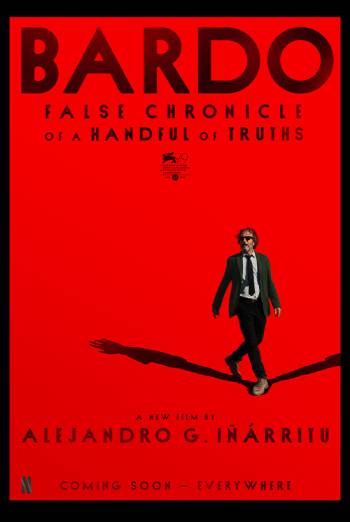
LFF 2022: Bardo, False Chronicle Of A Handful Of Truths – Review

Release Date – 18th November 2022, Cert – 15, Run-time – 2 hours 40 minutes, Director – Alejandro G. Iñárritu

A Mexican documentarian (Daniel Giménez Cacho) returns to his homeland after receiving a prestigious award in the US.

For those who aren’t fans of Alejandro G. Iñárritu, particularly his more recent works such as Birdman and The Revenant, it’s perhaps unlikely that you’ll be turned around by Bardo. With Bardo Iñárritu appears to take influence from his own life (with the help of co-writer Nicolás Giacobone), particularly following from the awards success of his previous two films, and injects it into the experiences of central figure Silverio (Daniel Giménez Cacho). Change an Oscar or two for an equally prestigious award looking at an entire career of work and we see the journalist-cum-acclaimed documentarian travelling from the US to his homeland of Mexico, revisiting his roots and, as you would perhaps expect, confronting both his past and his identity.

Along the way there’s plenty of strange fantastical elements into which many of the events are transcribed. The film opens with the idea of a baby wanting to be put back into the womb when it realises how dark and cold the world is, before the umbilical cord which trails behind the mother gets stuck in a pair of swing doors. It’s undeniably strange, but an undoubtedly enjoyable kind of strange, particularly when it comes to the opening of this almost three hour story.

While this style isn’t as frequent as you might expect, or hope, it certainly pops its head in every now and then to guide Silverio’s mind as the film as a whole feels relatively free from an overall narrative. Sometimes knowingly playing into, and prodding at, the early statement that “life is nothing but a series of idiotic images. Exposure at any price” before returning to Mexico truly appears to bring back his imagination, teased in the opening shot of a shadow trying to fly in the desert.


With such a long run-time there’s chance for things to go off the rails quickly and for the film as a whole to seem like a long slog. However, there’s plenty within Iñárritu’s seemingly now signature one-shot style to engage and keep things flowing throughout. Not just the fantastic visuals, courtesy of cinematographer Darius Khondji. As a whole the film avoids feeling overlong, however there are individual sequences which themselves feel quite lengthy. While, of course, it’s difficult to cut some of these down due to the one-shot style, the film appears to have been served well after having been cut down by around 20 minutes since its debut at the Venice Film Festival.

It’s often when ideas don’t quite seem to properly click, or generally feel thinner and therefore more drawn out, that sequences feel longer than they should. Yet, there’s still plenty to enjoy aside from the visuals. Cacho makes for a highly enjoyable lead with plenty of charm as he captures the delight of his character in the middle of a large dancing crowd and the more emotional aspects of his familial relationships, and when being questioned as to where his real home is when at US border patrol. It’s a wonderfully performance that, while his character is guided by the occasional fantastical elements and those around him, wonderfully leads the film, acting as the consistent through the events for the viewer.

Bryce Dessner’s score occasionally feels like it could be playing in the background of some form of wacky sitcom, when it leans into this feeling the most it works best when accompanying some of the closing stages where the film begins to rather entertainingly wrap itself up. There’s plenty of comedic moments throughout the film and a couple of chuckles which bring about a lightness to the proceedings, and even the moments which stand more in the line of the the dramatic.

The overall tone and blend of the film works well and manages to keep you engaged throughout as it tackles its various themes and ideas within the narrative-light linked events that construct it. Some may feel a bit long but as a whole the film avoids an overlong feel thanks to the interest and engagement formed within the fantastical elements which lead its well-performed central figure. For those who are yet to get on with Iñárritu this likely won’t change anything, but for those who have enjoyed his more recent works, and even enjoy something a bit more on the strange side, then this may work rather well particularly when it knows how to run with certain ideas without spreading them too thin, or too high.

For those who have liked Iñárritu’s more recent works there’s a fair deal to enjoy within Bardo, particularly the strong visuals and occasional drifts into fantasy. A strong central performance from Cacho acts as a likable consistent through the largely entertaining events which while some individual points might feel a bit drawn out, fill the film as a whole rather well.

Rating: 4 out of 5.

LFF 2022: Aftersun – Review

Release Date – 18th November 2022, Cert – 12, Run-time – 1 hour 42 minutes, Director – Charlotte Wells

Father and daughter Calum (Paul Mescal) and Sophie (Frankie Corio) spend a relaxed holiday in a foreign holiday park, however much of it plays out like a distant memory.

There’s very little that goes wrong in Aftersun, there’s little hinting that anything will. Yet, writer-director Charlotte Wells’ debut feature is one of the tensest films in years. For much of the 1 hour and 42 minutes run-time I was thrown into an intense state of fear, constantly bordering on a panic attack. All as I watched a father and daughter simply have a really nice time on holiday.

The father and daughter in question are Calum (Paul Mescal) and Sophie (Frankie Corio). They’re spending a few weeks of the summer at a foreign holiday resort, having been hinted that they’ve spent some time apart with Calum being divorced from Sophie’s mother. Over their time away we see their various conversations as they walk along the beach, play pool, make fun of the evening entertainment and more completely innocent activities. However, Wells underpins all of this with extremely subtle hints to the deeper, more unspoken elements of their relationship, or perhaps more simply brief visual threats. When the two are walking at a slight distance from each other, or Sophie is allowed to go off and play pool and swim with other kids, or teenagers, around the hotel there’s an inescapable tension that she’s somehow going to be abducted.

On the other hand, there are hints within Mescal’s performance and slight character details that Calum may be suffering from depression, perhaps even turning to alcohol. There’s a genuine worry that arises that at some point over the course of the film he may kill himself, leading to further worry for what may happen to Sophie. Much of this plays out at the same time, with the fear and panic layering to create a truly stressful experience. All while, again, you see a simple holiday play out. One which deeply contrasts your feelings to what you’re seeing.


It may take a little bit of time to properly work out what the film is showing you with its lack of narrative, but as it begins to give flashing glimpses of unexplained or uncertain events your interest in the characters deepens. Shots of what appear to be Calum at a nightclub could be in the past, the near future or a consistent display of what he’s doing while his daughter sleeps. Regardless they add to the film as a whole and the emotional responses it creates within the viewer. Yes, it builds up to something more over time, but much of this largely comes towards the final stages, remaining largely ambiguous for the most part.

The quietness of certain scenes allows for moments of worry-inducing threat to speak even louder. One particular lingering beach shot focuses just as much on the crashing waves as much as it does on Calum at the centre of it. It’s just before this that you realise you’ve been worrying just as much about him as you have his daughter. It’s also around here that the film begins to lean into wrapping things up. It may not be able to build up the same kind of suspense, but it gets around this by continuing to tackle a sense of ambiguity and mystery. What’s going to happen when this holiday that the pair have been posing as idealistic is over? What will happen to their bond once she vanishes into the airport tunnel?

All of this so quietly, effectively held in the background as subtle hints and ideas presented to the viewer behind the central holiday that the central father and daughter both wonderfully, naturally performed by Mescal and Corio are trying to enjoy. It perfectly contrasts with these images and allows for the fear and worry that lies throughout the feel even stronger. While what’s presented should be peaceful and relaxed what’s experienced is a truly emotionally intense ride for the viewer. Debuts don’t often come as emotionally complex as this.

While what’s visually presented is an often peaceful and relaxed holiday the central performances of Aftersun’s father-daughter duo, alongside Charlotte Wells’ subtle layering of hints and ideas, create a 102 minute panic attack through the intense fear and worry created for them.

Rating: 4 out of 5.

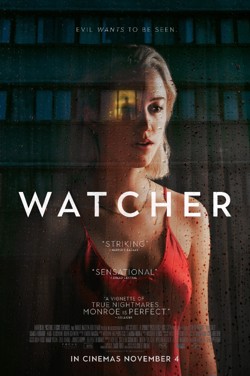
Watcher – Review

Cert – 15, Run-time – 1 hour 36 minutes, Director – Chloe Okuno

Having moved with her husband (Karl Glusman) from New York to Bucharest, Julia (Maika Monroe) begins to suspect that she is being constantly followed by a man (Burn Gorman) living in the building right across the street.

There’s a very traditional feel to the opening stages of Watcher. A quick set-up throws us into the eerie chills which haunt Maika Monroe’s Julia as she suspects that she’s being stalked by a man in the building across from her apartment block. She’s recently moved from New York to Bucharest with her husband, Francis (Karl Glusman). However, while he speaks Romanian she’s still learning and finds it difficult to communicate with others in her building, aside from neighbour Irina (Madalina Anea). Her increasing feelings of isolation heighten the tension and worry she feels as she both tries to escape being stalked and yet begins to follow the man she suspects of following her (Burn Gorman).

Plenty of elements come together to create the form of a classic chiller. It helps to engage and generally pushes the film as a whole. Its traditional tones mixed with a handful of modern stylings are brought to life through writer-director Chloe Okuno’s direction, mixed with a brilliant central performance from Maika Monroe who perfectly captures the inner, and eventually outer, fear her character is feeling.


As things progress the more modern elements of the film show as the darkness becomes more a part of the central narrative. Glimpses of an investigation into a serial-killer known as The Spider go from being mentioned in the news to playing an active part in Julia’s own investigation. While this increased darkness may somewhat change the styling and slight feel of the film there’s still a consistency to the narrative and the flow feels undisturbed. Tension still manages to rise throughout the short and fast-flowing run-time. Things might dip in the final stages as the film tries to keep its pace while making sure it brings things to a dramatic conclusion but, once again, the engagement is still there; with plenty of this down to the performances at the centre of the piece.

Things are effectively progressed and generally feel as if they avoid repetition, helping with the aforementioned flow and consistency. With the stylistic shifts which appear throughout there’s still tension and engagement thanks to the stripped back nature of the opening stages and how quickly the core situation is built up. The initial paranoia develops, of course clashing with attempts from others to rationalise, with the suspense rising in a number of scenes and situations. Convention may come into play, but when present it’s often questioned as to whether the film may go in a different direction with certain new pieces of information instead of just being accepted. Everything flows through the short time and while there might not be as much of a ‘classic’ feeling in terms of style towards the end there’s still an indie thriller future audience hit feeling to the film as a whole.

There’s an interesting mix of traditional and modern stylings within Watcher, while it might lean towards the latter more with the increased darkness there’s still plenty of tense scenes and sequences thanks to Okuno’s direction and Maika Monroe’s superb central performance.

Rating: 4 out of 5.

Weird: The Al Yankovic Story – Review

Cert – N/A, Run-time – 1 hour 47 minutes, Director – Eric Appel

A highly fictionalised account of the rise to fame and acclaim of Weird Al Yankovic (Daniel Radcliffe).

It feels fitting that a biopic of the life of Weird Al Yankovic doesn’t really serve as a biopic at all. As many fans would perhaps hope for from the musician largely known for parody tracks such as Amish Paradise and Like A Surgeon this highly fictionalised account of his life story slips into the realms of parody very early on. Perhaps not to the genre-ruining effect of Walk Hard, but Weird takes a different stance to that particular modern cult comedy.

Diedrich Bader’s opening narration assures us that “life is like a parody of your favourite song. Just when you think you know all the words. Surprise, you don’t know anything”. It’s something that writers Yankovic and director Eric Appel try to run with in the various scenes and genre pastiches throughout the film. From an early childhood where music is shunned by his father (Toby Huss), there are serious consequences when a young Alfred (David Bloom) sneaks out one night and attends a polka party, to a fight scene in a diner with the cartel there are plenty of send-ups on display. While some may feel somewhat distanced in humour simply down to how serious in tone the scene appears – there’s often uncertain as to whether moments are aiming for straight seriousness or very dead-pan parody – there are still a handful of laughs to be had along the way.


Daniel Radcliffe plays the grown-up version of Yankovic. An aspiring accordion player with a talent for re-writing the words to other people’s songs. It’s not long until, after frequent airplay from Dr Demento (Rainn Wilson), he’s propelled to the heights of fame and constant acclaim as one of the greatest musicians to ever live. His parodies even lead to boosted sales for hit bands such as Queen, something which Madonna (Evan Rachel Wood) wants in on, entering into a relationship with Al in the hope that he will make her an even bigger success with a parody of one of her songs.

Along the journey of rises and falls there are plenty of famous faces and cameos which pop up at various events – particularly at a pool party hosted by Demento. Such appearances capture aspects of the lighter, and definitely more absurdist elements of the film. It’s here that as a whole things appear to work best and provide the most amusement. It’s where the tone feels most clearly defined and certain of itself. Things move along well with the most chuckles, as is the case with most of the film, coming from quick lines of dialogue rather than drawn out ideas, although a one-off to developing gag about Pablo Escobar (Arturo Castro) being a huge Weird Al fan does prove to be consistently amusing.

As a whole the film fills its 107 minute run-time rather well. While it might occasionally walk an uncertain line between seriousness and parody in general there’s plenty to enjoy throughout thanks to a fair share of chuckles. In fact, even with its sense of parody it manages to not overdo it on the songs, although there’s plenty to like about those that do crop up with their acknowledged sense of silliness, pushed by the fact that Radcliffe is clearly having a great time with the lead role. Barely any of it is true, it’s pretty obvious from some of the initial playful twisting, and in a number of ways a Weird Al ‘biopic’ is perhaps better for it. For the time it’s on it’s rather enjoyable stuff which embraces absurdism with a good deal of laughs along the way.

While clearly not taking itself too seriously Weird: The Al Yankovic does occasionally walk an uncertain line between seriousness and parody, but as a whole there’s plenty of chuckles along the way, particularly when clearly displaying a silliness which everyone involved seems to embrace.

Rating: 3 out of 5.

LFF 2022: The Wonder – Review

Cert – 15, Run-time – 1 hour 48 minutes, Director – Sebastián Lelio

1860s Ireland, English nurse Lib (Florence Pugh) is sent to Ireland to watch over a young girl (Kíla Lord Cassidy) who remains perfectly healthy despite not having eaten for several months.

The Wonder pitches itself as going into a number of different tonal directions as it begins to establish the working relationship between English nurse Lib (Florence Pugh) and young Irish girl Anna (Kíla Lord Cassidy). Lib has been sent to Ireland to observe Anna who remains perfectly active and healthy despite not having eaten for several months. While her job is to watch over and report anything back to the elders of the town her own inquisitive nature begins to take action as she tries to get to the bottom of what’s really going on.

Anna’s claims of “I don’t need to eat. I live on manna. From Heaven” bring in a short burst of near-supernatural horror which dies down quickly as the film also abandons much mystery and ambiguity in favour of a direct period drama. Lib’s perspective is very matter-of-fact and simply presents events as they unfold with little questioning about what might or might not be real. The religious angle may still be played into every now and then but it never feels strong enough to lean back into something more genre-based, instead playing out as more of a character detail for Anna and her family.


It’s one of a handful of elements which appear to be dropped over the course of the film. Niamh Algar somewhat narrates the film; voicing the opening as the camera pans across a soundstage before zooming into the main set and the world of the film, yet her early reminders that ‘this is a story’ are almost entirely forgotten about until much later into the run-time. There’s plenty to be interested in and engaged by throughout the rest of the narrative’s course, but certainly it leans more into directness than the early stages perhaps hint at.

Amongst this there are strong performances from the central cast, particularly, as everyone has come to expect by now, Florence Pugh. Pugh effectively navigates the flow of the film and its occasional cracks and displays of other tones, genres and potential ambiguity with a consistent performance which helps to keep you engaged in how things are going to pan out.

After their initial meeting Lib initially battles with Tom Burke’s Telegraph journalist as they debate what may be the force keeping Anna alive, particularly as she begins to fall ill during Lib’s personal investigation. It’s another element that brings in a sense of slight confliction and mystery before somewhat dropping – although this one does crop up more often than others throughout the film. A number of elements appear to be brought up and dropped in the early stages of The Wonder. While some attempt to break through it largely continues down the lines of a direct period drama, but at least one which, with an intentionally gradual pace, generally holds interest and engagement.

It may only offer glimpses of more genre-based tones and ambiguity but thanks to a set of good performances at the fore The Wonder proves to still be an engaging period drama amongst its directness and intentionally slow-burn nature.

Rating: 3 out of 5.

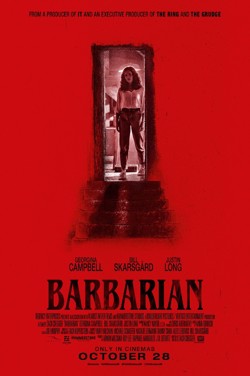
Barbarian – Review

Cert – 18, Run-time – 1 hour 39 minutes, Director – Zach Cregger

After arriving at a double-booked Airbnb Tess (Georgina Campbell) discovers that there’s a lot more to the house than just another renter (Bill Skarsgård).

It’s already been stated in multiple places that it’s perhaps best to go into Barbarian knowing very little. Having seen the trailer you might think that you’ve been shown some of the twists and turns that the film takes, however it turns out that even that shows the relative basics. There’s much more than just a double-booked Airbnb at the heart of this film, and while it certainly provides a fair deal of tension it does lead to a feeling of the film being somewhat overstuffed.

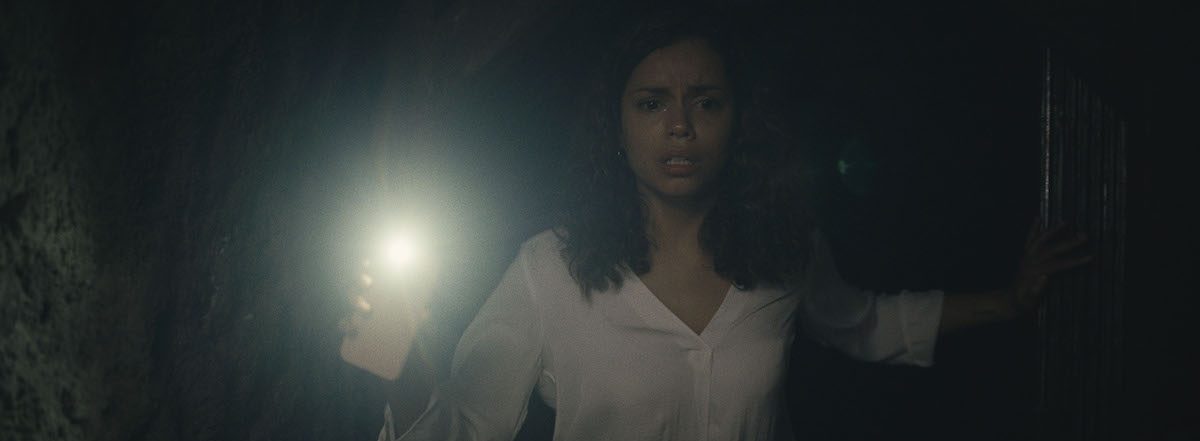
Throughout the course of the main events we primarily follow Tess (Georgina Campbell), turning up to an Airbnb late at night, ready for a job interview in Detroit the next day. However, on finding no key in the lockbox she discovers that someone else is staying in the house having booked on another app. With all hotels in the area seemingly booked up and the surrounding area not being ideal – to say the least – Tess stays the night, with Bill Skarsgård’s Keith taking the couch, at the house hoping to sort things out in the morning. However, after a couple of bumps in the night gradually it’s discovered that there’s a lot being hidden about the house – including an expansive set of underground corridors.


There’s plenty of tension to be found within these confines and the dark, maze-like construction. It comes after an already eerie nature to Skarsgård’s performance which has provided much of the build-up to this discovery, as the film clearly knows how it wants to pitch him and doesn’t appear to hide that fact. As we delve further into the setting we begin to see different perspectives which add more detail to the film and house as a whole, each witnessing something new, or simply more of what has come before, particularly when it comes to the core threat at hand. Certain moments which may feel like stupid ideas for some characters feel in context for others, such as Justin Long’s generally undisclosed role measuring the place up in the hope that it could make him some money to pay for upcoming legal bills.

Even with this in mind the moment still manages to build up eventual tension as his character delves deeper and eventually stumbles across the same thing that Tess has discovered. It’s as we learn more about this threat, including seeing more from the aforementioned different perspectives – some focused on more than others which act as brief glimpses to simply provide more detail than properly push things along – that the film begins to dip somewhat. It starts to feel slightly overstuffed and as if seeing more of the threat and learning more about it removes something from the film and what it’s been setting up.

While it’s understandable that there would be a restricting feeling to just having a ‘trapped in the tunnels’ horror for 99 minutes – although such sequences are dealt with rather well and certainly have a good air of tension to them – the extra detail and elements simply detract from the overall effect of the horror. Yes, there are still tense and engaging sequences which hold your engagement with the piece and allow for you to still feel involved with it, simply things feel dampened by just how much is eventually shown and explained instead of leaving an element of mystery and suspense in regards to just what lies in the cramped and littered confines of the tunnels. Barbarian is a generally good film, however it could be a truly great horror if it didn’t explore the source of some of its tension as much as it does throughout its run-time.

It may feel dampened by feeling overstuffed in exploring certain elements of the core threat a bit too much, however there’s still a fair deal of tension to be found within Barbarian as it remains engaging whilst travelling along its course.

Rating: 3 out of 5.

Prey For The Devil – Review

Cert – 15, Run-time – 1 hour 33 minutes, Director – Daniel Stamm

A nurse at an exorcism school (Jacqueline Byers) finds herself training to perform an exorcism after re-encountering a demon from her childhood.

Prey For The Devil is perhaps a classic example of a film suffering from ‘we’ve seen it before’. Yet, there’s a determination within it that lifts things up and still makes for a fairly watchable set of events. You can see the heights that it’s reaching for and while it may not quite reach them, due to its flaws, there’s an admirable quality to the film because of this.

Throughout we follow exorcism school nurse Sister Ann (Jacqueline Byers). She believes that she’s had experience with demons and possession in the past, primarily her childhood relationship with her mother (Koyna Ruseva) – who was otherwise diagnosed with schizophrenia. It’s part of Ann’s job to survey various patients in the hospital wing of the school, where they are being watched over to determine whether what is presented is a case of possession or, more simply, mental illness. It makes Ann’s eventual encounter with a demon, taking over the body of young child Natalie (Posy Taylor), more difficult to prove, and lead to an exorcism. Therefore, she breaks the tradition of priests-only in classes, led by Colin Salmon’s Father Quinn, in the hope of learning how to tackle the demon which has caught back up with her.


There’s plenty of horror-leaning sequences throughout involving demonic attacks and freaky body contortions. They may have more effect if not set in constantly flickering lights. In fact, the most effective moments of horror are the less ‘dramatic’ or showy moments that simply let themselves exist as an individual point. At one point, as if taunting her through a two way mirror, Natalie’s body stares at Ann, holes open up in her hands as maggots slowly begin to crawl out. Moments such as this are the most effective parts of the film as they don’t entirely play into the standard tropes of an exorcism/ possession horror, and stray away from throwing various ideas at once into the mix.

Away from the horror things are generally moved along fairly well, particularly thanks to a good central performance from Byers. While some dialogue may feel a bit heavy-handed with certain pieces of religious dialogue comparing the work being done to war and battles – in the opening stages it’s mentioned that “we are losing a war that has been raging for centuries” just to further get into the mind of the viewer just how tough these demons are – there’s generally enough within the drama to make things watchable and to move them along. The final stages may feel somewhat drawn out but as a whole the film feels more saved by the fact that it’s only 93 minutes long, including credits.

The biggest downfall is the feeling of having seen much of this done before, and the lack of subtlety, and forced intensity, or certain horror sequences. There are good ideas and moments here and there, helping to give the film an admirable feeling that it is trying, but as a whole things don’t quite reach the intended heights due to the handful of flaws that are present within the piece. It means that as a whole while fairly watchable Prey For The Devil falters due to not quite being able to overcome its own demons.

There’s a good film within Prey For The Devil and as a whole the film is watchable, it does, however, despite clearly trying, stumble due to familiarity and occasional heavy-handedness with dialogue and horror sequences.

Rating: 2 out of 5.

Lola Atkins ‘Purple Beatz’ Interview

Writer-director Lola Atkins joins me to discuss her upcoming debut feature Purple Beatz, available from Monday 31st October.

Purple Beatz is available to buy and rent on various digital platforms now. To see where you can watch it, including in your own country, you can find out through JustWatch.

You can find more from Lola, and about Purple Beatz, through their respective Twitter accounts.

If you’d like to hear Lola’s song requests you can listen to them by following the links below:
Quest – Shimon and Andy C
Don’t Be Afraid – Des’ree
To You – Rachel Foxx