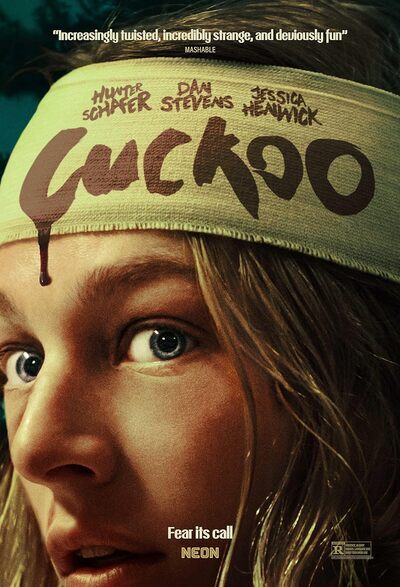
Cuckoo – Review

Release Date – 23rd August 2024, Cert – 15, Run-time – 1 hour 43 minutes, Director – Tilman Singer

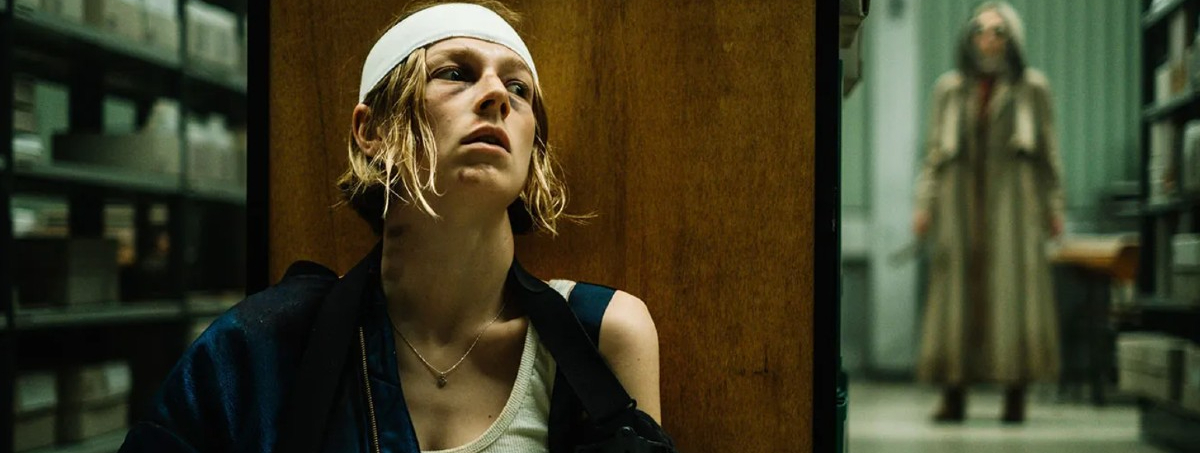
After encountering strange figures and screeches in the night, Gretchen (Hunter Schafer) discovers a sinister side to the quiet alpine resort her parents (Marton Csokas, Jessica Henwick) have been invited to.

The German alpine resort in which Cuckoo takes place in feels like an area trapped in another time. The 60s style décor and architecture is matched by the colour palette which is emphasised by the cinematography. Pair it with the fact that the resort is almost void of guests, and has very minimal staff, and it feels as if the area is recovering from being subjected to nuclear radiation. Perhaps this explains some of the strange goings on which teenage Gretchen (Hunter Schafer) encounters when her family are invited to stay, with her coming along at the last minute in the wake of her mother’s death.

Father Luis (Marton Csokas), distant step-mother Beth (Jessica Henwick) and mute step-sister Alma (Mila Lieu) are all greeted warmly by resort owner Herr Konig (Dan Stevens). Apparently invited so that Luis and Beth can work on developing a new resort for him, Gretchen seems to be almost instantly mistrusting of Konig. The same goes for the audience as Stevens creates an immediately skin-crawling figure. Everything isn’t as it seems might not apply to this film as the creepiness is already clear as soon as he appears on screen and begins to speak, his presence in a scene puts you on edge, wondering what he’s hiding or planning.

Is he behind the strange screeching noises which appear to shake the surroundings, seemingly reversing time for a few seconds, or is it the covered-up figures running through the night, one attacking Gretchen on her way back home from working late at the resort’s reception – having been told not to do so. As Gretchen explores more the fear factor effectively comes through in what we don’t know. It’s clear that something is going on, at not point is there ambiguity or a question as to if everything is in her head, part of the fear factor is how no one appears to believe her, and indeed the state of the resort, its fully functioning on-site hospital, and the overall abandoned aesthetic.

Jump scares aren’t the priority here, there’s only one over the 103-minute run-time and it’s very effective, instead building up the creepiness is the focus as Gretchen tries to uncover what might be happening behind the scenes at the resort, and why her family were really invited. As the investigation grows there are answers, although not quite enough when it comes to the third act. Just a bit more context would help to lift the climactic events a bit more, and stop the film from almost becoming tangled in itself. While we get some answers it feels as if some context is left out that would provide a more satisfying set of conclusions, and a general basis for what has come beforehand.

It creates an unevenness to the closing stages which while still providing something enjoyable, especially in the deadly confrontations which move more towards the centre as the end point gets closer. Even as she gets increasingly beaten-up and bandaged with each attack and encounter she faces you buy into Gretchen’s determination thanks to Schafer’s leading turn, her performance is part of what helps move the third act along and holds engagement amongst the mild dissatisfaction of not getting certain answers which could heighten the threat at hand.

Yet, for a good portion of the run-time, as Gretchen is investigating, occasionally with help from one or two of the few other faces at the resort, there’s a good deal to enjoy and be creeped out by the lingering sense of threat in the air – one which changes and turns into a much more upfront threat in the latter stages where the film makes something of a shift. It doesn’t derail things, and there’s still a lot to like and feel effective horror from beforehand, particularly thanks to Schafer’s central performance, and the fear-inducing presence of Stevens’ character, but if it provided a few more answers when needed then Cuckoo could be a much more solid horror from start to finish.

For the most part Cuckoo’s aesthetics and performances make for a creepy set of events with plenty of tension and fear factor, however things are let down in a third act which somewhat shifts threat and would be more effective with more contextual answers.

Rating: 3 out of 5.

Kneecap – Review

Release Date – 23rd August 2024, Cert – 18, Run-time – 1 hour 45 minutes, Director – Rich Peppiatt

Belfast-based hip-hop group Kneecap (themselves) rise to fame against pressure from the police for their Irish-language republican lyrics, and anti-drug republicans for their drug-based lyrics and consumption.

When it comes to the waves of recent musical biopics Kneecap is perhaps the boldest since Rocketman – and for very different reasons. A proud and defiant telling of the origins and rise of the Irish hip-hop group of the same name, the trio effectively play themselves in the grounded lead roles, this is a loud and unashamed telling of events. One less concerned with being a biopic and telling the story of the group and more the one of their message and the divisive responses to it.

Childhood friends Naoise and Liam Óg are constantly under the eye of the law, largely for reasons relating to drugs, and the republican activities of Naoise’s father Arlo (Michael Fassbender), despite not being seen publicly for years after divisive reports of his death. After a notebook of Liam’s falls into the hands of music teacher JJ, after acting as translator during a police questioning, the trio are brought together when the elder sees potential in the Irish-language lyrics scribbled down amongst the occasional sheet of LSD. Soon his garage-made backing mixed with the pair’s passionate words, and the odd drug session, leads to a handful of tracks which quickly connect with listeners. Rapidly growing from a few faces in the local pub to sold out concerts.

However, the West Belfast-based group have plenty of critics. The police are on their tail, waiting to strike against anything they perceive as anti-British messaging – the group in real life have said that their work isn’t anti-Brit and that this is a false spin – or stirring too much controversy. Meanwhile, a group of anti-drug republicans are after the boys for their constant promotion of banned substances. The group, known as Radical Republicans Against Drugs, are a source of comic relief, largely from not always having their message straight or agreed upon before going into a situation, or not knowing how to pronounce RRAD. However, behind the humour there’s still a layer of tension through the potentially violent threat that they pose to Naoise and Liam.


There’s plenty of humour throughout the film, both naturally springing up from the bond and escapades of the titular trio and also some more surprising moments – certain phrases exclaimed by Liam and protestant girlfriend Georgia (Jessica Reynolds) during sex scenes contain strong pause then laugh moments. Although, perhaps the biggest surprise comes during a performance in front of a large rap where the music takes a brief pause to make way for an unexpected, yet welcome, Pinky And The Brain reference.

The raps are belted with passion and that comes across in the overall tone and style of the film. When dealing with the core messaging of the group against the backdrop of campaigns for an Irish Language Act to officially recognise the language in Northern Ireland the film is at its best. When glimpsing strands relating to the RRAD and Naoise’s father the elements feel somewhat undercooked. There are still points to like, however with these moments not being the core focus of the narrative, although playing key elements at times, they don’t quite have the same feeling of prominence or detail that could provide them with more overall weight.

As a story of passion and defiance Kneecap is told with strength and humour. In some way perhaps helped by the fact that the real life figures play themselves, a decision which could end badly but here is a complete success. There’s an edge to the proceedings without feeling overbearing or as if it’s trying to disassociate itself from the viewer or show how different it is. Instead it comes through in a clear boldness which brings about a feeling far from a conventional musical biopic, and one that stands out from the rest of the crowd in terms of its style and tone. One that brings you in with plenty of laughs and connections with the titular group that radiate from the screen and speakers with loud colour and sound.

Kneecap is a bold and passionate telling of the titular group’s origins and defiant fight against their critics. Well-performed by the real life trio, bringing about plenty of humour, and capturing occasional threat and tension, this is a film with heaps of bite and personality.

Rating: 4 out of 5.

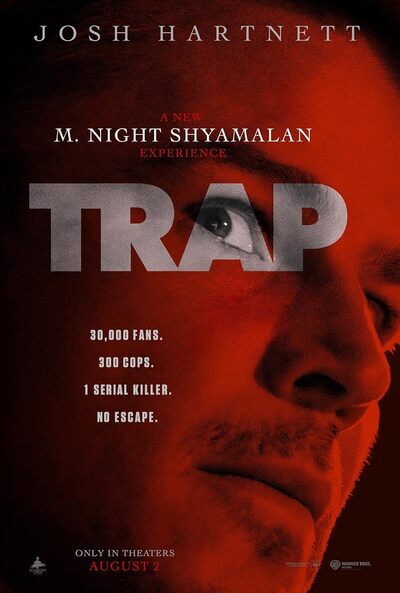
Trap – Review

Cert – 15, Run-time – 1 hour 51 minutes, Director – M. Night Shyamalan

Cooper (Josh Hartnett) takes his daughter, Riley (Ariel Donoghue), to a concert, however the arena is under strict police and FBI surveillance, intent on capturing his murderous side known as The Butcher.

Trap starts out as something different from writer-director M. Night Shyamalan. There’s a self-awareness to the film and its proceedings as Josh Hartnett’s Cooper finds himself surrounded by armed police and FBI agents attempting to catch his serial-killer alter-ego The Butcher. Stuck in an arena where he’s taken his daughter Riley (Ariel Donoghue) to a concert he attempts to do everything he can with his wits to evade capture, and suspicion.

Much of what the film has been sold on is the arena-set thriller that plays out for most of the run-time. This majority portion makes for a deliriously entertaining time, and sets up one of the best things that Shyamalan has done in his career to date. At each turn you can see Cooper thinking in real time and acting just as quickly, adopting new false sides to himself to deter those who are after him, especially in a room surrounded by cops being briefed on his past murders.


There’s a knowing humour which brings about a handful of laughs which become more frequent as the situation gets increasingly desperate for the central character. It’s fun to see him react and just how far he will go to not be caught within the trap that’s been set up, while also allowing his daughter to enjoy a concert. 

We know he’s a serial-killer, we hear some of the details of the crime scenes he’s been behind, and while we’re not rooting for him, there’s still somehow an air of tension about the events within the arena. Perhaps it’s simply because of the thrilling, and amusing, nature in which things are dealt with and how Cooper works. Whatever it is, there’s a really entertaining ride when navigating the fast-paced course of this environment. Much like the concert likely does for Riley, growing increasingly concerned for her dad who keeps disappearing, the time in the venue flies by.

Where things begin to dip is in the extensive third act where a much more familiar Shyamalan feel comes through. To some extent it almost feels as if we’re watching a different, much more serious, film. One focusing on the darker aspects of Hartnett’s character. Multiple potential resolves are brought into the narrative, however the third act continues to go on and on, drawing things out and bringing a suddenly overlong feel. If trimmed down closer to 90 minutes, there would likely be a tighter, and wholly entertaining, film here, however things start to loop around with occasionally different perspectives as if every initial idea is still included by the end.

While Trap’s third act doesn’t fall apart it certainly doesn’t have the grinning edge of fun that it once had as a smile-inducing single-location thriller. Hartnett gives a great performance, and it’s entertaining to see Shyamalan do something different before reverting back to his more familiar style.

Rating: 4 out of 5.

Borderlands – Review

Cert – 12, Run-time – 1 hour 41 minutes, Director – Eli Roth

Bounty hunter Lilith (Cate Blanchett) is recruited to save a young girl (Ariana Greenblatt) who may be the key to a much-coveted vault, leading to a team who take her job off course.

It’s taken a good number of years and barriers to get a big screen adaptation of hit video game franchise Borderlands to the big screen. One of the few things that didn’t get in its way was the writers strike, yet you’d be excused for thinking that might have been the case with the clunky assembly of the central ragtag team. ‘Dysfunctional’ may well be the word the film is aiming for, however there’s little time spent to get to know the characters meaning that we jump from action scene to action scene learning the bases of their intentions and moving on.

The most detail belongs to robot-on-wheel Claptrap (voiced by Jack Black), whose core personality is annoying and cartoonish – a character seemingly designed for failed comic relief in sudden jolts when confidence has been lost in the current scene of dialogue or action. Designed as an assistant to bounty hunter Lilith (Cate Blanchett), he follows her on the journey across her wasteland home planet Pandora to find explosive-obsessed Tina (Ariana Greenblatt); the daughter of a corporate giant (Édgar Ramírez) who has recruited Lilith to return her home.

However, Tina may be the key to a much-coveted vault, one which the trio of solider Roland (Kevin Hart), branded-psycho Krieg (Florian Munteanu) and tech-minded Tannis (Jamie Lee Curtis) – thankfully all listed with ‘as’ credits as otherwise I’d have no idea what their characters were called – are trying to open. Thus, Lilith’s job takes a detour as a journey through various areas of the planet begins with a group who certainly don’t mean the Guardians Of The Galaxy dynamic the trailers may have hinted at.

Instead of building them up together the team are more thrown towards each other and we’re just meant to run with it, despite a full lack of motivation. The set-up feels more like a shrug of ‘that’ll do’ as the narrative moves on to running and fighting. One 15 minute sequence involves the group trying to make their way through a lair of deadly, masked psychos. Constantly the moment seems to resolve and move on right before jumping straight back in with the exact same problem as 30 seconds ago. Instead of ramping up the tension the sequence simply seems to loop and repeat, as if it might construct almost the entire second act of the film while bringing nothing new to the table.


I must confess to have no knowledge of the Borderlands games outside of knowing the titles, but it strikes me that a 12/ PG-13 rating is more a studio mandated factor rather than something the filmmakers would have wanted, even if credited director Eli Roth has dabbled with family films in the past in The House With A Clock In Its Walls, also starring Black and Blanchett. Particularly in the early stages you can feel a more violent film wanting to break out, the screenplay wants to drop the f-bomb, but never does.

At one point a character gets dragged off by a giant monster, the shot appears to want to rip him in half; instead he’s briefly swayed from side to side before cutting to a new location. It captures a key problem that runs throughout most of Borderlands, and that’s the fact that it’s simply boring. Step away from the potentially baffling nature of certain third act developments for outsiders to the game and there’s just a rather bland film here. The bones of which we’ve seen plenty of times before.

The signs of development hell cover the film from start to finish in terms of both tone and narrative. It’s been a long way to the big screen, having been first announced in late 2015, amongst the video game adaptation boom which included the likes of Warcraft and Assassin’s Creed, with the film going through various writers and iterations since then.

There’s little to grab onto with a team who simply feel bundled together because they’re together in the source material and a narrative which feels blandly familiar. Had the journey to the big screen not been so long then the time spent watching it might not feel the same way, especially with a run-time that clocks in at just 101 minutes. Just part way through you can feel the urge for an R-rating also be shrugged off as autopilot kicks in and a team movie that lacks dysfunction, humour and character moves along with little engagement to be found.

Borderlands bears the markings of development hell with an end product with little to be interested by. A central team that lacks character, both individual and unified, and an overfamiliar narrative, the end result is a boring set of events that even to outsiders feels likely very different and watered down to the source material.

Rating: 2 out of 5.

Twisters – Review

Cert – 12, Run-time – 2 hours 2 minutes, Director – Lee Isaac Chung

Former storm chaser Kate (Daisy Edgar-Jones) is called back to the game for a week to help an old friend (Anthony Ramos) achieve funding for his tornado tracking company, however the team have to put up with YouTubers (Glen Powell) making content in the middle of storms.

1996’s Twister is one of the most fun films to have come out of the decade. It’s a film that’s aware of its own silliness and runs with it. As if openly admitting that it started out as an experiment with the latest digital effects technologies and making sure to enjoy the blustery ride. While a box office success the film is undoubtedly somewhat divisive and it’s taken a good while for any form of follow-up to come to fruition. However, almost 30 years later Twisters finally makes it to the big screen. A standalone sequel that while part way through it seems as if it would be great fun in 4D never quite manages to have the same degree of almost goofy cheesiness as the original.

This isn’t to say that Twister is wall-to-wall grins. The opening acts as a dramatic flashback for Helen Hunt’s lead character, witnessing her father be pulled away and killed, alongside her home destroyed, by a tornado. The opening scene of Twisters follows suit as Daisy Edgar-Jones’ Kate barely survives one of the strongest possible storms, her friends who were helping her experiment with calming tornados mostly killed. A sequence following a frantic rush to save people when one of the titular whirlwinds crashes a rodeo has plenty of tension, and is one of the best in the film. Such moments work well, and would likely still do so if the rest of the film relaxed into the style a bit more.

As Kate is called back from New York City by surviving friend Javi (Anthony Ramos) for one week to help track and monitor tornados in Oklahoma, to ensure funding for his company researching them, the game of storm-chasing has changed. It’s become much more popular thanks to YouTubers such as Tyler Owen (Glen Powell), livestreaming their experiences of chasing, and sometimes sitting in the direct centre, of a tornado – to the great fear of journalist Ben (Harry Hadden-Paton), writing a piece about Tyler and his team. A series of chases ensue, one after the other, with the teams seemingly working in competition – one for work, the other for fun and views. Yet, despite the soundtrack and intended joyous air that’s meant to be coming across it always feels as if such moments are taken a little bit too seriously.


The overall tone and style of the initial chase sequences, before the stakes and eventual destructive effects of the tornados are seen, never quite come across as relaxed enough to be properly entertaining. What comes across is an unplanned tightness amongst the almost free-wheeling escapades of Tyler as he lets off whatever his million subscribers have voted for him to release into a twister – whether it be flares or fireworks.

There are likable moments to be found, and there’s still an entertainment factor, however not quite enough for the film to be as enjoyable, or at times thrilling, as it perhaps wants to be. Powell and Edgar-Jones put in likable leading turns, although the film forces a romantic angle in the later stages which never quite takes off, in part down to little time spent building up this kind of relationship between their characters. And indeed there is tension to be found in faster-paced dramatic sequences such as one involving characters diving for cover in an empty swimming pool or the pacey events of the third act. Yet, these are the most serious moments of the film, dealt with at times with a similar face to the instances of characters letting loose, or the audience being introduced to the contrast between the two teams and the rivalry at hand.

Twisters holds a likable nature, and one that certainly provides enjoyment, but it frequently feels as if it needs to relax into itself a bit more. To be in the moment and embrace the energy of the swirling winds at the centre of so many moments. If it did so then there may be more fun to be had than the, albeit entertaining, amusement that there largely is throughout. The leads help to keep things moving and so does some of the more tense spectacle, however the overall energy of what for the characters are dizzying thrills never quite translates to the audience.

There are likable and tense sequences within Twisters, and while having entertaining moments the sequel appears to take itself a bit too seriously, needing to relax into itself to fully bring out the fun.

Rating: 3 out of 5.

Deadpool & Wolverine – Review

Cert – 15, Run-time – 2 hours 8 minutes, Director – Shawn Levy

In need of a Wolverine (Hugh Jackman) to save his universe, Deadpool (Ryan Reynolds) finds himself thrown into the Time Variance Authority’s Void, facing off against telekinetic Cassandra Nova (Emma Corrin) in order to escape.

Deadpool (Ryan Reynolds) doesn’t exactly come crashing into the MCU, nor does he bend to the Marvel rules (aside from Feige’s apparent one strict rule of no cocaine). The opening stages which see a bloody dance fight following a fourth-wall breaking, meta opening show that this is very much the same merc with a mouth as before, even after the Disney-Fox merger which makes for a number of strong gags throughout.

It’s been six years since we last saw the character and instead of a full catch-up we jump in with a convoluted set-up involving the Time Variance Authority, represented by Matthew McFadyen’s Paradox, informing Deadpool that his universe is at risk of destruction. In need of an anchor to save it he goes in search of a Wolverine (Hugh Jackman) that won’t relentlessly attack him to bring back to his home. The Wolverine he finds is a washed-up, drunken version grieving the world that he failed to save, reluctantly and forcibly dragged along for the ride. A ride which leads the pair to the TVA’s Void, where telekinetic Cassandra Nova (Emma Corrin) rules.

Once here the film truly finds its footing. For those who aren’t a fan of Marvel or Deadpool there may not be a huge deal here to enjoy, however for fans of both, and some light ribbing of the MCU, there’s a good deal here to enjoy. Reynolds and Jackman make excellent sparring-partners as a the long-awaited duo bounce off each other with highly entertaining contrast, bringing about a number of needle-drop fight scenes – one sudden scrap which sees a car beaten up more than the titular pairing is almost shot like it’s playing out as a frenemy sex scene for Deadpool. While Corrin may not have a great deal of screen-time it’s clear that they too are having a good time being a part of the film, and makes the most of her time when on screen. Holding their own amongst all the in-jokes and references going on around Nova in The Void.


With the road-trip style the film takes, and the barrage of nods, references, cameos, fourth-wall shattering and generally meta moments you could almost expect the Animaniacs to crop up at some points, especially when other franchises are brought up outside of the superhero genre. There’s a number of laugh-out-loud funny beats throughout, and this third entry in the Deadpool franchise, which even though an official entry in the MCU appears to stand aside from the rest and not just in terms of tone and style, may just be the funniest of the three so far, and as much of this comes down to the performances as it does the overall very-Deadpool tone.

A very-Deadpool tone that’s shown in both the action and comedy. There’s an enjoyable nature to the punch-ups, shoot-outs and various other forms of fisticuffs. From the opening scene the blood splatters and flows across the screen in entertaining fashion (it’s a good thing the red suit remains unchanged, although freshly tailored), and often with a solid needle-drop to enhance the moment – one thing’s for sure, the soundtrack brings a lot to this film, including a couple of brief jokes; Hugh Jackman’s musical outings are brought up more than once.

Overall, Deadpool is very much still free to do what he does best within the MCU. The workings of the Universe in regards to the TVA, a twisting set of details that may confuse even those who have seen both series of Loki, may create initially uneven surfaces, but once set free Ryan Reynolds’ central character has and brings about plenty of fun; alongside Hugh Jackman’s straight-faced return as Wolverine, aware of the laughs and not damaging the reputation of 2017’s still-swansong Logan, something dealt with in the very first scene of the film. This isn’t quite the palate cleanser or break from the Multiverse-building of the MCU that some may have hoped for, but for those invested in both the franchise and Deadpool there’s a good deal to like and enjoy here about the untamed (aside from cocaine – despite the wishes of returning flatmate Blind Al (Leslie Uggams)) merc with a mouth.

Deadpool is at his most Deadpool in his MCU introduction. While the multiversal exposition might feel convoluted, once free to create meta havoc, alongside an equally great comedic turn from Hugh Jackman, there’s plenty of laughs and entertaining action in Deadpool & Wolverine, if largely for existing fans

Rating: 4 out of 5.

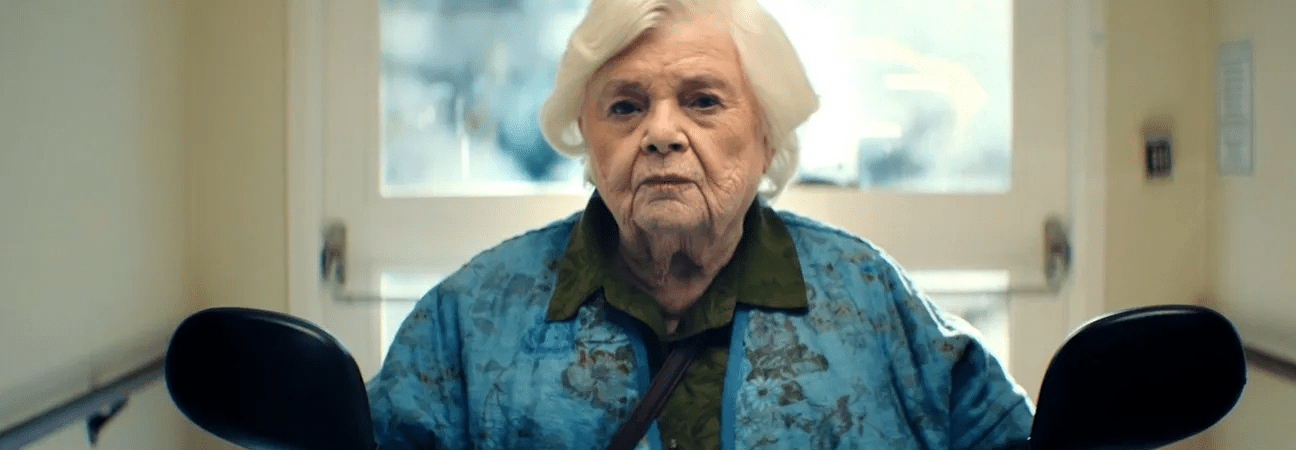
Thelma – Review

Cert – 12, Run-time – 1 hour 38 minutes, Director – Josh Margolin

After being scammed over the phone, 93-year-old Thelma (June Squibb) hijacks a mobility scooter and sets out to get her money back.

Often, the term geri-action conjures thoughts of Liam Neeson grumbling with a gun or an all-star cast getting together for another Expendables flick. From now on, I’ll be thinking about June Squibb riding around California on a mobility scooter. Does she also have a gun? Yes. Does she know how to use it? No, but how hard can it be? “Idiots use them all the time” she tells friend Ben (Richard Roundtree – in his final film role) who joins her for the journey.

Squibb’s 93-year-old Thelma Post spends most of her time sewing and getting her grandson, Daniel (Fred Heichinger), to teach her how to use the computer. However, after a scammer (Malcolm McDowell) claims that Daniel has been involved in an accident and money needs to be sent to sort things out, she sends all the money she has in the house to the address given. After discovering the truth Thelma gives Jason Statham a break and sets out to confront the scammers herself, without her concerned family (Parker Posey, Clark Gregg) noticing.

It’s amazing just how amusing watching Squibb and Roundtree cruise around the Californian streets can be. Both give enjoyable performances that manages to also capture a good deal of heart during more, perhaps even unexpectedly, dramatic moments. Elements which lean away from the comedy and into more serious reflections on aging; Thelma humorously rattling off which of her friends she no longer sees for lunch because they’re dead or can’t get out contrasts with seeing an old friend’s mind having deteriorated.


Early on we see Thelma sat with Daniel watching Mission: Impossible – Fallout, amazed at Tom Cruise’s pace and stunts. While Squibb may not be leaping between buildings, moments which parody such franchises have plenty of laughs – watching her try to quietly creep around someone’s house searching for a gun is a highlight. There are occasional likable motifs here and there, and something almost refreshing about the fact that Thelma and Ben aren’t completely technologically inept – we see Thelma using Instagram, even if most of her posts are of random items or places directly in front of her.

While cuts back to Thelma’s family in the retirement home she was last seen visiting, waiting for news of where she might be, don’t always land the hoped for dramatic impact, they generally tend to be brief before we jump back to the action of the titular OAP and her friend, who wants to get back to his home, and its plentiful varieties of much-praised melon, in time for a performance of Annie where he’s playing ‘Daddy’ Warbucks.

Squibb and Roundtree both provide heartful performances which bring out the comedy and help in the more dramatic moments featuring the pair. Once Thelma’s plan kicks in, once we’ve seen the opening stages of her day-to-day, things move smoothly and quickly for just over 90-minutes. This is a likable comedy with an entertaining action spirit at its core.

While scenes with the titular character’s family may not have the most weight, Thelma redefines geri-action for the better with great comedic performances from June Squibb and Richard Roundtree who both bring heart to the humour and more dramatic edges.

Rating: 4 out of 5.

Longlegs – Review

Cert – 15, Run-time – 1 hour 41 minutes, Director – Osgood Perkins

FBI Agent Lee Harker (Maika Monroe) is assigned to a serial killer case where the only evidence of the killer’s presence are the coded letters they leave behind.

It’s been a long time since a film has got under my skin in the way Longlegs did. Much of it comes down to the twisted threat which Nicolas Cage’s titular serial killer hangs over the proceedings, despite only being on screen for less than five minutes. The question as to whether he’s real or not is quickly put to rest, there’s no ambiguity about the pale-faced killer who may be watching at any moment.

Writer-director Osgood Perkins’ camera follows Maika Monroe’s (once again proving herself to be one of the best horror actors currently working) FBI Agent Lee Harker as she’s put on the Longlegs case. Frequently placed in the centre of the frame, even close-ups leave plenty of space on either side as if anyone could jump out from any direction. The off-kilter camerawork constantly brings a sense of unease as Lee deciphers the coded letters left by Longlegs at each crime scene, the only sign that someone else aside from the murdered families was present.

The suspense is truly ramped up after Longlegs visits Lee with a letter just for her. Barely seen and largely creeping in the shadows when we do actually briefly glimpse the character Cage’s unhinged performance matches the pale prosthetics which make him unrecognisable. Perkins frequently gets shots which make the killer look like a monster revelling in their actions. Anger and twisted joy working together, playing on Lee’s mind as she may have further connections to the killer.


While things lead to a likely divisive set of events in the third act, especially the way in which things are revealed and explained, the creepiness of the threat at hand remains truly unsettling. The final shot of the film left me on edge throughout the credits and has sprung back to mind a number of times since viewing the film.

Much of that effect coming from the way the film moves along as a whole. Developments in the investigation are consistently spaced out with just as much dramatic impact coming from torch beams gliding around a barn in the middle of the night as there is from the discovery of a key item under the boards. Intrigue melds with the tension to propel things forward with a good deal of pace while still maintaining an even balance of slow-burn styling.

What could so easily be played as a thriller has so much unease at its centre, thanks to the force of unseen threat permeating into each scene, to successfully turn it into an undoubted horror. One which you can feel crawling up your skin as it plays out without diving into masses of bloodshed and gore.  All down to the threat which you can see and feel hanging over Maika Monroe’s excellent central performance. One which we barely glimpse but can almost hear screaming or speaking in broken, song-like tone throughout.

Suspense runs throughout Longlegs, largely from the terrifying force of Nicolas Cage’s rarely glimpsed performance, propelled by Maika Monroe’s excellent central turn. Definitely gets under your skin throughout its well-paced slow-burn narrative, and continues to wriggle long after the credits.

Rating: 4 out of 5.

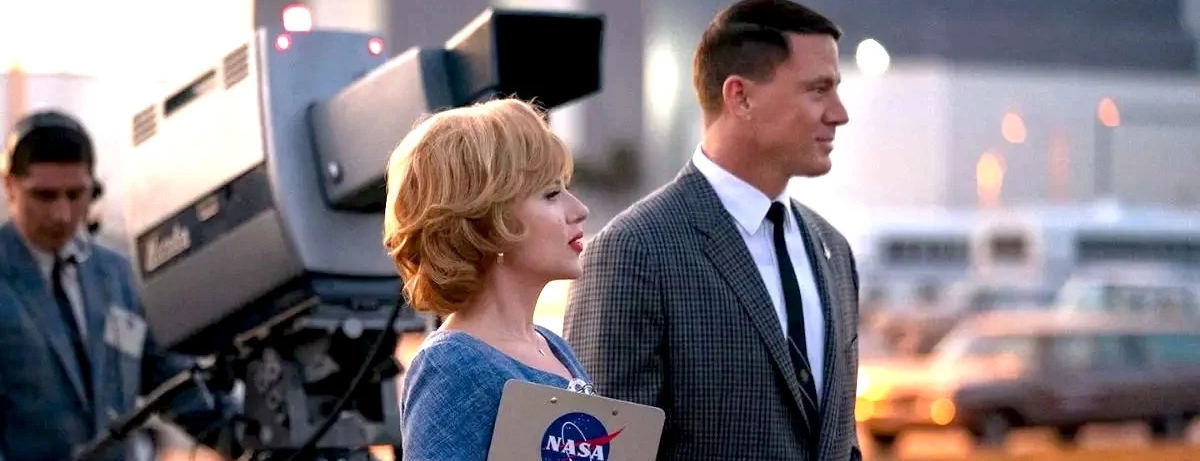
Fly Me To The Moon – Review

Cert – 12, Run-time – 2 hours 12 minutes, Director – Greg Berlanti

As NASA prepares for the moon landing, Kelly Jones (Scarlett Johansson) is brought in to market the agency and help secure funding, clashing with director Cole Davis (Channing Tatum).

Fly Me To The Moon is a film which sells itself on the charm of the two leads. Scarlett Johansson and Channing Tatum may have been cast as starry names to lead this rom-com stuffed with so many ideas that the rom-com sometimes feels like an afterthought, and their chemistry may be up for debate, but they ooze charm in every frame and make for a highly likable central duo.

Johansson’s marketing extraordinaire Kelly Jones is employed into NASA by the government, represented by Woody Harrelson’s suited Moe Berkus, in order to give the agency a marketing boost among the American people. It’s the late 60s and interest in the space race is dying, however the government wants to beat the Soviets for fear of what might happen if they lose, therefore NASA needs to ensure funding. However, Kelly’s ideas for Apollo 11 brand tie-ins and behind-the-scenes interviews for those within NASA clash with director Cole Davis (Tatum) who fears at every turn that the moon landing could be shut down.


As the pair’s relationship fluctuates amongst its workplace tension the struggles to sell NASA conflict with the struggle to get everything right in time for the big launch, while the government wants to fake the landing alongside the real events just in case something goes wrong, then the public are reassured and the Russians think they’ve lost. This latter point has featured in much of the marketing and doesn’t appear until what feels like over halfway into the film. While it produces a good deal of the comedy, particularly from Jim Rash as a Tab-bingeing director who needs full creative control to ensure his artistic vision, it’s another addition to a narrative largely constructed with various new ideas to show the pull between NASA and the government.

New issues and montages crop up every so often, with a black cat lurking around the agency being the least of Cole’s problems. Eventually the film shows signs of feeling too busy, especially in regards to its lengthy run-time which could be cut by half an hour for a tighter, better flowing film. Much of this comes from a slightly disconnected nature to the ideas which feel as if they’re being dealt with one at a time, yet somehow there’s still an enjoyable time to be had.

Much of it comes from the light, suitable-for-all-ages tone of the film, plus the central performances of Tatum and Johansson who cruise through in consistently likable style throughout, matching the traditional outline of the narrative. As a whole the film provides enough to entertain that while it might feel overlong it still remains enjoyable. Even the moon landing sequence itself, happening alongside chaos on the set of the fake landing, manages to conjure up some tension even while we know what happens. Yes, the structure may cause some issues, especially in the later stages and developments where you can feel the run-time, but what arrives during these clear stages provides enough good stuff, and infrequent chuckles, to help pass the time and move things along.

While the one-too-many stages bring an overlong feeling, Fly Me To The Moon lies on the charisma of its leads who bring a likable energy to the traditional leaning style of the overstuffed narrative.

Rating: 3 out of 5.

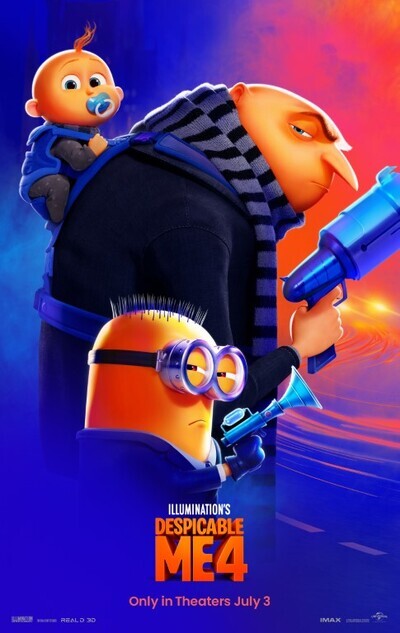
Despicable Me 4 – Review

Cert – U, Run-time – 1 hour 34 minutes, Directors – Chris Renaud and Patrick Delage

When a former rival (Will Ferrell) escapes from prison, Gru (Steve Carell) and his family are moved into hiding by the Anti-Villain League, however it’s difficult for everyone to keep to their new identities.

Despite now having their own film series the Minions are now firmly the heart of the Despicable Me franchise, too. What were once briefly-seen comic relief characters are now almost given a full narrative arc playing out alongside the main events of the film. Yet, not to be separated from the main events themselves we still see three of the much-marketed yellow figures pulling their own pranks on each other, largely involving a vending machine, and assisting Gru (Steve Carell) and his family as they’re moved into hiding by the Anti-Villain League. For those who aren’t fans of the characters, this latest entry in the franchise is unlikely to change any minds.

Even with the introduction of the Mega Minions, a group of superpowered creatures created to be a new force for the AVL, and potentially spoof some superhero flicks, the antics remain very much the same. They’re created to help take down Maxime Le Mal (Will Ferrell), a former rival of Gru’s out to get revenge by kidnapping his months-old son, Gru Jr, who Gru is struggling to bond with. The clichés are written large across the narrative as the family struggle to adapt to their new identities – whether it be youngest daughter Agnes (Madison Polan) worrying about lying, or wife Lucy (Kristen Wiig) showing no skills at being a hairstylist – and once again Illumination create a problematically familiar narrative.

Despite having a basic feel to the structure the overall plot still somehow feels overstuffed with ideas, crammed into the 94-minute run-time and jumping back between Gru, his family, the Mega Minions and indeed another set of Minions for even more cutaway gags. It would be easier to forgive if it wasn’t for the lacklustre nature of the laughs. With the reintroduction of AVL director Silas Ramsbottom (Steve Coogan) we get the same ‘pfft bottom’ joke we did 9 years ago; and treated only half as a throwback. In general the gags feel laboured and most of the time fail to get a proper response, whether down to how obvious they seem, the fact they just aren’t very funny or the fact we’ve seen them done before.


There may be some chuckles here and there, including a very good train gag during a montage of the Mega Minions wreaking havoc across a city, but not enough to sustain the film through its run-time. A possible reference to Spider-Man 2 works, but an extended reference to Terminator 2 during a chase in a supermarket falters largely down to just how much it’s drawn out.

Throw in occasional glimpses of Le Mal, just to remind us there is a villain here, and a couple of sidelines involving the new neighbours (primarily Stephen Colbert’s Perry and teenage daughter Poppy, voiced by Joey King for some reason with a lisp) in their lavish home, and the film ends up feeling more like a set of sketched ideas rather than something more fully-rounded. We’ve seen much of Despicable Me 4 before, including in the previous films in the series. While other entries have proved amusing and Illumination generally manages to get away with their convention here this isn’t the case. The proceedings quickly become boring and make for a set of events which appear to stretch beyond the near hour-and-a-half run-time.

There’s little new on display in Despicable Me 4, which rounds off with a near-lookback at the franchise in a way that doesn’t warrant nostalgia or memories, particularly knowing that this likely won’t be the last we see of the characters (Minions 3 has just been set for 2027). Instead we get a repeat of familiar narrative elements and gags from both in and out of the series. Some raise a mild chuckle, but very few, and you wish that the film would kick into gear and bring something new and more exciting to the table instead of relying on a heavy dose of reheated ideas melded into each other to get the characters from Point A to B.

Despicable Me 4 feels like a reheated version of the franchises previous entries, lacking in spark and excitement it eventually feels like a bland mix of familiar ideas and very few effective jokes amongst the busy muddle of perspectives.

Rating: 2 out of 5.