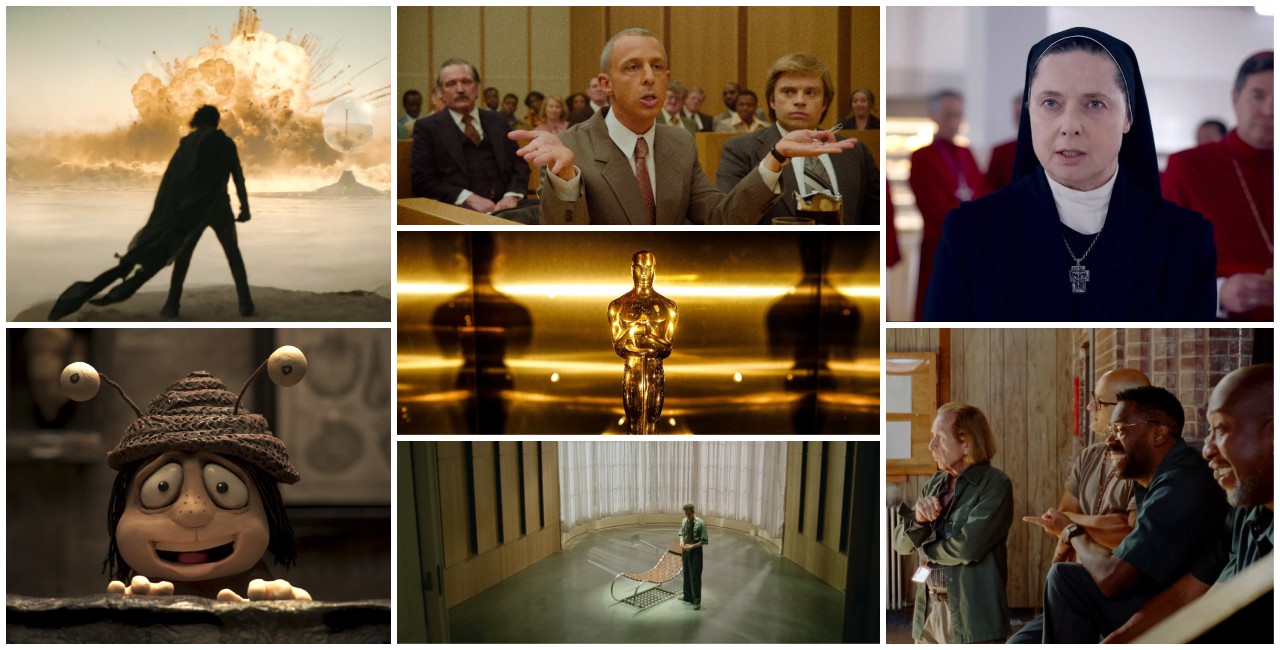
With another Academy Awards ceremony quickly approaching, and final predictions nearing their last-minute change it’s time for me to waffle about what I would personally vote for out of the nominees in each category. As usual, there will likely be consistent picks of frontrunners with the occasional left field (if that term can even be used when it comes to the 5 (or 10) nominees which have been whittled down to contend for one of the highest honours the film industry has to offer) choice thrown into the mix. So, to just jump right into it, here is who I would vote for at the 97th Academy Awards.
Best Cinematography – The Brutalist
For the most part this is a pretty strong category, but The Brutalist jumps to the front of the pack for me due to the detail that the cinematography adds to the grinding down of Adrien Brody’s character. The way the hopeful light of arriving in America appears to deteriorate over time as he pours his soul and passion into the multi-functional build he’s been commissioned to design. Yet, there’s still an impact from the colour and at times stillness of the film in the latter stages. When searching for marble in the Italian caves or the search through the layers of the building in the final stages – each of these moments looks fantastic with the camera drinking in the surroundings and adding to the designs and construction process, and the central character’s journey alongside it.
Best Costume Design – Wicked
There’s so much going on when it comes to the costumes of Wicked. Yes, this might be me falling into the trap of ‘most’ costume design rather than ‘best’, but then again that could perhaps also apply if I picked Nosferatu (which would likely be my second place pick). Taking some designs from the classic 1939 take on The Wizard Of Oz and spanning them across more locations, and characters, having not seen the stage musical I don’t entirely know how much was translated costume-wise from there. Nonetheless there’s a great variety of detailed and colourful costumes in the One Short Day sequence alone which could warrant this. And, as should be the case, each feels entirely fitting for the characters wearing them. (This feels like a lot of waffle saying nothing, regardless Wicked would be my pick here).
Best Makeup And Hairstyling – The Substance
Not just for the big changes and transformations we see in the final half hour for both Moore and Qualley, but for the gradual changes we see throughout the film. The changes we see in Demi Moore’s character, growing increasingly wild and frantic as she begins to lose her life to Margaret Qualley’s Sue. All as Elisabeth begins to physically lose herself and become unrecognisable with each switch. Yet, in addition to this, the hair and makeup we see throughout the film, particularly when it comes to those we see at the New Year’s Eve broadcast event in the final stages of the film. All adding to the tale of societal and industry-based body and beauty standards which the film tells, critiques and splatters with blood and strange-coloured fluids expelled from someone or something’s body.
Best Production Design – The Brutalist
Maybe in this case I’m being led by the fact that the film revolves around design and architecture, but there’s something truly impactful about the look of the brutalist structure as it grows in height and area. Even during the building process the building has this towering, haunting nature to it – from the deep foundations to the endless scaffolding. Yet, even outside of the sequences directly seeing the construction there’s a lot to admire about the general design of The Brutalist. The scale that it achieves and just how much it shows on just $10 million. It places you directly into the post-war landscapes and structures in which the events play out in, from run-down a dirty work yards and rooms to the more lavish estate of Guy Pearce’s character, including the initial work we see undertaken to put together a library for him. The design of The Brutalist has a core and daunting effect, working hand-in-hand with the aforementioned cinematography to make a strong, visceral and cinematic look helping to push the themes and emotions at the heart of the film.
Best Sound – Dune: Part Two
A tough decision between this and The Wild Robot – which it could be argued had the more difficult job of doing everything from scratch and alongside the animation. Dune: Part Two gets my pick here for the controlled chaos of the sound in its grand scale action sequences, and even the close-up fights involving Austin Butler’s Feyd-Rautha – the sound of the various elements at play; weapons, protective armour, a shouting audience, each increasing the atmosphere of the moment in a grand arena yet still capturing the close nature of the fight – with a much closer nature in the final duel which closes the film. All while still having the loud machine-like noise of spacecraft various other kinds of ‘vehicles’ (definitely not the right word), and the explosions which often accompany them, throughout the film.
Best Visual Effects – Dune: Part Two
In much the same way as this was the case for the first film, the visual effects in Dune: Part Two blend in seamlessly with the desert planet at the centre of it, and the other worlds that we occasionally see as well. They help to create the scale and make some of the best sequences – such as the much-discussed sandworm riding scene, or the aforementioned large-scale action scenes where we see the Fremen attacking large carriers and spice collectors. The visual effects enhance the world of Arrakis, and those beyond it, and create a believable and authentic world. They simply look brilliant.
Best Original Song – Like A Bird from Sing Sing
The Best Original Song category is often one of the most shambolic at the Oscars, with a number of notorious snubs over the years. For every I’m Just Ken and Naatu Naatu there’s a lack of an Upbeat Inspirational Song About Life, Drive It Like You Stole It or A World Of Your Own. This year the omission of The Wild Robot’s Kiss The Sky from the category is a standout snub, alongside for some Harper And Will Go West from documentary Will And Harper (and dare I mention Vengeance Most Fowl’s The Gnome Song?). However, of the nominated songs, Like A Bird was for some the one that seemed most unlikely to get in, but I’m rather glad that it did. I’ve stated in previous years that I don’t really know how to talk about music (although if this piece has shown anything so far I probably don’t really know how to talk about film either), it’s more a case of whether I like it or I don’t. And I rather liked the gentle and soulful nature of Like A Bird, it’s simply for me the song that stands out as the best in a somewhat weak category – this sounds like damning with faint praise, the song is great.
Best Original Score – The Brutalist
There’s a haunting quality to the music of The Brutalist which echoes throughout the film. Something quietly emotional and capturing the tragedy of the past echoing into the present. It both compliments the film wonderfully and works on its own as a great piece of music too. Even the intermission is worth sitting through for the brief bursts of piano which crop up throughout it, echoing into the second half. The Wild Robot and Conclave both have great scores, too, but Daniel Blumberg’s score for The Brutalist captures the emotional tragedy which hangs over the film and the characters, and is generally a great score and piece/s of music.
Best Film Editing – The Brutalist
Conclave could very easily have got the mention here for telling a tight 2-hour thriller, but at just over three-and-a-half hours long and not feeling like it – with two equal halves and an intermission in-between – The Brutalist’s editing makes what could be a very heavy, and perhaps lengthy, film pass by much more easily. Yes, there are scenes which they could remove and make a film an hour, or more, shorter, but they somehow work in the grander scheme of the narrative, adding to the film and the characters without affecting the flow. It’s also a film which allows its silences and pauses, letting them sink in and effectively so. So much of what is allowed could so easily backfire and push things into drawn-out territory. But it doesn’t, The Brutalist manages to get away with it somehow because of the way in which it’s edited and pieced together.
Best Documentary Feature – No Other Land
The best categories at the Oscars often tend to be International and Documentary Feature, they tend to hold the hidden gems. This year there are some great films in the Documentary Feature race, but the one which truly lands the biggest, most devastating emotional impact is No Other Land. A hard watch in every sense of the word, alongside its tragic story of a Palestinian village being destroyed by occupying Israeli soldiers it manages to tell a story of a growing friendship between Palestinian and Israeli reporters Basel Adra and Yuval Abraham. Urgent, devastating, harrowing and wonderfully constructed in its use of first-hand footage from the pair of journalists at the scene this is another case of the Oscars leading me to a film that if I had seen it last year it would have undoubtedly been in my top ten of the year – as was the case with last year’s deserving winner in this category 20 Days In Mariupol. No Other Land is a truly fantastic piece of documentary and journalistic filmmaking which puts the emphasis on the people in the village, their lives, experiences and displacement.
Best International Feature – The Seed Of The Sacred Fig
Another category where there are some truly great hidden gems, and for once thanks to release dates (and festivals) I’ve managed to see all the nominated films before the ceremony. The Seed Of The Sacred Fig would get my vote here as a film that’s in touch with its activism and just what it’s showing. Especially from the perspective of its two young leads, the way they see the truth of the world around them on social media leading them to growing activism, despite their father’s occupation as an investigative judge for the Iranian regime – asked to sign death warrants without investigation. Yes, things might feel a little overlong in the third act, but there’s still a great film here – made in secret after a ban from the Iranian government from making films – one with a good deal of tension and overhanging threat as the truths of the world are uncovered thanks to characters who, much like the film, have their finger increasingly on the pulse of the society they’re living in.
Best Animated Feature – Memoir Of A Snail
For so long I would have been adamant that Inside Out 2 would have got my vote here, and that it would win the actual award on Oscar night – which now seems set to go to The Wild Robot. However, Adam Elliott’s feature follow-up to 2009’s wonderful Mary And Max is full of just as much care for its characters and the tragedies, and uplifts, that they go through in their lives – particularly central figure Grace, voiced by Sarah Snook. I started tearing up in the first few minutes, and spent the remainder of the film on the verge of tears thanks to the understanding which goes into creating the characters and story at hand, all with an effective sense of humour which has self-awareness and brings a sense of joy to the proceedings. I just loved it and what it reflects – as was also the case with Inside Out 2 and it’s sublime representation of anxiety. Which I wrote about in a piece for Movie Marker last year.
Best Original Screenplay – Anora
While it might not quite be the bulk of it, once things kick off in Anora at the approach of the second hour there’s a wonderfully laid out barrage of chaos as the characters race around Brooklyn trying to find Mark Eydelshteyn’s Ivan. Even beforehand the extended home invasion sequence is full of laugh-out-loud chaos as Mikey Madison’s title character loudly bites back with swear-laden fury while those who have made their way in after hearing of her and Ivan’s marriage ask “rich people don’t have ice?” From here there’s a brilliantly scripted tale full of laughs, and there’s plenty of wit on display throughout much of the first hour as the central relationship is built up and Ani finds herself in a new world; just starting on her journey of the differences between love, intimacy and sex. All tracked throughout Sean Baker’s screenplay with acknowledgement from the film, but not always the characters until the end.
Best Adapted Screenplay – Conclave
There’s a lot I love about the script for Sing Sing and its open, frank conversations about mental health and healthy and unhealthy performance Conclave – at this moment – just gets the edge for me with the way its screenplay tells a tight, detailed thriller with plenty of twists and turns all whilst following the election of a new Pope. Completely subverting how the idea sounds on paper and making for a film of escalating tension with a new reveal around each corner, and its own sense of occasional, fitting wit amongst the battle to become the new head of the Catholic church, and that between the more conservative and liberal stances amongst the various cardinals; and indeed those which they are internally experiencing – such as Stanley Tucci’s doubts as to whether he wants the papacy or Ralph Fiennes’ crisis of faith. All wrapped up in a script and story which manages to be consistently suspenseful even on re-watches.
Best Supporting Actor – Jeremy Strong in The Apprentice
Jeremy Strong is truly the standout in this category for me. Even against Sebastian Stan’s Donald Trump – nominated in the Leading Actor category – he manages to steal the show as a slimy Roy Cohn introducing Trump to a world of power and influence, and how to get ahead in it. Yet, even after all the ruthlessness we see displayed by Cohn a small layer of sympathy is introduced in the closing stages of his arc in the film, pushed aside by his former apprentice outside of expensive clubs and offices and out on the street as a shadow of his former self. It’s an excellent transition which is all part of an amazing performance from Strong who truly excels in the role and gives one of the best supporting performances of last year.
Best Supporting Actress – Isabella Rossellini in Conclave
In all honesty, there’s not really a performance in this category that particularly stands out for me. They’re all good turns, but there isn’t quite an overwhelming standout for me as there is in the other acting categories. And while Rossellini’s nomination has proved divisive, with many saying her screen-time doesn’t warrant it – Beatrice Straight won in this category for her five-minute performance in Network, Judi Dench for eight minutes in Shakespeare In Love and even Anne Hathaway for a turn in Les Misérables largely confined to the first 25-minutes (albeit whilst singing a shattering rendition of I Dreamed A Dream) – her key ‘Oscar clip’ moment isn’t quite why I’ve picked her. Her role in Conclave may be minimal in run-time, and for some overall impact on the story, but there’s a lot to like about her various reactions, those internal which gradually leak out into her physical and verbal responses, to the battles raging on to become the new Pope which gives the film overall a big, understated push. Perhaps this also comes down to having seen Conclave a couple of times, and realising just how much she appears in the film, even if very briefly each time. But it is an enjoyable performance with plenty of quiet subtle beats to compliment the ensuing drama at the fore, and capture nervousness, and influence, amongst those not even voting for the new Pope.
Best Leading Actor – Ralph Fiennes in Conclave
Fiennes is truly brilliant in Conclave. A quiet, unshowy performance packed with so many subtleties. He wears his character’s crisis of faith, and burden of having to arrange the papal election, on both his face and stance. Concealing so much as he finds himself caught in the middle of the push and pull of the various factions of cardinals, trying to maintain calm and order as new details come to light; this is one of Fiennes’ best performances to date. Conclave very much revolves around him and the force of his, again quiet, performance captures things perfectly and brings the audience into this secretive world full of further secrets and twists.
Best Leading Actress – Mikey Madison in Anora
As a character, Anora is a force of nature and much of that is thanks to Mikey Madison’s performance. Relentless in the way she fights, and hurls f-bombs and those who dare to try to break up her marriage, the deeper core of the character begins to physically and emotionally come through in the developments of the third act. Madison is truly fantastic from showing the day-to-day attitude of an exotic dancer and sex worker to the whirlwind spiral of events once her work and life take the turn into the marriage. Fiery and adamant, again, Madison, like her character, is truly a force of nature blazing across the screen and truly selling herself and the film as a whole. Capturing the humour, and absurdities, in the escalating, racing daze of a search and the realisations and barriers of Ani when it comes to her journey of her own relationships with sex and intimacy.
Best Director – Brady Corbet for The Brutalist
The way in which all of the technical elements of The Brutalist are brought together is truly fantastic. Made on around $10 million there’s such a grand scale and scope to the look and feel of the film, all brought together by Brady Corbet’s gentle yet precise direction. A similar sense of scope is brought to the themes and narrative of the film as well, captured in the way Corbet brings out the personal angles and stories of the characters in what’s around them, and indeed the performances and developments of the film as a whole. The point where I truly realised just how much of an impact Corbet’s direction was having on me, and the film, is a long shot showing a train derailment. Focusing on the detail as a whole and yet also seeming to demonstrate a sense of detachment running hand-in-hand with the emotional response. And that’s the key factor of the elements of The Brutalist, they all work hand-in-hand. Complimenting and lifting each other up. Shining through in Corbet’s observant and truly brilliant direction.
Best Picture
With Best Picture being voted for via preferential ballot, as in previous years, I’ll list what my ranking would look like (from strongest to weakest – the only film out of this year’s nominees that I’m not really a fan of is Emilia Pérez) with a few sentences about my number one choice below that.
1. Conclave
2. Nickel Boys
3. Anora
4. The Substance
5. The Brutalist
6. I’m Still Here
7. A Complete Unknown
8. Wicked
9. Dune: Part Two
10. Emilia Pérez
As mentioned above, Conclave is a really well told political thriller taking place across the process to elect a new Pope. Filled with twists and turns all unfolding in quiet revelations and secretive discussions in silenced corridors in the middle of the night it plays out as a consistently suspenseful piece of work which works just as well on re-watches. The layered performances from a great ensemble cast add to the details of a quiet battle which grows increasingly loud in heated confrontations, all while the atmosphere attempts to remain calm for the sake of the process, cardinals, tradition and history of the papacy and elections. It’s amazing just how much subtle detail is packed into the performances, script and overall film, all bubbling to eventually come together amongst the various co-existing themes for a film about tradition and modernity, conservative and liberal stances and indeed what it means to be the head of the Catholic church.




 Just A Little Bit Random