LFF 2024: On Falling – Review

Release Date – 7th March 2025, Cert – 15, Run-time – 1 hour 44 minutes, Director – Laura Carreira

Portuguese immigrant Aurora (Joana Santos) spends much of her time working as a picker at a fulfilment centre, she wishes for a better job that will allow her more social contact.

I don’t entirely know what it is about On Falling that causes it to click, but whatever it is it’s loud and effective. A key connection is formed with quiet and isolated fulfilment centre picker Aurora (a fantastic Joana Santos), who herself is looking for connection and social contact which her job deprives her from. Only getting brief opportunities to talk to co-workers during breaks and barely seeing her flatmates, in a flat as cramped as her workplaces shelves, due to working nightshifts Aurora wishes for a job that both pays more and allows her more social contact.

We see her struggle, physically and mentally, in the wake of her consistent isolation. During key sequences that could open up doors for her, the camera staying still on her face as she struggles to come up with an answer in a job interview, there’s a worry of both wanting to see her succeed and fearing that things aren’t going well in the moment. The interview scene in question is truly painful, as is the tension of worrying that she’s going to be caught avoiding work in order to make the interview. At the end of the film my only thought was simply hoping that the character will truly be alright in the end.

Feature debut writer-director Laura Carreira understands the subtleties and the quiet, sometimes unnoticeable, details of isolation and loneliness. As does Santos who carries the weight, made heavier by hints of anxiety, of the mental impact on her physical person. Again, full of subtleties but which all add to a greater impact and quiet connection with the film as a whole and the story that it tells. One which to some extent does tell a ‘day-to-day’ story in a ‘slice-of-life’ vein while tackling multiple issues through the natural lens of Aurora and the struggles that she faces. Each in some way could be a contributing factor to her loneliness, and indeed many seem difficult to overcome or change; such as the way she’s undermined and patronised at work or the key theme of the immigrant experience as Portuguese-born Aurora, now living in Scotland, tries to connect with fellow immigrants but gets little opportunity to, or other circumstances in their lives arise.

Scenes which could so easily feel out of place or tacked on for the run-time have just as much power as moments of upfront worry, and at times warmth, or even irritation when Aurora’s hard work is acknowledged by being allowed to pick a chocolate bar from a tray in her boss’ office, because of Santos’ expressions and how she works with Carreira to convey loneliness in such a fantastically empathetic way. It all adds to the detail of the central character and her experiences, and the directions she wishes to take life as her current circumstances seem almost endless.

A wonderfully empathetic depiction of isolation and loneliness this is a strong debut filled with understanding from Laura Carreira, with a brilliant lead turn from Joana Santos who fantastically carries the physical weight of her character’s mental state through the worry, tension and hope we experience for her.

Rating: 4 out of 5.

LFF 2024: One To One: John And Yoko – Review

Release Date – 11th April 2025, Cert – 15, Run-time – 1 hour 40 minutes, Directors – Kevin Macdonald, Sam Rice-Edwards

John Lennon and Yoko Ono arrive in New York peacefully, and looking to spread peace and love, however American society at the time displays the opposite of this, including towards them, leading them to put together the One To One concerts.

Part concert film, part portrait of 1970s America, One To One is the world as seen through the eyes of John and Yoko. Arriving in New York City the pair are looking for a calm life where days of watching TV can fuel their creativity in both music and activism – clips of shows and adverts from the time crop up every now and then. While a young group of singers may claim they want to buy the world a Coke and sing in harmony the Vietnam War continues, with the central couple passionately speaking out against it.

Early on I realised that despite having heard a good deal of his music and a couple of images I knew very little about John Lennon, and almost nothing about Yoko Ono outside of rumours and theories relating to The Beatles. Kevin Macdonald and Sam Rice-Edwards’ documentary shows the two in a naturalistic light. One where they’re aware of their celebrity and how they can use it to spread their message of peace and love but clips of phone calls and their personal lives show two people passionate about the causes they believe in and the projects they work on to push them. Lennon particularly comes across as a really nice, passionate guy, even as the threat of being deported from America for his words and actions, whilst trying to look after his family grows.

The events of the film build up to the One To One concerts, Lennon’s only full live concert appearance after the breakup of The Beatles. The concert sequences are designed to be played big and loud. At an early morning screening the sound felt as if it caused the room to vibrate, with further energy pouring from the screen visuals of the concert where each performer on stage puts their whole self into the music and the cause at hand. One which is effectively built up to as both a singular point and encompassing the film as a whole. Not just in regards to the relationship between Ono and Lennon, which takes something of a secondary theme, but the depiction of America at the time which is so core to why the film works and has the impact that it does. Why the protests and acts of activism throughout have the effect that they do. With a handful of conversations relating to them bringing a smile through both the passion with which things are being spoken about and the purely entertaining nature of the film.

One To One is a film about many different relationships; that of the titular couple, theirs with America, America’s with its citizens, with itself, the world and those within society. They blend together seamlessly within the grander portrait constructed as part of the footage which makes up much of the documentary. Coming together with ease, a number of which naturally crop up as part of other themes and relationships. Giving a greater insight into the world as it was seen, and reacted to, by John and Yoko, and those around them. It makes for an interesting and enjoyable documentary that’s made to be seen loud with energy coming from both the highlight concert sequences and the passion being exuded by the pair at the fore of the concert’s music.

A portrait of early-70s America as seen through the eyes of John and Yoko, One To One is an entertainingly passionate documentary naturally capturing multiple relationships while still feeling focused, see it big and loud.

Rating: 4 out of 5.

Moana 2 – Review

Cert – PG, Run-time – 1 hour 40 minutes, Directors – David G. Derrick Jr, Jason Hand, Dana Ledoux Miller

Moana (Auli’i Cravalho) sets out to find a sunken island which could connect the whole ocean, however the force keeping it hidden could be stronger than her, demigod Maui (Dwayne Johnson) and co together.

Initially announced amongst a large slate of shows and movies shortly after the launch of Disney+ Moana 2 was originally set to be a TV series for the streaming platform. David G. Derrick, who served as storyboard artist on the first film, was to write and direct and the series would hopefully debut in 2023. It’s hard not to feel watching the eventual theatrically released sequel that the response to turn the series into a feature was a rushed reaction to the disappointing performance of 2022’s underrated Strange World.

Jason Hand and Dana Ledoux Miller were brought on as co-directors while screenplay credits have eventually gone to Miller and the original film’s screenwriter Jared Bush, with an additional story credit for Bek Smith. Multiple hands can be seen on the finished product which, as mentioned, feels both rushed and has plenty throwbacks to the direct-to-DVD sequels Disney made plenty of through the 2000s.

As Moana (Auli’i Cravalho) ventures further than she’s ever been before in the hope of finding a sunken island which could connect her own with countless others across the ocean she’s joined by new faces from her home. While only three additional characters (voiced by David Fane, Rose Matafeo and Hualalai Chung) their presence, and little overall effect on the film, does bring about a feeling that the original intention for them was greater when as a TV series. The same going for returning demigod Maui (Dwayne Johnson) who spends much of the run-time tied up in a giant sea-creature by a bat-commanding side-villain who has more screen-time than the actual unseen villain; making their sudden drop from the narrative all the more baffling no matter what the film’s explanation says.


The actual villain is god, Nalo. Keeping the island at the core of the film submerged under the ocean in order to keep humans separate, and continuing his being the strongest force possible. He surrounds that part of the ocean with storms and powerful hurricanes, which act as an eventually lacking threat; perhaps down to the fact that the antagonist doesn’t do very much in the film and perhaps isn’t the focus here, and more of a barrier for the characters to overcome to get to the island rather than a full villain.

While watchable I had a lack of proper engagement with the film as a whole as it simply unfolded with little emotional impact. Cravalho’s titular character remains one of Disney’s strongest in terms of both determination, actions and attitude but also in terms of belting out a note or two – especially helpful with the less memorable songs this time around. Her relationship with her younger sister, Simea (Khaleesi Lambert-Tsuda), creates some of the best moments of the film. which themselves manage to produce a warm smile while briefly happening. However, the overall narrative lacks the same punch as some of the aforementioned final notes due to its adapted feeling – how much of it was actually changed from the originally-planned series and how much was done before the switch I don’t know.

There are, as you’d expect, some good visuals throughout, and indeed some amusing ideas which raise a light chuckle here and there but as a whole the film generally moves along without much effect. Watchable while it’s unfolding it’s likely to not be very memorable once the credits have rolled, and finds itself amongst Disney’s weaker ventures.

Moana remains one of Disney’s best and strongest characters, however this sequel feels weighed down by multiple voices and a rushed transition from series to feature leading to a watchable, but unmemorable outing.

Rating: 3 out of 5.

LFF 2024: Small Hours Of The Night – Review

Release Date – TBC, Cert – TBC, Run-time – 1 hour 43 minutes, Director – Daniel Hui

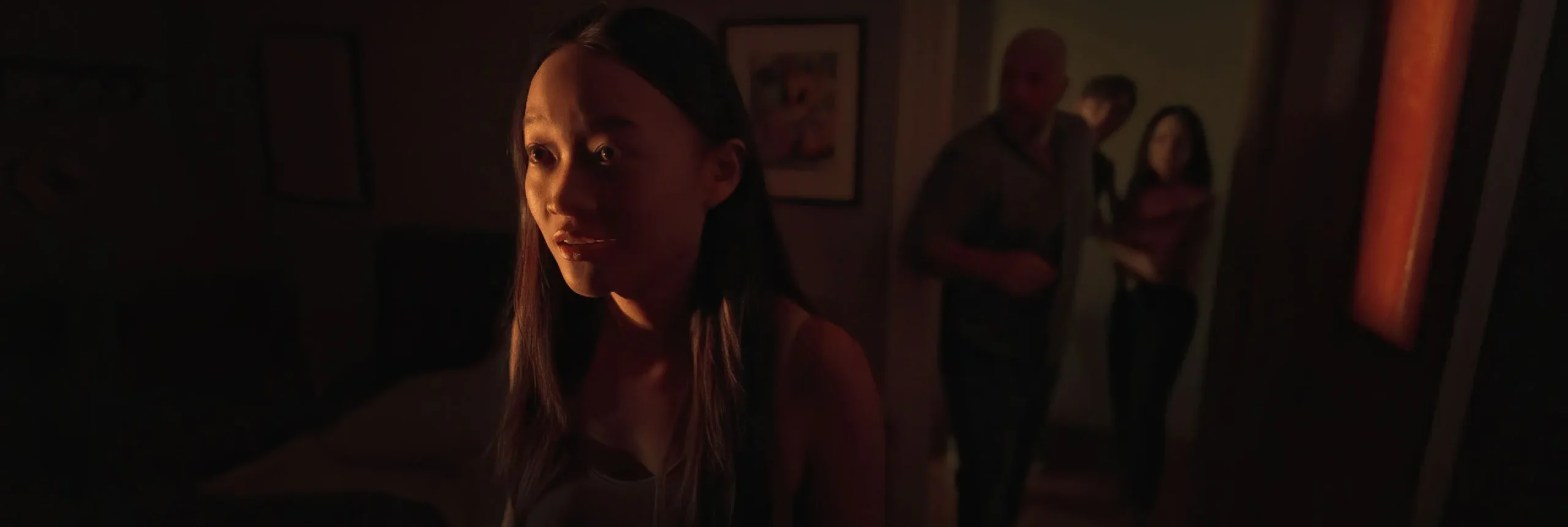
On opposite sides of a desk in an almost empty room, a woman (Yang Yanxuan Vicki) and her interrogator (Irfan Kasban) exchange details uncovering and linking to Singapore’s political history.

Small Hours Of The Night is a film to sit with its ideas for extended periods of time. As the camera focuses on one of the two figures sat in an almost empty room – shot in black and white to increase the darkness and shadows which fill the frame – there’s often one key idea running for sometimes ten or more minutes to accompany the monologue that’s unfolding. Whether it be a drum solo over a still shot or an alarm ringing with a bright light rotating around the room such details are as stripped back as the cell in which the central interrogation unfolds in, often starting to feel drawn-out the longer they go on for.

On opposite sides of an organised, yet cramped, desk sit a woman (Yang Yanxuan Vicki) and her interrogator (Irfan Kasban). Over the course of a stormy night they begin to unfold details of Singapore’s political, and legal, history. Set in the 60s the film apparently links to the 1980s Tan Chay Wa tombstone trial, the film has been effectively banned from public screenings and distribution in Singapore after being refused a certificate after being deemed “prejudicial to national interest”.

The back and forth of the conversation is largely in monologue form with details gradually leaked out with each new stylistic element. The execution of the film certainly won’t be for everyone, including myself, with its very slow pacing and minimalist style it may come across, despite its possible intentions and what it’s dealing with, as if it would work and hold attention better as a short film. Instead, the jumps back and forth between the characters and the views and realities they uncover together grow a staggered feeling with the lengthy speeches beginning to feel like individual segments with the start and end simply being the sudden jump to the next.

It causes a knock on effect that leads the run-time to also feel drawn out, with much of it being filled by disconnect between the viewer and the film. This is a slow burn drama where the focus from writer-director Daniel Hui appears to be on the detail of the dialogue as it unravels the history at hand, however the dominating factor in the final product are the various stylistic elements which crop up at each stage of the interrogation.

Small Hours Of The Night won’t be for everyone as its style often dominates the filmmaker’s focal dialogue and the central interrogation, creating a drawn-out and segmented feeling which creates increasing disconnect over the slow burn drama.

Rating: 2 out of 5.

Dear Santa – Review

Cert – 12, Run-time – 1 hour 43 minutes, Director – Bobby Farrelly

When sixth grader Liam (Robert Timothy Smith) accidentally sends his letter to Santa to Satan the devil (Jack Black) appears to him, granting him three wishes instead of the gifts on his list.

Over the past few years the separate and joint ventures of the Farrelly brothers have often felt stylistically better suited to another time. Even narrative beats feel as if they’re from the early-mid 2000’s rather than from the last decade or so. While some of these (Peter Farrelly’s Best Picture winning Green Book) have turned out slightly better than others (brother Bobby’s uneasy sports comedy Champions) elements of another time have largely been present. This continues with festive comedy Dear Santa; directed by Bobby and co-written by Peter with Ricky Blitt, where the film’s events are spawned by the fact that sixth grader Liam (Robert Timothy Smith) has dyslexia, and therefore addresses his letter to Santa to Satan.

The devil himself (Jack Black) appears that night in Liam’s room and says that while he can’t get him the items on his list he can grant three wishes – claiming that genie’s stole this idea from him. However, when the third wish is asked for Liam’s soul belongs to Satan. Therefore, the process is dragged out as Christmas nears as Liam hesitates over his wishes.


However, his niceness, and at times anxiety, sometimes gets in the way as he both wants to help his best friend Gibby (Jaden Carson Baker) get rid of his overbite and stop his mum (Brianne Howey) and dad (Hayes MacArthur) constantly feuding, and be able to go on a date with his school crush, Emma (Kai Cech). As the attempted comedy tries to come through with Satan tries to get Liam to make his wishes, showing off his magical powers in whichever way causes chaos in the moment, or simply causes a teacher to suddenly develop explosive diarrhoea, there are increasing references to the past of Liam’s family and why they had to move to their current home in the first place. The dramatic edges may come out more as the run-time moves on but it remains consistently uneven and heavy handed. The film spends little time properly discussing things and only hinting so that when the past tragedy is finally addressed it feels forceful and improperly dealt with, especially in the final stages which take a strongly disagreeable turn.

As a whole there are some really oddly played with beats throughout. Liam tells his parents, and others around him, that Gibby has cancer so that he can avoid introducing them. While briefly mentioned such elements crop up a number of times and disturb the rest of the film which could play out as a serviceable, if forgettable, comedy. Instead, these outdated, lazy ideas bring about a lazy feeling to the film as a whole. It begins to feel overall tired, we’ve certainly seen a good deal of its elements done before, and is largely saved by a couple of light chuckles scattered throughout thanks to Black channelling some of his School Of Rock and Tenacious D energy, watered down by the script and surrounding details.

With a number of outdated jokes and ideas Dear Santa feels assembled with very familiar elements from other festive comedies, only raising a couple of chuckles over the course of a tired run-time.

Rating: 2 out of 5.

LFF 2024: Nightbitch – Review

Release Date – 6th December 2024, Cert – 15, Run-time – 1 hour 39 minutes, Director – Marielle Heller

Facing the increasing mundanity and stress of motherhood, and with her husband (Scoot McNairy) constantly away, a stay-at-home mum (Amy Adams) finds herself transforming into a dog.

The trailers for Nightbitch have posed it as an out-and-out barrel of laughs comedy. While it’s certainly a very funny film the extent of its humour has been intensely exaggerated to make it appear as a film of pure wacky silliness. In actual fact the latest from writer-director Marielle Heller, adapted from Rachel Yoder’s book of the same name, is a serious film in the guise of an unserious one. One where the dramatic edges become sharper and more prominent as the narrative develops, and Amy Adams’ Mother begins to embrace the fact that she may be turning into a dog.

As motherhood creates a cycle of mundanity and stress for the stay-at-home mum the isolation and fear that she’ll never be the same begins to take its toll. A montage shows each day as very much the same as she spends her days looking and cleaning up after her toddler (Arleigh and Emmett Snowden – credited as ‘Son’), hoping to one day be able to get back to being an artist. As the days go on, looking after her son alone with her husband (Scoot McNairy) constantly away for work, the more Mother begins to display doglike behaviours. There’s a sense of fun to these moments, and the film as a whole, which begins to appear in the more serious beats too.


Marielle Heller’s screenplay contains a lot to like but perhaps the most effective element is just how well it balances the very tricky balance between seriousness and humour within a film like this. The two blend together wonderfully and while Nightbitch might not be for everyone it’s certainly ambitious in what it wants to depict. In some respects it shares themes with 2021’s The Lost Daughter, but in this case Amy Adams is happy with being a parent, but worries that she’s losing herself as part of it and wants to take back control and have time to herself, wishing to avoid becoming “a middle-aged, saggy mom with nothing intelligent to add to the conversation”.

Adams gives a brilliant performance capturing the tired scatter of thoughts and hopes for calm staggering around her character’s half awake brain which is largely focusing on her child. Rage and disappointment begin to burn a hole through her which allows for her inner dog to leak through, landing her in awkward situations in public such as when she starts eating like an animal but also giving her a sense of freedom as she runs with a pack racing after her at night. This starts to appear in her shifting day-to-day where confidence jumps back in and she gets more of a sense of agency in her life in addition to that of being a mother. Shifting from a lack of caring as if almost giving up to a lack of care about what the rest of the world thinks as she marches on with a growing confidence, perhaps both best summed up in a scene where Mother commits and then some to a rendition of Weird Al Yankovic’s Dare To Be Stupid.

Nightbitch’s humour effectively acknowledges the strangeness of the central idea yet never diminishes the more serious themes at hand. Well stemmed from Marielle Heller’s well-balanced screenplay and direction, with help from Amy Adams on great form, this is a film that really gets its tone right and works because of it, when it could so easily falter or feel like a jumble. Conveying its core themes with a sense of fun and growing thought, this is a serious film that dares to be silly but never feels stupid.

Marielle Heller and Amy Adams, on great form, find the right balance between seriousness and humour in Nightbitch, which manages to tackle its increasingly sharp dramatic edges with thought and a sense of fun.

Rating: 4 out of 5.

LFF 2024: Memoir Of A Snail – Review

Release Date – 14th February 2025, Cert – 15, Run-time – 1 hour 34 minutes, Director – Adam Elliot

Grace (Sarah Snook) reflects on her life of separation and tragedy, and the people who have offered hope and kindness.

Adam Elliot cares about people. His films have consistently extended a hand of caring understanding to those who feel isolated, lost and uncertain as to their place in the world; whether they have one or fit in. He acknowledges that the world can be an unkind place, particularly to those who find them distanced from the rest of it, but reminds us that there are always signs of kindness within it.

These are addressed up front in his first feature since 2009’s marvellous Mary And Max. Memoir Of A Snail sees young woman Grace Pudel (Sarah Snook) recounting the events of her life to a snail in the back garden of the home which she shared with recently-passed elderly friend Pinky (Jacki Weaver). Throughout a life of separation and tragedy there have always been people, such as outgoing and gloriously carefree Pinky or her twin brother Gilbert (Kodi Smit-McPhee) who writes her regular letters after the pair are separated as kids, who show glimmers of kindness in the world.

This is a film of real sadness. Yet, through its open honesty there’s room for an effective sense of humour to both lighten and add to the emotional beats. The look of the stop-motion, consistent with Elliot’s previous work, feels like it’s from a cartoon or children’s drawing, pushing the innocence of the central character when depicted as a child (voiced by Charlotte Belsey) and maintaining the reflection of the world while allowing for some of the sillier moments of humour – Gilbert is sent to live with an extremely devout Christian family who abuse him, one scene relating to this is extremely hard to watch, where the sons are humorously called Wayne, Dwayne, Shayne and Ben, while Pinky apparently used to work at a sausage and strip club called ‘Shnitz ‘N’ Tits’.


The connection with the film is almost instant. Very early on we see Grace being bullied at school, she huddles herself into as tight a ball as possible, tearing up and shaking. Around her an imaginary snail shell forms as a protective shield, later developed into an increasingly shabby, brown woollen hat with homemade eyeballs protruding from the top like a snail. The treatment of the scene and simple visual look of just a few seconds landed a very early knock-out punch. So many moments have a subtle quietness to them which brings a strong emotional effect. Simple images and moments which further connect you to the main character and make the joys feel all the more joyous and the upsets strike a strong emotional chord. Much of this comes down to Elliot’s beautifully written screenplay, treated with the same heart that the finished film emits, establishing its characters very early on to allow for the emotional core to be explored the more we learn about Grace’s life.

Often in the rush of a film festival my schedule will have three or four films noted in for one day. It does mean that sometimes when you just want to go and sit in a dark room and think about the film you’ve just seen, as was the case for me with The Whale back in 2022’s LFF, you start queuing for, or just move on to, the next film. Memoir Of A Snail forced me to take a step aside for the rest of the day; cancelling the other films I had that day for the need to digest the film and simply enjoy thinking over it more as it settled in further.

Its emotion comes from its human understanding. Both the upset which Grace experiences, and the moments where life’s uplifts and happiness are allowed to flourish, and sometimes linger in the form of hope. All excellently captured, visually and thematically, in believable characters who themselves create a sense of hope in the world. There’s an emotional weight on leaving the film, there’s certainly a number over the course of the short, breezy run-time, but there’s a sense of uplift and joy, too – as, again, there is throughout with the many laugh-out-loud moments. Much like in Grace’s life, they show the lighter moments of happiness, where characters embrace themselves and what they love, which help to keep things going and not falling under the weight of the finely tuned emotion on display. All because, like those who support her, Adam Elliot cares about his characters and those who may feel like them.

A fantastically human depiction of feeling separated and distanced from the rest of the world, Memoir Of A Snail is a tender and caring film that masters both the strong emotional punches and the equally touching uplift and joy.

Rating: 5 out of 5.

LFF 2024: Seeking Mavis Beacon – Review

Release Date – 9th May 2025, Cert – 15, Run-time – 1 hour 42 minutes, Director – Jazmin Jones

Friends Jazmin Jones and Olivia McKayla Ross search for the mysterious and inspiring Black woman who taught a generation to type in the game Mavis Beacon Teaches Typing.

Seeking Mavis Beacon is one of those rare films where I started to get truly excited about what the filmmakers will do next. There’s a unique voice to it that stems from the youth of director Jazmin Jones and her friend Olivia McKayla Ross – one of the pair celebrates their 21st birthday in the film. Not just in the documentary’s use of TikTok videos to break up scenes but in the general nature of the film as a whole. There’s a spark which appears to lean towards a young target audience which gives the film a very likable personality. One which demonstrates a new, fresh, modern generation of filmmaking talent which I couldn’t help but be excited by.

The pair are searching for the face, both on the cover and in the game, of PC game Mavis Beacon Teaches Typing. Described as “the Aunt Jemima of technology” it’s claimed that she helped build an entire generation of Americans relationships with computers. Yet, the key question playing out is “not only ‘who is Mavis Beacon’, but ‘why is she Black?'” The investigation is serious yet relaxed to create a welcoming feeling to a film that only occasionally slips into the feeling of ‘they’re searching for a person on the front cover of a video game’.


Whilst searching for the woman who portrayed Mavis Jones and Ross delve into just what seeing such a figure in a game like this meant to a whole generation of people of colour, and indeed how the figure featured came to be Mavis Beacon. While one or two street interviews feel like slight steps aside for the most part the various points that arise as part of the search feel well-linked and help to expand the central mystery and make for a wider-ranging film which feels both personally investigative for the filmmakers whilst also contributing to the main points at hand. In general this begins as a personal piece which eventually grows into something bigger, while still maintaining that individual note for those leading the film.

As a whole Seeking Mavis Beacon comes across as an impressive film. One which feels as if it could so easily feel slight or overstretched, but manages to lead its narrative in enough ways for it to maintain interest in the central investigation and the handful of branches linked to it. Leaning partly into our relationship with technology and the human factors that are a part of it – “would my relationship with computers have been as trusting if Mavis hadn’t been there?” sets off an early thread relating to just why this investigation is happening in the first place and why it matters to those embarking on it. There’s a spark to each thread, each treated with a seriousness which emphasises the effect that the events playing out have personally for Jones and Ross and just what past events meant for people of colour and Mavis Beacon herself.

Fuelled by a relaxed and modern personality which announces a new, young generation of filmmaking talent, Seeking Mavis Beacon’s seriousness makes for a welcoming documentary which expands its central search with equally engaging and personal branches all contributing to the central investigation.

Rating: 4 out of 5.

Blitz – Review

Cert – 12, Run-time – 2 hours, Director – Steve McQueen

At the height of the blitz, nine-year-old George (Elliott Heffernan) escapes the train he’s evacuated on to make it back to his mum (Saoirse Ronan) in London, however despite the war he discovers a still-divided city on his journey home.

Blitz is both a stripped-back war drama from writer-director Steve McQueen and one that’s dealing with a number of different themes and ideas. The direct narrative sees nine-year-old George (Elliott Heffernan) jump off the train taking him to the safer place where he’s to be evacuated to in order to make it back home to London, experiencing the height of the Blitz. As he makes the journey home we cut back and forth between his own experiences and those of his mother, factory worker and singer Rita (Saoirse Ronan).

As George experiences a city that remains divided, despite claiming to be united in the war effort, his mother sees that more united spirit, volunteering to help out in the shelter of the underground during air raids, whilst also trying to push ahead despite the last words of her son echoing around her mind – “I hate you.” With the different characters and settings seen throughout there’s something of a chaptered nature to McQueen’s latest as the separate events constructing the progress towards home feel very clear. At just two hours the film has a slightly overlong feel, largely sustained in sequences as the young protagonist gets almost to his doorstep but is sidetracked by the appearance of Stephen Graham and Kathy Burke, both on enjoyable form. With their appearance the film almost enters a dark Oliver Twist feeling as they go from pickpocketing to taking jewels from dead bodies after bombings.


Yet, of all the people George comes across perhaps the most success is in the figure who could most easily go wrong, in the form of Nigerian air raid warden Ife (Benjamin Clementine). Ife, alongside George, experiences racism despite his position and efforts to protect London and those in it. During one key scene he offers a speech to a group seeking shelter underground, after a white couple starts putting up sheets around their bed to split themselves up from those of other ethnicities. The words of unity and how division is exactly what Hitler is fighting for could so easily feel cliched, yet Clementine, with McQueen’s direction, manages to bring a sense of warmth and hope to them, making it a highlight scene. Indeed, Ife’s soft-spoken kindness towards George makes him a standout character in the film as a whole, even if things eventually move on to new characters and locations for both him and his mum.

While dealing with a lot of different points the overall tone of Blitz is kept relatively consistent across the various events helping it to flow in some of the longer moments. It also means, however, that sometime sit skips over ideas that it wants to dig its fingers into more. Certain instances feel as if they could be expanded in exchange for others, or in some cases have a more core focus put on them. There’s still an engaging sense to the film as a whole which remains consistently watchable and has a number of effective moments, particularly through McQueen’s direction and the way he observes a number of scenes and wills his characters on. Not everything has a complete push, but there’s still a solid film playing out which should successfully work for all ages, as McQueen has hoped.

Narratively simplistic yet full of events and ideas, Blitz occasionally feels as if it could cut some moments which contribute to a slightly overlong feel to expand others which emphasise a sense of warmth and hope in their cliché-avoiding messages.

Rating: 3 out of 5.

Wicked – Review

Cert – PG, Run-time – 2 hours 40 minutes, Director – Jon M. Chu

Sorcery student Elphaba (Cynthia Erivo) is outcast by everyone, however her strong powers may be of use to the Wizard of Oz (Jeff Goldblum), and conflicting roommate Galinda (Ariana Grande) is with her each step of the way.

Despite sharing a name with, and clearly being adapted from, the smash-hit musical of the same name, Wicked has largely tried to hide the fact that it’s a musical in its advertising, and the fact that it’s a ‘Part 1’. While we open with a big musical number marking the death of the Wicked Witch of the West the title Wicked follows, filling the screen from side to side, top to bottom, ‘Part I’ written in much, much smaller letters below. Adapted from the first act of the two-and-a-half hour stage musical (minus interval) this feature clocks in at two-and-a-half hours (minus credits) and certainly makes for an open ending.

While some have claimed that this first act adaptation ends with a rounded narrative, I’d argue that it leaves its characters in situations in need of development and closing off to get them to as we know them in The Wizard Of Oz, and indeed the very start of the film. Told in a flashback, green-skinned Elphaba (Cynthia Erivo) arrives at Shiz University to drop off her sister, Nessa (Marissa Bode). However, after an incident where she displays her strong sorcery powers she’s welcomed in by the subjects professor Morrible (Michelle Yeoh), who plans to personally tutor Elphaba. Bunked with arrogant and wholly unlikable, until her sudden turn, Galinda (Ariana Grande) the pair frequently butt heads, further pushing Elphaba into her own mocked sphere at school.

Erivo and Grande’s chemistry has been a major factor in the lengthy and expansive publicity tour for this film and it comes across in the film as well, none more so than when sharing musical numbers together. As you’d hope from a musical, particularly one as acclaimed as Wicked – which I’d only ever heard Defying Gravity from before seeing this film – the songs are the highlights. A number stick out with a bouncing sense of fun, each brought to life in stark contrast to the trailers with unashamed Broadway style.


Director Jon M. Chu brings a stronger Broadway sensibility to this than his previous, highly enjoyable, adaptation of In The Heights. This is a film that understands that it needs to nail the big numbers for both the existing fans who have looped the soundtrack over the years and also making them click for new audiences. The central pairing can undoubtedly belt out the tunes, and restrain them if need be, and Erivo in particular gets across a good deal of emotion through her songs and character in general, while Grande appears to be relishing the fun she’s having with standout tracks such as What Is This Feeling? and Popular.

The songs are the fastest moments of the film and those which hold the most spectacle. At no point does Chu, or the creative team behind the visual aspects of the production, make a musical that feels as if it could be played out on a stage. In fact, narratively there’s so much happening and so many locations visited that I sat there wondering just how the events of this film could be told in just around 75 minutes on a stage. Perhaps the stage version cuts down on some of the slightly tangential moments midway through where new ideas and relationships, particularly revolving around Jonathan Bailey’s Prince Fiyero, start to crop up and push the run-time. As a whole the film does end up feeling on the long side, with much of the heavily-advertised final stages suffering from this.

Much of this comes from the talkier scenes in-between songs which grow shorter as the run-time progresses, which sometimes feel as if they’re drawing things out before the next jump into song. Songs which are often matched with bright visuals and choreography for multiple bodies across each shot to embolden the fact that this is a big musical, with particular visual detail on the sets and general production of the Emerald City. The energy of the numbers helps the later stages to pass by with less issue and holds up the film as a whole, alongside the improved relationship between the central figures who light up together as the narrative, and their relationship, develops. These moments are where the films strengths, and biggest pushes, lie, conveying the biggest and grandest points within them with the most effect. It’s taken a long time for a Wicked adaptation to make it to the big screen, and we’re yet to see it in full until this time next year, but, much like Grande and Erivo, it certainly hits the right notes with great effect.

While this first act adaptation is undoubtedly overlong, the musical numbers of Wicked both hold it up and mark its biggest successes. Showing off Erivo and Grande’s performances alongside the spectacle and effect, there’s a lot to enjoy about the songs as they lead the film and its narrative.

Rating: 4 out of 5.