Spontaneous – Review

Cert – 15, Run-time – 1 hour 37 minutes, Director – Brian Duffield

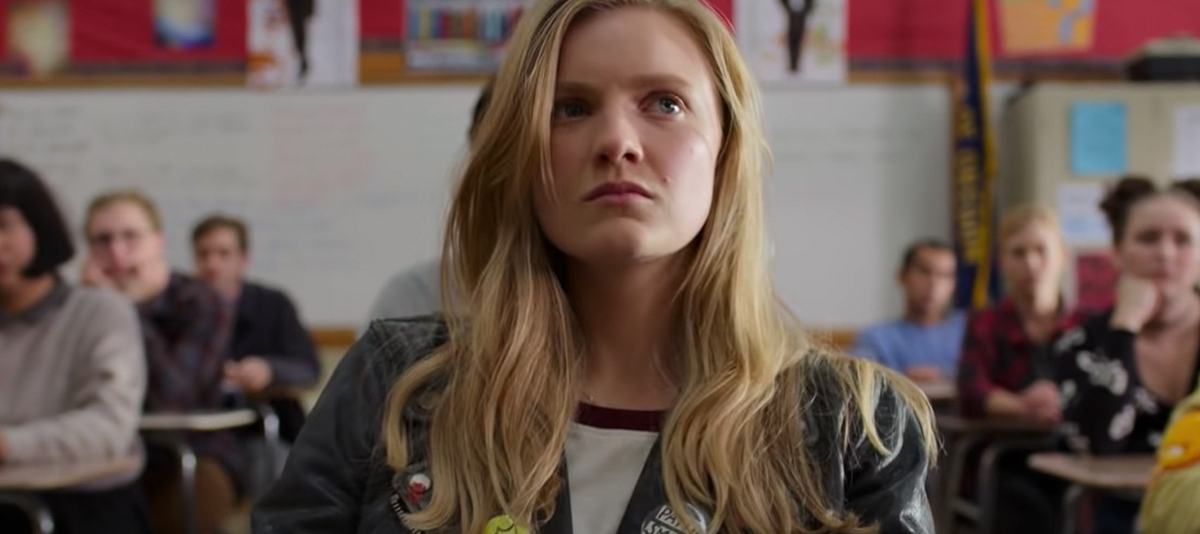
When her classmates begin to randomly explode Mara (Katherine Langford) sparks a relationship with fellow student Dylan (Charlie Plummer) when everyone who remains are put through quarantined trials.

Perhaps one of the best ways to describe writer-director Brian Duffield’s directorial debut has been used as the poster tagline, “an explosive love story”. Although while the relationship between students Mara (Katherine Langford) and Dylan (Charlie Plummer) does play a key part in this adaptation of the Aaron Starmer YA novel of the same name we focus for the most part on Mara and how the sudden random explosions of her classmates throws her life into turmoil. Teenagers in their final year of high school, planning to go off to college, simply turn into splatters of blood, vanishing simply leaving soaking dark-red clothes, with no warning. “It was like a Cronenberg movie” exclaims one student after the first instance leaves a number of the young adults traumatised. Duffield’s screenplay contains a handful of such references, including some to Dr Strangelove, showing some of the inspirations for the film, while its tone and feel still shows promise for a potential future cult following. Yet, amongst all of this there’s no denying the strong teen movie feel at Spontaneous’ heart.

As the teenagers are locked into a highly protective quarantine – cue laugh-out-loud testing and interview montages, on student dead-pan demanding that his lawyer be present – they go through various new drug tests in the hope that this will stop the increasingly frequent, bloody deaths. While some live in fear that the same will happen to them others worry about their school grades before college. Meanwhile Mara and Dylan grow closer and manage to blossom a romance out of it. They somewhat forget about their worries and begin to live for each other in the heady, swirling chaos of life in the town their stuck in until life moves on, however that may be. Mara spirals and swirls throughout the film, her mental state rising and declining over the fine-flow of the film’s narrative. The character remains a joy over this entire course thanks to Langford’s fantastic central performance.


While the supporting class, and Plummer’s likably, lightly awkward love interest who raises Mara’s mood and creates humorous uplift in the dark comedy, are all good and push the film further; making for an even more enjoyable teen comedy, Langford truly steals the show in a number of scenes. Even during the latter stages of the film where some moments appear to get a bit lengthier as themes and ideas are being wrapped up there’s enough energy in the central performance to keep you engaged and laughing along with the film. Duffield’s screenplay is cleverly written, not just when it comes to the great, snappy and often sarcastic dialogue and energetic montage sequences, further fuelling the wit and highly entertaining atmosphere of the film. It might feel free-wheeling, but it’s clearly been carefully planned out and scripted.

Even as the characters find themselves in increasingly desperate situations, their mood declining as Mara specifically turns to what she believes is her only friend – alcohol, including some of her own intensely boozy cocktail creations – the film never looks down on, or pokes fun at them. There are dramatic sequences. Panic in the corridors as more students begin to explode and the drug tests fail. While such scenes might contain hints of comedy the root is somewhat serious, yet helps to fuel character and the comedic tones to come. When blended with the fine performances and the frequently effective humour this is an absolute hit, both for the current teen audience and perhaps those in the future too, alongside a potential range of other audience members. This truly is an explosively fun time.

Very smart and very funny, Spontaneous is an absolute blast, not just because of Katherine Langford’s joyous lead performance. Brian Duffield’s directorial debut is cleverly written and brings about a number of great laughs throughout its high teen comedy energy.

Rating: 4 out of 5.

To Olivia – Review

Cert – PG, Run-time – 1 hour 29 minutes, Director – John Hay

When their daughter passes away Roald Dahl (Hugh Boneville) and Patricia Neal (Keeley Hawes) begin to experience rifts in their marriage and family relationships.

“You, Mr Dahl, are one big kid, and the day you stop is the day I file for divorce” the line that seals the course that Roald Dahl (Hugh Bonneville) and Patricia Neal’s (Keeley Hawes) marriage will take over the course of this film. Things might not be steady for the couple at the start. Yet, despite the lack of success of Dahl’s James And The Giant Peach and new acting roles for Neal, alongside Dahl being unable to come up with new ideas and dealing with lightly-touched upon alcoholism, the relationship is close. The family unit with their son and two daughters is close. All five are closely bonded in their worlds of imagination and make-believe. Throughout we’re shown the strong imagination that the

That is until the sudden passing of their daughter, Olivia. The death shakes the family and the marriage at the centre of the film. Dahl and Neal grieve in very different ways, The actor of them openly; although trying to quickly move on and stressing about other people, and the writer bans all mention of his daughters name, trying to move on with his emotion bottled up. Such different responses create a distance between the pair as they find themselves unable to properly empathise with each other. Although, throughout the seriousness of scenes depicting emotion and quarrels (very rarely do things develop into full blown arguments) the film as a whole is relatively calm. It feels like a quick ‘everything will be alright in the end’ British tale – at just under 90 minutes it certainly spares some details.


On many occasions the film simply cuts away from some of the more personal conversations by fading to black and moving to an entirely different moment and point in time. It feels as if a lot of time and potential detail is glossed over, detail that could strengthen the characters and create something that bit more emotionally engaging. At some points the most advancement comes from constant references to possible details to appear in his next children’s book project, Charlie And The Chocolate Factory. Things simply seem rushed at times, the film clearly wants to get in by 90 minutes but by doing this it appears to cut out a lot of stuff that could make for something more detailed and engaging.

While what we get is a decent enough calm, mid-afternoon TV drama there’s no escaping the feeling that there could be something more to this story about dealings with family tragedy. Bonneville and Hawes give good performances in the central roles, conveying the limited amounts of emotion and drama well. Yet, amongst the crowbarred Dahl references the feeling that there’s more to this piece and that there’s potential for more than just a decent enough middle of the road mild drama is, unlike the family initially is with their imagination, hard to escape.

Much like the project that Dahl works on throughout To Olivia feels somewhat incomplete, as if it’s missing some key details to properly drive its emotion and drama further for more effect. What we get is fine, it’s simply rather calm for the subject matter at hand.

Rating: 3 out of 5.

Willy’s Wonderland – Review

Cert – 15, Run-time – 1 hour 29 minutes, Director – Kevin Lewis

After his car breaks down, a stranger (Nicolas Cage) is tasked with cleaning a soon-to-reopening kids party space overnight, however the animatronic characters are coming alive to attack.

One of the maddest scenes in 2018’s chaotically enjoyable Mom And Dad involves Nicolas Cage destroying a pool table while angrily grunting the ‘Hokey Pokey’. The actor’s latest starring feature sees him involved in a fight set to ‘Heads, Shoulders, Knees And Toes’, and another scene where he takes down an animatronic gorilla with a plunger. It’s weird, it’s chaotic and it’s very recent Nicolas Cage.

The brief for Willy’s Wonderland in a number of ways is shorter than the plot description. It’s a cross between a stereotypical modern Nicolas Cage film and a dodgy Direct-To-DVD 2000’s teen horror. Cage stars as a stranger simply credited as The Janitor, as his car breaks down in a strange town he’s told that it can be fixed if he spends the night cleaning a long-abandoned kids party space for a grand reopening. However, the various animatronic animals seem to be alive, attempting to kill Cage’s silent energy drink binging, pinball playing part-time cleaner. Meanwhile a group of local teens appear to have previous experience with the out-of-the-way centre known as Willy’s Wonderland. On the same night they set out to burn the building to the heavily graffitied building to the ground, however when trying to get Cage’s figure out they find themselves trapped inside and also being hunted down.


For those who have been waiting for the upcoming Five Nights At Freddy’s film this may serve as amusement enough until then. The scares certainly aren’t there, but there’s plenty of silly bursts of action – particularly when focusing on the quiet protagonist of the film – to be found. There’s even chance for one or two mild moments of humour around the central character that help to pick things up as they begin to dip – The Janitor sees a threatening message written in blood on a freshly cleaned mirror and, otherwise ignoring it, simply sighs that he has to clean something up again.

In the instances where there is dialogue, mostly focusing on the fight for survival of the teenage group, the dialogue itself certainly feels basic and as if from a poorly aged teen horror. Lines feel cliché and almost stereotypical of the characters types, and not in an amusing or aware manner. It could be seen as lucky then that the characters split off quickly and we spend small amounts of time with each one, and predominantly continue to look in on Cage with his regular dance-infused pinball breaks.

All of this backing on to the various attacks from, and brief fights with, bulky worn-out robot creatures, such as a chameleon, an ostrich, an owl, a weasel and more. It’s often as daft as it sounds, and alternatively as clunky as it sounds too. And this likely won’t be to everyone’s taste. Yet, despite the sometimes testing state of the film there’s just about enough amusement to be found in the often brief actions of Cage’s central figure to make this a not too low quality, lacking affair.

The dialogue is certainly weak, and the film suffers its dips, however there’s also enough dumb action within Willy’s Wonderland to appeal to Nic Cage fans, and perhaps just about those still waiting for the Five Nights At Freddy’s adaptation.

Rating: 3 out of 5.

Barb And Star Go To Vista Del Mar – Review

Cert – 15, Run-time – 1 hour 47 minutes, Director – Josh Greenbaum

Two lifelong 40-something friends (Kristen Wiig, Annie Mumolo) venture out from their small-town lives for a sunny holiday of adventure and romance in Florida.

Barb and Star (Annie Mumolo and Kristen Wiig) are two stereotypical midwestern American 40-something’s. Life-long friends the two spend their days sat on a sofa having close, high-pitched, rambling conversations about the violence in the latest historical TV series. When one is at work the other goes with them, even if they aren’t working a shift that day; this is until the furniture store they work at suddenly closes down. Unsure as to what they can do with their days now, aside from the slow moving, strictly organised, talking club they attend, the pair realise the routine nature of their lives is getting them nowhere. On bumping into a seemingly replenished friend (Wendi McLendon-Covey) the pair are convinced to go on a similar “soul douche” to Vista Del Mar, Florida. A land far away from their quiet small-town lives, one of potential excitement and adventure.

Yet, even on the way there the two spend the hours long plane journey discussing the name Trish, creating the life story for someone who doesn’t even exist. Despite the stereotype there’s something convincing about Wiig and Mumolo’s central performances, likely familiarised from their role as screenwriters. As they constantly agree and discuss with surprise that they agree their conversations are no doubt amusing, the two performances raising a handful of chuckles here and there with the various dumb gags and throwaways that the film produces. However, perhaps none of the absurdity matches Jamie Dornan belting out a pop-ballad to seagulls. Dornan ditches all seriousness as he plays a conflicted love-interest, Edgar. Sent by the film’s villain (also Wiig, giving the feeling of Millicent Clyde played for laughs) to unleash a swarm of deadly mosquitos that will wipe out everyone in Vista Del Mar he pines for a relationship with both of Wiig’s characters.

The humour is definitely silly and often absurd, there are hints of – and potential references to – the likes of Airplane and Monty Python, specifically Mark Jonathan Davis as hotel singer Richard Cheese, singing songs much alike to Eric Idle’s Noël Coward impersonation in The Meaning Of Life. All such moments prove a fine distraction from some of the more plot-heavy elements involving the core villain of the piece. Such scenes occasionally feel in place to remind the viewer that this plot point does indeed exist and this isn’t a film just about two women having a cracking, if chaotic, week-long holiday at the Palm Vista Hotel – where your greeted with a grand scale musical number. The underground dwelling figure simply feels more of a background character, lacking in any major detail to have a proper impact, also not quite managing to raise as many laughs as other characters in the piece.

Such moments boost the run-time up to closer to two hours than 90 minutes, the final 15-20 minutes or so begin to drag as all plot-points converge and attempt to wrap up as one. It proves a busy film, and luckily there are a decent amount of chuckles scattered throughout to stop things from feeling longer and as if they drag throughout. Some major plot elements are pushed aside, however perhaps the film is better for this. It lets us delve further into the conversations and antics of the titular friends. Wiig, Mumolo and Dornan give a trio of entertainingly humorous performances and overall create something that while sporadic certainly creates a number of good laughs – verbal, visual and musical – along the way.

Some plot elements may not have the strength or laughs of the central friendship, however the dealing of occasionally absurd humour of all forms helps it along and makes for an enjoyable comedy from Wiig and Mumolo.

Rating: 3 out of 5.

Music – Review

Cert – 12, Run-time – 1 hour 47 minutes, Director – Sia

Recovering alcoholic Zu (Kate Hudson) finds herself looking after her autistic sister Music (Maddie Ziegler) after their grandmother (Mary Kay Place)

There’s been much discussion, and undeniable controversy, around the representation of autism in Australian singer-songwriter Sia’s feature directorial debut, and much discussion about the fact that there has been much discussion around it. However, autism is very much a side element of her film’s narrative, although a very key one. For the most part we follow Zu (Kate Hudson), a reckless recovering alcoholic drug dealer. After her grandmother (Mary Kay Place) suddenly passes away she finds herself taking care of her younger sister Music (frequent dancer for Sia, Maddie Ziegler). While Grandma viewed Music as “a magical little girl” Zu finds it difficult to cope with her high-end autism and almost instantaneously calls a local Mental Health department to see if they do “pick-up”. With the help of neighbour Ebo (Leslie Odom Jr) – “the smiliest person on Earth” – she learns to gradually get used to Music’s behaviours and how to take care of her.

Music has her routine known by everyone in not just the apartment building she lives in but almost everyone on the street that makes up her routine daily walk. On one of these Ebo explains to Zu about Music’s routine and how she views the world. She wears headphones to avoid sensory overload from the potential loud noises around her. Sensory overload which would definitely be caused by the various dreamlike escape sequences that occur throughout the film. At various intervals we get a glimpse into Music’s mind. A technicolour world much like a classic Hollywood sound stage, bright lights, flashy colours and loud music formed by writer-director Sia. The areas are comfortable and everything seems to be soft and protected; wrapped up, covered or locked – her apartment appears to be like a padded, graffitied asylum during a brief glimpse. Such moments don’t exactly provide much plot detail or advancement, and after a handful begin to lose their style, simply feeling as if they’re there to push the run-time on a bit.

One thing that remains very much the same is Ziegler’s caricature style performance – which many have understandably labelled as not just offensive but potentially damaging. While there are elements, particularly early on in the film as she finds the dead body of her grandmother, that seem to be aiming for something from the right place these are very few and infrequent. It simply feels as if the film has been misinformed or hasn’t done enough research – although Sia has spoken about working with controversial group Autism Speaks on the film – instead of coming from a place of malice. The biggest issues come in the third act, when things truly feel in place to be briefly rushed through and just there to extend the run-time that bit more, when the subject of autism comes more into play simply for emotional narrative beats that advance Zu and make her look better. This use simply feels lazy and misjudged, completely removing anything good that might have been built up over the course of the film, and reversing much of the way the viewer views Hudson’s character and the film as a whole – some decisions certainly seem as if the film hasn’t understood itself and as if they were made just to force the laboured points of “love is complicated”.

Most of what we see from Zu involves her dealing with the complications of her life. She’s trying to escape from her role as a drug dealer, working for self-inflated boss Ben Schwartz, and owes multiple debts to people and is still struggling not to get caught up with the authorities while she’s still recovering from her addiction while on probation. It’s the typical story of trying to get back on track, as she tries to escape to her paradise of Costa Rica, of course she’s only looking out for herself at the start of the film. This plotline and style mostly emerges during the second half of the film as the plot actually comes into play more and we see more of Zu and her regular life, simply dragging Music along to grunt and gurn in the background instead of growing and learning how to get on and care for her as was initially case. Things quickly become confused and wires are crossed as the narrative and focuses of the film become muddled and seemingly uncertain as to where they are going to go, relying more and more on music and dance sequences to get out of a half-dug situation. There’s even less time for Tig Nataro to occasionally appear as a spirit-lacking kids TV show host, the most entertaining thing about the film; actually managing to raise a laugh or two – “Good luck everyone on your mission, whatever it is”.

As everything eventually comes together – sometimes just starting to form in the extremely off-colour 25 minutes – there are ideas that are broken and elements that are pushed far aside and the whole things begins to feel lacking. Key points appear to be rushed or almost lazily written, with the detail being left for the narrative lacking, music-video-like breaks to push the soundtrack – when the film first entered production it was apparently not meant to be a musical, which in its current form would likely make it a short film. With everything that happens the final piece simply feels like a misjudged extended music video with some uneven drama sandwiched in-between.

Much like its handling of autism Music is an overall misjudged film. While on some occasions its mostly bearable plot-wise, when it begins to use autism for emotional advancement of other characters it loses itself and seems to forget everything it had initially built when not delving into frequent music video breaks.

Rating: 2 out of 5.

Helen O’Hara ‘Women Vs Hollywood’ Interview

Film journalist, and Empire Magazine writer, Helen O’Hara joins me to discuss the upcoming release of her book Women Vs Hollywood – which will be released 18th February.

Helen can be found through her Twitter account. Her book can be bought in a number of places; including Waterstones, Amazon and “all good and evil book stores”, from 18th February. The audiobook can be found here.

For those who want to listen to Helen’s song requests you can find them by following the links below:
Lose Myself – Ms. Lauryn Hill
Sunflower – Post Malone and Swae Lee
You Haven’t Seen The Last Of Me – Cher
It’s Been A Long, Long Time – Harry James And His Orchestra

LFF 2020: Supernova – Review

Release Date – 25th June 2021, Cert – 15, Run-time – 1 hour 33 minutes, Director – Harry Macqueen

Musician Sam (Colin Firth) and writer Tusker (Stanley Tucci) are travelling across England by motorhome to revisit old friends, family and treasured places as Tusker’s dementia worsens.

It’s almost impossible to believe that Colin Firth and Stanley Tucci were initially meant to play the opposite roles in Harry Macqueen’s Supernova. The pair seem so perfectly cast, and clearly understand their characters well, that the fact they swapped roles at any point is hard to think of. Perhaps their 20 year friendship has something to do with this, after all their chemistry as a couple, of around the same timespan, makes for an authentic, and indeed heart-breaking, relationship. They play Sam (Firth) and Tusker (Tucci), a musician and writer travelling across England by motorhome as Tusker’s dementia appears to be getting worse. For both of them this could be a final goodbye to friends, family, key locations of their relationship and so much more.

Throughout the two central performances match the subtlety of the screenplay. Sudden emotion is ramped up as Tusker’s dementia shows through, Sam’s panic and worry as it does clearly showing despite him trying to hold it back. Yet, while the film has such emotional beats it’s authenticity comes through its heart and humour. The pair bicker and argue about small things, often in a joking way – Tucci asks Firth while travelling along a scenic hillside road “how about exploring the outer regions of fifth gear?” Such moments of light, naturalistic humour don’t just raise a mild chuckle at times they’re laugh out loud funny. Joys are looked at through clear, bright images of serene and peaceful landscapes and environments. These should be places of calm and warmth for them both, and while they are to some degree – the cinematography truly capturing all of this, and the often stunning scenery – there’s also a lot of stress and upset poured in to bring everything back to the main point with sensitivity and ease.

Everything in the film seems to be taken one moment at a time, allowing for things to feel even more natural as you’re guided through the story one thing at a time. It makes each instance and scenario feel more real and, if the term can be used in relation to a film such as this, unpredictable – something which provides hope for the future of the couple. Throughout they worry about each other, worry through care and yet neither wants to properly show that in the hope that this prevents the other from worrying too. You feel their pain, not through force but through a genuine connection. Helped by the fact that you’re simply shown the events of the film and allowed to gently drink them all in.

By the end, through heart-warmth and heartbreak, you’re left with emotional chills of all kinds. You don’t just observe the struggles of the characters you experience them alongside them, thrown into everything with an ease of understanding from the very start. Both pains are felt, both hearts and humours too. This is an honest film that has all the more impact because of this fact, allowing you to get caught up in the conversations, thoughts and feelings of two authentic characters who deeply love and care for each other. Brought to life by two brilliant performances with an immense chemistry, Supernova is nothing short of a sparkling delight of all kinds of heart.

Firth and Tucci are stunning in the lead roles in this sensitively subtle dementia drama. Bringing to life a brilliant screenplay to form a gentle drink of humour and emotion.

Rating: 4 out of 5.

LFF 2020: Never Gonna Snow Again – Review

Release Date – TBC, Cert – N/A, Run-time – 1 hour 53 minutes, Directors – Małgorzata Szumowska, Michał Englert

The residents of a gated community trust their deepest secrets and worries with a mysterious, quiet masseuse (Alec Utgoff)

When it comes to being relaxed how much are you more likely to give away? What if you barely know the person you’re giving away this information too? According to the residents of the highly gated community in which Never Gonna Snow Again takes place the answer is quite easily – especially when a good massage is involved. Over the course of their increasingly frequent sessions with quiet Ukrainian masseuse Zena (Alec Utgoff) figures including wine-drinking widows and distant wives place their trust in the man they have invited into their homes. They let out their worries and secrets as the stranger who has barely been in town long gets to work relaxing them like it seems noone else can.

Initially it’s quite interesting hearing what such people have to say, it certainly acts as the main hook of the film for a large portion of it. The development of trust in someone they barely seem to know anything about and the words they disperse certainly has something that you can connect with. However, this can only go so far. It takes the film up to 50 minutes to bring in something more of an extra element, or at least the story – that of which there is – to develop in some way.

While most of the goings on that make up the film continue to take place in the homes of the highly gated estate in which the wealthy customers live there are one or two elements that stray outward. The laughs may not exactly be frequent throughout the film, but then again this doesn’t always seem to be the intention; when it is the tone changes slightly to create a speedier, more comedic, feel when the lines aren’t quick throwaways to satirise the residents of the community. One such scene being a dance routine turned magic act set to music that sounds like it could have come from the Nintendo Wii, whether this was the intention is a different matter.

Yet, throughout the whole film it’s Utgoff’s near-silent central figure – almost healer – who we observe throughout the course of the narrative. From the start of the film it’s made clear that he’s an outsider to the area – his silence, behaviours and mannerisms show that he recognises this. It almost feels at times as if he’s trying to get information on the residents, or perhaps the country (the Earth perhaps? – there’s something sometimes mysterious and otherworldly about the performance, allowing the character to become more of an enigma). One thing’s for certain, the residents clearly trust him, and it makes for something interesting, if occasionally thin, to watch.

While the open monologues and trust of the community’s residents make for something interesting these only take Never Gonna Snow Again so far, sometimes taking a while to pick back up by allowing the viewer to observe a bit more, or something slightly different.

Rating: 3 out of 5.

LFF 2020: 200 Metres – Review

Release Date – TBC, Cert – N/A, Run-time – 1 hour 30 minutes, Director – Ameen Nayfeh

A Palestinian father (Ali Suliman) is stuck on the other side of a border wall as he must smuggle himself into Israel where his son is in hospital.

The world record for sprinting 200 metres is 19.19 seconds, the average competitive run of the distance is around 21-22 seconds. To many the distance likely doesn’t seem too far, however for Palestinian father Mustafa (Ali Suliman) it seems a constantly extending ocean. He’s trapped in his home country, on the other side of the border wall, just 200 metres away from the Israeli hospital in which his son is currently in. While he says goodnight to them by shining a torch from just outside his house each night he’s desperate to get across the border to his Israeli wife and children. This is of course not by the regular means. Mustafa refuses to get a permit that would easily allow him in the country, instead he finds himself warily working his way in with a carful of people all wanting to evade border patrol and various checkpoints along the way.

Throughout the film we get to know the other figures that are taking this journey, some just so that they can have better chances of finding work, others returning from weddings, while one person simply seems to be documenting the experience for a project they are working on. With such personalities the conversation flows rather well. It feels natural and unforced. In fact much of the film’s content clicks and works, unlike other road trip films where some content feels as if it’s there to push the film to feature length. Perhaps it’s the dramatic tone of the film that helps with this point. The worry that the group are going to be found discovered or randomly attacked in the middle of nowhere. Tension lies as they cross each mile, a much more dangerous and lengthier method than the 200 metre walk across the border.

Suliman’s central performance helps to keep things believable and grounded over the short 90 minute course of the narrative. His character constantly thinks about his son, fearing not just that he might be able to get across the border into Israel, but might somehow die on his way and never be able to see his family again. The risk is made clear and lingers throughout each scene and advancement in the journey. Most of all this is felt after multiple fearful events and instances where hope seems to have been abandoned, or hope has potentially abandoned the characters, and Mustafa finds himself right outside the country in which he is trying to smuggle himself into.

It’s at this point that the tone shifts. The film becomes much more serious. Not exactly dark, but it certainly becomes quieter and more contemplative of what is being depicted, clearly trying to make a statement about not just the border wall but the Israel-Palestine divide as a whole. The initial tone is somewhat left behind as the film not exactly tries to wrap itself up but gets to its core point. Alongside this the pacing slightly changes to fully push the idea of the change in environment and how out of place the central figure – who you are at the side of for most of the entire run-time – feels. While this doesn’t affect the overall quality or style of the film it does take a couple of minutes to get used to, despite the journey there the ease into this change isn’t exactly gradual.

However, the film continues along its, if slightly shifted, lines rather well and continues to make for an interesting drama. When things could easily be comedic, although not in the third act, they continue to be played straight and gives the film the sense of drama and nervous dread that the characters feel as their trek unfolds. Much of this comes from the pacing of the film and the ways in which a number of key events and conversations occur, not to mention Suliman’s performance, on-screen for the majority of the piece. It all combines to make something rather interesting and engaging when it comes to the situations that you see the characters facing, especially impressive when it comes to how well everything flows before the third act change seem to happen.

While the third act seems to shift into something clearly political, but still keeping some interest from beforehand, 200 Metres is an engaging and fairly naturally flowing piece of nervous worry emitting from not just Ali Suliman’s strong central performance, but the supporting cast around him too.

Rating: 4 out of 5.

LFF 2020: Eyimofe (This Is My Desire) – Review

Release Date – TBC, Cert – N/A, Run-time – 1 hour 54 minutes, Directors – Arie Esiri, Chuko Esiri

Two Nigerians (Jude Akuwudike, Temi Ami-Williams), living separate struggling lives, dream of a better life outside of the country.

The subtitle of Eyimofe – the feature directorial debut of brothers Arie and Chuko Esiri – This Is My Desire very much shows the personal nature of the two separate narratives that make the film up. Central figures Mofe (Jude Akuwudike) and Rosa (Temi Ami-Williams) both dream of better lives outside of the Nigerian capital, Lagos, in fact outside of the country itself. Each figure dreams of leaving their lives of poverty and living in squalid conditions for something less stressful and definitely worry-free, a life infinitely more happy and easier. The first half of the film – entitled ‘Spain’ – follows Mofe, primarily a factory electrician with a number of other jobs on the side, trying his best to support his family. However, tragedy strikes and Mofe finds himself left alone in a state of grief and bereavement. His hopes of leaving and making a better life for himself are crushed, his desire remaining a hopeless dream.

Meanwhile in the second half of the film we follow hairdresser-by-day bartender-by-night Rosa (Temi Ami-Williams) as she dreams of escaping to chapter title ‘Italy’ with her pregnant younger sister, Grace (Cynthia Ebijie). Unfortunately Rosa is struggling to pay for herself, with her sister’s medical bills and rent taking priority, let alone a visa. When she meets American Peter (Jacob Alexander) things seem as if they’re about to turn around, although soon he suspects that his only benefit to her may be financial. It simply adds to more feeling that the dreams of these characters are never going to come true, it’s the main link between them in the two, somewhat lengthy, chapters that make up the film.

The tone is kept naturalistic throughout to add to the realism and effect. While this means that the emotion of the piece feels raw and honest it also means that a number of the scenes feel very quiet. The lack of score intensifies this and definitely keeps things grounded, and allows the use of music to have a stronger effect when it infrequently plays in the background of a select number of scenes. When it comes to such quieter scenes they seem to lack enough detail to properly engage with them, and when these happen to be some of the longer scenes your connection with the film dwindles. This is particularly the case in the transition between characters and chapters, the tragedies and struggles are different and initially they almost feel like two separate short films (although having shared themes and elements). At just under two hours the film does feel a bit too long, with more time spent with Rosa; who, despite having more detail to her story, doesn’t quite seem to have the emotional depth and sudden tragedy of Mofe.

Akuwudike’s intense response to his family bereavement is hard to top – his performance throughout his character’s 45 minute segment is deeply sombre and sets the tone for the rest of the film in an instant. Even some of the lighter moments, if they can be called that, within this naturalistic drama seem to have a feeling of sadness and emotion around them. Certainly not in a cynical way, luckily stopping the film from becoming excessively depressing. The film never looks down on the characters or treats them harshly, it simply captures them (not quite in a documentary style) and the multiple more-than-unfortunate experiences that they live through. At times it might feel that you’re living through them too, partly down to the emotion of the film, partly because of the lengthy impact that they have on the film too.

While it has an emotional effect thanks to the performances the biggest impact in Eyimofe is perhaps too early on, affecting the rest of the quiet, and sometimes too lengthy, nature of the film.

Rating: 3 out of 5.