The Comeback Trail – Review

Cert – Recommended for ages 15+, Run-time – 1 hour 44 minutes, Director – George Gallo

Two failing film producers (Robert De Niro, Zach Braff) stage a disastrous film production in order to use the insurance money to pay debts owed to a mob boss (Morgan Freeman).

Miracle Pictures’ apt slogan runs “if it’s good it’s a miracle”. After their most recent feature is a flop due to protests over its controversial nature they find themselves owing a lot of money, specifically to mob boss Reggie Fontaine (Morgan Freeman). With a strict time limit put in place producers Max (Robert De Niro) and Walter (Zach Braff) come up with a Producers style scheme where they can make more money from not making a film than by releasing a hit – all stemming from the realisation that if they kill off the insured star they can keep the, hopefully, excessive budget and insurance money from the unfortunate incident, pay off their debts and have money left over. Of course, they can’t kill off any major stars, and so in comes washed-up Western star Duke Montana (Tommy Lee Jones).

However, as expected, the various elaborate ways in which the pair try to kill their leading man all go disastrously wrong and production goes ahead as unplanned. There’s an almost cartoon style to the ideas behind most of the ideas that appear during the film. While this might not come across in the execution it certainly causes the mind to throw back to ideas seen in the likes of Tom And Jerry and Wile E. Coyote shorts. Even the narrative brings about thoughts of other works where other, very similar, ideas have been seen before. It pushes the generally repetitious nature of the film, something which is boosted even more by the fact that the majority of time is spent showing small chunks of De Niro and Braff’s hapless producers desperately trying to see their plan succeed.


It appears that the film, however, doesn’t realise how recognisable it is. How accustomed viewers have become to stories such as this – the narrative is set in 1973, by this point we’d have already seen a handful of films and shorts along these lines. Throughout scenes are lined with a forceful score, loudly pushing the fact that is meant to be a comedy, and we’re meant to be laughing. Even some of the performances appear to be saying this, De Niro appears to be giving a performance as overdone, and perhaps even dodgy, as his character’s hair and distracting moustache (and not the good kind). Unfortunately, such elements add up to create something that feels almost too in-your-face to make anything properly amusing, the laughs are barred from coming through due to the obviousness in the delivery.

The use of studio backlot sets and the style of some scenes involving Jones’ former star avoiding death do have some slight style to them. Certainly not anything overly unique but it does prove that there is something watchable here within the repetitious nature of the piece. We may have seen this plenty of times before, and that does mean that a light feeling of tiredness sets in at some point and hangs over the remainder of the piece, but this certainly isn’t an overly bad film – it’s more simply weak. Where it mostly alters is in the forceful nature of a number of elements that either appear to not have enough face in the film as it is and the repetition that begins to make The Comeback Trail feel longer than it should be. If some of the more overblown elements were also taken out there could at least be a slightly more satisfying return to the intentional disaster/flop gone wrong style of comedy.

More weak than bad, The Comeback Trail falters because of its often overblown, repetitious style making gags and sequences too obvious to be properly enjoyable.

Rating: 2 out of 5.

Luca – Review

Cert – U/ Recommended for ages 6+, Run-time – 1 hour 36 minutes, Director – Enrico Casarosa

Best friends Luca (Jacob Tremblay) and Alberto (Jack Dylan Grazer) leave the world of the ‘sea monsters’ to take part in an annual race in a small Italian town.

Pixar have undeniably become known for their layered storytelling. Narratives that work in different ways for different audiences. However, with their latest, Luca, they travel not just to the sun-soaked shores of Italy, but to a much simpler plot. For the most part we follow fast friends Luca (Jacob Tremblay) and Alberto (Jack Dylan Grazer). Luca’s life is much secluded in the relative depths of the ocean, avoiding humans who brand his glowing green fish form as that of a ‘sea monster’. However, on encountering Alberto he finds that on land he can take the form of a human. Alongside this he discovers the wonder that is the Vespa, and soon the pair set to work on trying to find a way to own one.

It’s as this element comes into play that Luca’s simplistic narrative gets a jump start. Beforehand, as we witness the early developing relationship between the two central characters, scenes feel more like connected short films and ideas rather than that of something building up to a proper narrative. However, when finally on land and discovering the existence of an annual race in a small Italian village, deeply rooted in anti-sea monster culture, with a cash prize that could win them their much desired Vespa. Looking to be more accepted in the area so as not to raise suspicions the two grow close to somewhat outcast Giulia (Emma Berman), who has, until now, competed in the three-man team race on her own. The bond that the three form creates a certain level of charm that brings you into the bright and breezy look and tone of the piece – some character designs seem to be shared with director Enrico Casarosa’s quietly charming 2011 Pixar short La Luna.


Of course, there needs to be someone on the tail of the three, not everything can be easy for them. Luca and Alberto risk being found out as sea creatures at many a turn, particularly when local rich-‘kid’ Ercole (Saverio Raimondo) – one of the only characters in a largely American cast with an outrageous Italian accent, Gino D’Acampo receives a two line cameo – is involved, dedicated to preserving his title to buy even flashier new toys and accessories. Meanwhile, Luca’s parents (Maya Rudolph, Jim Gaffigan) have also appeared on the surface in order to find their son, although they don’t quite know what his human form looks like, t take him to spend the rest of the season in the deep sea with his odd Uncle Ugo (Sacha Baron Cohen – a memorable scene-stealer in his one scene. Cohen apparently improvised so much that there was content that could be put to use later in the film, make sure to stay to the end of the credits!) Through much of this there’s plenty of light cartoon-style humour added in to keep things going throughout the fairly short, nearly 90 minute, run-time.

Luca’s simplicity does mean that it feels as if it could be slightly lost amongst Pixar’s strong catalogue in the future. But, it does appear as something different amongst the often highly-held titles. Something much more restrained and far less deep-thinking than more recent films such as Inside Out and Soul. But, that just makes it all the more enjoyable, and easier to escape into. It shows a new side to Pixar. Avoiding acting as a kind of palate cleanser (as the decision to release this for free on Disney+ might suggest to some, the feeling that an opportunity was missed not releasing this in cinemas is certainly present at times) Luca is a light, charming and enjoyable celebration of summer friendships.

Showing that simplicity is no bad thing, Luca’s more relaxed narrative, once it finally gets going, adds a layer of charm to its entertaining characters and sunny environment that brings about joyous summer friendships.

Rating: 4 out of 5.

In The Earth – Review

Cert – 15, Run-time – 1 hour 48 minutes, Director – Ben Wheatley

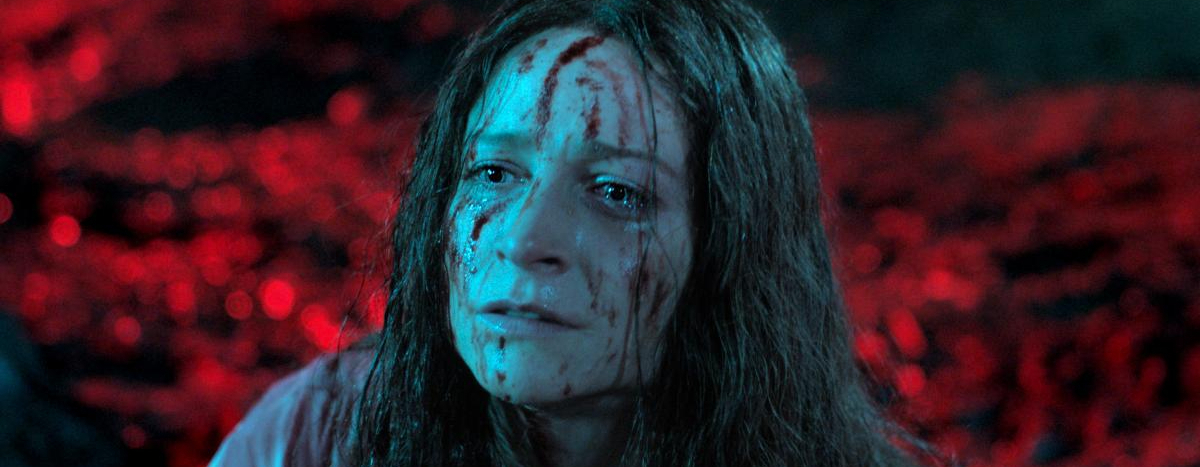
A scientist (Joel Fry) and park scout (Ellora Torchia) find themselves attacked and abandoned by unseen forces in the woods while taking essential equipment to a research base.

Since cinemas have reopened here in the UK highlights have been ones of spectacle. From the visual delights of Demon Slayer The Movie: Mugen Train to the audience-benefitting thrills of Nobody. Now, Ben Wheatley throws his latest, In The Earth, into the ring. Wheatley returns to low budget horror with a true visual, and audible attack. Following scientist Martin (Joel Fry) and park scout Alma (Ellora Torchia) on a two day trek through the woods in order to deliver essential equipment to a research base, led by Hayley Squires’ Olivia, trying to find a cure for an unnamed pandemic.

However, the pair find themselves attacked and abandoned in the middle of the night by an unseen force. It’s just part of the fear of the unknown that Wheatley conjures up in his latest mind-melting build-up. Pagan folklore runs throughout the narrative, started by stories of the demon Parnag Fegg, alongside discussion of the belief that the woods are connected. The plant life is all one active mind. This idea is pushed further when the two are rescued by Reese Shearsmith’s terrifically dead-pan Zach, a man who appears to have been making do just fine living in the woods for an uncertain amount of time. As the pair encounter their initial saviour Wheatley camera techniques take a much more sinister turn. Simply effects such as slight wobbles or the camera being placed at an angle at a distance, in the bushes, makes it appear as if someone is watching the pair.


While we never see any sign of a force beyond that of the other human characters a true fear of the woods is created. In The Earth’s tagline could have very easily been ‘just when you thought it was safe to go back outside’. Wheatley truly manages to convey a sense of being lost in an unidentifiable expanse while also pushing the idea of claustrophobia onto the viewer. Building up to a real twisting third act that, thanks to the plot elements that come beforehand this doesn’t feel out of place or unprepared for. One that’s as striking visually and bright as the blaring, ringing of panic in your ears is. All working together, ramping up the tension from the film’s eerie chills, for an even grander impact. An impact on both the two central characters and the audience, as both find them questioning their sanity, what’s real and what’s just fiction. Things aren’t helped as the environment becomes particularly hazy and confusing.

The psychological nature isn’t the only thing that puts the audience at unease. There’s plenty of slight body horror that adds up to a great impact. Botched self-surgery using whatever’s been lying around in the woods leading to much more gory effects, all escalating bit by bit with as much effect. Wheatley proves that sometimes you don’t need heaps of detail to get a response – there’s certainly plenty enough within this feature, though. The blends of horror work well with the low-budget nature of the film and truly help to form a sense of spectacle within this pandemic venture, the film was shot during lockdown. Spectacle which deserves to be seen, was made to be seen, big and loud! A true welcome back for horror on the big screen, In The Earth will certainly make you wary about leaving the indoor confines of the cinema.

All building up to a well-executed third act mind-melter In The Earth is a true audible and visual experience. A blend of chilling tension, body horror and cinematic storytelling it’s Ben Wheatley at his finest.

Rating: 5 out of 5.

In The Heights – Review

Cert – PG, Run-time – 2 hours 23 minutes, Director – Jon M. Chu

In the middle of a heatwave a group of hardworking dreamers find themselves longing from escape from their Washington Heights neighbourhood, however find it hard to leave their close community.

“Our neighbours started packing up and picking up, and ever since the rent’s went up. It’s gotten mad expensive, but we live with just enough”. It’s the loop that the residents of Washington Heights appear to have been stuck in for years. Each with their own dreams of escape, but stuck to the same block because of money and, the bigger factor in play, the connection they have with their neighbours. They keep each other going while their dreams appear to be placed on a prominent backburner. Bodega owner Usnavi (Anthony Ramos), the core focus of the film, dreams of returning to the Dominican Republic. He idolises going back to his homeland to rebuild and run his late father’s bar – El Sueñito, little dream. He believes the best days of his life, all eight years, were spent there until moving to the US where he’s been chasing return; and hopeful fashion designer and beauty salon worker Vanessa (Melissa Barrera), ever since.

Usnavi finds his longing to return to his home island heightened even more by the summer heat. A strong heatwave is occurring and it seems to strengthen everyone’s passions. Salon ladies Daniela (Daphne Rubin-Vega), Carla (Stephanie Beatriz) and Cuca (Dascha Polanco) are moving to the Bronx, after other recent shop closures. Preventing full closure, taxi company owner Kevin Rosario (Jimmy Smits) has sold part of his business in order to fund his divided daughter, Nina (Leslie Grace), through college. Meanwhile his employee Benny (Corey Hawkins) is trying to achieve bigger career heights, while watching all his friends and family struggle. And how do they all release their stresses and passions? Through rap and song! Originally a Tony award winning stage musical by Lin-Manuel Miranda (who appears in the small, yet scene-stealingly joyous, role of a Piragua seller – stay to the end of the credits!) there’s plenty of grin-inducing numbers throughout.


The opening number itself leaves you speechless. Not just with the introductions and build-up that it creates but the passion and power that comes across in the performances. The scale of the increasing dance number that culminates in the towering block letters of the title appearing on screen is grand and is only out done later in the film. While you do wish that there could be less cuts during big scale dance numbers, the crowds of bodies rapidly moving in unison is certainly impressive however you do wish that some shots of them had more space to breathe to add impact instead of just showing it from a different area or angle. Yet, many of the numbers are loud, bold and joyous. One particular swimming pool setting is used to colourful effect for even more of an energetic visual treat. Proclaiming summer joy from the screen and into the eyes and ears of the audience. By the last beat of the big finale you can truly feel one final heart pound caused by the electrifying energy that runs throughout the film.

It’s testament that the joy and excitement that such numbers are able to conjure up is matched by the emotion that the same musical outpourings are also able to create. A lot of this is down to the performances as restrained characters cry out in song. Abuela Claudia (original Broadway actress Olga Merediz) is very much the emotional core of the film, connecting the characters as a caring grandmother figure. As she finishes proclaiming about her childhood and her difficulties growing up and living in America it’s hard to fight the urge not to stand up and applaud. Meanwhile other songs simply have so much power in the delivery or even simply the execution and choreography that you become emotional because of the force they have. Some songs might push the run-time a bit, but for the most part they all work, and the nearly two and a half hour course of the piece is rarely felt.

Outside of the songs there are plenty of wonderful character exchanges to keep your interest. This is a film about the relationships of the community that has resided on this block for so many years. They’ve supported each other and become a family (this may be the big-screen alternative for those not wishing to see Fast And Furious 9 this summer). The connection comes across in the efforts of the ensemble cast. Everyone is eager to leave but resisting the urge in order to not leave their friends and the people they can identify with in a proud largely Latinx community. These exchanges are what help make the film the proud slice of entertainment that it is. Allowing the musical moments to burst open and flourish in the glare of the summer sun that oversees the heatwave that causes many elements of the lives that we’re witnessing to boil over. Whether for better or worse. For the viewer it’s for the better. Boosting their connection with the array of entertaining characters and enhancing the overall impact of their often ecstatic, enthusing musical celebrations.

While the dance sequences might occasionally have a few too many cuts it’s still easy to enjoy the celebratory summer musical numbers burst out by the infectiously enjoyable ensemble of In The Heights, just about gotten away with, run-time.

Rating: 4 out of 5.

Dream Horse – Review

Cert – PG, Run-time – 1 hour 53 minutes, Director – Euros Lyn

The members of a small Welsh village unite to raise and train a race horse.

There’s a mild, warm smile that forms on your face as things begin to come together for the small, Welsh village of Cefn Fforest. It’s one of slight wonder as their small dreams of owning and training a race horse are seen escalating into ecstatic successes. As the group throw their initial contributions to the fund into the ring bar owner Gerwyn (Steffan Rhodri) states “if there’s gonna be a circus in town, may as well have a ringside seat”. Which is very much what the viewer gets as the ‘based on a true story’ events of Dream Horse play out.

For the most part we follow shop employee by day, bartender by night Jan (Toni Collette). Along with her husband, Brian (Owen Teale) she tends to a number of injured animals that reside near to her home, mostly ducks. She trudges each day in the same circle of events through a seemingly half-abandoned village. The clock appears to have been stopped a long time ago amongst the grey scenery and graffiti. Looking for more excitement she makes the decision, spurred by a conversation she overhears involving former race horse owner Howard (Damian Lewis) to breed a race horse. She’s told repeatedly that this is likely to be an easy disaster, a waste of money that could put her into even further financial ruin. However, with Howard’s eventual help and the gradual formation of a syndicate involving the various members of the town Dream Alliance becomes a big part of the lives of the members of the village, and an even bigger dent in the profits of the local betting shop.


Within the fairly conventional markings of the Brit-com narrative there’s a quietly engaging nature to Dream Horse. Amongst the mild-chuckle inducing humour created by the various characters that pop up – Karl Johnson’s village-drunk Kirby is certainly an entertaining highlight – there’s also a fair deal of effective race sequences. It’s perhaps these moments that truly show your involvement with the film. While not anything particularly tense you certainly find yourself willing the figures on scree, and their horse, on; wanting to see them succeed. As they battle with richer horse owners – including Peter Davison’s (a presence very nice to see) Lord Avery – who doubt and then try to buy the efforts of the close community, tensions somewhat raise within the syndicate when it comes to arguments about what happens to the horse, what brings money in the moment and more.

It may have its clichés and predictable elements, but thanks to the performances that line the piece and the generally quaint line that the narrative travels across it forms a light connection with the viewer through the more entertaining character beats and quirks of the screenplay. The cast themselves appear to have had a good time making the film while still wanting to tell a good story and that comes across in the tone and overall effect that Dream Horse has. It’s an entertaining Brit-com with a fine cast that help get across the humour to put it a stride or two ahead of the rest of the pack.

It might have its clichés and conventions, but Dream Horse has a fine cast that help bring about much of the character based humour that engages you within the quietly entertaining nature of the film.

Rating: 4 out of 5.

Hitman’s Wife’s Bodyguard – Review

Cert – 15, Run-time – 1 hour 40 minutes, Director – Patrick Hughes

Bodyguard Michael Bryce (Ryan Reynolds) is taken out of a peaceful break from work where he’s paired with con artist Sonia Kincaid (Salma Hayek) and her husband, former client, Darius (Samuel L. Jackson) to take down a Greek billionaire (Antonio Banderas) planning to take down Europe.

As Ryan Reynolds’ Michael Bryce sits peacefully reading a book on a sun lounger in a sunny resort it’s evident that the character is having a nice time. In fact throughout Hitman’s Wife’s Bodyguard it seems as if the whole cast, particularly the central trio of Reynolds, Salma Hayek and Samuel L. Jackson, are all having a great time in the Italian settings of the feature. It comes across in their performances and the comedy of the film, a lot of which feels heavily improvised. Perhaps this explains why, once again, the central cast appear to be playing caricatures of the stereotypical characters they appear to have become associated with. Reynolds makes the occasional wisecrack or becomes the butt of his own joke, Jackson shouts out a two word phrase beginning with m and f that isn’t melon farmer and Hayek bursts out in anger before a joke is made about her breasts.

It’s very much the formula that made up the first film, although in this instance with much more presence from Hayek. And one that’s likely to be just as forgettable. Reynolds’ character finds himself reteaming with Jackson’s hitman, and former client, Darius Kincaid alongside, his wife, con artist Sonia (Hayek). Throughout we see the three roaming through Italy after being recruited to help take down Greek billionaire Aristotle Papadopolous (Antonio Banderas) who plans to wipe out all of Europe’s electricity, putting hundreds of millions of lives at risk in the process, because of the lack of help Greece has received when it comes to their struggling economy. It feels as if a lot of content with Banderas has been cut out of the film in favour of chaotic action sequences, backed by very on-the-nose musical cues, and attempted comedic beats with the three protagonists. There are plenty of moments where you begin to forget about Banderas, or what the mission the characters are even on is.


The way the plot’s treated very much feels as if it’s been taken from the 2000’s, outdated and lacking in any overall engaging style. It’s not as if it feels as if the hearts of those involved aren’t in the project, and unlike the first feature this doesn’t feel as an in-between Deadpool project for Reynolds. It just feels as if many of the ideas, and indeed characters, have been seen so many times before that the film as a whole is too hard to engage with to make it anything enjoyable or worth watching. The comedy falls flat and the action bursts that appear throughout simply feel too chaotic, with too many cuts or too much movement of the camera meaning there’s no focus to properly follow during such moments.

It matches the feeling of the overall narrative of Hitman’s Wife’s Bodyguard. One that lacks focus and feels too lacking to be able to properly follow. You simply find yourself watching the cast having a great time in largely sunny Italian landscapes. “Boring is always best” is a line said early on in the film, unfortunately this isn’t the case for those watching this sequel, the original film itself wasn’t best, while it’s on. At least afterwards this allows the film to be easily forgettable wants it’s over, even if it feels like it takes quite a while to get through the clichés and seemingly heavily improvised caricatures to reach that point.

The cast of Hitman’s Wife’s Bodyguard all appear to be having a great time throughout the film, unfortunately this leads to it feeling largely improvised and lacking in both laughs and detail within the rather loose narrative.

Rating: 2 out of 5.

The Amusement Park – Review

Cert – N/A, Run-time – 53 minutes, Director – George A. Romero

An elderly gentleman (Lincoln Maazel) finds himself segregated and abused by the staff and visitors of an amusement park.

If you’re wanting to make a relatively friendly public information film then, of course, the person you want to direct is the name behind such horror films as Night Of The Living Dead. When George A. Romero submitted his film designed to bring awareness to ageism and mistreatment of the elderly to the Lutheran Service Society of Western Pennsylvania they refused to do anything with it due to it being too horrifying – or as the late Romero’s wife, Suzanne Desrocher-Romero, has put it “a little edgier than they would have liked”.

For the most part the film, initially made over the course of three days in 1973, is relatively plain and simple. We see an elderly gentleman played by Lincoln Maazel, roaming around an amusement park, dressed in a white suit which gets increasingly bloodied and dirtied over the course of the film, simply trying to spend a day enjoying the thrills of a number of the rides. However, it appears that most of the attractions are off limits to the elderly, many restrictions are put in place that don’t specifically ban them by name, but still prevent them from boarding. Those that are open are dilapidated haunted houses of abuse and swindling – extensive tokens are plucked straight from older patrons hands for minimal return.


There are plenty of moments throughout that echo as slightly absurdist takes on the way older people are treated in society. Many moments play out like a silent film, minimal dialogue and the viewer simply observing the exaggerated actions of the ideas that the film poses. Through this also comes evidence that this was clearly made as a public information film, made to encourage volunteering. Maazel appears at the start and end of the short piece to state that this is indeed a film made to encourage volunteering to help, or just be kinder to, the elderly.

The ‘scares’ certainly aren’t anything strong, in fact this doesn’t exactly appear to be a film with the intention of being anything horrifying. The Amusement Park acts as an interesting set of perspectives that mostly manage to just about engage thanks to Romero’s vision and the angles he chooses to add. Brief inclusions such as sudden appearances and disappearances of grim reaper and zombie like figures in the middle of scenes certainly add something, even if slightly, to the piece.

The second half perhaps doesn’t click as well as the first, which perhaps feels slightly less forced at times than a handful of moments in the latter half of the piece. However, the short run-time – 53 minutes, including the intro, outro and credits – does help avoid this from being a major distracting factor. Perhaps the novelty that the film was considered lost for almost 50 years, after being rejected, does help The Amusement Park along. But, for what it does provide and the Romero-tinged points it has to make in its volunteering encouragement stance there’s enough to keep you interest within this somewhat unconventional public information film.

It might loose itself a bit in the second half, but for the most part The Amusement Park has enough absurdist public information points to keep you interested, mostly thanks to the hints of Romero’s style.

Rating: 3 out of 5.

Shiva Baby – Review

Cert – 15, Run-time – 1 hour 18 minutes, Director – Emma Seligman

While attending a shiva college student Danielle (Rachel Sennott) finds herself encountering many awkward interactions, including with her ex-girlfriend (Molly Gordon) and sugar daddy (Danny Deferrari).

Out of all places where you’d least want awkward, pressured into a corner, interactions a post-funeral gathering is perhaps towards the top of the list. It’s just the place where money-tight college student Danielle (Rachel Sennott) experiences almost every kind of social disaster possible. Her anxiety skyrockets, as does that of the audience, over the course of a tense 78 minutes as she encounters not just her ex-girlfriend, Maya (Molly Gordon) and her sugar daddy Max (Danny Deferrari), but every unnameable friend and family member possible. All of the latter asking her if she’s lost weight and is eating enough, while saying that she appears to have gained weight as soon as she’s walked off.

Writer-director Emma Seligman’s feature debut – adapted from her short film of the same name – plays out in what feels like real-time. This style heightens the anxiety and tension that rises throughout the short run-time of the piece and truly places you in the shoes of the suffering central figure as she tries to weave her way through the event with as little trouble, mix-ups and identity reveals as possible. None of which is helped by her parents (Fred Melamed, Polly Draper) who want to tell everyone about how well their daughter’s doing at college, which Max doesn’t know she attends. In tandem Danielle is unaware of Max’s business-minded wife, Kim (Dianna Agron), or the fact that the couple have a child together. Seligman manages to mix humour into the proceedings while also allowing for the awkwardness to come through at the same time, hand in hand with tension. A cocktail of effects that all have an impact on the viewer and never get in the way of each other.


Seligman’s fluid and clearly structured narrative is brought further to life by the fine performances that line it. All characters largely present in the cramped environment of a small front room. Sennott in particular, in the lead role, perfectly captures and gets across the internal panic and fear of her character as she fails to avoid conversation and all manner of awkward encounters. Ariel Marx’s score adds to this with rising strings that feel as if they’ve been taken directly from a horror movie. Truly adding to the piece and putting you near the edge of your seat with tension and anticipation, wanting to see how the unpredictable set of circumstances will pan out.

The build-up suggests that it could end any way, although mostly perhaps that it won’t end well for a number of characters with the amount of secrets that some are hiding, painfully discovered by others at various points throughout – the slight feud between Danielle and Molly turns into a battle with known secrets as weaponry. There’s not one moment or scene where full advantage is not taken to increase the heaped tension and humour that the film raises, alongside advancing characters with something to do that helps to advance the narrative, or rather dizzying awkwardness that the central figure is plunged further into.

Despite the tension and anxiety that runs thickly throughout Shiva Baby is still a hugely enjoyable watch. All elements come together to create a fine, entertaining blend that forces the viewer to take a centre seat in-front of the crowd of gathered mourners and gossipers. It’s far from the drama of something like Uncut Gems, but equal levels of tension are mixed in with the film’s finely tuned humour, boosted by an excellent ensemble cast and stirring score. There’s a lot to like with the anxiety-based endurance test that is Shiva Baby. Luckily it’s a brilliantly made debut feature and keeps you entertained rather than cringing over the course of the gripping, fast-flowing 78 minute run-time.

The real time feel is just the tip of the iceberg when it comes to the anxious tension that flows thick throughout Shiva Baby. Luckily, there’s plenty of effective humour in Emma Seligman’s excellent debut feature, brought further to life by a great ensemble cast.

Rating: 4 out of 5.

Nobody – Review

Cert – 15, Run-time – 1 hour 32 minutes, Director – Ilya Naishuller

A former intelligence agency worker (Bob Odenkirk) finds himself the target of a Russian mob boss (Aleksey Serebryakov) after an attempted night-time robbery in his home.

There are plenty of action films where a character will say a line just before a needle-drop where you know that it’s about to go down. Nobody is filled with such moments. Each one bringing the viewer closer to the screen in giddy anticipation to see how someone’s face is going to meet Bob Odenkirk’s bloodied fist next. Odenkirk plays Hutch Mansell, by day he’s a number-cruncher for his father-in-law’s (Michael Ironside) factory, by night he oversleeps so that he misses the chance to put the bins out. It’s a mundane life of repetition as distanced as his relationships with his family appear to be. Excitement arrives when one night Hutch finds his home being subject to an attempted robbery. Not much is stolen – a few dollars, his watch and his daughter’s prized kitty-cat bracelet – however the family man who once plodded through life finds himself subject to ridicule from neighbours and friends as they tell him how they would have engaged in full combat with the would-be burglars.

Where the narrative then runs almost feels like a classic episode of The Simpsons. One random thing is built up to then lead to almost absurd, unrelated heights. Setting out to prove himself Hutch soon finds his situation spiralling. His façade of a normal life is shattered as he becomes the target of Russian crime boss Yulian Kuznetsov (Aleksey Serebryakov). It’s here that we learn about Hutch’s past life as an “auditor” for various intelligence agencies and it’s made clear that there will indeed be glorious action.

Nobody has already received plenty of comparisons to the successful John Wick franchise – screenwriter Derek Kolstad has worked on the script for each title. There are plenty of (literally) explosive knife, gun and good old fashioned fist fights to call back to the series, however there are also sequences that feel inspired by, what was viewed to be Wick’s rival at the time, The Equalizer. What sets this out from both features is the levels of humour that the film brings in. Far from that of a generic, cheesy action film, and not exactly one-liners as some may have come to expect from the ‘geriaction’ genre – of which this doesn’t really fit into, although the age of the central figure is subject to a couple of prods and nudges – it’s simply small details that involve themselves in the ensuing violence and bloodshed, adding to the overall entertainment value of the film. As things pan out and circumstances escalate it’s hard not to let out giggles of joy as more and more great introductory lines and needle-drops are introduced. Paving the way for moments that can only be described as COOL!


Director Ilya Naishuller – with previous action experience on the first-person perspective feature Hardcore Henry – makes sure to keep things fast-paced and engaging. The run-time is only 92 minutes, with credits. While the violence is often centre-stage it’s never completely dwelled on. While some might choose to show a triple headshot in slow-motion for full effect Naishuller simply shows the event happening as it happens and moves on; managing to have more effect on the pacey nature of the piece. As open-road car chases smoothly lead into enclosed battles and trap detonations there’s plenty of exciting, entertaining thrills that lead you to sit on the edge of your seat, leaning forward towards the screen in anticipatory joy.

The initial gradual build-up of Hutch’s conventional mundane everyday family man routine pays off when it comes to the ensuing action. It’s a worthwhile build-up that also acts as a near deception for the audience, almost unprepared for what’s to come as you witness the, still amusing, normal life of Odenkirk’s wonderfully performed character; it’s clear that he’s having a great time. As he grunts and stabs a group of Russian home-invaders for ruining a perfectly calm family lasagne dinner it’s hard to not want to punch the air, or raise both fists up in celebration, as he puts long-dormant skills to use. Even the brief appearances of Christopher Lloyd, who it’s wonderful to see, elicit this response. It’s all down to the highly entertaining nature of Nobody and the humour in which it carries with itself. Not taking things too seriously and recognising, alongside Odenkirk, exactly who its main character is. Allowing for a violently COOL! audience experience.

Much like Odenkirk’s wonderfully performed main character, Nobody slightly deceives you, before transforming into an endlessly entertaining action flick that knows not to be without humour, injected well into the effective violence and needle drops.

Rating: 5 out of 5.

Demon Slayer The Movie: Mugen Train – Review

Cert – 15, Run-time – 1 hour 57 minutes, Director – Haruo Sotozaki

A group of demon slayers board a train believed to be full of demons who have been killing fellow blade-wielders.

Demon Slayer The Movie: Mugen Train is perhaps the first time since cinemas reopened in the UK where the big-screen experience truly elicited a genuine “Wow!”. Its visual flare and style, mixing together stylish anime with dashes of CG animation, is fantastic, drawing you into the action-packed world of demon slaying battles that make up the fast-paced near two hour run-time of the piece. The narrative carries on from the first series of the hit anime series Demon Slayer: Kimetsu no Yaiba, acting as a bridge between that and the upcoming second series. However, the film successfully ticks the boxes of working for both the worldwide fanbase of the show and those who may not have seen it or are completely unaware of it – myself falling into the latter camp.

For those who haven’t seen the worldwide phenomenon – as the feature has also become, now in place as the highest grossing film of 2020 – the main story revolves around a group of young demon slayers boarding a train which is believed to hold many demons who have been killing fellow slayers. Led by Tanjiro (Natsuki Hanae), they board and meet master blade-wielder Rengoku (Satoshi Hino). While for audience who are more engaged with the series there’s a look into characters past and minds, elements delving into background and context – although nothing to exclude other viewers. In fact there’s something interesting about the nature of the film as it delves into the dreams and subconscious of the central figures. Forming a connection with them and engaging the audience into the film all before the action once again kicks off.

There’s almost a solid 30-40 minutes of non-stop action. Finely styled to match the tone and themes of the film, not to mention the visual nature which commands to be seen on the big screen, especially when it comes to the design of the various battles. Each one filled with tension and excitement. What makes the action work even better is the fact that even with so much going on there’s a focus on where each character is, you know where they are at all times, who they are and what they’re doing. While focusing on one figure the film never allows others to be forgotten at any point, simply making the action all the more better. Allowing it to flow with more ease and catch those watching up in that world-involved action. Causing them to lean forward in engagement and intrigue as the simple base narrative pans out, adding in character detail and background along the way to make for an even more effective piece of work.


This is far from a dark film. The contrast between the character styles shows that, demons are often darkly shaded, covered in what look like tattoos and body markings – one main villain, Enmu (Daisuke Hirakawa), bringing in a lot of fun and some of the best combat exchanges and sequences, has a hand with its own mouth; think a scarier, more gothic version of Thing from The Addams Family – while slayers have more lighter colours and abilities. Rengoku has a fiery nature, often surrounded by bright blasts of yellow, orange and red. Intensifying the flare and stunning visual nature of the film that truly comes to life on the big screen. There’s so much detail present in the animation that the senses and responses to the unfolding action are heightened making for an even better experience. All wrapped up in a wholly entertaining film, almost from the very start as the central characters run to leap onto the train as it departs from the station.

Alongside this the film is certainly not without its slight humorous beats. Most of which come from half-man, half-boar character Inosuke (Yoshitsugu Matsuoka). Initially his appearance on the train is treated as fairly normal, he walks past people who generally appear to ignore him. And within the world of the film this works perfectly, it’s simply another factor that adds to the detail and brings you further in and therefore has an even bigger impact on the already repeated effects. Add to this a not half bad score and the generally consistent nature that the film has, rarely missing a beat and working for all kinds of audiences, no matter what their familiarity with the series is – although the final 10-15 minutes perhaps leans more towards the fans as it establishes the end of the bridge towards the likely start of the second series – and you have an excellently entertaining time. One that commands the big screen thanks to its visual style and finely pieced together near non-stop action which expands the world and makes for what’s perhaps one of the most entertaining films of the year. Cinema is very much back!

The brilliant blend of animation and fluid world-involved action are already great, however where Demon Slayer The Movie: Mugen Train truly succeeds is in its ability to explore characters, with detail, for both fans and those unaware of the series it extends from.

Rating: 4 out of 5.