The Menu – Review

Cert – 15, Run-time – 1 hour 47 minutes, Director – Mark Mylod

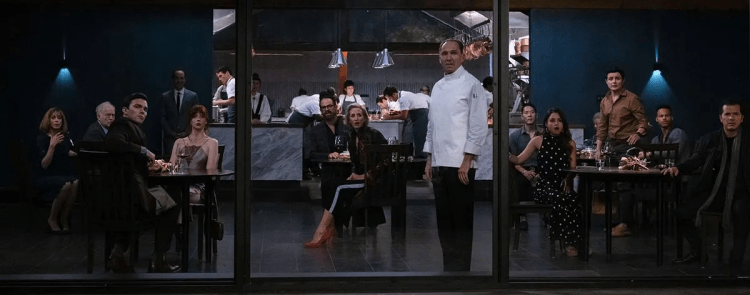
12 diners are presented with more than a lavish menu when attending a dining experience on a remote island.

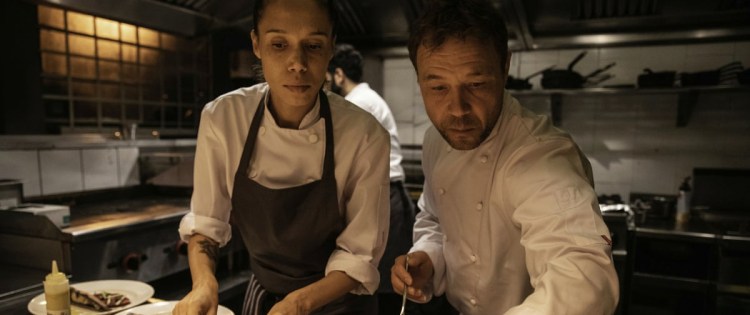
While you may not be able to relish and savour the various lavish dishes that are put on display throughout The Menu you’re certainly able to do so to the mysterious darkness which lies within them. The meal itself may start off as something over-complex in terms of design and background – at least to diner Margot (Anya Taylor-Joy) who doesn’t quite get the fascination her partner Tyler (Nicholas Hoult) has with the various medleys put in front of them, and chef Julian Slowik (Ralph Fiennes) – but overtime personal details about those eating come to light as darker reasoning in-between the various dishes is revealed.

As the threat level increases with each course there’s plenty of fun to be had as the diners worry escalates, whether they be regulars (Reed Birney, Judith Light) or out-of-the-limelight film stars (John Leguizamo). Amongst the finely tuned dark comedy which adds to the fun there is to be had with this particular film there remains something captivating about Fiennes performance. The film pitches him and his working-in-unison staff, with Hong Chau as maître d’ Elsa, as the antagonists of the piece early on. Yet, with his early displays of culinary storytelling and introductions to each dish you can’t help but be held in the palm of the “Lord High Emperor of Sustenance’s” hand.


Things may start to lose their edge somewhat as the threats become more certain when led to the fore as the new driving force instead of the meal itself, but there’s still plenty of enjoyment to be had. The film keeps in mind various aspects of humour within the panic of the assembled twelve and manages to keep its pace up through a handful of laughs and chuckles as they have a dining experience like no other. Making it all the more perplexing that the ending barrels into staggering cliché as if going for the simplest thing due to having not known where to end.

Luckily, it’s not enough to disturb the film as a whole, and the flow is still kept alongside your interest in the unfolding evening. Perhaps helped by the fact that while certain instances may lean into intentional theatricality for the presentation of each course but as a whole never feels as if it could be played out on a stage – despite the largely one-location setting of a restaurant on a remote island. Director Mark Mylod helps to keep a cinematic feel with his movement of the camera and drift through the conversations occurring at each of the different tables before everyone comes together in fear at what they are witnessing and what is being revealed within their dishes – including personal details printed on tortillas which are otherwise praised for their taste.

The second half of The Menu may not quite have the same edge of the first with the darkness brought more to the fore instead of lying as a sense of mysterious threat. However, there’s still plenty of enjoyment and devilish fun to be had witnessing the unfolding events weaved into the tales of food and cooking which are part of the initial engagement with the film as a whole thanks to Fiennes’ soft-spoken chef, alongside the rest of the ensemble cast – particularly the focuses of Taylor-Joy and Hoult who find their responses to everything they witness being polar-opposites. Things are well balanced and generally pass along with ease thanks to the flow of the meal and the various courses helping to initially present the twists, turns, surprises and intentions of the Hawthorne restaurant.

There’s plenty of fun to be had within the subdued threats and darkness of The Menu, while the edge might be slightly lost when that comes more to the fore there’s still a good deal of entertainment value to be had weaved amongst the various well-presented courses.

Rating: 4 out of 5.

LFF 2022: Guillermo del Toro’s Pinocchio – Review

Release Date – 25th November 2022, Cert – PG, Run-time – 1 hour 57 minutes, Directors – Guillermo del Toro, Mark Gustafson

After the death of his own son (Gregory Mann), carpenter Geppetto (David Bradley) carves a wooden boy (Mann) who is miraculously brought to life in an immortal wooden body.

It goes without saying that Guillermo del Toro was going to bring something different to the much-adapted Pinocchio story. Yet, there’s still a sense of surprise within the opening stages of his take (co-written with Patrick McHale and co-directed with Mark Gustafson) as we see an elderly yet joy-filled Geppetto (David Bradley) spending a life with two loves. That for carpentry, he’s renowned in the town and is working on a new statue of Jesus on the cross for the church, which is only surpassed by that for his young son, Carlo (Gregory Mann). He sings about his love for his son and we see the pair gleefully spending time together amongst getting on with various pieces of work.

However, all of this is brought to a sudden halt during a pre-World War II bombing of the church which takes away the sparks of Geppetto’s life. He becomes isolated and turns away from everything around him as we see him carve a wooden boy not out of tearful emotion, but a drunken, rage-filled grief. The scene plays out like a creation of Frankenstein’s monster as the bereaved father’s intense anger fuels the moment with a sense of colliding loss and desperation. All leading to a brought-to-life pine child (also Mann) not learning to be honest, pure and true (although that’s certainly on the agenda when it comes to his not-as-present-as-you-may-think cricket conscience Sebastian (Ewan McGregor – seeming to relish the chance to (almost) belt out another musical number)) but instead navigating the course of lessons in mortality.

When Pinocchio ‘passes away’ he finds himself confronted by a Wood Sprite played by Tilda Swinton before being returned to the world of the living. Each time his desperation to return appears to increase as lessons of life and death increase. Each time the character also nears becoming slightly less annoying. Certainly as we’re first introduced to him and he’s exploring everything around him in Geppetto’s workshop for the first time there’s a very excitable and chaotic nature to the character – adding to Geppetto’s Frankenstein-like response when being greeted by the impossible ‘creature’ first thing in the morning. One which may prove a bit much for some viewers. However, there’s still plenty to enjoy the film.


It’s far from an overall hyperactive affair as, as you would expect, del Toro and co lean into the darker elements of a story such as this. It may come as a surprise that he doesn’t tackle Pleasure Island (a sequence which many may have been looking forward to seeing being tackled through his lens) but the film is set against the backdrop of rising fascism in Italy. Mussolini (Tom Kenny) appears not just on an increasing amount of walls and posters in the background of scenes but as a very short – and therefore consistently amusing when on screen – figure who claims to strongly “like-a puppets”. However, the threat of his rising regime is shown more and more throughout the film alongside Pinocchio’s exploration of the world and ways of life around him.

There’s an undeniable darkness to the film, again, you’d expect it with del Toro’s influence amongst the helm. He’s stated that while it’s not for kids they can watch it as long as adults are prepared to have certain conversations, particularly surrounding ideas of death, afterwards. It’s a point which has been particularly thought about within the course of the film and the directions that it goes. Perhaps such themes are perfectly summed up in the screenplay’s own words, “what happens happens and then we are gone”. The film’s overall treatment leaning towards its characters trying to make what happens reach the side of good through the likes of dedication towards family, friends and those around them.

It makes for something interesting and undeniably unique for a Pinocchio film, all enhanced through the strong visuals of the excellent stop-motion animation (del Toro has made sure to point out how the animators are credited equal to the starry voice acting cast of the film, alongside taking some of the puppets, particularly Pinocchio, on the festival and premier circuit). Increasing the fantastical elements such as Pinocchio’s interactions with the Wood Sprite and the towering darkness which begins to sprawl during certain sequences displaying the fascist threat confronting Italy at the time the film is set. It simply allows for further detail and establishing of tone in regards to some of the scenes and themes which run throughout the film. All while still allowing for the theatricality of some of the musical numbers, largely in terms of sound, to come through. Amongst all the stylings of themes and tones throughout the film there’s plenty to be engaged by and enjoy in this darker take of Pinocchio which is successfully influenced by the classic story.

It may take a bit of time to get used to the character of Pinocchio himself, but there’s still plenty to enjoy within the visual and tonal styles of this particular interpretation, which gets philosophically darker alongside the rising threat of the settings.

Rating: 4 out of 5.

LFF 2022: Glass Onion: A Knives Out Mystery – Review

Release Date – 23rd November 2022, Cert – 12, Run-time – 2 hours 20 minutes, Director – Rian Johnson

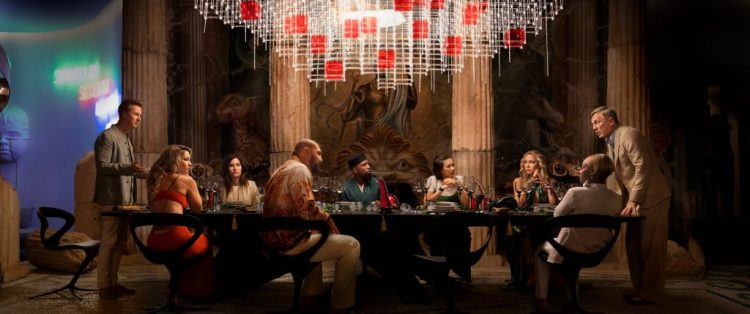
Detective Benoit Blanc (Daniel Craig) finds himself mysteriously invited to a billionaire’s (Edward Norton) private island where it seems each of the wealthy and successful guests are hiding their own secrets.

In writer-director Rian Johnson’s hit murder-mystery Knives Out it was mentioned that victim Harlan Thrombey “practically lives in a Clue[do] board”. The film with its gleeful twists and turns played around with this idea and the various hidden doors and passageways that could be used by the murderer. In much the same way follow up Glass Onion sees Johnson having just as much fun scheming with puzzles, mind games and riddles. We’re introduced to our potential suspects as they sit on a phone call together trying to solve a box filled with puzzles sent to them by their billionaire friend, Miles (Edward Norton). Inside is an invitation to his private island just off the coast of Greece where he plans to hold an annual gathering between friends. Also present is Daniel Craig’s well-spoken, strongly-accented detective Benoit Blanc. Cue the unfolding mysteries and dramas.

We see Blanc interacting with the various wealthy and successful faces present on the island – whether that be through their role as a content creator/ influencer (Dave Bautista) or in politics (Kathryn Hahn) – gradually realising that it seems that each figure may very well be hiding their own secrets. It’s not difficult to engage with Blanc as a character. He’s an even more entertaining, not to mention devious, figure this time around; helped by the fact that Craig, Johnson and the film as a whole lean much more into the comedy this time around.

The mystery is still front and centre – you’re guessing from the start, yet held in fascination as you see each potential suspect interact and converse before anything actually happens, the film playfully meddling with this information in mind – but the laughs certainly feel boosted. There’s a flavour that this could be a, very successful, out and out comedy thanks to the humour that it presents, not just from Craig but the highly enjoyable cast as a whole. Much like the first film you can tell the cast are all having a great time bringing to life the range of characters that are on display and relishing constructing the twists and turns of this particular narrative.


Part of the fun comes in the tension that arises during a handful of sequences. Of course as the mystery deepens and certain figures find themselves threatened things become heated, particularly when you think you may know who the culprit is before the film jumps backwards for every character. It’s all part of the fun as over time you find yourself leaning into the screen in fascination and anticipation for where things are going to go next, and just how the central detective’s mind is working. Particularly when we’re first introduced to him craving for a new challenge whilst bored during the pandemic.

Like the first Knives Out twisted standard murder-mystery rules by still having us guessing even after showing us the events leading up to the murder Glass Onion equally plays around and prods at the genre. It makes use of the knowledge that the audience – who are as integral to the film as the characters and events – will be trying to guess along, themselves playing detective alongside the great Benoit Blanc. Referencing this in subtle ways and further displaying the immense effort that has gone into the screenplay. Johnson’s writing and directing are overwhelmingly sharp as you can see his efforts shine as much as anything else in the film through the fast-flowing 140 minute run-time.

Amongst the highly effective humour Glass Onion once again poses a tense, thrilling and especially fun murder-mystery that acknowledges the audience participation and experience which can heighten the overall effects of a film such as this. Fitting as Glass Onion is best viewed with an audience just as much for the collective intrigue as the loud gasps at both the reveals and fun appearances throughout (none of which overwhelm or distract from the main course of the the feature). It’s all part of the fun there is to be had within another hit murder-mystery from Rian Johnson who proves himself a rather masterful mystery carver in terms of both plot and characters, boosted by another successful cast. It’s a brilliant, twisting puzzle.

Amongst the various laughs created by the finely-tuned characters there’s plenty of tension and fascination within the core mystery of Glass Onion which is constructed around the audience’s fascination and want to play along. Another cleverly layered and constructed mystery from Rian Johnson and a stellar cast.

Rating: 5 out of 5.

My Father’s Dragon – Review

Cert – PG, Run-time – 1 hour 39 minutes, Director – Nora Twomey

Having recently moved to the city with his mother (Golshifteh Farahani) Elmer (Jacob Tremblay) finds himself in search of a dragon (Gaten Matarazzo) to help him raise money for them to buy a place to open a store.

Cartoon Saloon are currently five for five with their latest feature My Father’s Dragon continuing their brand of finely animated drifts into fantastical storytelling. While it may take a couple of minutes to get used to one of their films containing prominent American accents (The Breadwinner very much being its own thing with the non-Irish accents) you can’t overly hold that against the film and soon the fantasy begins to settle in shortly after young Elmer (Jacob Tremblay) moves with his mother (Golshifteh Farahani) from a small town the expanses of the city.

Before moving the pair ran a shop where every customer seemed to know each other and them. The place was filled with colour and there seemed to be little trouble for mother and son. However, when the shop closes and they move to the dark city streets there’s plenty of business but little interaction. That which they do get is from hostile landlord Mrs McClaren (Rita Moreno) – who ends up receiving most of the coins saved up to buy a place to open up a new shop as rent.

Despite trying his best Elmer finds himself raising little money to help. While things may begin to feel somewhat conventional and unlike other Cartoon Saloon fare just as Elmer is on the verge of giving up the fantasy steps in in the form of Whoopi Goldberg as a talking cat, quickly followed by Judy Greer as an excitable whale called Soda. They direct the young protagonist to a place called Wild Island in the hope of finding a dragon which can help him raise money to save up for the dreamed-of store. Yet, while he may be ready for a dragon Elmer isn’t quite ready for the kind of dragon that he’ll find – namely a round, clumsy one with a broken wing, still waiting to become an ‘Ever Dragon’.


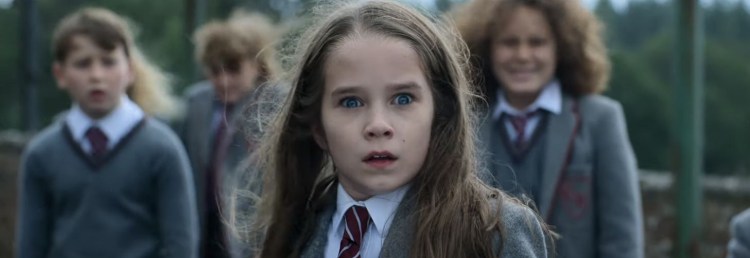
To do this Boris (Gaten Matarazzo) must lift up the island to stop it from sinking as is done by a dragon every 100 years, however despite trying the change has never occurred for him. Meanwhile, the other inhabitants of the island – led by large, white gorilla Siwa (a highly enjoyable Ian McShane who, like a number of members of the starry voice cast, seems to be relishing the role in a film like this) – are increasingly fearing that it will sink and that their home will vanish at any point. Therefore the hunt is on to capture the missing dragon and the boy who set him free before it’s too late.

As we explore the various elements and sections of the island, and more colourful creatures – including Alan Cumming as an irritable crocodile called Cornelius – it’s easy to generally be caught up within the unfolding events. The film as a whole may not be anything overly complex, but does that really mater? There’s an enjoyable time to be had with the occasional moment of humour and the general lightness that’s on display throughout. The more the relatively short (99 minutes, including credits) run-time goes on the more engaged you feel, particularly once in the realm of Wild Island.

Eventually you can feel a bond between boy and dragon which provides further amusement and allows you to simply feel more a part of the piece. There’s a mild charm to their bond which you realise in the later stages as the film begins to reach the third act. A number of the elements and tones may take some time for you to realise, and in some cases the film as it builds each thing up over time, but in the end there’s an entertaining and rather delightful piece of work here. One which eventually takes you in for another fantastical dive into a love for storytelling and escapism from Cartoon Saloon, perhaps some of the most creative and imaginative storytellers working in cinema today.

While some elements may take a bit of time to build up there’s plenty to enjoy within My Father’s Dragon, particularly once it gets into its rather charming fantastical reaches.

Rating: 4 out of 5.

Black Panther: Wakanda Forever – Review

Cert – 12, Run-time – 2 hours 41 minutes, Director – Ryan Coogler

After suffering the death of King T’Challa, the Black Panther, the country of Wakanda finds itself weakened and vulnerable after opening up to the rest of the world and receiving threats of war from an underwater civilisation.

The authenticity of the fictional country of Wakanda was praised as a large team effort. The highly visceral style which was on display was reflected in the overall sound – which led to a handful of rightful Oscar wins for the film in the creative categories. Yet, Wakanda was also authentic because of its characters and the internal conflicts which could impact the outside world. Now the country has opened up to the rest of the world there’s a global want for vibranium, the rare, almost indestructible, metal only available in that part of the world. There are tensions rising with other countries, including the US, who all believe that the peaceful nation could use the metal for weapons of mass destruction. All while they try to recover from the death of King T’Challa – the opening scenes certainly create an emotional build-up and response in the wake of Chadwick Boseman’s passing.

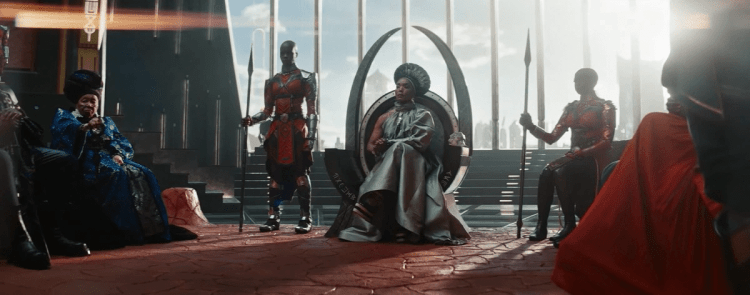
Without the defence of the Black Panther Wakanda finds themselves at perhaps their most vulnerable and weakened state. Particularly when threatened with war by leader of the underwater Talokan civilisation Namor (Tenoch Huerta Mejía) who asks the grieving queen Ramonda (Angela Bassett) and princess Shuri (Letitia Wright) to find the scientist who created the drills that have invaded his land or else he will destroy Wakanda. However, it turns out that this scientist is college student Riri Williams (Dominique Thorne). It’s with this introduction that Wakanda Forever really starts to find its flow. It’s introduced most of its characters and set itself up, now it can truly get into its narrative.

There’s certainly still a lot to see and get through over the course of the nearly three hour run-time (which manage to go by rather quickly), but the generally flow of the film is rather good as your kept engaged throughout. It’s the aforementioned authenticity of the titular country which manages to do this. Not just visually and audibly but in terms of the way that those within the nation interact with others and prepare for battle against forces which they haven’t seen before – forces which feel grounded and believable in their reasoning for threats and attacks, perhaps adding further interest in various fight and battle sequences.


There are a number of undeniably ‘cool’ shots within a number of these scenes, including a handful which linger through co-writer (alongside Joe Robert Cole) and director Ryan Coogler. Add to that the visual flair brought about by the cinematography and there’s clearly a strong visual effort that’s been brought into play to further bring you in to the creativity of the world on display. It mixes well with the third act in particular where there’s an understated nature to the build-up and escalating action held within it.

Further propelled by what has come beforehand in terms of the film narratively taking a step outside of familiar surroundings, particularly for the central characters. Looking at how Wakanda interacts with the rest of the world now that it has opened up and finding themselves in an increasingly uncertain situation as everything seems to have disappeared from around them.

While there’s plenty of action what truly propels and engages within Wakanda Forever is the dramatic side of things. A nation still mourning and trying to recover while in an already uncertain situation. Something shown and developed among the more present supporting characters, not just the likes of Danai Gurira’s fierce yet effortlessly funny Okoye and Lupia Nyong’o’s Nakia, in instances such as discussions between the various tribal leaders of Wakanda – including Winston Duke’s returning M’Baku. The same goes for the way in which we see the oceanic world of Talokan and the people within it. It adds to Namor as a character and that new realm as a whole. Creating yet another villain within this particular franchise, after the first film’s Killmonger, where you can understand their motives and reasoning, but they certainly go the wrong way about resolving it.

That is where Wakanda, and indeed Wakanda Forever, succeeds the most. Once it properly delves into this point after a slightly lengthy set of introductions – somewhat lessened by the simple use of fade edits from one scene to another to avoid feeling jumpy and somehow less busy – it finds its stride and manages to run with it for most of the remaining run-time. There’s plenty of humour along the way amongst the action and dramatic stakes which are well grounded by Cole and Coogler and the entire cast of the film. All of whom you can tell are dedicated to telling this story about a country, a group of people, trying to prevail. And in the end it succeeds because of all the detail and effort that has been put into the various different aspects of making an authentic place and people, as grounded as possible (of course with a number of sci-fi, fantasy and action tints) within a world which further reflects that.

While the build-up might take a bit of time to introduce the various different characters there’s no denying that the pay-off of Black Panther: Wakanda Forever is successfully engaging because of the various believable dramas which push the authenticity of Wakanda and the world it’s opened up to, playing out amongst plenty of enjoyable action.

Rating: 4 out of 5.

Living – Review

Cert – 12, Run-time – 1 hour 42 minutes, Director – Oliver Hermanus

When told that he has only six months to live the head of a London council department (Bill Nighy) tries to make the most of his life.

There seems to be something about Akira Kurosawa’s Ikiru which appears to lend itself rather nicely to the backdrop of 1950s London. Kurosawa’s film itself was released in the 50s and while very much fitting of its time and Japanese culture and stylings undoubtedly has a sense of timeless universality. It’s brought into this English language remake with ease thanks to Kazuo Ishiguro’s screenplay and a fine capturing of traditional repressed British emotion under the guise of the stiff-upper-lip attitude. Much of this is conveyed through the leading performance of Bill Nighy as head of London Council’s Public Works department, Mr Williams.

While Williams is certainly the central focus of Living’s midsection he plays something of a supporting role in the stages which bookend the film. It’s here that while he certainly plays a prominent role and remains a central focus we see more of how other characters view him. Those who he works with in the quiet office filled with the sound of occasional paper filing alongside his distant son (Barney Fishwick) and daughter-in-law (Patsy Ferran). The difference in the bookends is the lease of life he finds in-between as, after being given six months to live, he tries to find a way to truly live.


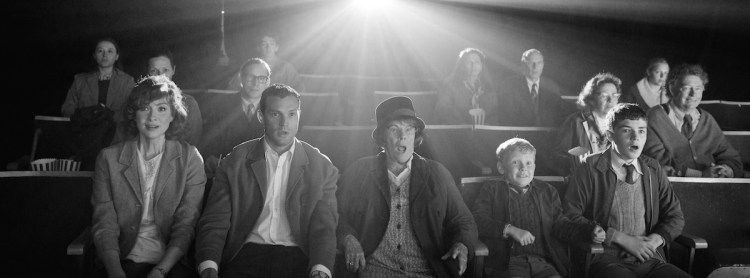
Initially this takes him to other people’s interpretations of living, via a boozy seaside night with Tom Burke, before eventually finding it in that which was already around him. Simple cinema trips to see Cary Grant in I Was A Male War Bride with former employee Miss Harris (a rather charming Aimee Lou Wood) who he begins to form a friendship with. While Nighy’s performance throughout remains effectively quiet and restrained there’s a clear change in his character as the film gets through its moments rather quickly. Certainly the core change in attitude of the central figure feels condensed into a number of rather quick scenes which move from one to the other with a quicker pace than some of the other strands of the film. Time is still taken, but it feels slightly pacier as you can tell the film wants to reach a key point and development that will lead to the next big stage in the narrative.

In general little has changed from the original film, yet Living manages to get away with this and still makes for engaging viewing. There may be a sense of familiarity at times, but never too much to be bored or disengaged. Leaning more into the realms of faithful remake than a shot-for-shot one. Similarly tones and feelings are captured without feeling as if you might as well be watching the original. And much of this comes from Bill Nighy’s performance and the way that the film focuses on the effect that his character has in taking control of his life. Sometimes seen from the perspective of new-to-the-office Mr Wakeling (Alex Sharp), told to expect a stern, little-talking, punctual head of department before he fails to turn up multiple days in a row, after having to leave work early on the new employees first day.

As a whole there’s a calmness to the film which allows for the quietness of the emotion to come through and have more of a connecting effect. Much of why the film works is down to its subtleties and the conflicting restrained emotions of the themes and the displays of what the characters are often feeling. It has an engaging effect which manages to flow rather well, even if a bit sped up during one key part of the central Mr Williams’ course of change, and fits right in to the time period in which it is set – starting off with various 50s-style shots of central London, music and title cards to reflect a film of the period – to further reflect the tones and ideas on display throughout. All rather well captured and simply helping to create an even more thoughtful impact which perhaps remains due to the fact that never does the film go for loudness or heavy forcefulness.

The restrained tones and emotions that make the subtleties and thoughtfulness of Living as effective as they are are captured within Bill Nighy’s wonderfully restrained central performance. While some moments may feel a bit rushed through the film remains well placed within its time period, with quietness making an impact at the fore throughout.

Rating: 4 out of 5.

LFF 2022: Bardo, False Chronicle Of A Handful Of Truths – Review

Release Date – 18th November 2022, Cert – 15, Run-time – 2 hours 40 minutes, Director – Alejandro G. Iñárritu

A Mexican documentarian (Daniel Giménez Cacho) returns to his homeland after receiving a prestigious award in the US.

For those who aren’t fans of Alejandro G. Iñárritu, particularly his more recent works such as Birdman and The Revenant, it’s perhaps unlikely that you’ll be turned around by Bardo. With Bardo Iñárritu appears to take influence from his own life (with the help of co-writer Nicolás Giacobone), particularly following from the awards success of his previous two films, and injects it into the experiences of central figure Silverio (Daniel Giménez Cacho). Change an Oscar or two for an equally prestigious award looking at an entire career of work and we see the journalist-cum-acclaimed documentarian travelling from the US to his homeland of Mexico, revisiting his roots and, as you would perhaps expect, confronting both his past and his identity.

Along the way there’s plenty of strange fantastical elements into which many of the events are transcribed. The film opens with the idea of a baby wanting to be put back into the womb when it realises how dark and cold the world is, before the umbilical cord which trails behind the mother gets stuck in a pair of swing doors. It’s undeniably strange, but an undoubtedly enjoyable kind of strange, particularly when it comes to the opening of this almost three hour story.

While this style isn’t as frequent as you might expect, or hope, it certainly pops its head in every now and then to guide Silverio’s mind as the film as a whole feels relatively free from an overall narrative. Sometimes knowingly playing into, and prodding at, the early statement that “life is nothing but a series of idiotic images. Exposure at any price” before returning to Mexico truly appears to bring back his imagination, teased in the opening shot of a shadow trying to fly in the desert.


With such a long run-time there’s chance for things to go off the rails quickly and for the film as a whole to seem like a long slog. However, there’s plenty within Iñárritu’s seemingly now signature one-shot style to engage and keep things flowing throughout. Not just the fantastic visuals, courtesy of cinematographer Darius Khondji. As a whole the film avoids feeling overlong, however there are individual sequences which themselves feel quite lengthy. While, of course, it’s difficult to cut some of these down due to the one-shot style, the film appears to have been served well after having been cut down by around 20 minutes since its debut at the Venice Film Festival.

It’s often when ideas don’t quite seem to properly click, or generally feel thinner and therefore more drawn out, that sequences feel longer than they should. Yet, there’s still plenty to enjoy aside from the visuals. Cacho makes for a highly enjoyable lead with plenty of charm as he captures the delight of his character in the middle of a large dancing crowd and the more emotional aspects of his familial relationships, and when being questioned as to where his real home is when at US border patrol. It’s a wonderfully performance that, while his character is guided by the occasional fantastical elements and those around him, wonderfully leads the film, acting as the consistent through the events for the viewer.

Bryce Dessner’s score occasionally feels like it could be playing in the background of some form of wacky sitcom, when it leans into this feeling the most it works best when accompanying some of the closing stages where the film begins to rather entertainingly wrap itself up. There’s plenty of comedic moments throughout the film and a couple of chuckles which bring about a lightness to the proceedings, and even the moments which stand more in the line of the the dramatic.

The overall tone and blend of the film works well and manages to keep you engaged throughout as it tackles its various themes and ideas within the narrative-light linked events that construct it. Some may feel a bit long but as a whole the film avoids an overlong feel thanks to the interest and engagement formed within the fantastical elements which lead its well-performed central figure. For those who are yet to get on with Iñárritu this likely won’t change anything, but for those who have enjoyed his more recent works, and even enjoy something a bit more on the strange side, then this may work rather well particularly when it knows how to run with certain ideas without spreading them too thin, or too high.

For those who have liked Iñárritu’s more recent works there’s a fair deal to enjoy within Bardo, particularly the strong visuals and occasional drifts into fantasy. A strong central performance from Cacho acts as a likable consistent through the largely entertaining events which while some individual points might feel a bit drawn out, fill the film as a whole rather well.

Rating: 4 out of 5.

LFF 2022: Aftersun – Review

Release Date – 18th November 2022, Cert – 12, Run-time – 1 hour 42 minutes, Director – Charlotte Wells

Father and daughter Calum (Paul Mescal) and Sophie (Frankie Corio) spend a relaxed holiday in a foreign holiday park, however much of it plays out like a distant memory.

There’s very little that goes wrong in Aftersun, there’s little hinting that anything will. Yet, writer-director Charlotte Wells’ debut feature is one of the tensest films in years. For much of the 1 hour and 42 minutes run-time I was thrown into an intense state of fear, constantly bordering on a panic attack. All as I watched a father and daughter simply have a really nice time on holiday.

The father and daughter in question are Calum (Paul Mescal) and Sophie (Frankie Corio). They’re spending a few weeks of the summer at a foreign holiday resort, having been hinted that they’ve spent some time apart with Calum being divorced from Sophie’s mother. Over their time away we see their various conversations as they walk along the beach, play pool, make fun of the evening entertainment and more completely innocent activities. However, Wells underpins all of this with extremely subtle hints to the deeper, more unspoken elements of their relationship, or perhaps more simply brief visual threats. When the two are walking at a slight distance from each other, or Sophie is allowed to go off and play pool and swim with other kids, or teenagers, around the hotel there’s an inescapable tension that she’s somehow going to be abducted.

On the other hand, there are hints within Mescal’s performance and slight character details that Calum may be suffering from depression, perhaps even turning to alcohol. There’s a genuine worry that arises that at some point over the course of the film he may kill himself, leading to further worry for what may happen to Sophie. Much of this plays out at the same time, with the fear and panic layering to create a truly stressful experience. All while, again, you see a simple holiday play out. One which deeply contrasts your feelings to what you’re seeing.


It may take a little bit of time to properly work out what the film is showing you with its lack of narrative, but as it begins to give flashing glimpses of unexplained or uncertain events your interest in the characters deepens. Shots of what appear to be Calum at a nightclub could be in the past, the near future or a consistent display of what he’s doing while his daughter sleeps. Regardless they add to the film as a whole and the emotional responses it creates within the viewer. Yes, it builds up to something more over time, but much of this largely comes towards the final stages, remaining largely ambiguous for the most part.

The quietness of certain scenes allows for moments of worry-inducing threat to speak even louder. One particular lingering beach shot focuses just as much on the crashing waves as much as it does on Calum at the centre of it. It’s just before this that you realise you’ve been worrying just as much about him as you have his daughter. It’s also around here that the film begins to lean into wrapping things up. It may not be able to build up the same kind of suspense, but it gets around this by continuing to tackle a sense of ambiguity and mystery. What’s going to happen when this holiday that the pair have been posing as idealistic is over? What will happen to their bond once she vanishes into the airport tunnel?

All of this so quietly, effectively held in the background as subtle hints and ideas presented to the viewer behind the central holiday that the central father and daughter both wonderfully, naturally performed by Mescal and Corio are trying to enjoy. It perfectly contrasts with these images and allows for the fear and worry that lies throughout the feel even stronger. While what’s presented should be peaceful and relaxed what’s experienced is a truly emotionally intense ride for the viewer. Debuts don’t often come as emotionally complex as this.

While what’s visually presented is an often peaceful and relaxed holiday the central performances of Aftersun’s father-daughter duo, alongside Charlotte Wells’ subtle layering of hints and ideas, create a 102 minute panic attack through the intense fear and worry created for them.

Rating: 4 out of 5.

Watcher – Review

Cert – 15, Run-time – 1 hour 36 minutes, Director – Chloe Okuno

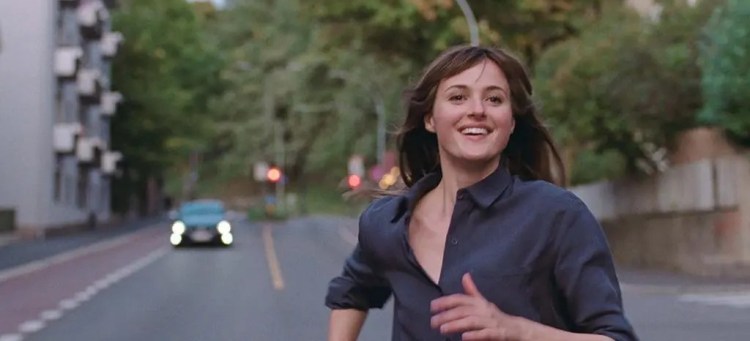
Having moved with her husband (Karl Glusman) from New York to Bucharest, Julia (Maika Monroe) begins to suspect that she is being constantly followed by a man (Burn Gorman) living in the building right across the street.

There’s a very traditional feel to the opening stages of Watcher. A quick set-up throws us into the eerie chills which haunt Maika Monroe’s Julia as she suspects that she’s being stalked by a man in the building across from her apartment block. She’s recently moved from New York to Bucharest with her husband, Francis (Karl Glusman). However, while he speaks Romanian she’s still learning and finds it difficult to communicate with others in her building, aside from neighbour Irina (Madalina Anea). Her increasing feelings of isolation heighten the tension and worry she feels as she both tries to escape being stalked and yet begins to follow the man she suspects of following her (Burn Gorman).

Plenty of elements come together to create the form of a classic chiller. It helps to engage and generally pushes the film as a whole. Its traditional tones mixed with a handful of modern stylings are brought to life through writer-director Chloe Okuno’s direction, mixed with a brilliant central performance from Maika Monroe who perfectly captures the inner, and eventually outer, fear her character is feeling.


As things progress the more modern elements of the film show as the darkness becomes more a part of the central narrative. Glimpses of an investigation into a serial-killer known as The Spider go from being mentioned in the news to playing an active part in Julia’s own investigation. While this increased darkness may somewhat change the styling and slight feel of the film there’s still a consistency to the narrative and the flow feels undisturbed. Tension still manages to rise throughout the short and fast-flowing run-time. Things might dip in the final stages as the film tries to keep its pace while making sure it brings things to a dramatic conclusion but, once again, the engagement is still there; with plenty of this down to the performances at the centre of the piece.

Things are effectively progressed and generally feel as if they avoid repetition, helping with the aforementioned flow and consistency. With the stylistic shifts which appear throughout there’s still tension and engagement thanks to the stripped back nature of the opening stages and how quickly the core situation is built up. The initial paranoia develops, of course clashing with attempts from others to rationalise, with the suspense rising in a number of scenes and situations. Convention may come into play, but when present it’s often questioned as to whether the film may go in a different direction with certain new pieces of information instead of just being accepted. Everything flows through the short time and while there might not be as much of a ‘classic’ feeling in terms of style towards the end there’s still an indie thriller future audience hit feeling to the film as a whole.

There’s an interesting mix of traditional and modern stylings within Watcher, while it might lean towards the latter more with the increased darkness there’s still plenty of tense scenes and sequences thanks to Okuno’s direction and Maika Monroe’s superb central performance.

Rating: 4 out of 5.

Weird: The Al Yankovic Story – Review

Cert – N/A, Run-time – 1 hour 47 minutes, Director – Eric Appel

A highly fictionalised account of the rise to fame and acclaim of Weird Al Yankovic (Daniel Radcliffe).

It feels fitting that a biopic of the life of Weird Al Yankovic doesn’t really serve as a biopic at all. As many fans would perhaps hope for from the musician largely known for parody tracks such as Amish Paradise and Like A Surgeon this highly fictionalised account of his life story slips into the realms of parody very early on. Perhaps not to the genre-ruining effect of Walk Hard, but Weird takes a different stance to that particular modern cult comedy.

Diedrich Bader’s opening narration assures us that “life is like a parody of your favourite song. Just when you think you know all the words. Surprise, you don’t know anything”. It’s something that writers Yankovic and director Eric Appel try to run with in the various scenes and genre pastiches throughout the film. From an early childhood where music is shunned by his father (Toby Huss), there are serious consequences when a young Alfred (David Bloom) sneaks out one night and attends a polka party, to a fight scene in a diner with the cartel there are plenty of send-ups on display. While some may feel somewhat distanced in humour simply down to how serious in tone the scene appears – there’s often uncertain as to whether moments are aiming for straight seriousness or very dead-pan parody – there are still a handful of laughs to be had along the way.


Daniel Radcliffe plays the grown-up version of Yankovic. An aspiring accordion player with a talent for re-writing the words to other people’s songs. It’s not long until, after frequent airplay from Dr Demento (Rainn Wilson), he’s propelled to the heights of fame and constant acclaim as one of the greatest musicians to ever live. His parodies even lead to boosted sales for hit bands such as Queen, something which Madonna (Evan Rachel Wood) wants in on, entering into a relationship with Al in the hope that he will make her an even bigger success with a parody of one of her songs.

Along the journey of rises and falls there are plenty of famous faces and cameos which pop up at various events – particularly at a pool party hosted by Demento. Such appearances capture aspects of the lighter, and definitely more absurdist elements of the film. It’s here that as a whole things appear to work best and provide the most amusement. It’s where the tone feels most clearly defined and certain of itself. Things move along well with the most chuckles, as is the case with most of the film, coming from quick lines of dialogue rather than drawn out ideas, although a one-off to developing gag about Pablo Escobar (Arturo Castro) being a huge Weird Al fan does prove to be consistently amusing.

As a whole the film fills its 107 minute run-time rather well. While it might occasionally walk an uncertain line between seriousness and parody in general there’s plenty to enjoy throughout thanks to a fair share of chuckles. In fact, even with its sense of parody it manages to not overdo it on the songs, although there’s plenty to like about those that do crop up with their acknowledged sense of silliness, pushed by the fact that Radcliffe is clearly having a great time with the lead role. Barely any of it is true, it’s pretty obvious from some of the initial playful twisting, and in a number of ways a Weird Al ‘biopic’ is perhaps better for it. For the time it’s on it’s rather enjoyable stuff which embraces absurdism with a good deal of laughs along the way.

While clearly not taking itself too seriously Weird: The Al Yankovic does occasionally walk an uncertain line between seriousness and parody, but as a whole there’s plenty of chuckles along the way, particularly when clearly displaying a silliness which everyone involved seems to embrace.

Rating: 3 out of 5.