Champions – Review

Release Date – 10th March 2023, Cert – 12, Run-time – 2 hours 4 minutes, Director – Bobby Farrelly

A minor league basketball coach (Woody Harrelson) finds his career halted after an act of aggression leads to him receiving 90 days of community service coaching a team with intellectual disabilities.

There’s a decent enough film within Champions. The kind of conventional ‘feel-good’ sports flick that comes around every now and then and proves to be a likable enough crowdpleaser. Mark Rizzo’s screenplay, and the story arc, certainly seems to say this. It should be fine, however there’s something about the film that often feels off for most of its run-time.

We follow Woody Harrelson as Marcus Marakovich, an assistant coach for a minor-league basketball team. He’s hoping to make it to the big time of the NBA, however those dreams are halted when he pushes head coach Phil (Ernie Hudson) and is booed of the court during a game. Things begin to spiral for Marcus quickly resulting in him receiving 90 days of community service, coaching a local team with intellectual disability – cue multiple gags about what the correct term for the group is, even if characters clearly know that certain “boo-boo words” aren’t at all suitable.
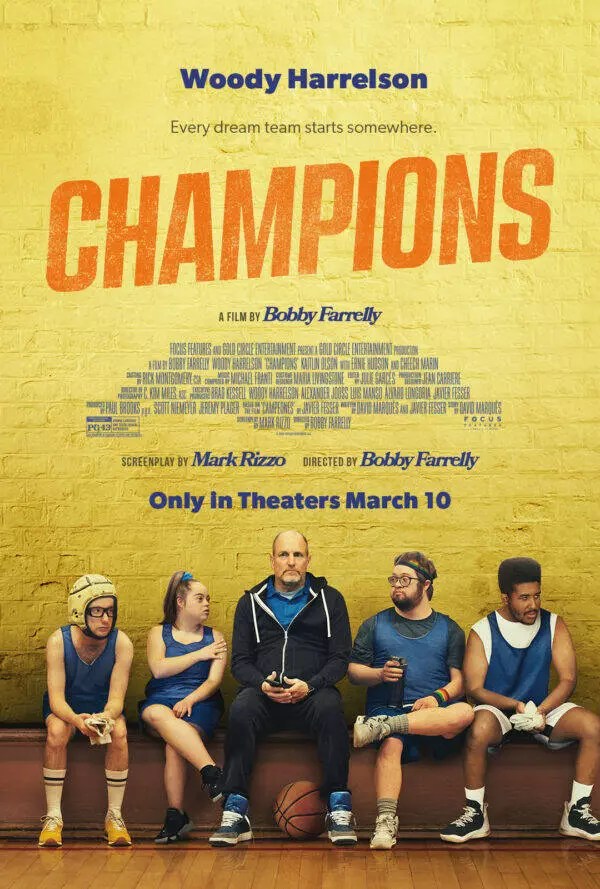

Thus Marcus finds himself having to train the Friends to at least become a working team. However, as he begins to develop a relationship with those on the team – particularly “homie with an extra chromey” Johnny’s (Kevin Iannucci) sister Alex (Kaitlin Olson) – and training starts to pay off Marcus’ career starts to show more signs of restarting. This especially being the case as the Friends find themselves on the road to the Special Olympics. Yet, before that, of course, we need to see them not always able to get the ball through the hoop. As Marcus’ initially finds himself reluctantly serving out his court ordered unpaid work the film feels somewhat oddly framed. It feels as if the disabilities of the central team are almost framed to push certain gags – even when they’re not mentioned or a part of the moment, which is a lot of the time.

It means that instead of a pull factor the film, and the gags in general, seem to push the viewer away due to this strange angle. Maybe it’s from how Marcus sees those in front of him, yet this feeling is still present later in the film, only really dropping for the big finale. It leads to a number of instances which feel rather manipulative, not for those in the film, but for the audience. Uncertainty begins to form as to how you’re supposed to feel about certain moments due to the framing of certain moments leaning away from what it feels like the script intends (although, even that does seem a little bit lax on some occasions).

If it wasn’t for the way in which the direction of the film seems to come across – whether unintentional or not – there would perhaps be a good, if conventional, film from Champions. There’s certainly one within the screenplay, you can even see it at some points during the film. It’s likely to come out more for some audience members, and there’s sure to be something of a crowdpleaser here even if it’s not the entire crowd. The laughs don’t overly come across, perhaps largely down to the angle a number of the core characters seem to be shown from, and in general you sit through Champions thinking two things; that it feels as if there should be a more likable film here, and that (despite being set in Iowa) this is one of the most Canadian-looking films ever made (it was shot in Winnipeg).

The base of Champions is a fairly conventional sports movie, the elements are certainly present however they, alongside the laughs, never quite come through as it feels as if the film often uses the disabilities of the central team to push jokes and ideas even when not relevant, leading to uncertainty of intention during some scenes

Rating: 2 out of 5.

Creed III – Review

Cert – 12, Run-time – 1 hours 56 minutes, Director – Michael B. Jordan

Adonis Creed (Michael B. Jordan) returns to boxing when an old friend (Jonathan Majors) enters the ring, after almost 20 years in jail, with more than the heavyweight champion title on his mind.

Perhaps its helped by the fact that he makes his directorial debut with this film, but you can truly see Michael B. Jordan’s personal and emotional connection with Adonis Creed in Creed III. Retired from boxing and helping coach the next generation in his gym his life seems calm and collected as he enjoys spending more time with his family (Tessa Thompson returns as now music producer Bianca, and Mila Davis-Kent makes a scene-stealing turn as their daughter Amara). However, Creed’s world is shaken up when an old friend is released from jail. Jonathan Majors’ Damian, a former promising boxer, wants to get back in the ring and shows himself to be an opponent as powerful as his knock-out punch.

It’s clear that Damian is after more than just the title of heavyweight champion, it’s said that “Damian ain’t a boxer, he’s fighting a war and he’s trying to hurt people”. You can see the anger, the rage, which he holds in himself both in and out of the ring. He’s looking for some form of revenge, to get back at the world which led him to be imprisoned and let Adonis go free in their youth (the pair played by Spence Moore II and Thaddeus J. Mixson respectively). Majors is brilliant and truly gets across the growing rage of his character as he makes it clear he wants to bring down Creed’s world.


What allows the drama to feel so believable and engaging is the fact that the events feel formed around the characters. Naturally fitting them and allowing for things to naturally progress. While in the first half you might be able to see the individual chapters and details which are constructing the narrative it’s the strength of the performances, and indeed the engagement with the drama, which keep you in place. Allowing for the second half, where things smooth out, to truly push ahead and get across the conflict between the two figures. Whilst one is fuelled by anger the other is trying to deal with his emotions, unsure as to what to do or where to turn as past events and traumas are being brought back up after many years of not having properly faced them – despite Bianca’s encouragement to talk about his feelings.

Much of this comes together in the aforementioned second half, and particularly plays a part during the inevitable training montage and final showdown. The former emphasising the pain and struggle which Creed is going through and managing to get that across to the viewer with plenty of effect. While focusing itself as a character drama – as the best of the Rocky/ Creed films have been – there’s no denying the more stylised nature to some of the boxing sequences make for further interesting viewing and continue to stirring emotions within both characters – alongside two brilliant performances at the heart of the film. The elements successfully come together to create and engaging, and at times thrilling, character drama where the events have been formed around them to push the emotions at play. Michael B. Jordan’s personal investment with the central character and his arc shows and strengthens the proceedings allowing for a natural feel to the events and his character’s best turn to date.

Majors is brilliant and Jordan gives the best performance of his career so far as the two power through an engaging character drama with its fair share of effective, and personal, punches, especially once things smooth out in the second half.

Rating: 4 out of 5.

Cocaine Bear – Review

Cert – 15, Run-time – 1 hour 35 minutes, Director – Elizabeth Banks

Various groups find themselves trying to escape a murderous cocaine-fuelled bear after a drug drop goes wrong.

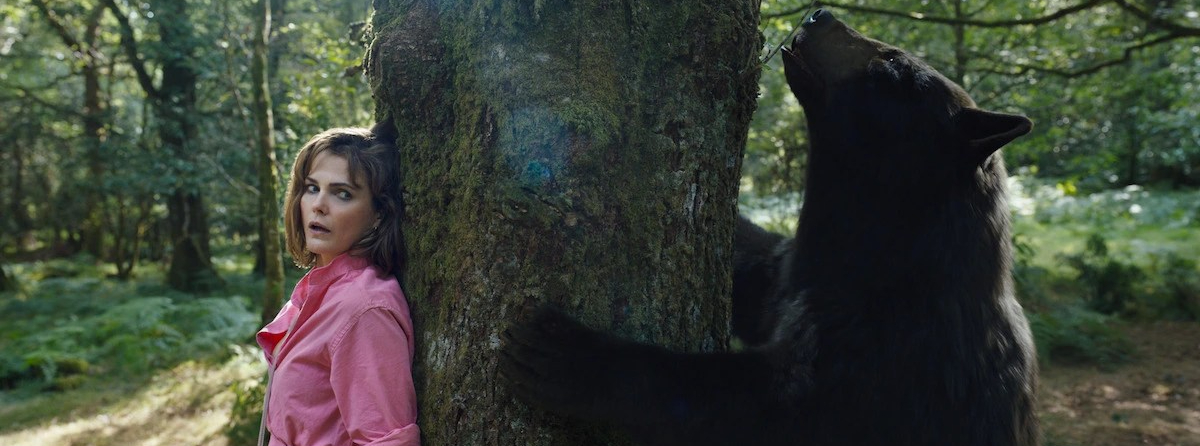
For those going into Cocaine Bear simply for a bear that takes cocaine, and perhaps goes a bit mad afterwards, it’s unlikely that you’ll be disappointed. Yes, it might take some time before things properly kick off, but there is certainly a fair deal of action relating to a cocaine-fuelled bear attacking various groups of people in a forest. It’s the core selling point of the film, and basis, really. It does what it says on the tin, and largely what you would expect. There is a bear on cocaine.

How is this stretched out to 95 minutes? By bringing in different groups of people all trying to escape attacks from said bear as it roams around the forest sniffing out its next brick of white powder. The reason for so much of the drug being there in the first place being a drug drop gone wrong. Thus we see drug dealing gang members Daveed (O’Shea Jackson Jr) and ‘wishing-to-get-out’ Eddie (Alden Ehrenreich) trying to find as many millions of dollars worth of the substance as possible to deliver back to their boss (Ray Liotta). Yet, despite the biggest connection to the central drugs themselves they share the run-time with various other figures from police detectives (Isiah Whitlock Jr) and a mother (Keri Russell) looking for her daughter (Broklynn Prince) and her friend (Christian Convery), amongst others figures who frequent the park.


There’s a lot of characters and for much of the first act the film jumps back and forth between them, building up to them simply getting to the park (conveniently named Blood Mountain) before things kick off. While things pass by relatively fine the film feels as if it knows that you’re waiting for the titular action to the start, however it somewhat draws itself out, not quite gaining the anticipation it may want from the audience. There are various other conflictions of tone throughout, especially when the attacks actually start. It’s uncertain as to whether the ‘horror’ elements – there’s certainly a lot of bloodshed in this film – are being played for a pastiche effect or there’s meant to be a more enjoyable-action nature to things. They may settle down eventually – particularly for the much-advertised ambulance sequence which stands out as one of the highlights of the film – but for the first few stages with the bear the tone never quite feels completely solid.

A bear which may be the central draw, and the reason for the film in the first place – the ‘based on a true story’ marker very much used to ramp up the ridiculousness – but is largely used for the commonality between the different groups we see throughout. The creature travels from location to location, stumbling upon more cocaine, and thus characters, attacking them and moving on. There’s a fair deal of enjoyment to be had with this, and again the film largely delivers on what it promises and should well work for the target audience and those who have simply been looking forward to it, however with the bear seemingly teleporting from place to place for a new sequence and incident things start to feel somewhat drawn out, even at just 95 minutes.

While not overloaded with figures, and easing itself when some come together with little force (e.g. Whitlock’s character comes across the drug gang in a rather amusing set of circumstances) there is a slightly jumpy nature to things as the film tries to live up to itself without allowing the bear to become the main character (the right thing to do with something like this). However, for the most part it works. Cocaine Bear provides enough amusement for the time that it’s on, and from the start recognises its own ridiculousness – it’s a film made because of its ridiculousness and everyone is aware of it. Not very laugh might take off, but there’s a good deal of chaos unfolding to enjoy and have a good time with, especially when things feel more gelled together. There’s a bear. It takes cocaine. It goes mad and tries to kill people. It’s what’s promised, and you can’t really fault it for that.

Cocaine Bear certainly delivers on what its title promises. While it might take a bit of time to get there, with one or two too many characters, there’s a good deal of amusement to be had within the chaos depicted.

Rating: 3 out of 5.

Broker – Review

Release Date – 24th February 2023, Cert – 12, Run-time – 2 hours 9 minutes, Director – Hirokazu Kore-eda

A young mother (Lee Ji-eun) joins the child traffickers (Song Kang-ho, Gang Dong-won) who have taken her baby from a Church baby box, not knowing the police (Bae Doona, Lee Joo-young) are after them.

Broker is a film which integrates the audience into the group of strangers at the heart of it by treating them exactly like a group of strangers. As each figure learns something new about those around them we do too in the exact same moment – this even being the case for those who have a hesitant familiarity with each other. Details and reveals come through in natural conversation to allow for a realistic sensibility to come through which further engages us in the actions of the group.

So-young (Lee Ji-eun) is a young mother who at the start of the film leaves her baby outside a Church’s baby box – however when she comes back for it she discovers that the child has been taken by two child traffickers (Song Kang-ho, Gang Dong-won), also working as laundry-shop workers. Instead of trying to get Woo-sung back she joins the pair travelling across South Korea in a rattling laundry van to try and sell her child – the mother being present might bring about more money, and certainty for the potential buyers. However, while one is aware that he owes a great deal of money no one is aware of the fact that they are being followed by two police detectives (Bae Doona, Lee Joo-young), who only need an exchange of money to make an arrest.


Throughout the road trip each new location offers an opportunity for the characters to open up that little bit more. Becoming more comfortable and aware around each other a real family nature begins to sprout amongst them. As this becomes the case slight humours become more frequent, strengthening the bond between the core figures we see on screen. The more we learn about them, especially in regards to their pasts, the more writer-director Hirokazu Kore-eda unveils a the personal emotions that truly construct the characters.

Of course, once properly placed together and embracing the not-quite-family nature of the ensemble things need to move along and properly move along the narrative. Much of the former takes place while travelling between locations, but eventually the developments need to take prominence. Luckily, such points continue to be well tracked and our connection to those on-screen is used effectively. Just as it seems the film may be drawing itself out it reminds of of just why it’s so great. Allowing the performances and conflicted emotions and aims of those we’ve spent time with so far to continue to be an integral part of the mixture. Reminding us of the internal, personal aspects at play, the ones rarely spoken about yet that we’re fully aware of. Perhaps the best display of this being a ferris wheel scene where the characters have no choice but to talk as they’re confined to an up-close and cramped space.

Broker knows and understands its characters and yet gets to know them more as their journey takes place. Allowing the viewer to connect with them as the strangers gain some sense of familiarity with each other, particularly amongst their various internal emotions. Things are finely held together by the strong performances from the whole cast and Kore-eda who, alongside cinematographer Hong Kyung-pyo, captures the events with a wonderful flare featuring a number of shots truly capturing the extent of the personal feelings being held in the large world surrounding them. We meet these strangers and somewhat get to know them over time, yet the film continues to acknowledge that we don’t entirely know these people – and they don’t entirely know each other either. That’s the real key of Broker and it makes for an engaging, emotional, yet occasionally effectively light, drama.

In Broker we meet a series of strangers and continue to spend time with them as strangers, yet we’re brought in through an ensemble of great performances which convey the personal emotions and pasts which help to construct a family-figure amongst them. All finely captured by Kore-eda, this is a brilliant multi-character drama.

Rating: 5 out of 5.

What’s Love Got To Do With It? – Review

Release Date – 24th February 2023, Cert – 12, Run-time – 1 hour 49 minutes, Director – Shekhar Kapur

A documentary filmmaker (Lily James) follows her best friend (Shazad Latif) as he goes through the process of an assisted marriage.

Perhaps one of the most refreshing things about What’s Love Got To Do With It’s central relationship is that for a fair portion of the run-time the pair simply come across as good friends. Two figures trying to work out, whilst observing each others, their own individual relationships. Whilst Kazim (Shazad Latif) has chosen to go through the process of an assisted marriage, childhood friend and family neighbour Zoe (Lily James) doesn’t seem to be able to properly start one with anyone – she’s either not looking for a relationship, or simply hasn’t found someone she clicks with yet. She’s much more focused on her work as a documentary filmmaker, leading her to observe Kazim’s family as he prepare to get married for her next project – tentatively labelled ‘Love Contractually’.

The central friendship avoids a feeling of light rom-com fluff throughout much of the first half – although there’s not overly anything wrong with light rom-com fluff, of course. It almost brings that bit more access to the pair and their other relationships over the course of the narrative, especially as the film jumps straight into things from the very first scene where Kazim announces his intentions to Zoe in his childhood treehouse. And from here the cross-cultural observations begin.


There’s a slightly conflicted nature to a number of the points and themes which are brought up in various scenes. A number of them feel somewhat base level, not overly developed as things move from one point to the next; or simply don’t dwell on points long enough to properly have an effect. Yet, there’s apparently enough time for Emma Thompson as James’ character’s mum to disperse some light-hearted unintentional racism – gags which never quite sit well, despite the otherwise delight of Thompson’s presence. In general all that’s covered just gives more for the film to wrap up, or at least include in the final stages, meaning that the final half hour feels rather drawn out due to just how much it has to get in – including certain directions and choices which don’t quite feel right considering earlier tones and developments.

It’s been a busy film before this – largely involving Zoe’s dating life, largely told through twists on fairy tales she tells to her friend’s children – but not quite to this degree. There’s enough to like and engage, and a couple of chuckles dotted throughout, but not quite the big cross-cultural rom-com that it perhaps wants to be. The elements are certainly present, but not always with the right amount of detail and focus to properly get them across with a real impact. Making for a handful of drawn out segments which don’t quite click due to everything else that’s already being dealt with within them. The cast are still likable and there’s a similar quality to the film as a whole, avoiding a distance being created between it and the viewer. Not everything quite takes off, and certainly some inclusions – including narrative beats – feel unnecessary, but as a whole there’s a likable enough film here that keeps you engaged throughout the slightly overlong run-time.

While it might not quite strike all the cultural chords it wants to due to everything it wants to pack in there’s a likable film, and cast, within What’s Love Got To Do With It’s slightly lengthy run-time. Keeping you engaged throughout with interest in the central friendship and a handful of chuckles along the way.

Rating: 3 out of 5.

Ant-Man And The Wasp: Quantumania – Review

Cert – 12, Run-time – 2 hours 4 minutes, Director – Peyton Reed

Scott Lang (Paul Rudd) and his family find themselves trapped in the Quantum Realm, however they’re not the only people looking to get back to their universe.

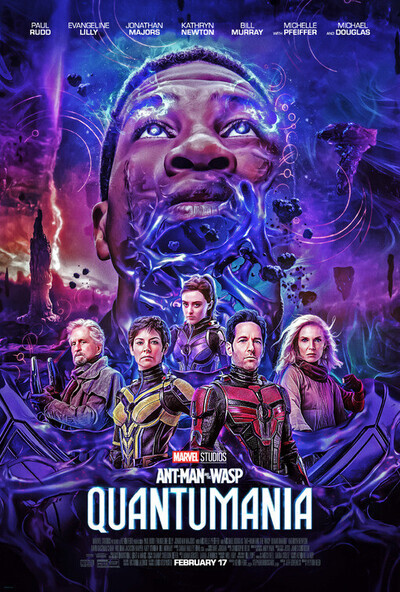
“You’re out of your league, Ant-Man” Jonathan Majors’ Kang tells Paul Rudd’s hero after much build up of the film’s villain. It’s a statement which rings true in a number of ways as the character who has largely led – as even director Peyton Reed has admitted – palate cleansers within the MCU ushers in the fifth phase with a world-expanding venture. We’re far from the world of giant everyday items, instead we’re plunged into the alien-like environment of the Quantum Realm, which Scott and his family are all taken back into after his daughter Cassie (Kathryn Newton) creates a satellite to the invisible universe. Perhaps it’s in part because of this that Lang feels something of a different character compared to his previous appearances. It may occasionally even-out, but there’s often something slightly out-of-place about him here, and not just in terms of him trying to find his way home.

Yet, alongside the Lang-Van Dyne clan Kang is also looking at making his way into their universe. Marvel are clearly building up their next ‘big bad’ quickly. Much of the first half of the film is spent simply talking about him without actually giving away any details. All we hear is about ‘Him’ and occasionally ‘The Conqueror’, it would be nice to actually get some other form of information aside from the fact that everyone is scared of ‘Him’ and Janet Van Dyne (Michelle Pfeiffer) had bad experiences with him for the years she was trapped in the Quantum Realm. In general the build-up of Kang in this particular instalment is just one of a number of drawn out elements and details within the narrative.


Characters are split up and must scour various different poorly green-screened terrains to find each other. All whilst running into the clans and creatures of the Quantum Realm (including Bill Murray, David Dastmalchian, Katy M. O’Brian and William Jackson Harper) – which as a whole feels as if it could be given a boost via some better CG; although it’s not consistently, or even majoritively, poor. Yet, with all that’s going on amongst the constant jumping back and forth between incidents and locations there’s never really anything to properly bring you into the world shown on screen. Yes, it may be watchable, but it never quite feels properly engaging, therefore losing the interest of the viewer overtime as they sit through a selection of scenes constructing the idea of ‘we’ve seen this all before’.

Admittedly, things pick up as everyone begins to come together, and Kang actually shows the threat that he poses not just to the characters in this film but in the future of the wider MCU. It’s fine in the moment and provides amusement, however the feeling still lingers that this is largely a 2-hour long ‘Next time’ trailer for future instalments. Again, one that’s fine to sit and watch, but also one that creates its fair share of frustrations as it almost feels as if the wrong (albeit only) character was picked for the job. One who has changed, alongside the style of the film he leads. The sense of fun isn’t really present here, alongside a reduced number of laughs – and general comedic moments. He’s out of his league, and it shows.

Ant-Man And The Wasp: Quantumania perhaps suffers most from its differences to previous films. The sense of fun isn’t quite present and a familiarity with the narrative provides little to properly engage with. What’s there is fine on a very basic level, but it never truly grabs your attention as it feels the wrong character has been changed to usher in the next phase of the MCU.

Rating: 3 out of 5.

Marcel The Shell With Shoes On – Review

Cert – PG, Run-time – 1 hour 30 minutes, Director – Dean Fleischer Camp

Marcel (Jenny Slate) lives in an Airbnb with his grandmother (Isabella Rossellini), when a documentarian (Dean Fleischer Camp) renting the house makes a film about him, the tiny shell begins to search for his missing family.

“Guess why I smile a lot” says Marcel (Jenny Slate), a tiny shell turning around to the camera operated by the documentarian (Dean Fleischer Camp) who is making a film about him. “Why?”, “Because it’s worth it”. It’s such a small line and yet one of the most wholesome moments of an irresistibly wholesome film. In many ways it sums up the innocent figure of the titular character rather perfectly. He’s fascinated by the giant world around him, living in an Airbnb with his grandmother (Isabella Rossellini), travelling around via tennis ball – although not being able to see whilst driving is an issue. Questions to the meant-to-be-invisible filmmaker are filled with interest as he quizzes the human renting the house as to “have you ever eaten a raspberry? And what was that like?”

Yet, there’s plenty working in the background of Marcel The Shell With Shoes on to push emotion through the wholesomeness. Over time we see the one-eyed mollusc begin to search for his missing family, seemingly taken in the break-up of the original owners of the house. It’s less a plot and more a set of developments over the course of the short 90 minute run-time. Yet, one which holds you firmly in place as you sit and stare at the screen in wonderment, entranced in the story that’s being told. You buy into the mockumentary format, so detailed that you totally buy into the shells and they might as well be real figures in a real documentary.


With all the details that come through in the characters and the various instances we see them in, including in the animation, one thing is made clear and that’s that director Fleischer Camp, alongside co-writers Slate and Nick Paley, has made a film that celebrates the small details. Both within the film and in life. The quiet elements – in what is a very quiet film, although frequently backed by a fantastic score from Disasterpiece which accompanies many scenes perfectly – which connect us more to the characters and help to get across the sentimentality amongst the humorous patches. Simple cuts, edits and glimpses which show the world as it truly may be, or rather against how Marcel sees it. There may be a handful of chuckles along the way, alongside audible exclamations at just how wholesome and innocent the central character, and the film as a whole, is, but there’s certainly a fair deal of unexpected emotion and sentimentality on display too. All gelling together for an even greater overall effect.

Within the first few minutes you’re sat wrapped in the blanket that the film places around you. Utterly entranced by its gentleness and heart as a warm, fond smile appears on your face on multiple occasions. All of this from the heart and mind of a tiny shell with shoes on called Marcel. Yes, he’s thrown into the chaos of the world and we see the worries and stresses that he faces, in many ways it’s what makes his positivity more effective when it’s on display. But, regardless, he’s absolutely sure to be one of the best characters to grace the big screen this year in one of the best films of the year. A stunningly warm slice of wholesome joy. You can’t help by fall for and into it as you’re swept up into believing that the shells on the screen are actually real. A calm stirring of care and emotions, it’s just fantastic.

Perhaps one of the smallest characters we’ll see this year emits one of the biggest hearts, there’s so much to love about the tone and style of Marcel The Shell With Shoes On. A film which celebrates the small, subtle details and makes for what may be the most wholesome film of the year.

Rating: 5 out of 5.

Magic Mike’s Last Dance – Review

Cert – 15, Run-time – 1 hour 52 minutes, Director – Steven Soderbergh

Mike Lane (Channing Tatum) returns to the striptease game to direct and choreograph a stage show for theatre owner Max (Salma Hayek Pinault).

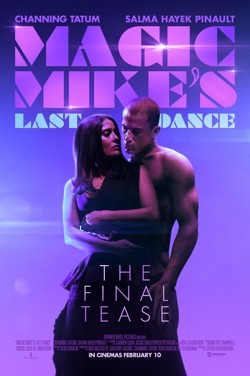
“You’re in another one of your phases, aren’t you?” teenager Zadie (Jemelia George) asks her mother, Maxandra (Salma Hayek Pinault) on meeting her latest inspiration, Mike (Channing Tatum). She’s brought him to London, from Miami, to trade his social-event bartending job for directing and choreographing a production for the stage. Max has been known to run with ideas and overcomplicate them until they implode, often referred to as never getting past the first act themselves. However, Mike is – despite being far from familiar waters – determined to make something good of The Rattigan theatres production of romantic period drama Isabel Ascendant.

How can the material be updated? By adding a few more attractive men dancing and performing stripteases – in typical Magic Mike fashion. Stepping away from the traditional ‘will she marry for love or money?’ narrative and making something more empowering for the largely-female audience. There’s plenty of discussion throughout the film about the development of the play and the disagreements between Mike and Max about the direction in which it’s going. “You wouldn’t say that what we’ve done so far isn’t f*ckin’ special” infuses Mike at one point, a line which would perhaps have more effect if we actually saw more of the developing production.


What we focus on more is the conversations behind it, and the relationship between the two central characters. While the previous two Magic Mike films have been more about the male friendships at the centre of them, this is upfront about the journey of the stage-show – inspired by Magic Mike Live – and the relationship of Mike and Max as they combat the various barriers for them causing the stage production. There’s interest to be found in such moments as the height of the stage only just breaks the law or Max battles with her separated husband (Alan Cox) (or receives wry remarks from her butler, Vincent (Ayub Khan-Din) – a character who steals the show so much you want to see a film just about him).

When there’s a clear direction for the film and its more focused on the way in which the show is being produced that’s where it moves and works best. Generally improving as it goes on and builds things up, particularly as we get to the big dance finale that many will be expecting. There’s less blandness as the film goes on and the camerawork, and editing, during the dance sequences helps to liven things up; used more with each new instance, pushing the closing stages to have more effect. The film generally appears to be one which develops as it progresses, realising its better elements and piecing them together as it takes time to take out the weaker, less-engaging back-and-forths. Making for less fluctuations throughout and a slightly smoother ride overall. It may take some time but as the focus expands and comes together there’s a more likable and engaging piece of work as the film, like Mike, displays its confidence in different ways.

As the fluctuations become less frequent there’s a more enjoyable time to be had with Magic Mike’s Last Dance. Ironing out the creases and more drawn out sequences to make for a smoother, more engaging piece through its collected ideas.

Rating: 3 out of 5.

Puss In Boots: The Last Wish – Review

Cert – PG, Run-time – 1 hour 42 minutes, Directors – Joel Crawford, Juanel Mercado

Down to his last life Puss In Boots (Antonio Banderas) retreats to a quiet life of being a regular cat, unless he can be the first to reach the mythical wishing star to wish for more.

There was something of a worry that the main trailer for Puss In Boots: The Last Wish had shown the majority of content, luckily my mind was very wrong in thinking this as most of what’s shown comes from the opening stages. It might be the fact that I’d seen so much from this that the prologue and build-up for the film felt somewhat drawn out, but luckily it’s not a lasting tone. We see a fearless (and reckless) Puss In Boots (Antonio Banderas) taken down to his last life. He’s told by the doctor (Anthony Mendez) that he should consider taking things easy, and therefore finds himself taking to the downbeat life of a regular cat (now named Pickles) in the quiet, cramped home of Mama Luna (Da’Vine Joy Randolph).

However, on learning of the mythical wishing star Puss jumps back into his life of fights and adventure as he becomes set on wishing for more lives. Yet, as he enters the path that will lead him to the star he discovers that he’s not the only one on the track. He teams up with self-training therapy dog Perrito (Harvey Guillén) and old face Kitty Softpaws (a returning Salma Hayek) to outrun criminal family Goldilocks (Florence Pugh) and the three bears (Ray Winstone, Olivia Colman, Samson Kayo), alongside power-craving Big Jack Horner (John Mulaney) alongside his Bakers Dozen and plethora of magical items. However, perhaps the biggest threat faced by Puss in the constantly changing magical landscape – according to whoever is holding the map to the star – is Death himself (Wagner Moura). Chasing him with an eerie whistle there’s a truly sinister nature to the darkness and threat posed by the character as he stalks the protagonist.


The visual style of the film truly comes to life when he appears, alongside the various fights that take place. Many have cited the potential anime inspirations, which are notable, within the explosions of rushing colour and the ways in which the battles are depicted. They bring an engaging energy to certain sequences and allow them to burst through the screen, further catching your attention. As do the ways in which the landscapes, and the elements within them, we see throughout the predominant chase/ race element of the film – which once started is where things truly start to move – capture your interest through their general design and style. The ways in which they change and create obstacles for the characters whilst never feeling like they just happen for the sake of narrative convenience or to add to the run-time

In relation to this, the fairy tale and nursey rhyme elements and references feel much more lived in this time around than in the previous Puss In Boots film (released 12 years ago now). They’re played around with more and allowed to feel more a part of the world, even if just for a point of effective humour. Including an occasional patch of successful self-awareness; Jack Horner’s backstory relates to the fact that his nursey rhyme was never as successful as other attractions – such as Pinocchio – and in general was quite naff and not as memorable. It’s a potentially small detail within the rest of the film but works rather well and simply adds more to keep you amused as things pan out. It’s the detail within the world/s which keeps you engaged and entertained, in this case it’s a rather good thing as these are such big parts of the film and the narrative which takes place an unfolds in a truly entertaining fashion – also managing to not jump back and forth too much between different characters in different locations.

As a whole there’s plenty of visual creativity on display to help liven up the film with its already successful humour and narrative. There’s an energy to it that helps to lift the fantastical elements in both light and dark realms. Allowing them to work together and all feel a part of the same piece. All held in through the pacing and the ways in which the narrative is kept moving along largely thanks to just how much detail there is in the various areas of the film.

Once past the prologue and build-up there’s a fine pacing to Puss In Boots: The Last Wish as its world truly feels lived in to allow for the visual energy to match that of the narrative and the well-used, amusing fairy tale elements which crop up throughout.

Rating: 4 out of 5.

Knock At The Cabin – Review

Cert – 15, Run-time – 1 hour 40 minutes, Director – M. Night Shyamalan

A family (Jonathan Groff, Ben Aldridge, Kristen Cui) find themselves held hostage in a holiday cabin, with four strangers (Dave Bautista, Nikki Amuka-Bird, Abby Quinn, Rupert Grint) telling them that they must choose one to kill to stop the apocalypse.

With his last couple of films M. Night Shyamalan has made some films with undoubtedly interesting ideas. They start off rather well, however over time somewhat become lost within themselves, focusing on concept over narrative and while there’s a decent film overall it’s not quite been anything great. Knock At The Cabin is another case of this, although perhaps the best of recent features such as Old and Glass.

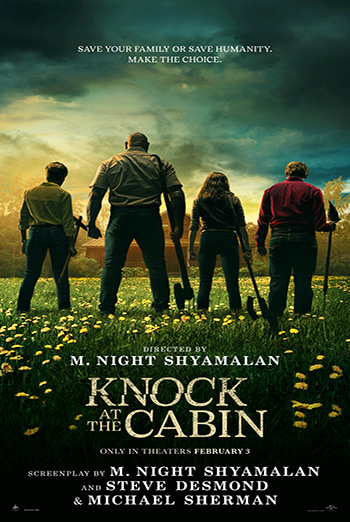
The film starts off with a highly suspenseful nature as fathers Eric (Jonathan Groff) and Andrew (Ben Aldridge) find themselves tied up and held captive in their rented holiday cabin by four strangers (Dave Bautista, Nikki Amuka-Bird, Abby Quinn, Rupert Grint). Alongside adopted daughter Wen (a standout performance from child actor Kristen Cui) they’re told by the home-invaders that they must choose to kill one member of their family to avert the apocalypse, however the family must make the sacrifice themselves. There’s an almost instant eeriness which lingers and adds to the overall tense nature that the opening stages have. Before we even know why these strangers are here and want to be let in Bautista nails the man-with-a-reluctant-mission role when lightly talking to Cui outside the cabin, alone.


The tension is consistent throughout much of this build-up, and indeed the first act as a whole. Where it begins to dip is as we cutaway to Eric and Andrew’s past. While such moments are very brief you do sometimes question their inclusion, largely due to the fact that they break up the pace somewhat and once back in the cabin things don’t quite go back to the same level as before. It’s almost as if the film settles into itself and begins to move along from there. It’s still good and watchable and there are some interesting ideas, but it lacks the same punch and style as was there at the start. Eventually settling more into this feeling with each new flashback.

There’s certainly a fair deal of development and bursts of action here and there as the couple try to reason with those who claim visions have brought them on this mission to this highly remote location yet as the stakes appear to rise the less the film seems to ask. Generally it keeps the same question – is what these people are saying true? – and while there’s nothing bad about this it never quite expands upon it or dives into it apart from, again, in various bursts that we see through news broadcasts on the TV. The different responses from the pair – particularly Aldridge – create some interest and further help to keep you engaged in the way that things eventually pan out, especially when more movement is involved, but again it ends up feeling settled within itself and focusing more on the themes and ideas than the narrative as a whole.

The film is stopped from rising as much as it could, and having the effect that it once had and could have continued to have. There may still be interest to be found within what is there, especially when things feel as if they truly move and start to develop and change up a bit. But overall it feels too settled within itself to properly run with this feeling and allow for the strong levels of eeriness and suspense felt in the opening stages of the film to run throughout. You’re able to watch the film fine, and it still works and moves along fairly well, you just wish that it did it with a bit more push.

While it starts off with plenty of suspense Knock At The Cabin eventually settles into itself and with each cutaway or flashback it seems to loose itself within its ideas instead of the developing narrative making for something watchable but less involving.

Rating: 3 out of 5.