Asteroid City – Review

Cert – 12, Run-time – 1 hour 45 minutes, Director – Wes Anderson

The story of a play about a group of strangers quarantined in a small desert town after an alien encounter.

There’s been plenty of internet discussion around Wes Anderson in the last few months from TikTok trends to AI created trailers for ‘Star Wars if it were directed by Wes Anderson’. Some claim this has diminished the writer-director’s work showing that anyone can make one of his films. Yet, as Anderson opens up the first layer story of his latest film he demonstrates just why this isn’t the case, not just with him but for cinema and the creative arts as a whole. Television host Bryan Cranston details that we’re about to see a televised production of Conrad Earp’s (Edward Norton) stageplay Asteroid City, with details on the creation of the production scattered throughout. The ode to the creative process is passionate and caring and continues to show Anderson’s love of stories and storytelling.

His empathy shows, with particular emotional disconnect, to allow for feelings to be improperly shown. The characters within the play especially are unsure of how to express their true feelings, leading to a confused state of emotions, as if being experienced for the first time. Yet, with how much is going on within the film – a grieving father (Jason Schwartzman) telling his children they’re mother has passed away and them coping with the loss, an actress (Scarlett Johansson) wishing for more comedic roles yet constantly playing tragic alcoholic drug addicts, teenagers trying to work out their place in the universe – the emotional disconnect hinders a number of the themes. You can’t help but feel that there would be more effect during such moments of drama if there was more emotional expression and connection from and to the characters.


Even in regards to the central idea of a group of strangers trapped in a small quarantined desert town after a brief alien encounter. The surrounding environment is plainly laid out with some truly excellent production design, creating room for the camera and cinema audience while also reminding of the story-within-a-story nature and the fact that this is meant to be a play. The town, and indeed its temporary inhabitants, joined for the stargazer and space cadet camp, provide plenty of amusement against the backdrop of the circumstances. Plenty of traditional dead-pan Anderson chuckles are dotted throughout, alongside one or two slightly absurdist elements to provide some surprise.

However, while the core arc is engaging and provides good amusement perhaps the best moments lie in the black and white depiction of the play’s creation and performances. Somewhat breaking the barrier showing different angles of figures trying to find meaning within their life and work. It’s an interesting enhancement which works and helps to push the themes with a more engaging angle – particularly in the third act as the film develops and rebuilds some elements from the second act; more focused on the uncertainties of character emotions and reactions. Building back up it stops the viewer from disengaging and provides enough impact in each moment to make the themes and previous thoughts of those on-screen worthwhile.

When asked what his play is about Conrad Earp responds “it’s about infinity, and I don’t know what else”. Indeed Anderson’s film deals with a small group of characters struggling with the idea of infinity, how that places them now compared to how they were placed beforehand in perhaps already struggling lives. Some of this largely comes to the fore, or at least is only realised as at the fore, in the closing stages of the film – perhaps making for an interesting rewatch – yet it certainly leaves a good deal to reflect on in terms of the characters in Asteroid City itself and the effects a very brief alien encounter have on them. Not all may resonate due to Anderson’s emotional disconnect, but there’s still enough to create an interesting film which leaves plenty to think about, dwell on and grow on you, perhaps.

While the personal emotional strands of Asteroid City could do with more open expression from the characters there’s a good deal of interest within the themes brought to the fore in the third act and how they reflect on the humorous, finely-designed film beforehand.

Rating: 4 out of 5.

No Hard Feelings – Review

Cert – 15, Run-time – 1 hour 43 minutes, Director – Gene Stupnitsky

Desperate to not lose her summer Uber income 32-year-old Maddie (Jennifer Lawrence) takes a job to ‘date’ a 19-year-old (Andrew Barth Feldman) and bring him out of his shell before college in order to get a new car.

No Hard Feelings has been billed by some as bringing back the raunchy R-rated summer studio sex comedy. However, what it doesn’t seem to recognise is the fact that this subgenre seemed to fade away largely because such films often felt quite repetitive. That’s somewhat the case here with an added layer of discomfort as 32-year-old Maddie (Jennifer Lawrence) attempts to ‘seduce’ 19-year-old Percy (Andrew Barth Feldman) in order to bring him out of his shell before college.

For Maddie it’s all about getting a car offered by Percy’s parents (Laura Benanti and Matthew Broderick) in exchange for her ‘dating’ their son – she’s desperate to get the summer Uber money from tourists visiting the seaside town where she lives however her own call has been towed due to being behind on rent payments. For Percy he genuinely thinks someone is interested in him. You can’t help but feel sorry for him at times as Lawrence’s character simply seems so annoyed that he won’t have sex with her and keeps rejecting her advances – starting off by unwillingly taking him to her house within half an hour of first meeting.


As the pair get to know each other over the ensuing days Maddie’s attitude may somewhat change but there’s still a slightly uncomfortable nature to a number of her actions. Later developments from around the halfway point when the film realises it needs to rectify this behaviour never quite feel as if they justify what has come beforehand leading to a somewhat lacklustre feel, even more so when paired with little-seen strands such as barely touched suggestions of Maddie’s struggles to commit in previous relationships. Eventually much of the film feels as if it’s trying to rectify and redeem itself from the tone and nature of the first half instead of properly moving things along.

In a number of ways it feels like the central character herself. While clearly putting on a different personality around Percy in order to achieve her goal of making him a man as quick as possible there are a handful of other points where Lawrence appears to be playing a different personality and not in the way the character or film intends. It leads to some odd points where her character’s intentions and mindset don’t quite seem to match what’s come before, or at least aren’t entirely clear – especially standing aside from her general development over the course of the narrative.

While still remembering to bring in some laughs very few of the gags within No Hard Feelings actually take off. Despite how clearly the film has gone for the R rating from the off the best gags are the much simpler ones leaning away from the raunchy nature. The brief lines of dialogue which are inserted into a moment and then moved on from. However, there’s few of these in the largely unamusing 103-minute run-time. The film is so intent on being a big, brash sex comedy that it suddenly realises that it might need to redeem its main character and in a rush to do so begins to lose itself in crossed developments while still continuing with the same, lacking, style of humour.

There’s a tangled nature to No Hard Feelings as it clambers to redeem its central character, and uncomfortable nature, through multiple barely touched details while still continuing its brash sex comedy humour, only really gaining laughs with much simpler gags.

Rating: 2 out of 5.

Mark Cosgrove ‘Cinema Rediscovered’ 2023 Interview

Founder of Cinema Rediscovered film festival Mark Cosgrove joins me to discuss this year’s edition of the festival, being held across Bristol from 26th-30th July. Throughout the interview we talk about capturing modern attitudes in a repertory festival, the role independent cinemas play in delivering films and, of course, the events which makes up this year’s festival.

To find out more about this year’s Cinema Rediscovered, and buy passes and tickets, you can do so via the Watershed website. If you would like more from Mark you can find him on Twitter.

To listen to Mark’s song requests you can hear them by following the links below:
Everybody’s Talkin’ – Harry Nilsson
Suicide Is Painless – Johnny Mandel
Time Is Tight – Booker T. And The M.G.’s

Greatest Days – Review

Cert – 12, Run-time – 1 hour 52 minutes, Director – Coky Giedroyc

Four friends (Aisling Bea, Jayde Adams, Amaka Okafor, Alice Lowe) reunite after 25 years apart to attend a concert of their favourite boy group from their teenage years, however rifts of their pasts are still present

Both Mamma Mia films so far undoubtedly get a good deal of their energy from the crowbarring of ABBA songs into the plot. There’s a slight joy in seeing just what the next song will be, and how it’s going to be worked in to the moment, with the entire cast clearly having a ball. The songs may only have slight relevance to the moment, but more often than not we run with it. As a jukebox musical of Take That songs the same cannot be said for Greatest Days where perhaps one word of certain songs feels lazily crammed in to certain scenes. There may be more but the lack of energy with which some musical numbers are delivered with simply leads to a lack of interest.

As our four central characters (Aisling Bea, Jayde Adams, Amaka Okafor, Alice Lowe) reunite after 25 years ready to fly in glamorous style the boarding area is filled with dancers. The group are about to jet off to see their favourite boy group from their teenage years in Athens after Rachel (Bea) has won an extremely unrealistic prize for a (presumably) community radio station to be giving away. Champagne flows in their minds as the pilot in a sparkly hat and jacket, making him look like the Megabus man dunked in sequins, sings about how their time is coming “don’t be late (hey hey)”. That’s right, for them the whole world is going to shine. Unless it’s in this musical number set against the backdrop of an easyJet plane. The whole sequence is so lacking and tacky that it could genuinely be an advert for the company.


Songs are forced in with little relevance with each one becoming more and more tiring. There’s certainly a narrative here but not one that truly grips you. When we get close to properly engaging – one particular moment towards the closing stages involving Rachel looking back on her childhood comes to mind – the film starts back up with a song, even if just one line, to knock what it’s built up back down again. While some of the renditions are fine others feel strange and almost otherworldly. As Greatest Day itself is drawn out it seems that most of the Greek residents performing it line by line can’t quite sing – some of the few figures seemingly not assisted by autotune – although themselves seem to question in the moment the relevance of some of the lines aside from the actual point of it possibly being the greatest day of the character’s lives. In general songs simply feel used to lengthen scenes and base ideas before moving on to the next point.

When drama finally properly comes in after exploring the teenage connection with ‘The Boys’ in various flashbacks it all feels a bit late. Arguments seem to come from nowhere – aside from some early hesitation and estrangement before the partying begins – just at the point where all care for what’s happening seems to have disappeared. Things don’t quite become frustrating – although I did raise an eyebrow at a handful of details throughout, such as the group taking selfies by a fountain with the phone screen off, or simply sighing when the point of certain songs is revealed – they just never quite feel carved out, or joyful, enough to truly engage and bring you in to the story which is attempting to slowly unfold.

Writer Tim Finch, creator of stage musical The Band on which the film is inspired by, appears to want to focus on the core narrative of the quartet of distant friends reuniting. However, the film appears to want to focus on the music of Take That without ever quite getting the right tone. Neither celebrating it or getting caught up in it – the people who seem to love it the most are the sixteen-year-old versions of the central figures, so in love with the group that they want to have their “sweat baby”. In the end it feels as if hopes and intentions are tangled up and the final piece isn’t quite sure what it wants to be, or who it’s meant to be for.

The more Greatest Days goes on the more it loses its shine. Tangled focuses on narrative or music create a clash with the flood of songs never quite seeming to fit the moment, and the film needing more patience before jumping into the next underwhelming number.

Rating: 2 out of 5.

The Flash – Review

Cert – 12, Run-time – 2 hours 25 minutes, Director – Andy Muschietti

In an attempt to change his past Barry Allen (Ezra Miller) finds himself crashing into an alternate universe with no superhumans, trying to save the world of multiple timelines.

The journey to the big screen for The Flash has been a long one. Through various iterations of development hell the flashpoint story has been rumoured to have been worked on to lead to resets into various iterations of new DC universes. And indeed one of the big selling points for the film has been just who pops up in the different timeline which Ezra Miller’s Barry Allen crashes into. DC universes and characters of the past collide in a film which, if its production/s and build-up were anything to go by, could so easily have been a mess.

Luckily, there’s a solid enough piece of work present. Yes, it may be too long – you start to feel the run-time at about the half-way point with various scenes or moments which could be shortened or skipped past – but at least your attention is generally held for the most part as Barry tries to save not just the alternate world he finds himself stuck in but multiple others as a timeline without superhumans finds itself under attack from General Zod (Michael Shannon), searching for Earth’s hidden Kryptonian – Sasha Calle’s Supergirl.


His parents may both be alive in this universe, the film opens with patches of exposition explaining Barry’s mother (Maribel Verdú) was killed when he was a child with his father (Ron Livingston) wrongfully accused of the murder. However, the family reunion is short-lived when an alternate un-powered 2013-Barry (also Miller) turns up. One thing leads to another and soon both are teaming up with Bruce Wayne (Michael Keaton) to save the world. There are various criss-crossing moments within the drawn-out narrative, largely simply to explain the next steps and where things are going to go from x-point, but for the most part it’s easy enough to follow, and not think about it too much. Certain patches may feel like they’ve come from an origin film of years gone by, but there’s still enough to like and be amused by within what’s present to help things pass by.

Perhaps not the attempts at humour which frequently never quite land, although manage to avoid a groan or eye-roll, but in general the more relaxed nature in which the film seems to go about itself. There’s an air of seriousness about it but not an intense one to drown out any colour or thrills. The action may be dampened by heavy amounts of dodgy CG making certain events look like they’ve been taken out of a mid-2000s video game cutscene – especially during the lengthy third act – but as the film goes on it generally manages to improve from the early stages where tonal confusion runs rampant. As the titular hero runs up a collapsing hospital saving falling babies the music suggests everything is very serious, but the visuals – including one of the newborns being put inside a microwave to protect it – lean towards a more comedic intention.

There are plenty of bumps throughout The Flash’s lengthy run-time yet it’s held down by its lighter nature. Occasionally this might bring about some of the rougher patches, but Andy Muschietti’s direction manages to keep you engaged in the winding events through the lack of grit and seriousness which the film is told through. There’s uneven terrain, but generally the film runs across it with enough pace to get through it fine.

The run-time may not provide a short run and there are a handful of visual and stylistic bumps along the way, but The Flash’s lighter and generally engaging nature brings you in after taking some time to dust away initial uncertainties

Rating: 3 out of 5.

Chevalier – Review

Cert – 12, Run-time – 1 hour 48 minutes, Director – Stephen Williams

Set on leading the Paris Opera Chevalier Joseph Bologne (Kelvin Harrison Jr.) finds himself in a contest to put together the best opera, however as talk of revolution rises in France his race and background are further discriminated against by his high-society peers.

Perhaps it’s down to my ignorance (I used to play percussion and would quite like to know how to play the banjo, and maybe the steel pan drums) but I never knew the violin could be so exciting. Yet, there’s a captivating nature to the musical duel between Chevalier Joseph Bologne (Kelvin Harrison Jr.) and the man he shows up in the middle of a concert, a praised foreigner called Wolfgang Amadeus Mozart (Joseph Prowen). Unknown to Mozart the Chevalier is a highly praised figure in Paris, known for his musical compositions, fencing skills and friendship with Queen Marie Antoinette (Lucy Boynton); and he’s certainly aware of his own talents. So much so that he’s determined to take over as leader of the Paris Opera.

However, it’s a highly sought after title, leading to a contest, suggested by Antoinette, to see who can produce the best opera, whoever succeeds claims the role. Yet, making the best opera possible isn’t the only thing that stands in the Chevalier’s way. As talk of revolution rises in the streets of France he finds that his race and background, not just as an illegitimate child, are frequently being brought up by his high-society peers. Despite his title has he ever truly been viewed as an equal in this society?


The core creation of the opera – which includes the Bologne’s affair with his lead actress Marie-Josephine (Samara Weaving), married to the famously ruthless Marquis de Montalembert (Marton Csokas) who forbids her from performing – makes for an admittedly conventional arc, however it’s surprising just how much you don’t notice it thanks to your engagement with the film. Perhaps it’s down to the attention to detail in the visual nature of the piece – the costume design is certainly one of the most striking elements of this period drama.

Elements such as the revolution or the protagonist’s mother (Ronke Adekoluejo) – now free from her son’s slaveowner father – residing in his home, offering occasional words of wisdom guiding her son to realise who he truly is are occasionally brought into the mix but only for a brief burst every now and then. While not quite disturbing the flow these points do create an occasional bump of cliché when brought back without bringing much more detail with them.

It’s in the final half an hour where such points are truly brought to the fore. This also happens to be when the convention is much more noticeable. There’s still a good film here, helped by the tone of the drama and the solid performances throughout – particularly Harrison Jr, Weaving and Boynton – it’s just more noticeably familiar with the elements that it switches to. During one sequence it almost feels as if you’re watching a different film due to a strong tonal change, almost exclusively for this one scene. It may be understandable in the moment but it still feels odd. Yet, there’s still an engaging piece of work to be found, although more so in the first hour where the core of the work and narrative appears to be held. Helped by the fact the film deals with what it claims is a little-known story without seeming to boast about it or treat everything with a sense of shaded mystery.

While it may tip into cliché there’s an engaging nature to the core of Chevalier’s narrative which, alongside Kelvin Harrison Jr’s lightly charming central performance, brings you in to the visually detailed world for most of the run-time.

Rating: 4 out of 5.

Transformers: Rise Of The Beasts – Review

Cert – 12, Run-time – 2 hours 7 minutes, Director – Steven Caple Jr

To stop planet-eating Unicron (Colman Domingo) from destroying Earth the Autobots must team up with humans and Maximals to stop his servants from obtaining an ancient artefact which can open portals through space and time.

There’s a point midway through Transformers: Rise Of The Beasts where a giant robot falcon from space called Airazor details with great seriousness, in the voice of Michelle Yeoh, the feud between the Autobots, Maximals and Teracons in relation to the transwarp key. It’s a moment which almost leads to a humoured response simply due to how seriously it seems to be taken. Certainly in comparison to the lighter tones of what has come beforehand, particularly in regards to the Transformers franchise as a whole. In general this is a film that understands that these a giant transforming robots and, particularly in the first half, runs with it – largely by focusing more on the human characters.

Noah (Anthony Ramos) and Elena (Dominique Fishback) are the core engagement of the film and make for the most interesting perspectives, even during the big action sequences, although eventually melding with the Autobots and co in the end. They meet when Noah breaks into the museum Elena interns at when looking for an artefact to help his recently-discovered aliens stop planet-eater Unicron (Colman Domingo) from destroying the Earth, and opening portals through space and time to do the same to other planets, including the Autobots home world Cybertron. Yet, fuelled by the dark energy of their master Unicron’s towering servants – led by Peter Dinklage’s Scourge – seem like an unstoppable force, no matter how much planning and knowledge is on the protagonists side.


While as the film goes on the human and robot perspectives combine somewhat more, especially during the action sequences which get better as things progress, it remains the case that the most believable elements lie with Elena and Noah. Even as things explode and clang in front or behind them they prove to best get what’s going on across – best shown in a brief shot of them ducking for cover compared to the blasters and fire of the rest of the scene. While not entirely bland or confusing – Steven Caple Jr is in the director’s chair for this particular entry instead of Michael Bay – you occasionally wish the film would call back to that feeling of remembering the base of these characters. They started from toys after all. Certainly a globetrotting element and sense of narrative through-line helps with this, particularly when in a race to reach the hidden transwarp key before the Teracons.

Things are direct and easy enough to follow and overall there’s a likable piece of work here. With plenty of focus on the human figures who make for the stronger segments of the film, and strengthening action along the way it works best with lighter moments which feel more of a family-friendly feature. Elements of a more fantastical PG, although the film is a mild 12, certainly without the grit and grimness (of various kinds) of the other main features in this franchise, it’s definitely more towards Bumblebee territory; even with its 90s setting (let’s not worry about the timeline now). Certainly not perfect, but for the time its on there’s plenty to be caught up in and amused by, largely thanks to the adventure elements within the narrative. Following the characters in search of that key item. It works rather well and while there might be some bumps along the way there’s an overall decent arc here.

Transformers: Rise Of The Beasts is best when focusing on its human characters rather than the titular robots, luckily it uses them quite often. There’s an enjoyable nature to the lighter adventure and fantasy-like elements which helps move on from the occasionally bumpy action. Overall it’s rather likable.

Rating: 3 out of 5.

Spider-Man: Across The Spider-Verse – Review

Cert – PG, Run-time – 2 hours 20 minutes, Directors – Joaquim Dos Santos, Kemp Powers, Justin K. Thompson

When a new villain (Jason Schwartzman) intent on taking down Miles Morales (Shameik Moore) travels across the multiverse to grow his powers thousands of Spider-Men are at risk of having their canon and worlds destroyed

Amongst various other elements one of the many reasons for which 2018’s Spider-Man: Into The Spider-Verse received praise was its visuals. One things that’s clear from the very beginning of sequel Across The Spider-Verse is the even more stylised nature of the animation. Different styles crop up throughout as we meet different variants of Spider-Man from across the endless universes and each one fits right into the piece and simply allows for an overall stronger visual flare, and there are some truly stunning (and fun) shots in this film. The sequel was delayed a handful of times during production for reasons of the pandemic and just to give it more time. The extra time was worth it as not only are the visuals great but the story flows effectively from one development to the next.

The flow best comes across in the extended action sequences where it’s clear that the creatives know how best to move things along and keep track of them in the moment through both the storytelling and animation. It helps to move the overall story along as Miles Morales (Shameik Moore) finds himself thrown in and out of different universes in an attempt to track down The Spot (Jason Schwartzman – having increasing fun with the character the more the film goes on). After being labelled as a simple ‘villain of the week’ the ‘nemesis’ in question truly begins to gain the label of an unstoppable threat as he grows power from the different spider-universes intent on taking down Morales and his family.


However, as Miles tries to chase him down and stop him, with familiar faces such as Hailee Steinfeld’s Spider-Gwen by his side, it’s him who comes under even greater threat as he risks breaking the canon, the key events of each Spider-variants life, which holds each universe together. The figure monitoring everything and making sure all stays in order? Spider-Man 2099, AKA Miguel O’Hara (Oscar Isaac). A looming figure with seeming little trust for most new figures he meets as he tries to ensure that what needs to happen in each world happens. He contrasts to the much brighter, far less threatening, figures we meet across the way, especially the likes of Pavitr Prabhakar AKA Spider-Man India (Karan Soni) and Spider-Punk (Daniel Kaluuya).

With a number of the variants, particularly when all roaming around together in one world where there are plenty of references, jokes and cameos to delight in, there are a number of laughs to be found. Amongst the action which takes place, and the tension which arises, this is a very funny film almost from start to finish. Finding the right balance with everything that goes on over the course of the relatively tight 2 hour and 20 minute run-time. With so much going on there’s a well-tracked nature which keeps you engaged and generally avoids dropping for the most part, only seeming to take a slight second after the big action sequences before getting back into the swing of things. Plus, it gets out just as it borders on feeling a little too long.

There’s a strong feeling that Across The Spider-Verse may even strike better on a re-watch. However, for a first viewing there’s plenty to enjoy within what is an excellent piece of work. You can see the time and effort which has gone into making both the visual story and that taken upon by the characters and it all draws you in and keeps you in place throughout.

Overflowing with visual style and an equally strong narrative flow. especially during action sequences, there’s a lot to like about the developments and storytelling within Spider-Man: Across The Spider-Verse. An overall excellent piece of work.

Rating: 4 out of 5.

The Boogeyman – Review

Cert – 15, Run-time – 1 hour 39 minutes, Director – Rob Savage

After a visit from a new client (David Dastmalchian) a grieving therapist (Chris Messina) and his two daughters (Sophie Thatcher, Vivien Lyra Blair) find themselves haunted by a creature which lurks in the dark

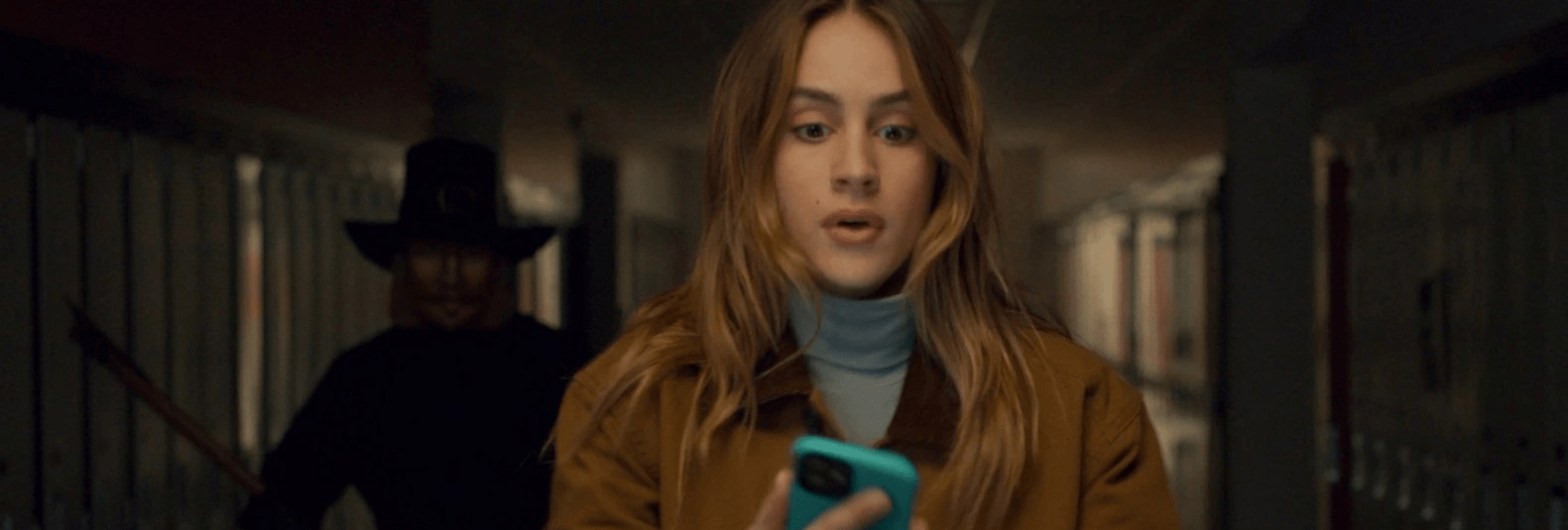
After Host and Dashcam I was very much prepared to consider myself as a fan of Rob Savage and his works of tension building. With The Boogeyman preparedness is removed as I’d happily label myself a fan. The director’s first studio venture certainly has the markings of a studio horror piece in being more direct with its elements of convention than the former two titles, however this largely comes in the presence of one character. The character who often crops up in Stephen King adaptations, this particular one taken from the short story of the same name, to explain what’s going on and give warning to the protagonist.

Yet, there’s a fair deal of time spent building up the tension before this. Savage solidifies that he’s an excellent suspense-builder with the smallest of details. Bringing you in to the moment to feel the fear of those on-screen – primarily sisters Sadie (Sophie Thatcher) and Sawyer (Vivien Lyra Blair). Much of this assisted by the quiet and lingering nature of Patrick Jonsson’s score which emphasises the tension of the moment, the uncertainty and realisation of just how little is known about the unnamed creature which appears to be living in the darkness.


A refreshingly little amount of information is given for a studio horror of this nature. All we get is what we need to get the gist of the story. A new client (David Dastmalchian) to Sadie and Sawyer’s therapist father (Chris Messina) appears to bring with him a demon which lurks anywhere light doesn’t touch, attacking anyone in the darkness of the family home, still holding many shaded memories of their recently-passed mother. It’s effectively enough to build-up the story and ideas being played with and allow for the scares to come through in a number of scenes. They arrive early in the moment and continue to build-up there lasting until the cut to the new location or sequence.

This even being the case after the, luckily brief, moments of convention which themselves have good points about them and some good horror within. Perhaps it comes down to the central performances which effectively capture the family throughout, alongside a number of the ideas which crop up every now and then – one highlight includes a character lighting up a room with blasts from a spell in a video game. Things move along easily and quickly and make for an engaging piece of work with plenty of moments of suspense to keep the fear factor in place. Even with work he hasn’t co-written (Gemma Hurley and Jed Shepherd are also not present here as Mark Heyman adapts previous drafts written by also-credited duo Scott Beck and Bryan Woods) Savage manages to focus on the small details and recognise that suspense and what’s not to be trusted lies in the background, or does it?

While it may stray into occasional brief patches of convention The Boogeyman is an effective studio debut for director Rob Savage who, with a strong cast – particularly Thatcher and Blair – manages to create plenty of moments of suspense with little build-up and detail.

Rating: 4 out of 5.

The Little Mermaid – Review

Cert – PG, Run-time – 2 hours 15 minutes, Director – Rob Marshall

Mermaid Ariel (Halle Bailey) makes a deal with a sea witch (Melissa McCarthy) to grow legs to explore the sea world, however if she doesn’t obtain true love’s kiss in three days the deal becomes a curse.

I’ve said many times that I try to go into every film with an open mind, however going into Disney’s latest reimagining I must admit to having felt a bit of scepticism. Perhaps because of the announcement of a Moana remake not even ten years after the original film was released, or the fact that since 2019’s take on The Lion King these live-action takes have felt, while generally fine, somewhat subpar. The Little Mermaid itself suffers slightly from similar points to The Lion King in that the bright, colourful worlds created don’t always translate to the screen. In particular I Just Can’t Wait To Be King fell flat due to the fact that the characters simply ran across a watering hole for three minutes.

While there’s less photorealism on display and a bit more chance for fantasy to play in, and indeed the songs themselves work with good performances given, there are some restrictions from the live-action nature. Yet, the performances of the likes of Under The Sea and Poor Unfortunate Souls – both of which show the money Disney has thrown at this film with a heavy amount of CG; not necessarily a bad thing and indeed helping to show that imagination and creativity is on display – are enough to lift things up, and the visuals manage to not fall entirely flat helping to pull things through.


It’s the songs which feel like the necessary elements from Disney for this particular remake. And while the film still follows the same general narrative, albeit with one or two changes, the rest of it certainly feels like a reimagining, you can tell there was some thought as to how this could be made different, and much of this arrives in the second half once mermaid Ariel (Halle Bailey – who eases you into the film and settles any worries with her performances of Part Of Your World around 20 minutes in) has arrived on the land with her newly obtained legs.

There’s plenty to enjoy and be entertained by as director Rob Marshall explores the island Ariel almost washes up on, particularly a market sequence which evolves into a dance scene. However, while enjoying all the surface world has to offer crustacean Sebastian (Daveed Diggs), fish-friend Flounder (Jacob Tremblay) and gannet Scuttle (Awkwafina) must keep her on track to obtain true love’s kiss in three days or else she returns to being a mermaid, and becomes the property of sea witch Ursula (Melissa McCarthy – effectively channelling Pat Carroll whilst doing enough to give her own spin on the villain). The man she’s already formed a connection with after saving his life at sea? Jonah Hauer-King’s Prince Eric – a character who now with his own autotuned song truly demonstrates the music-video nature of some of the songs.

The more the film goes on the more you ease into it and enjoy it. There’s a character to it that, yes, sticks to the Disney mould but manages to differentiate it from the original and just about earns the label of reimagining. At over two hours the run-time may be a bit on the long side, with certain elements from the largely-underwater first half perhaps in need of some trimming, but as a whole things pass by relatively well with plenty to enjoy. Including some effective darkness in the closing stages which brings to mind the kind which was present in some of the older Disney animations (even pre the ’89 adaptation of the story). There may be elements of the live-action format which hold the film back slightly, largely during musical numbers which are lifted by the performances (and, let’s be honest, it’s hard to beat that original soundtrack) but overall there’s an enjoyable nature to this take on The Little Mermaid.

A reimagining with both an entertainment factor and some new ideas there’s a good deal to entertain and carry you through the run-time in this take on The Little Mermaid. Some of the songs may be restricted by the visuals, but there’s still a push from the performances and a spark of creativity every now and then.

Rating: 4 out of 5.