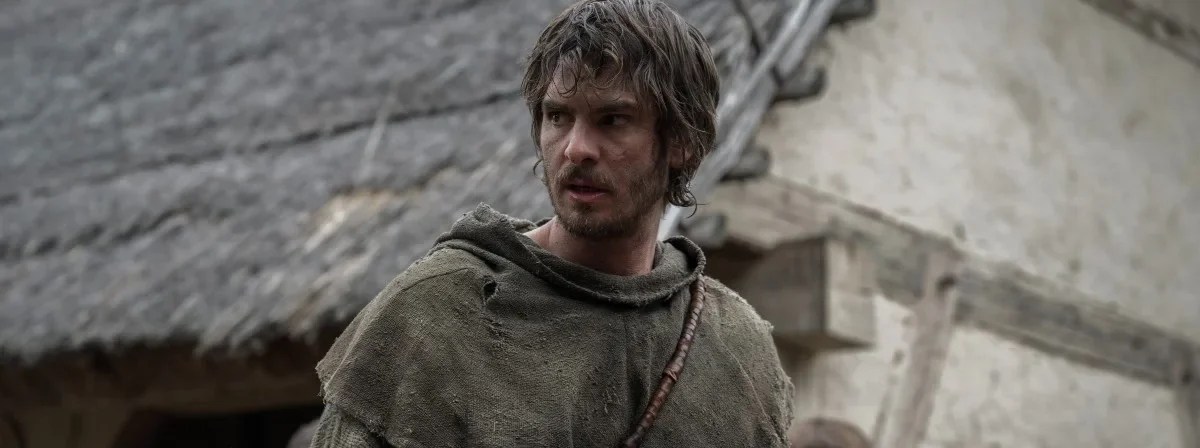
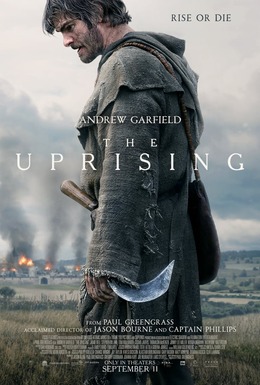
Cert – 15, Run-time – 2 hours 8 minutes, Director – Paul Greengrass
England, 1381, a farmer known only as Ploughman (Andrew Garfield) leads a rebellion against Richard II’s (Woody Norman) raising of taxes on the poor after the Black Death.
There’s a lot of anger and ferocity in The Uprising. From Andrew Garfield in front of the camera and Paul Greengrass behind it. The pair make a solid team in getting across the heat, fury and bloodshed that makes up the events of the titular rebellion. There’s an intensity to them as we’re thrown directly into the action each time, the mud and the blood captured in documentary style, although occasionally feeling a tad overused and having an adverse effect.
However, despite there still being a passion on display for the subject matter of a peasants uprising, and the relevance that holds today in different contexts across the world, a feeling of repetition in the style of the clashes between the peasants, led by Garfield’s farmer Ploughman – “I am what I do” – and King Richard II’s (Woody Norman) army begins to settle in. When happening multiple times over the 2-hour+ run-time there’s a slightly stretched, almost thin, feeling to the film.
Events are certainly quick to start, and end, with Greengrass’ screenplay staying focused on the events of the rebellion and purely that – occasionally glimpsing the decisions of the king and his council (led by Tom Hollander’s Treasurer Hales), responsible for the rise in taxes on the poor that leads to the initial backlash at the film’s opening, with Garfield yelling “enough!” as he swipes away the papers across a tax collector’s table in the first outburst.
Supporting characters pop in and out of the proceedings – played by the likes of Jamie Bell, Thomasin McKenzie and Cosmo Jarvis. Some have more of an impact than others, with it being clear that some are clearly going to turn into some form of inspiration for later, or rather closing, events. With the eventual closing events potentially dividing people as to how they end up, while I personally think they generally worked and leaned into an idea of folklore that the film itself appears to capture in the way that it tells its tale and views its lead character, and those around him, on their journey towards London to get the King to do something about the unjust taxes and treatments faced by those far beyond the city.
As word spreads and more and more people join the growing crowd headed towards the capital the feeling of growth on really appears in those moments where we see the extent of those taking part in the rebellion. Otherwise, things still feel somewhat the same when it comes to how sequences, encounters and exchanges are shot. There’s something of a cycle rather than progression, and while it largely works it feels as if more needs to escalate – which is difficult to do when things are dialled up so high almost from the start, which has its own effect but causes issues later on.
Feeling as if it cycles more than grows The Uprising has a fire to it from both Garfield and Greengrass, but spreading a similar style to its clashes over two hours means events can feel repetitious or thin overshadowing the intensity and folkloric beats.

