
Cert – 15, Run-time – 2 hours 12 minutes, Director – Aaron Sorkin
Facebook engineer Frances Haugen (Mike Madison) turns whistleblower to Wall Street Journal writer Jeff Horwitz (Jeremy Allen White) over the company’s intentional pushing of extreme and rage-inducing political content.
When told that Aaron Sorkin’s 160+ page script for The Social Network was too long director David Fincher sat down and recording him reading it to prove that it would clock in at two hours. Exactly that time later, the eventual run-time for the film, his ‘they’re going to say it quickly’ point was proved. It comes across in the punchiness of one of the most acclaimed, and still relevant, dramas of the 21st century. 16 years later Sorkin writes, and takes on directing duties, for what has been branded either a spiritual sequel or follow-up, documenting the whistleblowing that lead to The Wall Street Journal’s publication of The Facebook Files.
Clocking in at just 12 minutes longer the conversations here are slower, less sparky and feel dissected into chunks. We see Mark Zuckerberg (Jeremy Strong) in 2021 preparing with a media team to testify, rarely taking on their advice and simply adding to his own frustration. Strong could be giving a great performance but he’s reduced to ‘another day at the office’ with brief snippets to simply provide info for the scenes to come between Mikey Madison, as Facebook engineer Frances Haugen, and Jeremy Allen White, playing journalist Jeff Horwitz.
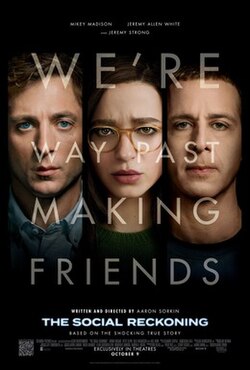
Together the pair back-and-forth, piecing together a series of articles about how Facebook’s algorithm purposefully pushes rage-baiting content, leading to political extremism and toxic behaviour in society. Yet, Haugen wants to keep her job at Facebook but also wants to stop the negativity being spread, especially to young people via Instagram. This means she flits between helping and providing information and holding back. She also at times comes across as an almost unlikable character because of her shifts, particularly when seemingly switching in the middle of a scene or things start to heat up in exchanges with Horwitz. Small comments about Frank Capra films, music or books are placed for amusement, but none get any response and sit somewhat awkwardly amongst the surroundings.
Interesting beats arrive at the sporadic unveilings of information, finding out just what Facebook has been hiding and pushing. It’s what holds engagement and helps to maintain the drama that runs throughout, actually building up to the release of The Facebook Files and seeing the articles form. It’s where Sorkin appears to find his biggest kick, in the details actually about the journalism and writing side of things rather than the conversations that lead to them. He seems as his snappiest when writing for Horwitz’s exchanges with two young interns working at the WSJ offices and helping him with sudden Q&A riffs or experiments with the social platform.
The problem with The Social Reckoning is that, despite the fact that we eventually get insurrection footage in relation to what the files uncover, and there is a heat that comes from that, the film doesn’t quite feel as if its lit its own fire. It seems to be at a consistent smoulder, dampened by the fact that as it goes between times and perspectives it almost feels as if it’s explaining itself to an audience that would be able to keep up without it. Disturbing its own flow with scenes that don’t feel stop-start but certainly the individual segments can be seen and felt. It feels strange for a film written by Sorkin to feel so safe in pace and tone.
While it has its moments The Social Reckoning never quite feels as if it has a complete spark, almost slowing down for the audience to explain to them what they’ve just seen, or are about to see. There’s interesting beats and effective reveals, but largely things are played surprisingly safe.

