LFF 2020: Nomadland – Review

Release Date – 30th April 2021, Cert – 12, Run-time – 1 hour 47 minutes, Director – Chloé Zhao

After her husband passes away and work appears to instantly vanish from around her, Fern (Frances McDormand) turns to living life roaming around America in her new home, her van.

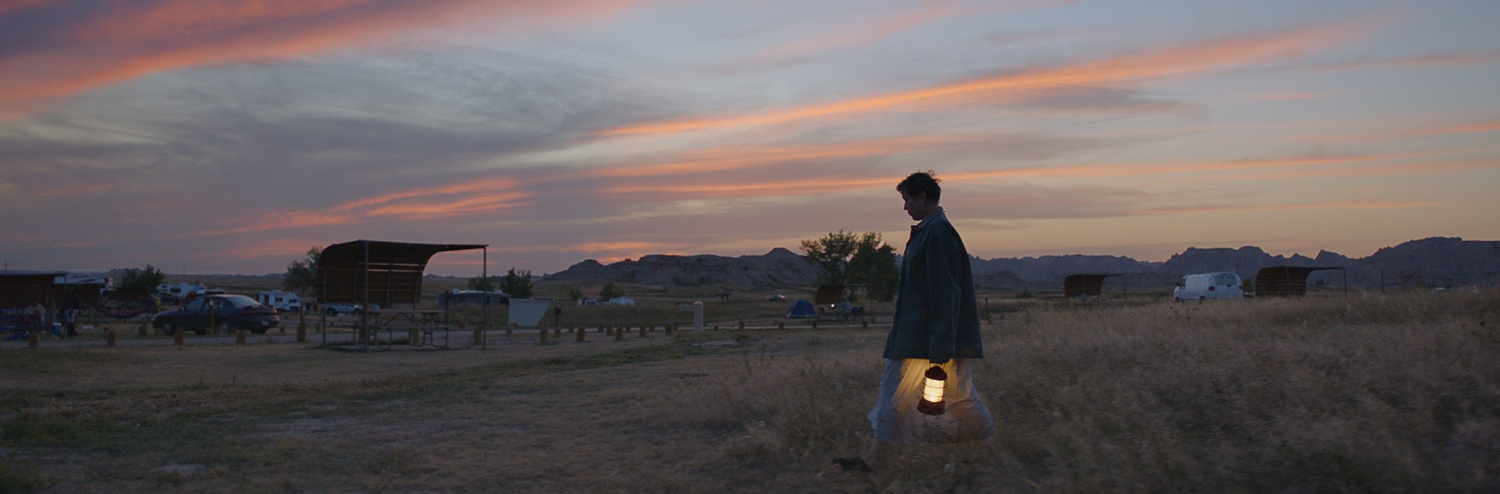
As with her previous feature, 2018’s excellent The Rider, writer-director Chloé Zhao demonstrates within awards favourite Nomadland an ability to make place feel like a calming presence, a character itself, while becoming a part of character identity. For Fern (Frances McDormand) this isn’t one specific place. We follow her as she travels across America in her van as she joins the nomad community following the death of her husband. With work having dried up due to the gypsum plant in Empire, Nevada closing down in 2008 and having a knock-on effect that led to the postcode of the town being removed in a matter of months, she takes seasonal and part-time jobs wherever she can find them. Meanwhile, in the evening’s, she grows bonds with those around her, some of whom have been on the road for many years, exploring the seemingly infinite world of deserts, parks and plains that surround her.

While a small and quiet film, Nomadland is undeniably made for the big screen. Cinematographer Joshua James Richards captures an entrancing world of sweeping landscapes made up of dark pastel-like colours, giving you a front-seat view to the seemingly picture-perfect views of the likes of Arizona, South Dakota and even the cold winter of Nevada. And yet, all of the visuals simply enhance the lives and stories of the cast on show – a number of whom are non-acting nomads themselves, telling their genuine stories. It’s a personal piece and that comes across in the time that the film gives to tell a tale, time can be paused just to give someone the space to breathe and recount how they found themselves where they are, or to give advice to Fern. You’re equally captivated by such conversations and form a bond with each figure as they expand the world that Fern has entered and begins to find a piece of herself within.


Themes of loss, isolation and community which would already have an atmospheric care to them are perhaps heightened by the events of the past year. Zhao’s gentle touch helps to make the film even more accessible, she wants you to connect with McDormand’s finely performed character – one of subtlety and restrained emotion. By focusing on her and how she develops in her surroundings, both in terms of scenery and people, rather than a major plot there’s a more personal note to the piece as a whole – much as was the case with The Rider. During certain scenes the film almost begins to feel like a documentary – apparently a style that was aimed for during production – simply observing the goings on of a little-seen group in America.

While plot does slightly rear it’s head into the later stages of the film, to begin to round up Fern’s development and journey, or perhaps simply escape; whether from or into something is for the viewer to decide, it’s nothing to distract or take away from what the film has established up until this point. If anything this is just one scene that continues to work within the film and progress Fern as an emotionally engaging, and at times privately conflicted, character. It’s not just her who acts as the core of the film. It’s the community she finds herself opening up to, become further a part of because of this, and the environments they travel throughout. It’s a true escape not quite into another world – although the scenery might seem like it sometimes – but into another perspective, one that grows and changes and develops as we here more from those around her. Zhao’s effective direction emphasises so much while still managing to create a calm and thoughtful piece of explorative work into character and identity within community.

Chloé Zhao seamlessly roots character into wonderfully shot place with the most subtle of details, paired with Frances McDormand’s excellent lead performance and the stories of those around them Nomadland is a personal character tale of multiple calmly dealt with journeys and discoveries.

Rating: 4 out of 5.

Sound Of Metal – Review

Cert – 15, Run-time – 2 hours – Director – Darius Marder

A heavy metal drummer (Riz Ahmed) finds his life and career shattered as he enters a centre to help deal with his sudden deafness.

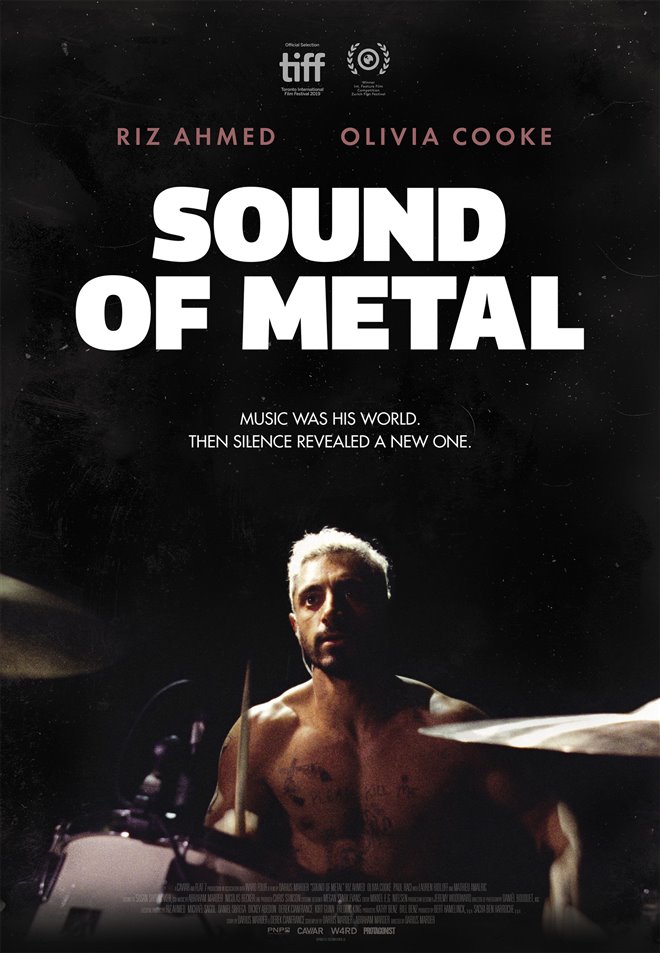
Back in October Riz Ahmed gave a career-best performance as a rapper dealing with a deteriorating body in Mogul Mowgli. Now, we see him top this with the story of metal drummer, Ruben, who finds his world plunging into silence as his hearing rapidly declines. As things worsen for him – and he can’t afford to get $40,000 implants – he, with the help of girlfriend and bandmate Lou (Olivia Cooke) enters a centre to help people come to terms with deafness. Leader Joe (Paul Raci – who grew up the hearing child of deaf parents) makes clear that here deafness is not viewed as a disability or handicap. Ruben is taught sign language and living his life more patiently, learning to cope with his deafness with the help of those around him – alongside recovering from a drug addiction.

Ahmed is chameleonic in the lead role, you truly forget that it’s even him, that the character looks like him or anything else. The performance is physical as well as deeply involved in the slightest of terrified facial expressions. He gives a sensational performance of effective and authentic emotion. He’s scared and worried about almost all of his decisions, let alone what’s happening to him. And yet, there’s gradual change and what some might call redemption. You can’t help but have a smile put across your face during certain moments, whether it’s of pride, relief, happiness, something else or perhaps a mixture of the above. While a lot of this is down to Ahmed’s fine performance you have to also credit the fine editing and pacing of the piece, as it finely tunes the arc and development of the central figure.


You form a connection with him as your put inside his head and experience the world through both his eyes and, more importantly, ears. The sound design is, of course, integral to the piece and it deserves the Oscar that it’s likely to win. From the focus on the slightest sounds at the start of the film; such as dripping coffee, the creaking of a motorhome and other small everyday noises, to muffled, rumbly, distorted confusion as Ruben begins to almost instantly lose his hearing – he’s told early on by a doctor that the damage to his ears could mean that his hearing completely vanishes in a number of hours. While the film’s sound design has been vastly praised the visual aspects of it haven’t quite been discussed as much. Ruben’s world is plunged into a cold, grey look that while perhaps not overly striking is subtly effective in allowing the viewer to further feel the world, especially what Ruben himself is feeling.

As everything pans out words don’t properly come to mind as to how to describe the film and what’s happening within it, one thing’s for sure, it certainly lodges itself in your mind and stays with you long after. It’s the type of film where clichéd words such as touching, affecting and emotional do apply. The film is a true mixture as it follows the rises and falls of its subject trying to cope with his sudden deafness, trying to regain a life he’s unsure he can get back, and trying to cope with what he views as a new, if potentially temporary, one. All told through a finely flowing story filled with great performances, and an outstanding turn from Riz Ahmed, more than deserving of every plaudit he finds himself nominated for, and potentially winning, for his role in this film – much like the excellent sound design that pushes you further into his terrified mind and deteriorating hearing.

Riz Ahmed is unrecognisable as a character who looks just like him, when mixed with the pacing and sound editing of Sound Of Metal what’s formed is a well-tuned character piece of fear and development that puts you into every detail of their rises and falls.

Rating: 5 out of 5.

Promising Young Woman – Review

Cert – 15, Run-time – 1 hour 53 minutes, Director – Emerald Fennell

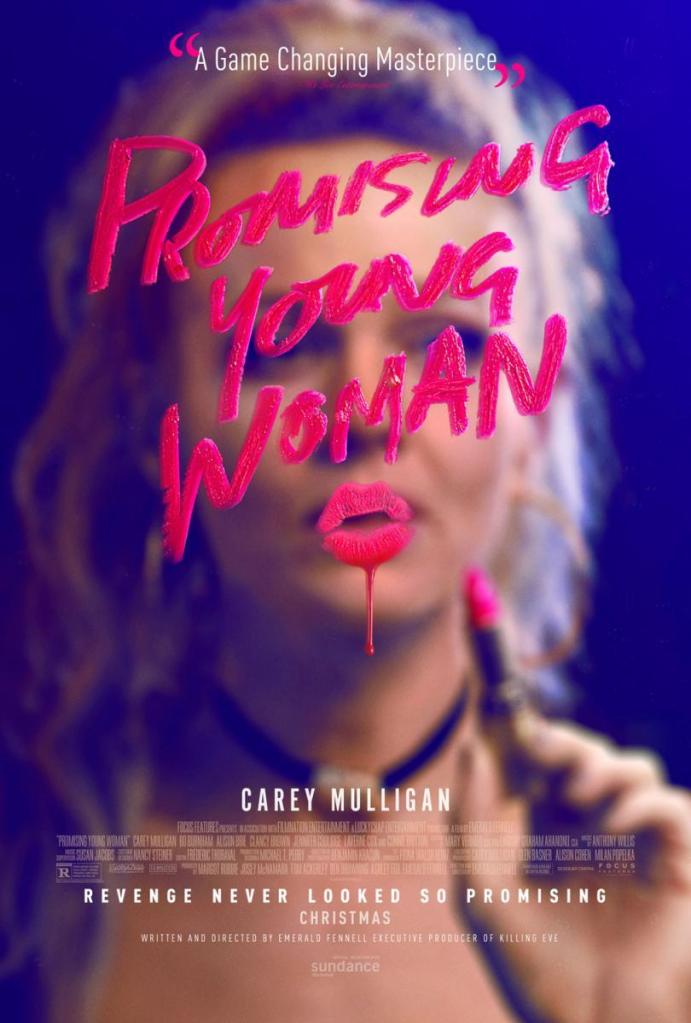
After years of being struck by grief, Cassie (Carey Mulligan) goes out to get revenge on the people who she believes led to her best friend’s suicide.

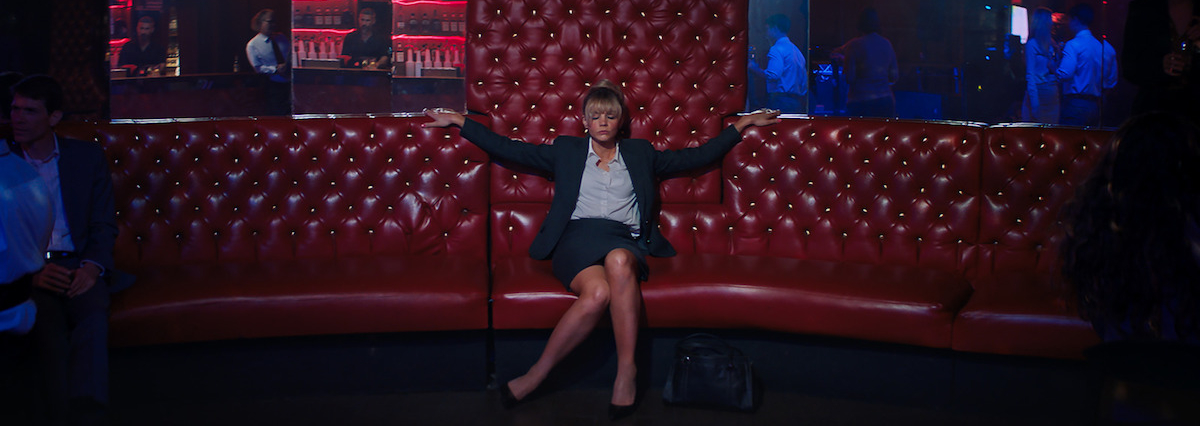
There’s something unexpectedly tense about a high-pitched string version of Britney Spears’ Toxic, it acts as a final countdown to protagonist Cassie’s (Carey Mulligan) grand act of revenge. We’ve already seen that she’s a force to be reckoned with, grieving and angry she spends her evenings pretending to be drunk, being taken home by different men and boldly confronting them before they non-consensually take advantage of her. Mulligan’s performance is subtle and nuanced, fire hiding behind her eyes, almost visible with each breath she emits. While it seems she doesn’t hurt the would-be-rapists – the true consequences aren’t always shown – it’s perhaps tension for her, and how her actions will spin back onto her, that builds up, a stark contrast from the discomfort just seconds before.

Cassie is a medical school dropout, casually working at an almost empty white-void small-town coffee shop – appearing to do almost minimal work she sometimes seems to be there as a Randal to Dante for Laverne Cox’s Gail. It’s here that she re-meets familiar face Ryan (a wonderfully charming Bo Burnham). As a relationship with him grows, he appears to be an actual “nice guy”, not parading around with the thin façade of one for his own sexual gain, Cassie begins to look into other former collegemates. However, her aims are more for revenge than to properly catch-up. Her best friend Nina committed suicide after being sexually assaulted and raped while at the same school, and she’s out for cleverly-planned justice – much of it coming through in feature debut writer-director Emerald Fennell’s screenplay.


There’s something increasingly sinister about Mulligan’s performance as she encounters each new figure in her grand plan. A number of reveals, sometimes you piece things together just before the film confirms your fears, are genuinely shocking, a gasp-inducing mixture that sometimes leads to gut-punch horror – even if everything isn’t always as it seems. All of this is mixed in with the drama of the situation which is rightfully dealt with in pure seriousness and helps to firmly establish a number of the other themes and ideas of the film, while not being degraded to simply a framing device – this is far more than a standard revenge thriller. Even with all of this Fennell finds room for natural and light humour, more so in the light of Mulligan’s challenging of self-believing ‘nice guys’, their either unwillingness to properly respond or general fear of the totally sober woman in front of them, alongside her entertaining interactions and scenes with Burnham.

For everything that the film conjures up and makes a point of, even as a piece of successfully dark satire, there’s a rather cinematic nature to it all. This may not initially seem like the type of film that requires a big screen experience, however as the story develops there’s plenty that demonstrates highly cinematic storytelling that commands to be viewed on a big screen – while still acting as a personal story. By the time Mulligan gets to deliver her standout monologue, conveying the film’s themes and the drama that everything has been encased in so well, there’s an astounding effect that forces you back in amazement, Mulligan dominating your attention with Fennell’s finely written words.

It’s understandable how this film has been divisive, and in some aspects controversial, particularly in regards to the ending – which for some may raise a slight grin, while others may feel it goes for an incorrect tone – and also the way the film goes about the content of a number of scenes as a whole. Either way, hopefully, this scene remains as outstanding thanks to its simplicity, fine writing and Mulligan’s precise performance creating emotion and a slightly sinister hint. Points which run throughout the film and make for an entertaining piece of storytelling with occasional beats of dark satire amongst the somewhat different revenge thriller course that also takes shape within the carefully dealt with core themes.

Mulligan burns with fiery passion in a performance of emotion and rage that captures a sinister feeling in Emerald Fennell’s finely tuned part revenge thriller, part satire mixture. Through darkness and emotion this is certainly a stand-out debut.

Rating: 5 out of 5.

The Father – Review

Release Date – 11th June 2021, Cert – 12, Run-time – 1 hour 36 minutes, Director – Florian Zeller

A woman (Olivia Colman) sees her deteriorating father (Anthony Hopkins) through life in his flat, interviewing various potential carers.

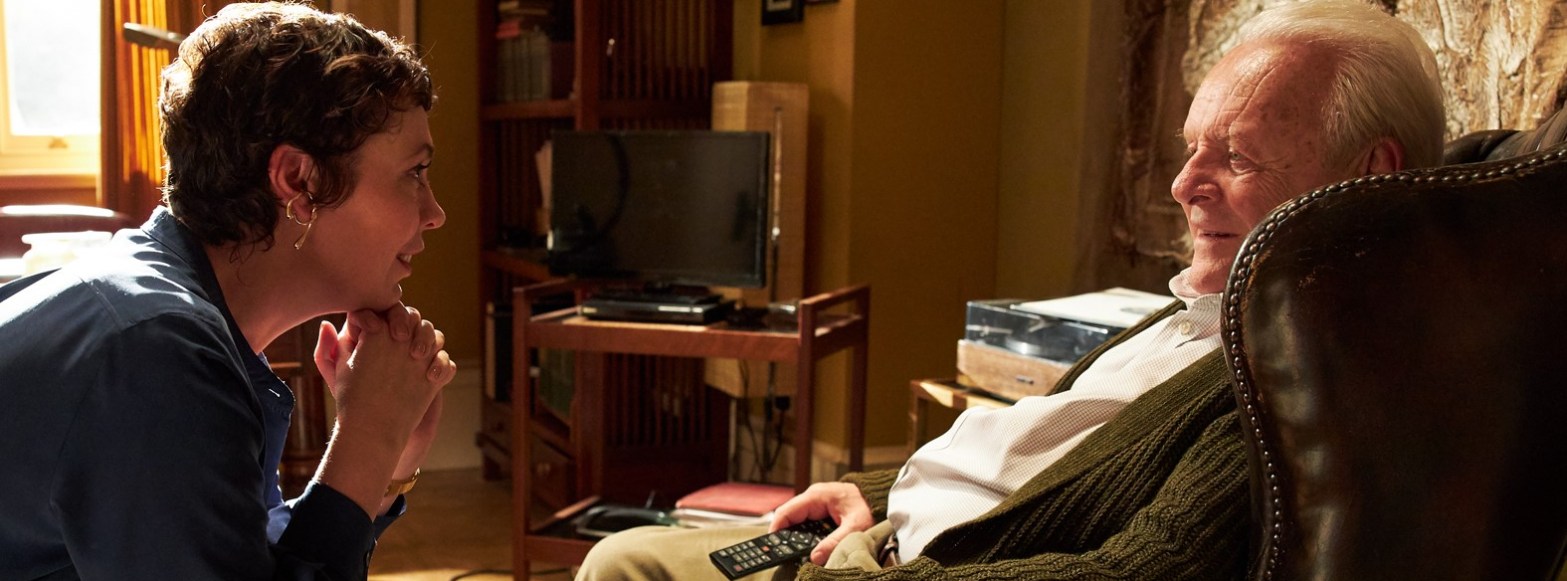
With such a reputation as the one he has it’s weird to think that Anthony Hopkins has only won one Academy Award to date, Best Actor for his terrifying 16 minutes in The Silence Of The Lambs – arguably still his best performance. However, with his latest role this could change. Far from the reaches of Hannibal Lecter. Anthony – a former engineer (even if his lavish, expansive flat of 30 years would suggest a better-paying profession) – is a frail, yet confident gentleman. Living his days listening to the radio, sipping the occasional whiskey and conversing with his daughter Anne (Olivia Colman). However, Anne’s face appears to change throughout the film (Olivia Williams), and so does that of her husband (Rufus Sewell/ Mark Gatiss). It’s made clear that it may not be a case that things aren’t right in Anthony’s home, but potentially his mind.

Anne sees him through a number of, often disastrous, interviews with potential carers – her father is adamant that he is fine and doesn’t need help, despite protests from those around him, and even her. The gradually changing details and effective state and attention to detail within the production design put you directly into the mind of the central figure. The character is dealt with tenderly, his narrative somewhat simplistic, yet immense in emotion and detail. Hopkins’ towering performance is surrounded by a strong supporting cast, all delivering realistic, authentic depictions of the family circle that surrounds Anthony. It’s such gentle, generous performances that add to the gradually increasing emotional impact of the film, as the viewer’s understanding of the circling events increases. There’s strength that truly allows for the subtlety of the screenplay to come through.


Christopher Hampton and director Florian Zeller’s screenplay (adapted from Zeller’s stage-play of the same name) is thoughtful and considered and guides you through the world of the titular Father as his mind, and the should-be-familiar surroundings around him get increasingly shrouded in chaos and shadow. Following him through the warping environment of his flat and the increasing worry of Colman’s concerned and conflicted daughter, hiding a rising helplessness. There’s a mixture of emotions throughout the film. One second Hopkins is cheerfully charming, pretending to have been a tap dancer before he retired, the next he’s panicking and breaking down as his world literally disappears around him. It’s a shattering portrayal and one that truly gets to the heart of the film’s themes and ideas – connecting with the viewer in a much more effective way than you may initially feel it has; one particular scene really shows your bond with the film and its characters as it devastates you emotionally and leave you feel as helpless as Hopkins conveys. To the point where a slight fear factor (fear of the unknown, or for the character?) begins to settle in.

It’s an overall fantastic film and the elements truly come together for something worthwhile. Establishing itself firmly by the end when everything comes full circle and a number of built-up points are completely revealed the focus is still always on the character, yet with attention to detail always on background elements. The fantastic performances elevate the eventual gut-punch nature of the piece, and Hopkins completely owns the final 25 minutes – a fine performance towards the top of an undeniably distinguished career. Those around him in this feature also put in strong efforts, doing the quietly effective screenplay and individual visual elements a great service. All give fine contributions and make for something that is eventually an immense piece of heart-breaking emotion, rattling through a demolishing third act in which Hopkins shines stronger than he already has throughout the rest of the film. This is a fine, tender and thoughtful piece of work that is considered and quietly powerful in its portrayals of the effects that a mind’s deterioration has on multiple people, all from the increasingly scary perspective of the person its happening to.

Hopkins not only owns the final 25 minutes of The Father, but provides a superb performance throughout. With attention to detail and a quietly strong screenplay backing him, alongside a great supporting cast, this is a shattering, and sometimes scary, piece of work all from a fantastically performed perspective.

Rating: 4 out of 5.

Minari – Review

Cert – 12, Run-time – 1 hour 56 minutes, Director – Lee Isaac Chung

A family move from a California city to a caravan in Arkansas, with father Jacob (Steven Yeun) leading work on a farm for Korean vegetables.

Earlier this year, as with most years, the Golden Globes came under fire when it came to their nominations. One of the reasons for this was because of its exclusion of Minari in a Best Motion Picture category – and being snubbed in any other than Foreign Language Film, which it won – due to it largely being in Korean, the same went for Parasite last year in the top category. Despite this the film has picked up multiple nods at other awards ceremonies, including Best Picture amongst five other nominations at the Oscars, with what is a very American story. One that some might describe as a sort of bootstraps tale.

Inspired by writer-director Lee Isaac Chung’s childhood in Arkansas the film feels like a fond memory, warm and brightly lit throughout. The Yi family move from a California city to a plot of land in the middle of a quiet town in Arkansas, Dad Jacob (Steven Yeun) hopes to independently set up a farm for Korean vegetables. While his kids are simply taken along, son David (Alan Kim – for many, a scene stealing delight) taking it more in his stride than his sister Anne (Noel Cho), his wife Monica (Yeri Han) is understandably more hesitant in the change of surroundings, especially when tornados and harsh weather conditions add to the isolation that the family feel by finding themselves living in a caravan in the middle of a small field. The family bond is brought to life by fine performances and Chung’s direction which fills each frame of the film with a warm air of reflection; heart, humour and soul all linking back to the family unit at the centre of the piece.


You don’t properly realise the connection that you’ve formed with the characters until the presence of Grandma (Yuh-Jung Youn) is brought into the equation. The relationship between grandparent and grandkids might initially be somewhat uneven, however gradually bonds grow and connections are formed. Youn in many ways becomes the heart and soul of many of the film’s elements – while still remaining a supporting player. Her performance is the standout in a film filled with great performances. Capturing swirling joy, emotion and deterioration she pinpoints perfection and gives what may already be the best performance of the year. She acts as both a support for the family and cause for worry as situations don’t seem to be as ideal as perhaps they may have once looked, at least for Jacob as he pours his passion into his farm with the help of neighbour Paul (Will Patton).

Minari refers to a Korean vegetable that can be used in a number of different dishes, it acts as the title and a background element to a film that while initially seeming like a light film about family introduces subtle elements along the way to pack in much more. Emotion is plentiful leading to uplift and heartbreak in equal measure and helps craft a film with a great deal of universality, beyond that of a traditional American tale. One that many can find something within and connect with. The simplistic nature of the piece, the steady observational nature of the way the camera is held adding further to this and allowing for the piece to unfold creates an even softer and gentler nature that welcomes you in to what appears as a piece of reflection and has the impact of a well-tuned light family drama that manages to pack in nuanced observations, humour and emotion. All calmly stirred to the point where you don’t properly realise just how much a part of this truly wonderful film you’ve become.

A simplistic and traditional American film that’s more effective for it, making for a strong, bright narrative about an excellently performed family filled with heart, warmth and the stylings of a fond memory.

Rating: 4 out of 5.

Godzilla Vs. Kong – Review

Cert – 12, Run-time – 1 hour 53 minutes, Director – Adam Wingard

While trying to get King Kong to Hollow Earth a group of scientists and researchers encounter Godzilla, reawakening an ancient rivalry between the two titans.

If there’s one place you perhaps wouldn’t expect a battle of the titans to begin it’s possibly with King Kong casually going about his morning routine to gentle music. It’s an amusing enough concept, and entirely different to the delight felt as he lands the first almighty punch of his handful of fights with Godzilla. During this moment time seems to slow down, a wide smile gradually forms, as he lamps the iconic lizard in the middle of the ocean. Not much context is given to why the pair instantly go on the attack, apart from mention of an “ancient rivalry”, yet as the fights begin that doesn’t really seem to matter as the scale of the action takes hold. Action which was undeniably made for a titan sized screen.

The reason for the two titans meeting in the first place is something of a chance encounter. Kong is taken away from a replication of his former home Skull Island, by the scientists and researchers who are keeping him there, when the fear of having more than one titan on Earth grows, especially after a number of seemingly random attacks from Godzilla – who has once again had a change of heart and is causing random destruction again. Thus Kong is being taken to Hollow Earth, where it is believed he came from. What little exposition there is for the rivalry seems to have all gone into the various human characters we meet throughout the film.


For the most part we see the narrative through the eyes of Rebecca Hall’s Ilene Andrews, who, alongside Alexander Skarsgård’s Nathan Lind, leads the project to get Kong, and humanity, to safety. However, we also find ourselves following Millie Bobby Brown and Julian Dennison as two teenagers who meet conspiracy theorist and podcast host Brian Tyree Henry (always a welcome presence), trying to infiltrate the Apex Corporation, who it is believed are provoking monster-related attacks. There are various other minor characters that we see play a part in the narrative, or have an effect on those that are more prominent in the piece. Yet, with so many players it almost feels at some points as if Godzilla is only there as a minor figure. At least Kong kind of gets something to do as we explore his world in Hollow Earth, even if through someone else’s eyes, brought to life through effective and great CGI – which when it comes to the fight scenes really makes an impact.

Because of the heavy exposition and various human angles we do often spend little time with the titular monsters – a trend in the last month appears to be that of title characters acting as supports in what is otherwise believed to be their own film. In fact, it takes 40 minutes for them to finally meet, before waiting a long time to finally re-encounter each other. The action may be worth it, it’s definitely exciting to watch a giant gorilla and lizard smash each others heads into skyscrapers – one thing’s for sure the film doesn’t take itself too seriously when it comes to such fight scenes, it knows that the audience are there for not entirely dumb monster clobber – it just takes a while to get to all of this. The human aspects certainly show the film’s run-time, alongside giving it a busy feel. However, the action is certainly on a big enough, destructive scale to be worthwhile – and would likely have an even large impact on a bigger screen.

The destructive fights are exactly what you would hope for, in-between the large amount of, not always developed, expositional human characters that take up most of Godzilla Vs. Kong’s run-time.

Rating: 2 out of 5.

The Dissident – Review

Cert – 12, Run-time – 1 hour 57 minutes, Director – Bryan Fogel

Documentary looking into the murder of Saudi Arabian journalist Jamal Khashoggi in the Saudi consulate in Turkey in 2018.

If you think that Tom Cruise’s increasingly deadly stunts in the Mission: Impossible franchise are tense, or the risk of making a noise in A Quiet Place, try tweeting against the Saudi government. It’s this line that Bryan Fogel’s The Dissident – his follow-up to the Oscar winning Icarus – takes as it delves into the murder of Saudi Arabian journalist Jamal Khashoggi in the Saudi consulate in Turkey in 2018. This is far from a direct line, it’s a messy one filled with twists, turns, diversions and seemingly never an end, yet Fogel manages to craft a finely told narrative with the various different angles that he has. Through interviews with people involved with the Turkish government, fellow journalists and more a shocking timeline of characters and events is gradually formed creating a gripping course that has you glued to the screen. Far from a standard documentary, Fogel’s latest plays out as more of a thriller than anything else.

Acting not just a s a series of interviews or looking into a topic The Dissident acts as a piece of investigative journalism. Thorough and focused it often feels like a highly cinematic piece from the This American Life team. It’s not long until you get so invested in the spiralling story that’s taking place that you find yourself digging your fingers into the seat in tension. Even the naturally jumpy and grainy quality of CCTV footage adds tension, and a slight fear factor. By the time a simple transcript of events comes up the feeling that runs through the viewer is that of pure terror. It’s testament to the craft of Fogel’s film and the expert pacing that runs throughout it, both as a documentary and a general feature this is a truly sensational piece of filmmaking.


Long after the credits roll shockwaves of detail continue to float around the mind with a lasting effect, this is undeniably a film that will stay with you for a while as it takes time to fully settle in. The themes of “Learn more. Take action. Make a difference” ring throughout as the film delves into Khashoggi’s journalism for various sources, including The Washington Post and his interactions on Twitter with other critics of the Saudi government, some of whom are interviewed in the film and truly reveal a dark world, more than we already knew the social media platform to be. Some aspects of which are virtually recreated – faces gradually turning to the camera putting you further into a state of fear as they look into you, even more impactful due to the role they play in the central focus of the film.

Everything is kept tight and focused as the film explores Kahshoggi’s career and work as a journalist. His fight for freedom of speech and the opportunity to criticise those in power. This film about his assassination is as passionate as his fight for just this cause, turning this into the intense and pacey drama that is laid out over the almost two hour run-time. Such feelings are heightened by Adam Peters brilliant, stirring score that swirls in the background of many scenes, montages and recreations, capturing the exact feeling that the film is trying to get across and simply increasing the effect that it has on the viewer. Overall, everything creates a gripping narrative, filled with fear and tension as the highly cinematic investigation goes deeper and deeper into the subject matter, with power, shock and fine craft and precision.

Forming an expertly told narrative The Dissident is a sensational investigative documentary, equally tense and shocking it’ll certainly leave shockwaves long after its highly cinematic detail is finished.

Rating: 5 out of 5.

Bad Trip – Review

Cert – 15, Run-time – 1 hour 25 minutes, Director – Kitao Sakurai

Best friends Chris (Eric Andre) and Bud (Lil Rel Howery) travel from Florida To New York so Chris can meet-up with his high school crush (Michaela Conlin).

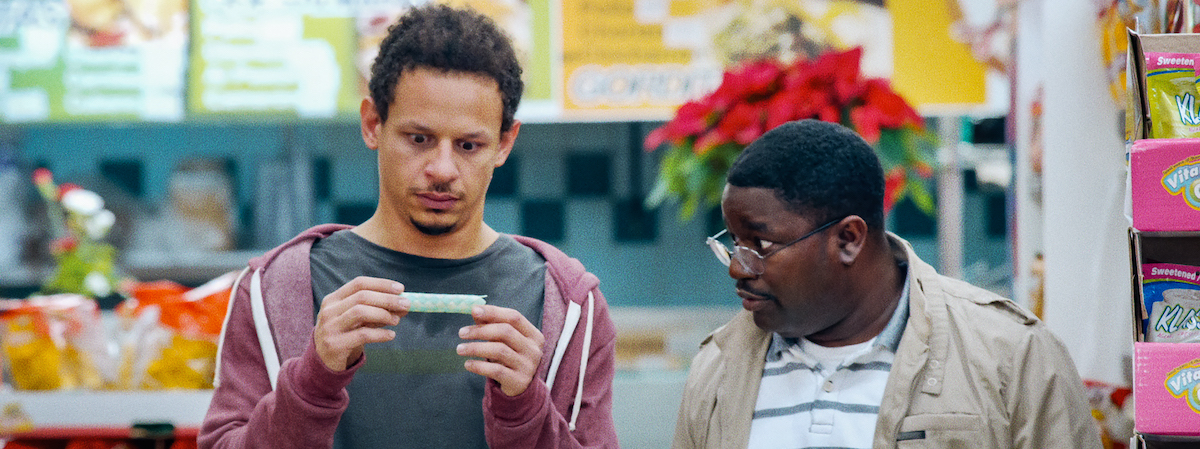
Hidden camera prank films often rely on the reactions of unsuspecting participants for humour. The natural responses as members of the public try to hold back laughter, or act out in anger, or sometimes just stand by and watch in bemused shock and amazement, are emphasised in close-ups so we understand what we’re supposed to be laughing at. Yet, in Bad Trip the humour almost always comes from the characters at the centre of the various pranks. Their actions and persistence in their various goals helps form the often laugh-out-loud nature of the pranks, simply showing the improvisational skills of the central trio of actors as they interact with unknowing people. Through this a plot is formed, linked by the various events of the film, one that is focused on throughout and yet never gets too heavy or in the way of the stunts at that make up this loose, yet un-dropped, storyline.

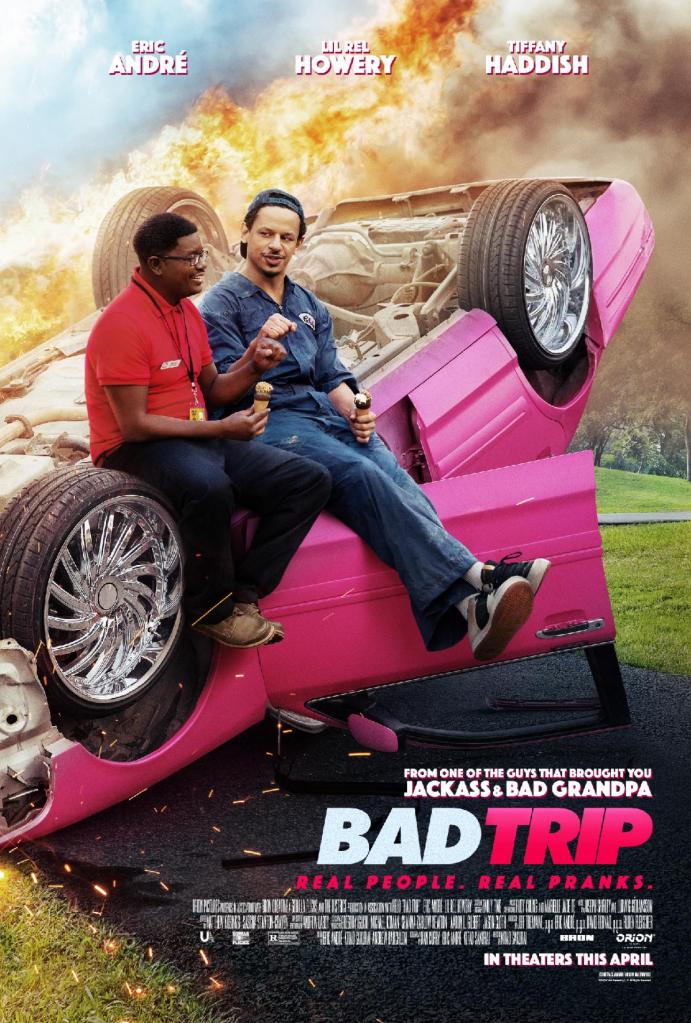
Best friends Chris (Eric Andre) and Bud (Lil Rel Howery) go on a road trip from Florida to New York City in the hope of meeting up with Chris’ high school crush Maria (Michaela Conlin). However, their only mode of transport is the intensely decorated, bright pink car of Bud’s imprisoned sister Trina (Tiffany Haddish) – emblazoned with the words “Bad B!tch on the back window. Unfortunately for them, freshly escaped Trina is hot on their tail and she’s out for deadly revenge, Haddish’s exasperated rage at the lack of help from any member of the public is delightfully comic. Her scenes and presence break up the bursts of hilarity ranging from the dark to the utterly gross.


For those aware of Andre’s Adult Swim fake talk show, The Eric Andre Show, Bad Trip very much has elements – perhaps the more disgusting, bodily moments – that feel like they could go alongside his awkward celeb interviews, with less of the more alternative stylings of the show. Throw in dream sequences, some bad trips (the title acts like 2017’s Girls Trip) and a musical number – Andre acting as the clumsily unprepared lead of a mall flash mob – and there’s plenty of variety when it comes to the chaotic scenes of the film, telling the story with each moment, where the extras and supporting cast are simply unaware that they are being filmed. It’s a lesser-seen element when it comes to this sort of film and it works well in regards to the places that Bad Trip goes – especially with a trio of wildly funny performances at the centre of it.

Fully pushing the limits of a number of the ideas and scenarios -resulting in audible gasps of “Oh no” from the viewer as they can’t look away from the screen at the mania that unfolds, although some may be peeking through their fingers, particularly during one scene containing an interaction with a ‘gorilla’ at a zoo. It’s clear from the surprise of Andre going completely starkers in the first three minutes that there’s a lot to come over the course of the film. And at 85 minutes it breezes through its hysterical road trip, never feeling in your face or as if it’s showing off how funny it is by zooming in on the reactions of strangers (who don’t happen to identify the cast) who just happen to be in the right (or wrong) place at the right (or wrong) time. It effectively carries along its narrative, told through the links between each setting and prank, and does it with truly funny results.

By focusing on plot through the pranks and making the three great central performances the core source of humour Bad Trip feels different to a number of other hidden camera films, and shows, and makes for a laugh-out-loud hilarious, highly gross-out, time.

Rating: 4 out of 5.

Adam Leader ‘Hosts’ Interview

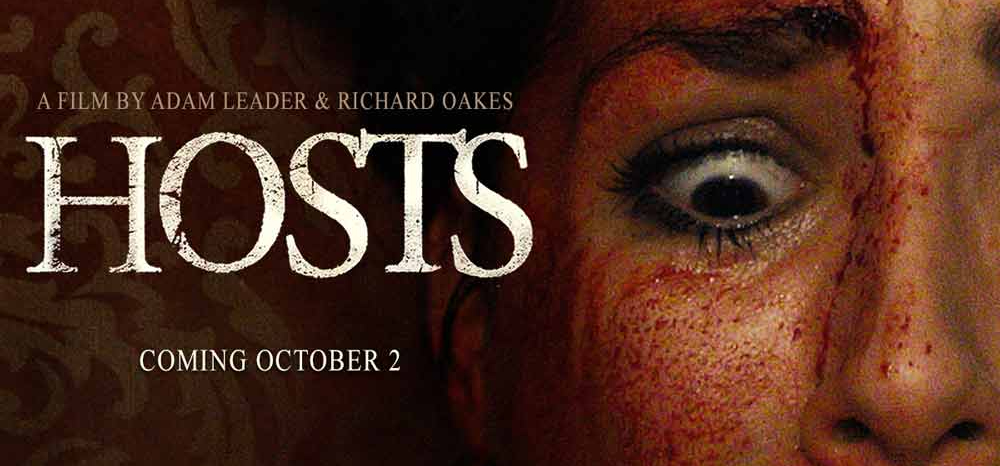
Writer-director Adam Leader joins me to discuss his feature debut horror, Hosts – available to watch online now on various platforms.

Adam can be found through his Twitter account. If you want to watch the film you can see the places it’s available by following this link.

If anyone’s interested in hearing Adam’s song request you can listen to it by clicking the below link:
Don’t Wanna Fight – Alabama Shakes

Stray – Review

Cert – 18, Run-time – 1 hour 12 minutes, Director – Elizabeth Lo

Looking at the world from a dog’s-eye-view as Zeytin roams the streets of Istanbul, where stray dogs are allowed to live freely.

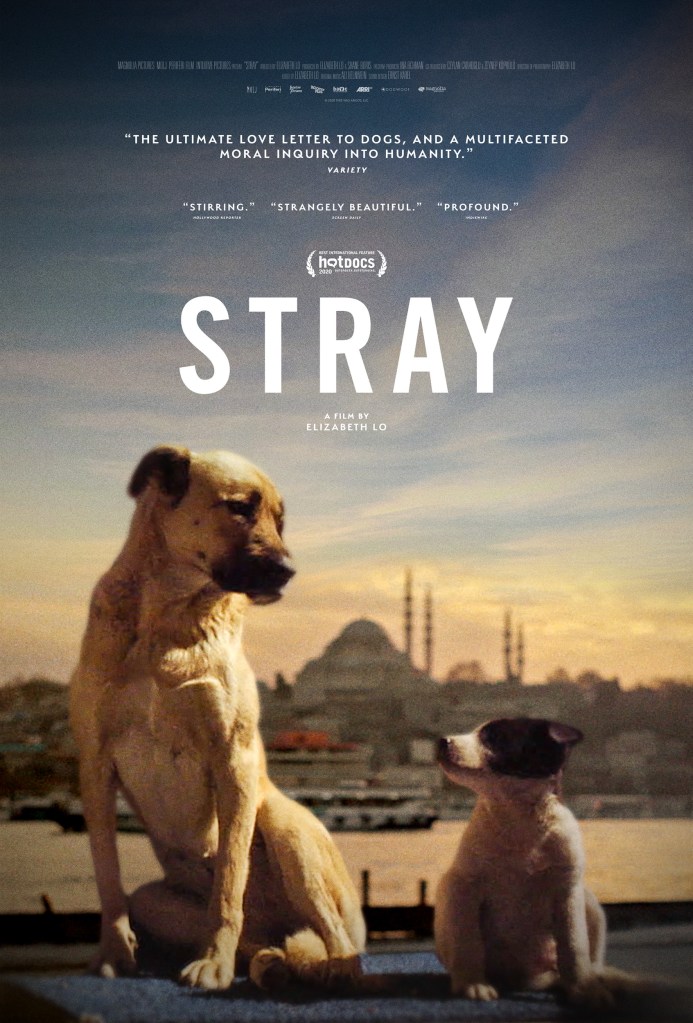
There’s an innocent, joyous grin that spreads widely across the face as dogs pounce, play, sniff and go freely about their days in Stray. It’s the type of content that makes up short, amusing videos on social media that you sometimes can’t help but watch because of the dog-related content. Yet, there’s much more than just these base moments of delight in Elizabeth Lo’s film. As she follows proud and playful dog Zeytin the camera is kept at the height of a dog’s head, as the world is naturally explored and people and animals are seen going about their days. Turkey is one of the few countries in the world where stray dogs are allowed to roam freely without risk of being taken in by kennels or authorities, or being euthanised. It’s almost made to seem as if humans and dogs, mostly, peacefully co-exist on an equal level with the occasional interaction.

While there are, of course, the humans that want to give Zeytin and co – including Nazar and Kartal – fuss there are also those that almost mentally depend on them. We spend time with a group of Syrian refugees who find mental calming and relief in the company of the canines. If they had the funds – and, as told by one person, didn’t sniff glue from plastic bags – they would likely try to take them in as their own. They’re a source of comfort and distraction. They share qualities of residing in Istanbul, and having their own lives apart from the busy city streets. This relationship, one of a handful explored over the short course of the film, goes to some shocking and surprising places as Lo explores just how far some people will go for this bond.


Throughout philosophical quotes appear across the screen looking into the connection of humans and their apparent best friends. How we’re apparently not so unalike, and perhaps need each other; or at least we need them. All forms of dogs are integrated into Turkish society, going about their days and getting on with their various business (whatever your mind came up with, it’s very likely correct – yes, even in the middle of a crowded street). They walk amongst humans and appear to behave like them, and yet we’re reminded throughout; thanks to the interactions that they have with each other and other species, that these are dogs – the occasional moments of butt-sniffing certainly remind us of this.

Stray tells its story simply and effectively, constructed so as to gradually travel across its course with the viewer alongside Lo and her canine subjects. Within this it manages to pack in quite a lot of detail, never forced so as to disconnect the audience. We see the world from a dog’s perspective, marvel at their play and interactions with humanity, yet find ourselves further engaged and interested by the connections that humans form with them. For the most part this is a fairly innocent film, and that helps with a number of the themes and ideas that are brought up and naturally occur over the course of the run-time. And even those more serious points – this film does after all have an 18 rating from the BBFC for, as their description says, “drug misuse” – are dealt with well and yet in a manner that doesn’t distract from the overall style and feeling of the film. Definitely one for dog-lovers, there’s plenty there for others as the film gently travels along its course of looking at centuries old bonds between dogs and humans.

Playfully filled with plenty of delightful “aww” moments Stray isn’t without its seriousness, in an interesting and effective layer of human-canine relationships.

Rating: 4 out of 5.