Eternals – Review

Cert – 12, Run-time – 2 hours 36 minutes, Director – Chloé Zhao

A group of immortal superhumans known as Eternals reunite as a race of thought-to-be-extinct aliens, called Deviants, re-emerge amongst discussion of the end of the Earth.

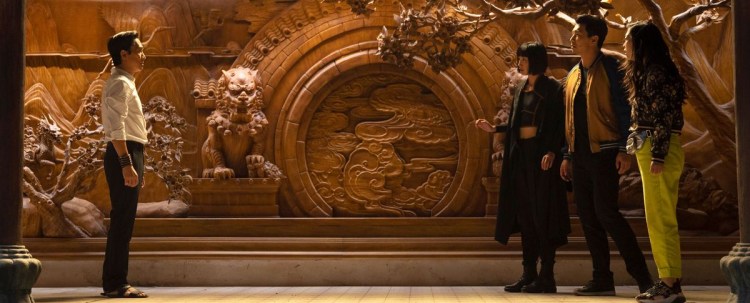
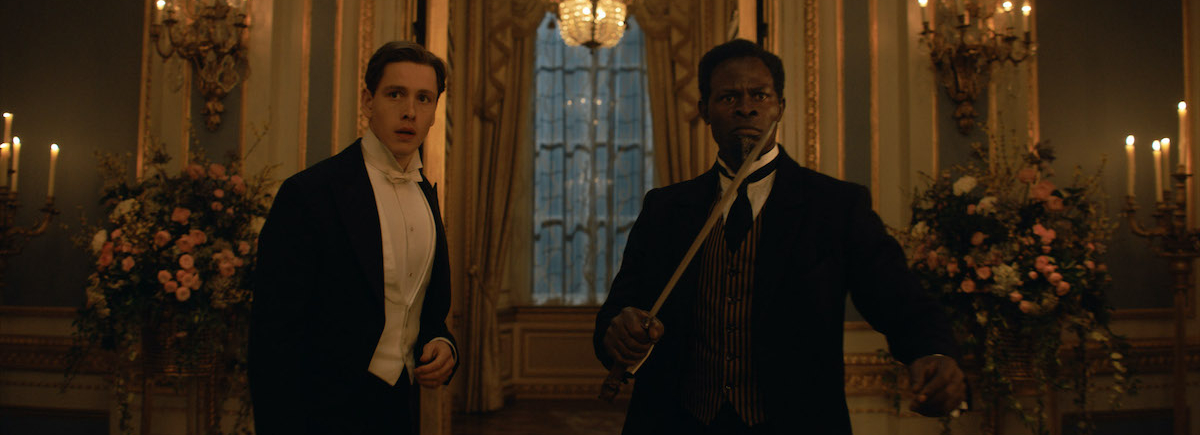
Director Chloé Zhao’s name was perhaps one of the biggest points of interest when it came to the 26th, and latest, entry into the Marvel Cinematic Universe, Eternals. Her visual style is certainly on display in plenty of scenes and it forms an image different to that of other features produced by Marvel Studios thus far. However, the view is often distracted, rather interrupted, by extensive sequences of CGI fights, battles and spectacle – often causing a confliction between the locations and the visual effects that doesn’t completely sit well visually. There appears to be a slight rivalry throughout between the progressing narrative and the titular Eternals themselves.

With ten characters they each need time to form a connection with the audience and get across who they are, what their powers are and help to push the plot forwards. Leading the group of immortal superhumans sent to protect Earth from an alien race known as the Deviants is Ajak (Salma Hayek). Keeping the group in order as they try to fulfil their mission and reason for being on the planet, influencing human and societal evolution along the way. Largely we see the film’s events through the eyes of Gemma Chan’s Sersi, formerly in a relationship with fellow Eternal Ikaris (Richard Madden), but now happy – although not revealing her true identity – seeing colleague Dane (Kit Harrington) in modern day London. As the Deviants become a returning presence she must travel around the globe, with Ikaris and youthful, yet shapeshifting, Sprite (Lia McHugh) to find the reassemble the group.

Through various flashbacks we learn about the past of the Eternals and just how close a group they were in enforcing the task set upon them by rocky, red, six-eyed Iron Giant Arishem (David Kaye). It forms various introductions and contexts to each figure, who we are then re-introduced to later in the film when finally arriving at their respective locations. The film jumps back and forth both in time and location making it feel considerably busy, and causing it to reach a lengthy two and a half hour plus run-time. It feels like more than half of this time is spent simply meeting and re-meeting members of the titular team, all while trying to find space for fights with the creatures that they’re hunting down and battling. There’s certainly a lot going on within the film, creating certain elements of conflict between its focused elements and creating a slight sense of disorder. It’s a surprise when even Angelina Jolie doesn’t appear to get a great deal to do during her somewhat short amount of screen time.


It all leads to much repetition as instead of moving on and assuming that each new character has been told what’s already happened we essentially get told the plot all over again. It feels like the result of multiple hands involved in the writing of the screenplay. And while the Eternals are already aware of their powers and this isn’t an origin story there’s a fair deal of work going in to building all of them up as if characters that we’ve spent multiple films with already – almost like an Avengers style team within their first film, although the feeling doesn’t overly come across. You don’t even always get the united group style eventually found in James Gunn’s Guardians Of The Galaxy, although that only had half the amount of core members.

Once the elements have come together and the third act finally arrives the final battle is all set up. It’s here, once it seems the build-up is out the way, that things properly come together. We’ve had glimpses beforehand – the film builds itself up and improves however slightly knocks itself back with each new flashback – and generally the film has a number of elements that work in its favour to keep the audience engaged and involved, however as the final fight pans out this is where what is perhaps the highlight of the film lies. It no longer feels bogged down by repetition and greetings, instead getting on with the task at hand and providing some fairly decent fight action while at it. The less cluttered feeling helps and it actually allows for a handful of characters – particularly Lauren Ridloff’s Makkari – to have that bit more to do, while allowing their unique powers to also take a role in the team course of action.

There’s a long and slightly uneven path on the way to Eternals’ finale. While it occasionally builds itself up with new pieces of detail and an improved flow it soon feels knocked back by jumping to a new location for another character introduction, or to an extended moment and idea in the past. It pushes the run-time to beyond where it should be – closer to two hours than three, or rather two and a half. Yet, despite the conflicting nature of some elements there are those moments where the flow and tone improves and you manage to find yourself caught that little bit more in the piece and the world that has been created. It might not always be for long, but it helps make the third act an enjoyable finale in the wake of the clutter that comes before it.

Much like the titular team themselves, Eternals eventually comes together, and does so bit by bit over the lengthy run-time. However, it feels very busy and a bit all over the place beforehand.

Rating: 3 out of 5.

LFF 2021: Bull – Review

Release Date – 5th November 2021, Cert – 18, Run-time – 1 hour 28 minutes, Director – Paul Andrew Williams

Having been believed to be dead for 10 years, Bull (Neil Maskell) returns to exact revenge on those who suddenly turned against him all those years ago.

“Your family was put on this earth to destroy mine, and I’m not gonna allow it”. An idea which appears to be believed by both sides of the feud when believed-to-be-dead Bull (Neil Maskell) suddenly returns after ten years. He’s hurt, angry, grieving and most of all seeking revenge on those who suddenly turned against him all those years ago. He creates a path building all the way to the top, ex-father-in-law Norm (David Hayman). Bull’s trail starts quickly, swift and clearly. A stream of blood begins to flow as his thirst for revenge seems to have only strengthened over the decade – in which none of the characters appear to have aged – since he was seemingly disposed of after multiple arguments with Norm’s daughter, and Bull’s ex, Gemma (Lois Brabin-Platt), from whom he tried to get custody of their son.

The 18 rating is certainly lived up to in the case of the killings that we see Bull act out. He’s an unflinchingly tough figure who knows exactly what he wants to do and how he wants to do it. Such moments certainly have an effect on the viewer, however the scenes around them seem somewhat generic within the British gangster/ revenge genre. It’s pushed by the feeling that initially the film appears to be telling two stories at the same time. One of Bull getting revenge, and one building up the reason as to just why he’s seeking revenge in the first place. The two begin to feel as if they’re competing for space within the short 88 minute run-time and the shifts in focus turn to your shifts in attention and having to settle back into the other/ next point despite the fact that both are linked.


However, as we enter into the second half and the film builds further up towards an eventual meeting between Bull’s increasing anger and Norm’s growing worry, gradually not doing his best to hide it, things slightly pick up. A somewhat episodic nature is left behind and the narrative comes together a bit more to have a bit more fluidity. Maskell certainly makes for an interesting lead. The rage of the character particularly comes through his near-enjoyment of his revenge. One sequence in a fairground in particular has an effect as you feel his victim’s unease and knowledge that there is no escape from the uncertainty at what will happen with Bull confronting him on one of the rides. Yet, Bull isn’t completely a character that you get behind – in fact the film as a whole isn’t overly one where you find yourself supporting any of the major characters; although Bull does have the aim of trying to find his son, freeing him from a life within the crime family who attacked him all those years ago.

It’s a point that Bull doesn’t always dwell on as it moves from violent attack to preparations for further violent attacks in the guise of construction workers in a greasy spoon. There’s certainly plenty to like and generally keep you invested in the film as it goes over its fairly short course, and while initially feeling slightly conflicting with its narrative style it eventually comes together for the final standoffs and the core finale to have more effect than the more generic, slightly episodic stylings of the first half. It makes for a solid British gangster, revenge thriller. One that, like the character of Bull himself, knows exactly what it wants to go out and do and goes to do that with a direct plan, even if it does cause a few splatters along the way.

Once the narrative becomes more direct, with less competition between the build-ups, it’s easier to enjoy the violent British gangster revenge stylings of Bull, especially when it shifts away from more generic elements.

Rating: 3 out of 5.

LFF 2021: Spencer – Review

Release Date – 5th November 2021, Cert – 12, Run-time – 1 hour 57 minutes, Director – Pablo Larraín

1991, feeling increasingly repressed, Princess Diana (Kristen Stewart) spends a brief yet tense Christmas with the royal family at Sandringham House.

Spencer is very much a film not just concerned with restrictions faced by Princess Diana (Kristen Stewart) as a member of the royal family, but one where she finds her mental state declining when seemingly beginning to believe the rumours circulated about her. Harassed by the tabloids who will gladly print anything to put her less in favour with the rest of the royals it’s hard not to have your mind thrown to more recent echoing events. As Diana struggles through the endless, closing in corridors of Sandringham House she fears “all rumours of my disintegration confirmed”. We’re firmly placed in the spiralling state of her mind, pushed further by Jonny Greenwood’s eclectic, swirling score and director Pablo Larraín’s swirling use of the camera. Tension rises throughout the film and it truly feels as if there could be any outcome within the dark fantasy course that the piece seems to travel along.

As for the rest of the royal family themselves there’s little dialogue given to them. A handful of key exchanges, particularly heated arguments with an imposing Jack Farthing as Prince Charles. There’s something gothic to the presentation of many scenes involving the family. A number of dizzying dinner sequences where Diana finds it difficult to stomach the lavish dishes laid out in front of her almost play out like a horror film. The idea of “they don’t want us to be people” echoes in such scenes as daunting stares pierce through Diana and further bring her down; there’s an ease to which almost every other character is made to feel like an antagonist. It’s clear with very little being said that judgement and mistrust are placed heavily upon Stewart’s sensationally performed central figure while she simply tries to be a good mother to her two children (Jack Nielen and Freddie Spry as William and Harry respectively).


It feels that the only people who are there to show any sympathy are dresser Maggie (Sally Hawkins), constantly offering calm words of comfort and understanding solace to Diana at the most difficult of times, and head chef Darren (Sean Harris). While unable to do much in his position he does the best he can to look after Diana from the sidelines in preparing food especially for her, altering his menu in the process. They offer slight relief from the tension that’s felt rising throughout. However, during such moments you almost don’t want to completely enjoy the moment as you know that soon you’ll see Stewart thrown back into the ring with worry and fear flooding her tearful eyes. It’s a truly emotional performance that forms an almost immediate connection with the audience and holds them in place for the entire run-time. As she’s hounded by the press outside of a church on Christmas Day she glances away from the gaze of the cameras and it becomes immediately clear that Kristen Stewart IS Princess Diana and her effort truly pays off with a flood of impact.

When paired with the design and look of the piece – Sandringham is a cold residence often surrounded by mist or darkness to provide no way out – there’s a true feeling of entrapment. Each scene is so wonderfully and carefully shot to emphasise such feelings, particularly a heated exchange between Charles and Diana after she apparently hasn’t followed various instructions, including wearing certain clothes at specific times, you’re caught in the swirling nature that the film and Stewart’s performance – which will, deservedly, likely be a hit come awards season – so wonderfully capture.

There are plenty of layers that blend together with ease within Spencer. All excellently delivered through Kristen Stewart’s triumphant central performance as her central figure gradually breaks down under the pressure of both the press and those who she’s supposed to be spending Christmas with. It’s an often gothic depiction with horror-like elements that help to raise the tension and your immersion within in the piece. Topped off with the quietly lit design and visual strength of the piece, and Larraín’s swirling use of the camera to match Jonny Greenwood’s similarly spiralling score there’s plenty to bring you into Spencer. Helping you connect with the titular figure, reclaiming her identity, yet still leaving you with fear that something could go very wrong. It’s a finely drawn line and it’s walked along with strength and confidence that helps to further solidify this depiction of Diana Spencer.

Tense, gothic and dizzying, with little time for hesitant breaths of relief, there’s a lot swirling within Spencer, all perfectly captured within Kristen Stewart’s fabulous central performance. One which forms an easy connection with the viewer and truly gets you into the breaking-down mind of the repressed central figure.

Rating: 4 out of 5.

Antlers – Review

Cert – 15, Run-time – 1 hour 39 minutes, Director – Scott Cooper

A teacher (Keri Russell) begins to investigate an isolated student (Jeremy T. Thomas) when his classwork becomes increasingly dark, reminding her of familial abuse in her past.

There’s a lot of director Scott Cooper’s Antlers which is concerned with the re-emergence of the past. Over the course of the 99 minute run-time we see a handful of characters face the demons, sometimes literally, which have held them back for times ranging from weeks to years. Predominantly we focus on quiet twelve-year-old Lucas (Jeremy T. Thomas). An isolated student whose increasingly dark classwork begins to concern his new teacher Julia (Keri Russell). Julia has moved back to the quiet Oregon town in which she grew up, living with her sheriff brother Paul (Jesse Plemons). Lucas’ work reminds her of the abuse she suffered from her father as a child. Occasional hints and beats throw back to this demonstrating the trauma that she went through in the exact same walls in which she finds herself living again now. She feels trapped in by them, much like Lucas does in the darkened room that he’s confined to. Crouched in the opposite corner to a door with the same number of locks that would take a ‘funny-not-funny’ amount of time to unlock in a comedic context, he scribbles by the light of his torch while an unseen figure crashes, scratches and roars all around him.

Particularly when dwelling on the ideas and themes of abuse Antlers often feels more like an emotional drama rather than focusing on the darkness of the horror. The overall tone feels slightly muddled, only truly choosing one – the horror – when it comes to the third act. The horror certainly seems to fit the piece better, however when the emotional elements are almost completely dropped in exchange there’s a slightly odd feeling overall. Different to that which has been lying over the film beforehand, slightly preventing the viewer from forming a proper connection with the piece and the characters within it. Characters who we jump back and forth between as they deal with their pasts or myths and fables of the past – an early scene in the school sets this up by discussing just what stories are – each almost telling a different story, or one pausing the main narrative to sidetrack to them not quite observing the main narrative, so that the film begins to feel somewhat lengthy.


Over time the film gradually builds up characters, trying to add more detail to some side characters who pop up every now and then. Plemons sheriff is one figure who the writers attempt to give more prominence to, however he feels underserved and therefore the actor has little to deal with when he is on screen. It gets to the point where the core antagonistic force even feels underserved and with little screen time. To the point where the titular reference of the film almost feels like a spoiler due to how late into the run-time it appears – although even after this we don’t see much development or action from the titular CG antlers. Instead we get further mystery and flashbacks to look at Lucas’ past and his family relationship – it appears that he almost lives alone, aside from the potential creatures on the upper floor, although it’s only known that his mother passed away a number of years ago.

Things tangle and twist and manage to build up the rough, if not completely detailed, plot of the film. However, with seemingly so many elements, most of which feel underdeveloped, there’s little room for engagement and connection with the film, leaving the viewer stuck outside of it, feeling fairly distanced. Even as the horror takes more centre stage and a barrier is slightly removed it’s still difficult to properly feel a part of the unfolding events as the scares don’t really add up to much and it all feels to have been done a little too late in the piece. While being emotionally rooted in various pasts and fables, Antlers spends little time properly creating scares and progressing the narrative in the present.

Part emotional drama, part dark horror. There’s a confliction of tones within Antlers, not helped by the confliction of characters and underdeveloped focuses which removes from the main horror force which should be more towards the centre of the piece.

Rating: 2 out of 5.

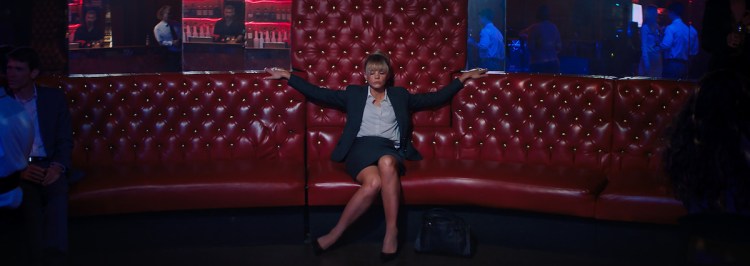
LFF 2021: Last Night In Soho – Review

Release Date – 29th October 2021, Cert – 18, Run-time – 1 hour 57 minutes, Director – Edgar Wright

New-to-London fashion student Eloise (Thomasin McKenzie) finds herself transported to 1960’s Soho at night, observing the gradually darkening life of aspiring singer Sandie (Anya Taylor-Joy) as the past begins to echo into the present.

We’ve become used to Edgar Wright’s taste for style and soundtrack choices to add extra flair to his films, and there’s plenty of both in his latest venture, Last Night In Soho. Yet, amongst the wonder-inducing visual style the effective sound mix of the film is not lost, further fleshing out the time-travelling confusion that central character Eloise (Thomasin McKenzie) finds herself a part of. You too are taken back to 1960’s Soho to witness, alongside Wright’s love for occasional camera trickery taking the place of the fast-paced editing which he has become known for, Anya Taylor-Joy’s mysterious aspiring singer Sandie as she tries to build herself up from a backing singer on the variety stage. There’s a true open-mouthed sense of wonder as Eloise first treads into the brightly-lit past

As Sandie begins to find herself delving into a darker world which, according to Matt Smith’s boyfriend turned manager Jack, apparently comes as part of the job, her life, and indeed appearance, begins to echo into modern day London. Eloise begins to adapt her own look from the self-made clothes of a Cornish fashion student (her accent slightly wobbling at times, as does Smith’s occasional Cockney accent) to pricier 60s-inspired clothing from throwback shops. Yet, despite how well things appear to be going for Eloise in the present as she’s transported back in time, from her bed in her rented room in a scene-stealing Diana Rigg’s brilliant final role, each night things become more and more sinister for Sandie. The tone and effect of one particular revue scene as McKenzie’s character is trying to piece everything she’s missed out on during the day in a strong state of confusion matches that of the viewer. When mixed with the effectively excellent visuals there’s often a lot to bring you further into the blended world that Wright and his creative team have created.


When it comes to the elements of horror that make this stand out from Wright’s other work to date there are certainly moments which manage to establish a certain fear factor. A slight sense of fright, and even occasional terror, do line the piece. While not frequent, and not completely the dominating tone of the piece as a whole, they certainly manage to make an, even if brief, impact on key occasions during Eloise’s increasingly panicked investigation into the past that she’s becoming a part of, partly by her own choice. As things begin to blend together and the initial dreamlike nature of things turns into a nightmare for both central parties the past and present begin to support each other further. Initially the sequences of the past, with all their detail and style, feel a bit stronger than those focusing solely on Eloise. However, as we see more and the worlds further open up in various ways they begin to merge and work well together to further progress the story.

While this might occasionally lead to some more on the nose elements – including a, still kind of enjoyable, use of Dionne Warwick’s (There’s) Always Something There To Remind Me; matching a couple of other moments which could easily slip into a more comedic tone, aside from the couple of hit or miss laughs dotted throughout when compared with the tone of the rest of the film – there’s still enough to keep you engaged with the film and caught in its flow. This particularly in the build up to the various points and conclusions of the third act. It might not be to everyone’s tastes, however the style is still in place and manages to keep you engaged with the events and gives them more of an impact. It slightly steps away from the engagingly detailed 60s look, feel and style of what has come beforehand. But, still manages to work well enough to give a good conclusion to this fade from glamorous gaze of the darkening streets of Soho.

The past of Last Night In Soho is filled with strong attention to visual and audible detail that leaks into the present day scenes. Merging together for a further engaging story and world. The third act, with its more on the nose elements, might split some viewers, but its style is undeniable.

Rating: 4 out of 5.

Dear Evan Hansen – Review

Cert – 12, Run-time – 2 hours 17 minutes, Director – Stephen Chbosky

When another student takes his life, Evan Hansen (Ben Platt) finds himself forging a friendship to console the grieving family (Kaitlyn Dever, Amy Adams, Danny Pino) when Connor is found with one of Evan’s therapy letters to himself.

The feature adaptation for Tony award winning Broadway musical Dear Evan Hansen has largely plugged the award winning stage production in its marketing, and particularly the fact that it’s a musical with its seemingly fan-favourite opening number. However, sitting down to watch the film it seems apparent that over the course of the over two hour run-time that a number of the songs have been cut out in the adaptation. Generally the film doesn’t overly feel like a complete musical – particularly with the rather static feel of almost every song. While not bursting into a dance number isn’t a bad thing you do begin to want more action in the songs instead of people simply sitting or standing for three or four minutes while staring at each other and singing. It particularly removes something from a number of the third act encounters where the songs begin to feel longer and with much less impact, partly down to the stationary nature in which they come across.

The near lack of songs also perhaps makes the actions of the titular character (Ben Platt – in makeup that seems to age him up more than it does make him look like a teenager, not helped by the fact that the lighting often glaringly defines the makeup) more unforgivable. Initially alongside his only friend, Jared (Nik Dodani), Evan fakes a number of emails to make it seem as if he had a strong friendship with distant student Connor (Colton Ryan). This is after Connor takes his life and is found with a therapy letter Evan wrote to himself earlier that day before a second altercation with Connor, whose mother (Amy Adams) and step-father (Danny Pino) now want to know about their son and his friendship with this stranger.


It’s clear that what Evan’s doing is wrong, he even knows it himself. However, over time it feels as if this element of the film is glossed away. Things are generally watchable, even if not all of the elements completely balance well together, during the first hour. However, as things move on into the second hour it feels as if the narrative itself gets lost in exchange for throwing various different points and elements down the hole which has already been dug in the hope of making it deeper. It causes the run-time of a long film to be pushed and loses any form of connection for the viewer as Evan becomes even more of an unforgiveable character – particularly as his relationship with Connor’s grieving sister (Kaitlyn Dever in a quiet yet strong performance considering what she’s been given) grows from his too-awkward-to-approach attitude at the start of the film. Somehow managing to further echo a number of teen/ high-school movie clichés which are scattered throughout a number of the earlier scenes where the film feels slightly unsure of its initial tone.

The film occasionally shows glimpses of the bereaved family grieving and their different ways of coping, alongside the arguments that emerge from it. However, they seem so brief that they almost come across as underdeveloped and another attempt to create another layer of drama within the narrative. A narrative which is filled with various hints and glimpses that don’t really carry much further. Yet, for a film busy with such glimpses and moments Dear Evan Hansen manages to feel somewhat empty with ideas.

Things continue to dive deeper down the hole that has been dug in a repetitious spiral to the point where it’s hard to possibly reconnect with the film again. When taking into consideration the lack of repercussions or reprimanding, aside from some brief personal dealings, faced by Evan things feel particularly odd. As if his awkwardness and anxiety are being used as the reasoning for everything that has happened to him. This weight is largely felt in the second hour of the piece as the main point is ‘look how far everything has gone’. Turning a not-as-bad-as-you-might-think film, even if not everything properly clicks with the viewer in its state of slight imbalance, into something of complete disconnect with the central character and the events that he dishonestly forces himself into. For a film that has advertised itself as one for the outsider in all of us it certainly manages to shut its central figure out from the audience with both his actions and the way that the film generally treats and handles him.

While starting off on watchable, if slightly wobbly, ground Dear Evan Hansen soon dives into a deep hole that’s hard for it’s central character to get out of. Becoming as repetitive and static as its few lengthy musical numbers.

Rating: 2 out of 5.

Dune – Review

Cert – 12, Run-time – 2 hours 36 minutes, Director – Denis Villeneuve

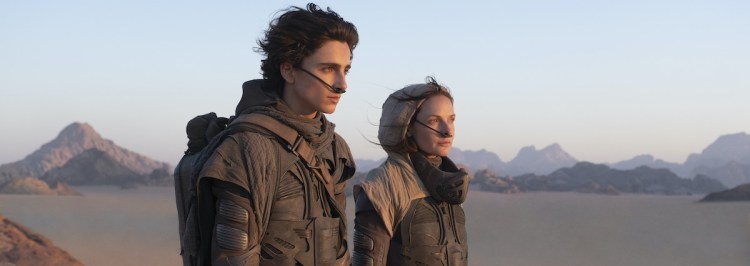
Ducal heir Paul Atreides (Timothée Chalamet) finds his visions of the future becoming true with increasing frequency as his family arrives on the much fought over desert planet of Arrakis, holding the universe’s most expensive and sought after substance, Spice.

There’s a slight surprise when the title ‘Dune: Part One’ appears on screen at the start of Denis Villeneuve’s latest. It’s not because this is only an adaptation of Frank Herbert’s classic sci-fi novel – it’s been stated many times that this will be at least a two parter – but the fact that the lettering is so small when compered to the size of the screen. In many ways it reflects the film as a whole. While undeniably grand in scale with its awe-inspiring visuals, Dune never feels overinflated or as if it’s grabbing for your attention. Dune is unashamedly itself.

It allows for the vast landscapes of the desert planet of Arrakis to speak for themselves. Pouring over the viewer and bringing them into the futuristic world that has been visually carved out. Each shot, region and detail helps to expand this world and simply creates an even more impressive cinematic spectacle which explodes, sometimes literally, onto the big screen. What has been achieved visually makes Dune a rarity of a cinema experience. A feat close to that of getting away with bagpipes on another planet thousands of years in the future. There’s a striking impact which keeps the viewer in place over the course of the gradual build-up that acts as much of the film’s somewhat loose narrative.

We follow house Atreides her Paul (Timothée Chalamet) as he travels to Arrakis where his father (Oscar Isaac) is to take charge. It’s a time of great change for the planet, which has been much fought over and craved for the Spice which can be found on it. Spice is held highly as perhaps the most expensive substance in the universe thanks to its ability to held with space travel. It also makes the sandworm filled planet a must have for Stellan Skarsgård’s little-seen Baron Harkonnen. It’s after arriving on Arrakis that strange, almost painful, visions of the future that Paul has been having begin to become reality with increasing frequency. It builds up to an event that will shake the Atreides family, including Paul’s mother Lady Jessica (Rebecca Ferguson), and cause Paul to drastically change – perhaps a bit too suddenly? – whether he likes and knows it or not.


In the build-up to this event there’s not much in the way of story. The planet is explored and there are certainly some visually stunning moments. From the expansive confines of the palace which the family reside in to some eye-widening sandworm action in the heights of the sand dunes there’s plenty to keep you engaged and entertained throughout. Moments which aren’t just visually engaging but also sound fantastic, truly capturing the atmosphere of the world which has been created and bringing you deeper into another layer of authenticity and believability which has been sculpted by the entire creative team behind the film. There’s no denying Dune’s chances in at least technical categories come awards season. The budget has clearly been used to great effect, however it’s also in the smaller details where there’s great effect. There’s something quite effective about the way protective suits worn by the characters during moments of combat surge red when hit and killed, perhaps landing more of an impact than the sight of blood would in this futuristic realm.

When it comes to more core elements and happenings in relation to the building narrative some points feel somewhat glossed over. Particularly the first appearance of Javier Bardem’s Stilgar – a leader of Arrakis inhabitants the Fremen. There’s a lot placed into this film, and it does mean that some elements are covered almost too quickly, yet there’s still the scale and appeal of the piece, which particularly helps when considering the fact that there seems to be little dialogue over the two and a half hour plus course of the film. You’re captivated by what’s happening on-screen, helped by the look and style of the piece. Everything builds up and continues to escalate and escalate towards a rather thrilling climax. And then the film continues.

It feels slightly weird to still be kept in the film, with a slightly slower pace, after what you thought was going to be the end. Perhaps this just me, but personally it did feel as if the ending was being built up towards and then the narrative progresses, albeit to the logical conclusion for this first half of the story. It’s certainly not that the film outstays its welcome, you definitely don’t feel the two and a half hour run-time. It’s more a case that it feels slightly odd remaining a part of it as it builds up momentum again in a much shorter space of time as the actual ending is built up towards.

Again, maybe this is all just me thinking that things began to slightly retract away from the five star spectacle that the film initially held. Perhaps on a rewatch I might see the film as just that all the way through. It certainly starts as one. Things just don’t completely recover after perhaps too much build-up and eventual release. But with a film of this magnitude and impact, perhaps it was bound to happen at some point?

One of the best cinematic spectacles for a long time, Dune effectively uses the big screen to express its grand-scale locations and stunning effects. Bringing you in for a story that while sometimes slightly rushed builds up pace to a point that on a first watch is perhaps eventually almost too far?

Rating: 4 out of 5.

The Boss Baby 2: Family Business – Review

Cert – PG, Run-time – 1 hour 47 minutes, Director – Tom McGrath

Distant brothers Tim (James Marsden) and Ted (Alec Baldwin) are transformed into their younger selves to investigate the actions of the mysterious principal (Jeff Goldblum) of a new advanced, high-tech school.

2017’s The Boss Baby was a film with plenty of obviousness. However, it was a success and therefore a sequel has arrived. But, in terms of this sequel perhaps the most obvious thing is the fact that, when looking at the credits, of course Gary Barlow wrote the main song Together We Stand. There are certainly still elements of predictability within Family Business, and indeed not every joke lands, but with even one chuckle it has more of a success rate than the original film.

Brothers Tim (James Marsden) and Ted (Alec Baldwin) have grown up and apart since we last saw them. Tim is happily a stay-at-home dad to his two daughters, Tabitha (Ariana Greenblatt) and baby Tina (Amy Sedaris), while Ted is fittingly the billionaire CEO of a major business. In many ways Tabitha is growing up to be more like her uncle, formal and pushing forward with serious matters. It contrasts with what is branded as her own father’s ‘active imagination’. “I think it’s time we both grow up. I look forward to greeting you at the breakfast table” she states in the manner of a business email exchange rather than a child being put to bed.


Her behaviour is perhaps an effect of the school she attends. A new high-tech school developing advanced, competitive minds run by energetic, yet mysterious, headteacher Dr. Erwin Armstrong (Jeff Goldblum). On seeing Armstrong’s character design, like a tall, bubbly sheep which has been partly shaved to make the knitted jumper it’s wearing, the thought does arise that he doesn’t overly match Goldblum’s mystical tones. It’s a thought that comes to mind a couple of times when the character appears on-screen, gradually fading as more is learned about him and you simply embrace the fact that Jeff Goldblum is a part of this film. Nonetheless he runs a tight ship which Ted and Tim investigate after discovering that Tina is in fact able to talk and ‘in the family business’ by working for Babycorp, who are themselves looking into Armstrong and just what’s happening inside the school. Thus, after agreeing to take on the mission, the brothers set aside their differences to transform into their younger selves for 48 hours so they can feed back.

Unlike the first film Ted is much less in the spotlight here. There’s much less reference to his pretentious nature and those of which there is manages to raise a mild chuckle on one or two occasions. While the relationship between the brothers is certainly a focus for the film the narrative feels tighter and much more about the mission at hand, and indeed Tabitha. Tim’s younger self watches her excel in class while being made fun of by other, jealous, students attempting to spoil her performance at the upcoming Christmas pageant. Overall the film doesn’t feel as lazy as the 2017 feature. While it might not be anything overly brilliant it’s certainly not dreadful and makes for watchable, mildly amusing content. Providing enough chuckles and exhales of amusement along the way, particularly from Gandalf like Wizard alarm clock Wizzie (James McGrath), to avoid all the humour being a miss.

Initially you’re caught off guard by this and begin to think that it might just be for the time we see Tim as an adult, before he and his sibling ‘shrink’. However, as things continue you’re able to properly settling into them and simply become able to enjoy the film and get slightly caught up with its flow. Things might seem slightly slotted and taped together at times, mostly for when linking from scene to scene, or rather location to location, but there’s still some amusement to be found. The laughs might not be in abundance, although there are still some scattered throughout, but generally as The Boss Baby 2: Family Business expands itself and dwells on more than just the one-note gags of the first film, exploring the family dynamic at the centre of this film and the narrative in general, a fairly likeable course is set out that provides enough amusement for the run-time and makes for a pleasant enough watch.

Expanding both in terms of character and narrative from the first film The Boss Baby 2: Family Business strikes thanks to feeling generally less lazy and, even if slightly, more detailed. Providing fine amusement, and one or two chuckles along the way, for the duration of the run-time.

Rating: 3 out of 5.

Halloween Kills – Review

Cert – 18, Run-time – 1 hour 45 minutes, Director – David Gordon Green

The residents of Haddonfield unite to finally take down Michael Myers (James Jude Courtney/ Nick Castle) after he survives a fire in Laurie Strode’s (Jamie Lee Curtis) home, while she recovers in hospital believing him to be dead.

Back in 2001 to truly show the ridiculous lengths that it had stretched to the Friday The 13th franchise came up with, arguably the worst film in the series, Jason X. Not only launching the silent killer into space but also turning him into a literal machine, kitted out with full shining silver armour, the kind you only find in cheap early-2000s sci-fi flicks. While Michael Myers (James Jude Courtney/ Nick Castle) doesn’t get the same treatment, after surviving being trapped in a fire-flooded basement, in Halloween Kills he certainly feels almost frustratingly indestructible. Although, perhaps this is because there’s not much around him that can possibly kill him as he seemingly attempts to make his way back to his childhood home – killing everyone in every house and park along the way. It becomes apparent that almost every character we spend more than five minutes with, preparing to do battle with the masked figure in the dead of night, is being set up to die because of their own ineptitude. Almost every character in this film is an idiot.

As we barely see Jamie Lee Curtis’ staggeringly underused Laurie Strode spend most of her small amount of screen time in a hospital bed – recovering from the events of the previous film, this one picking up immediately after – or shouting at the growing mob in the corridors, the residents of Haddonfield prepare to end the terror of Michael Myers once and for all. Led by previous victims or people who have encountered him, particularly Anthony Michael Hall taking on the role of Tommy Doyle, there are plenty of scenes focusing on the escalating numbers and anger of the mob.

Strode’s daughter Karen (Judy Greer) and granddaughter, Allyson (Andi Matichak), also play bigger roles in this sequel as they try to prevent Laurie from discovering that Michael is in fact still alive, while assisting the mob or going out on their own missions. If the last film was about trauma this one is about generational trauma. It’s stated at one point that Michael “has infected my family, he’s infected your family; with grief and fear for 40 years”. However, amongst the other points and themes that the film is juggling many ideas simply get drowned out and never really have as much effect as they would perhaps like. This is amongst various flashbacks to moments in Michael Myers’ past (Airon Armstrong taking on duties for the 1978 figure) – to show just how many people are still hurt from his actions 40 years prior and just how much stronger he becomes every time he is knocked down – and of course killings in the present (2018) day. There’s a lot crammed in to Halloween Kills and it certainly feels busy on a number of occasions.

Many scenes come with plenty of build-up just to get to one short burst of summarised dialogue. It generally feels as if the film could be made much shorter by just having characters get to the point more quickly. It would also perhaps help boost some of the film’s tension and mean that certain points have more room to breathe instead of having to wait for crowds of people to run through multiple hospital corridors for a not overly effective conclusion where the outcome can be seen by the viewer a fair while before it’s finally delivered.

Amongst everything that the film brings up it’s sometimes hard not to question whether the film is trying to be a parody of the slasher genre. Certainly certain actions and indeed killings begin to stray towards laughter territory rather than that of fear – and for some audience members, at one point myself included, this clearly becomes the case. It comes from the truly stupid decisions of a number of characters, none of whom we form a connection with, partly due to their own idiocy when confronting the armed figure of Michael Myers and also the general lack of screen-time that anyone gets. This all comes after initial killings which almost seem to dwell too much on the justifiably 18 rated gore and violence of the film. Not that this is generally a negative, but certainly as it seems to almost be emotionless in depiction during the first couple of instances and there’s a lack of response from the viewer it almost feels as if the film dwells on such moments for just a bit too long.

In a number of ways, for both plotting, themes, character, etc Halloween Kills feels a rather different film from the one that came before it. The feeling of a bridge film – before Halloween Ends comes out to complete what is currently a trilogy of sequels to the 1978 original – isn’t quite present throughout, although it does make an appearance at the very end, as is perhaps to be expected from a bridge film. Generally the structure, tone and feel of this second film fluctuates throughout. At times feeling like a gore-dwelling slasher, at others something of a parody of the genre; due to plenty of frustrating character decisions. The film is very busy and manages to both rush and stagger through its various themes with not a great deal of response – aside from occasional bafflement and slight irritation – from the viewer. Hopefully it’s just juggling all the elements so that we can get a smoother, more consistent final showdown (properly featuring and using Laurie Strode) when Halloween Ends.

While building up to having its moments Halloween Kills knocks itself down with inconsistent, not always properly established, tones that only lead to further frustration for the viewer who’s already dealing with the many baffling decisions of the multiple characters throughout the film.

Rating: 2 out of 5.

The Last Duel – Review

Cert – 18, Run-time – 2 hours 33 minutes, Director – Ridley Scott

A pair of knights (Matt Damon, Adam Driver) find themselves competing in a duel to the death after one accuses the other of raping his wife (Jodie Comer), who will burn at the stake if her husband loses.

Amongst the effectively bloody battles of 14th Century medieval France Nicole Holofcener, Matt Damon and Ben Affleck’s screenplay (the first joint script for the latter duo since their Oscar winning turn for 1997’s Good Will Hunting) for The Last Duel bubbles beneath with the slight memory based drama (each writer tackles a different stage/ memory in the narrative) largely for the two parties involved in the titular duel. There hasn’t been a duel to the death in France for many years, however when his wife Marguerite (Jodie Comer) claims to have been raped by Jacques Le Gris (Adam Driver), knight Jean de Carrouges challenges the man he believed to have been his closest friend to prove his protests of innocence wrong. We see the events play out from the perspectives of the three main parties, all building up to the duel – which also acts as our dramatic introduction to the film – where Marguerite could find herself burned alive for providing false witness if her husband loses.

As the film travels across its lines it shifts from simply being about the responses and changing behaviours of the two central figures over the course of the film’s events and begins to delve into the gender politics of the time. The belief that women were property to provide men with an heir – it’s claimed that “rape is not a crime against a woman, it is a property crime against her husband”. There are certainly some interesting points as the film begins to touch upon such subject matter, and there’s particularly potential for the final strand focusing on Comer’s character, however it feels that after what has come beforehand that her strand – which should really be the most pivotal – feels somewhat underwritten. Even as the film finally turns to focus on her Marguerite feels like the support in her own truthful take on events. The feeling of the film becoming more basic and less detailed certainly begins to settle in as the three takes on the tragic event come together in the fateful duel.

It’s testament to the film that you don’t really feel the two and a half hour run-time and largely this comes from the interest created within Driver and Damon’s own segments. The relationships that twist and turn around them as they put across their own worries and arguments, particularly as their friendship is already on uneven ground before de Carrouges leaves his wife alone at home – although believing her to be with his cold mother (Harriet Walker) and servants. Director Ridley Scott does a good job of piecing things together throughout the narrative, showing the different perspectives while still reminding us of how other characters appear to have ‘perceived’ the events. This even goes for those of whom we don’t see the viewpoint of – such as Ben Affleck’s Pierre d’Alençon, a close ally of Le Gris with a high sex-drive who seems both oddly fitting for the film and yet somewhat out of place with his levels of comic relief; either way Affleck’s clearly having a great deal of fun playing the character.

Scott’s direction also helps to capture the atmosphere and visual flair of plenty of scenes. The detail that has gone into the sets and costume design of the piece demonstrates the high budget of the film. It helps to engage you within the world and the unfolding events – particularly within the first two strands, and it’s perhaps what helps keep you somewhat in place during the point which should really be Comer’s time to shine. We do get some brief yet engaging courtroom style drama, and by the time we finally get to the big battle it’s well done, yet you can’t help but feel that things would be heightened if Comer’s character truly had more room rather than still having her story told through those around her, and what begins to feel like their words and actions over hers. The drama still generally works and keeps you in place, it just feels as if it shifts and not quite to the right place to allow the character who should be the central focus to be just that.

There’s plenty to like about the detail of The Last Duel. Both visually and within the course that it takes throughout the narrative. Helped by Ridley Scott’s direction there are a handful of themes to pass through over the two and a half hour course – which isn’t overly felt – and most of them are dealt with rather well. While the first two perspectives are well dealt with and detailed when it comes to the relationships that build up to the titular duel you can’t help but feel that the third strand is somewhat pushed back and not as detailed as it could be, particularly when it comes to truly giving material for Jodie Comer to shine with. The final fight still works, and the drama still has effect, just not in the way you would perhaps hope.

The detail, themes and drama of The Last Duel are generally well held, particularly when it comes to the relationships and conversations in the build up to the duel for the two central figures. It’s just a shame that Jodie Comer’s underdeveloped pivotal character doesn’t ever completely come to the fore.

Rating: 4 out of 5.