Release Date – 20th November 2026, Cert – 12, Run-time – 1 hour 41 minutes, Director – Rafael Manuel
17-year-old Isabel (Jorrybell Agoto) works at a golf resort, in the middle of a heatwave the darker sides of the wealthy guests starts to come through.
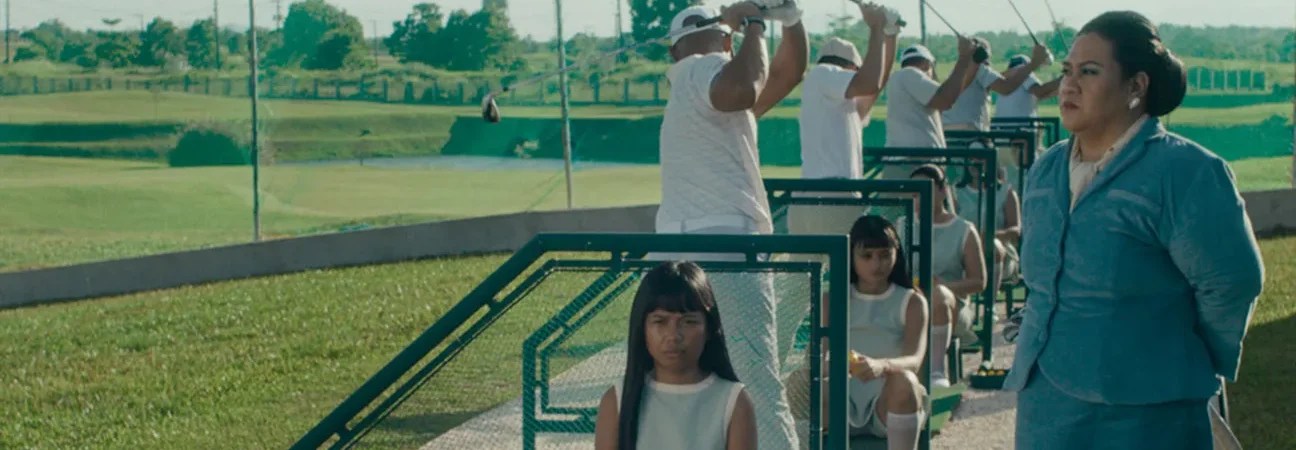
“We’re talking about the violence of gentrification” explained writer-director Rafael Manuel about the themes of his debut feature, Filipiñana. The heat comes through amidst a Philippine heatwave at the height of summer. Lighting up the golf resort at which 17-year-old Isabel (Jorrybell Agoto) works at as a tee-girl for wealthy guests who often struggle to hit the ball, or at least propel it very far. The resort, and at times the people in it, radiates artifice. It’s landscapes, particularly as we see golf carts slowly scuttle across the horizon, look like miniatures, a set of models as if pitching the perfect getaway to be built later.
While we see, and sometimes feel, the heat of the weather that of building tensions can’t quite have the same for it. Class disparities are focused on, with it occasionally leaking into the upfront dialogue as a young woman (Carmen Castellanos’ Clara) says “I think you ordered too much food, uncle” as he tucks into his personal banquet, “this is just how we eat here, you’ll get used to it” he responds. Elsewhere the simple stature and casualness of wealth contrasts with those working at the resort. However, as events pan out with a slice-of-life aspect I couldn’t help but wander what it was that I was meant to be taking away from the film beyond what had been said in the introduction to the screening.

The film doesn’t quite feel surface level, but it doesn’t quite feel as if it digs into the themes that it’s presenting, or gets the heat out of them as it does the sun that hangs over the events – helped by cinematography from Xenia Patricia. There’s a slow pace to the film overall, which adds to the slice-of-life feeling to the single day which the events of the film cover, particularly when we see glimpses of the various figures present at the resort, including one giving an amusing musical number.
But, it still feels uncertain what the film is building towards until there’s some form of culmination in the final stages which are treated with the same slow-burn pace, which feels as if it removes a possible effect from them. Things are largely observational than obtrusive or leaned into for emotion, and that does mean that they tend to come across with something of a blank stare rather than more affecting. Manuel has also stated that having grown up with a family that worked at a similar resort to that seen in the film that his film is a critique made with love, but even confliction doesn’t quite feel present in the sedate view that appears on screen.
There are interesting details in Filipiñana, and they help to keep general engagement throughout, but sometimes the slow-burn of events can prove a bit much and stop the potential effects that the various events and segments that construct Isabel’s day, and those around her, could have. Not digging in to the class disparity that’s present in the location and often feeling as if it needs to do more with what it has to bring out the violence that it wants to be present – even if just thematically.
The calm slice-of-life view that Filipiñana has means that, despite the clear heat throughout, its tensions struggle to come through until the closing stages with more layered elements of class disparity.

