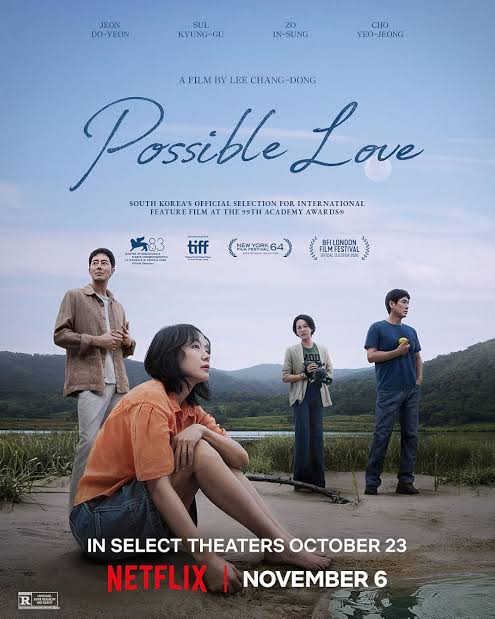
Cert – 15, Run-time – 2 hours 46 minutes, Director – Lee Chang-dong
Two married couples find their lives and desires intertwining when one chooses the others to be subjects in their documentary about those struggling for work.
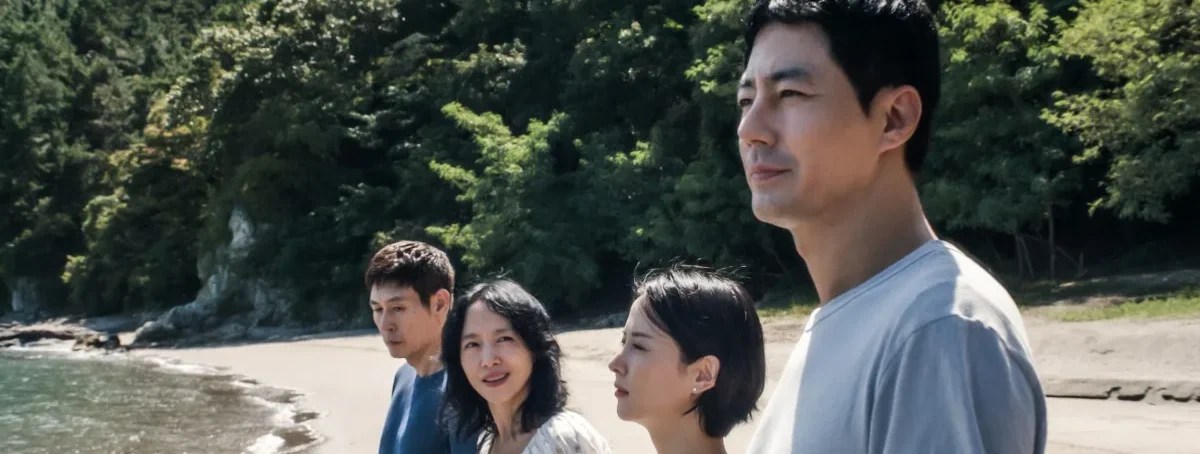
As we see characters being emotionally open, and from some directions being encouraged to do so, in Possible Love each remains guarded with their feelings. Even as lives, trusts and desires begin to tangle, or perhaps intertwine, between the two central couples. Documentary filmmaker Ye-ji (Cho Yeo-jeong) has chosen mask factory employee Mi-ok (Jeon Do-yeon) and her laid-off husband Ho-seok (Sul Kyung-gu) as subjects for her latest project about working class struggles for work. The pair are brought into Ye-ji’s world, alongside that of her husband Sang-woo (Zo In-sung), which appears brighter and much more ordered than their usual surroundings, and yet almost empty in comparison.
As writers Lee Chang-dong and Oh Jung-mi look at the emotional complexities of the characters amidst their unravelling before each other. The contrasts in lifestyles are evident on the surface and in the conversations and interviews that come up as part of the documentary. Ho-seok carries traumas and guilt around with him. He was part of strike action at the company he once worked for which was attacked by police, leading to the deaths of a number of his colleagues – those he worked with are now referred to as either ‘the living’ or ‘the dead’. Time has passed since then, but he, and those who survived, has struggled to find work. There’s a sense of No Other Choice at times here, with slow-burn naturalism replacing that film’s black comedy.
When we see the events of Ho-seok’s past they bring a fierce hit of violence and fear to his struggles. One particular sequence posed as a one-shot is a stunning shift in tone whilst keeping a bluntness that’s been present in others factors of the film, largely Ho-seok’s interactions with past colleagues. Whether it’s the pain of revisiting those moments, or a reminder of his current situation there’s a heaviness to the emotions, and how he particularly carries himself – Sul’s performance is particularly strong and contrasts with Cho’s smiling demeanour as she brings her film together, occasionally questioning the moral nature of her position making a film about the struggles of the working class.
Such ideas break through well, particularly in Lee’s handling as director where emotions, particularly those relating to the loves and desires of each character, as they, too, become entangled in the relationships we see on screen. Like the characters the film is constructed of complex emotions and conflictions, some of them potentially stemming from the filmmaker himself in his own approach to some of the subject matter at hand. It allows for an open look, and brings out more of the engaging naturalism with which we follow those on-screen through. Yet, it’s during some of the louder, most personal, and blunter moments of the film that the real effects come through, having been built-up to or talked at but yet to be properly confronted. And when they are there’s a true punch and impact, an understanding for the characters and where the film has taken them in their different lifestyles – in some instances, such as for Sang-woo, through simple generational wealth.
There are conflictions, but never fiercely so or angrily approached. Those moments are for the instances of police brutality and internal pain within certain figures. What Possible Love looks at for its main quartet is a well-observed, and naturally open, set of people consistently questioning what they’re doing, and if it will help them in any way.
A well-approached look at South Korea’s class divide and struggles, Possible Love’s open yet guarded emotion allows for its impactful bluntness to have a striking effect, held on to by a set of great performances.

