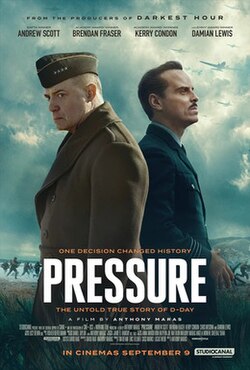
Cert – 12, Run-time – 1 hour 40 minutes, Director – Anthony Maras
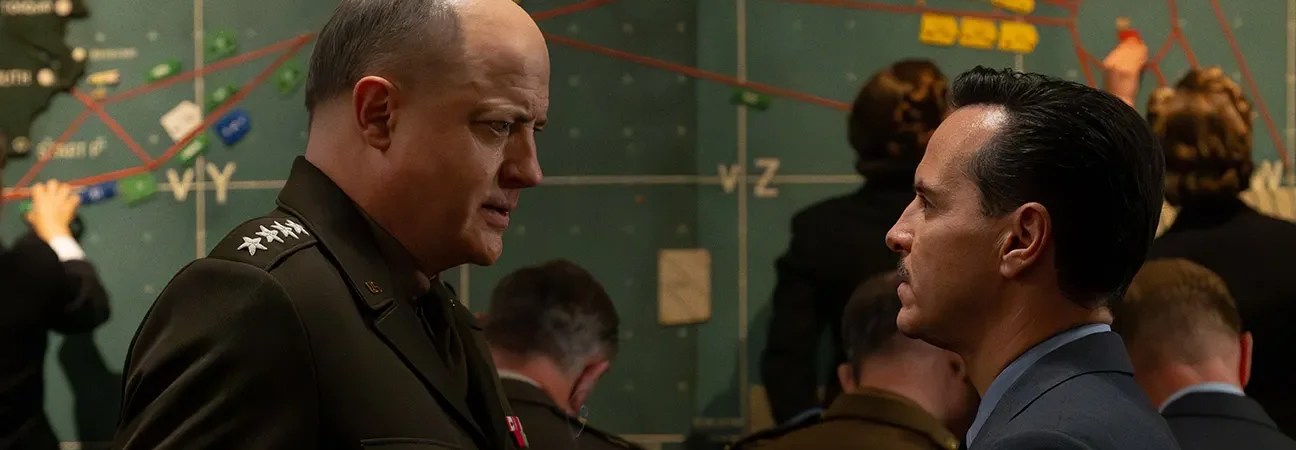
With days to go until the planned invasion, meteorologist Captain James Stagg (Andrew Scott) is brought in by allied military leaders to give a weather forecast that will determine if D-Day will go ahead, however he can’t provide the certainty, or forecast, they want.
It doesn’t matter that we know that D-Day goes ahead, it doesn’t matter that we’ve seen this story play out from multiple angles before – in the case of the actual D-Day sequence almost quite literally as some shots don’t try to disguise how they borrow from Saving Private Ryan – there’s still a tension to the countdown of Pressure. With just three days to go until the planned date of invasion meteorologist Captain James Stagg (Andrew Scott) is called in by allied military leaders to provide a weather forecast that will determine if the invasion can actually happen. However, his forecasts aren’t what key figures are looking for, especially when they contrast with historical data analysis, the kind that doesn’t work with the changing face of Northern Europe.
Tensions rise in the confined rooms of the country estate that’s being used as a base of operations. There’s pressure to get the invasion launched on time so as not to give anything away to the Nazis, to protect the lives of as many soldiers as possible and pull off a successful mission, and simply for the likes of General Eisenhower (Brendan Fraser, on particularly fine form when taking full command) to not lead another failure, such as Operation Tiger. It all successfully builds, catching you in the competing dramas between departments and just what is being laid upon Stagg.
Scott gives a strong performance of bubbling restraint as his emotions are concealed behind a stiff-upper-lip attitude, while his mind also thinks of his pregnant wife (Tamsin Topolski) at home, due any day soon. He and Fraser successfully butt heads and work together, capturing the push-and-pull that runs throughout the film, as the fate of the war is put into the hands of the characters, at least how the film puts it, of course historical accuracies and who had a bigger influence in reality has been brought up here as much as any other film relating to the subject of D-Day, World War II, or history in general.
And much like a number of these films you can maybe feel some coincidental timing in the narrative, alongside one truly crowbarred hymn that marks one of the most on-the-nose uses of a song this year. But, there’s still plenty of engagement and tension to be found in Pressure. It matches the seriousness and officious attitude of Stagg, whilst charting the emotional knocks and stresses that he and other characters face. Helped a great deal by the performances in quieter, more sombre moments where the characters are left alone, either literally or a distance from the rest of a scene’s activity. It’s in these moments that Fraser and Scott, alongside David Haig and director Anthony Maras’ screenplay – adapted from Haig’s play of the same name, with the film avoiding feeling stage-like – form the personal stakes for their characters without intruding on the grander points at play, instead contributing more to them whilst connecting us further overall.
Tightly told, the tension continues to build, led by the interactions and reactions of the characters. It’s an effective piece of work that stops you from thinking, or rather remembering, how it ends and takes you along for the journey up to that point. It’s perhaps the biggest success of the film, which has a number of them. Particularly relating to the tensions which crop up thanks to the interactions and knowledge of the characters at hand, each with strong performances behind them. At one point when it’s posed to him that the weather is boring, Stagg responds asking how it could possibly be boring. It controls our daily lives. We only ask when the rain will end, not why it rains, or why the wind blows, or where. Pressure captures that idea of a potentially detrimental force out of our control and with multiple charts and scenes of communicating with data centres at no point makes it boring.
Bringing suspense out through strong central performances creating the push-and-pull on the characters through their personal stakes as well as the pivotal point at play, Pressure captures the tension of the force that is the weather through feuding character interactions.

