Cert – PG, Run-time – 1 hour 42 minutes, Director – Andrew Stanton
As Bonnie (Scarlett Spears) grows up her toys have different views on how she should make friends compared to her new hypnotising tech device Lilypad (Greta Lee).
Toy Story saw the sudden arrival of a new favourite amongst the toys of Andy’s bedroom. Toy Story 2 saw multiple Buzz Lightyear’s experiencing the world of play whilst Jessie revisited her past with owner Emily. The trilogy closer looked at ideas of separation and moving on. Toy Story 5, following on from the solid, philosophical questions of what it means to be a toy that Toy Story 4 looked at in its sort-of-epilogue, appears to look back to this original trilogy for much of its events.
There’s not a sense of a victory lap but at times an accidental re-tread this around. As the franchise reaches 31-years-old tech has finally entered the world of play, and completely changed it. Now eight-years-old Bonnie (Scarlett Spears) is struggling to make friends as everyone around her is focusing on tablets rather than toys. As she tries to introduce other kids to Jessie (Joan Cusack) and Bullseye she’s almost laughed at, quickly giving them back to her dad in exchange for electronic Lilypad (Great Lee).
The toys have been the heart of each of these films, and their relationship with their owners. This time around Bonnie is the heart of the film, many of the best moments revolve around her as she faces an addicting, and sometimes harsh, online world. As her toys become ignored, with Jessie fearing a repeat of her first owner Emily, who we see flashbacks to with the still tear-jerking When She Loved Me returning in Randy Newman’s once more integral score, Bonnie’s personal journey creates the most emotional impact. Both in terms of the joy of play – this time around we don’t see the full-world environment of what’s in the child’s mind or the simple play but a different colour scheme and animation style for the unfolding fantasies; creating a handful of wholesome chuckles – and the emotional beats, although only a few specks of dust are present here rather than enough to require a vacuum.
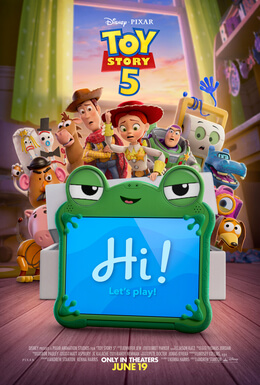
Toy-wise, Jessie is the focus here. She’s become the sheriff of the toy gang and is determined to prove that toys can still make friends over the draw of tech. As a consequence of the events of the previous film Woody (Tom Hanks) has somewhat been reduced to the Buzz role of that instalment, called in to assist with the fight against Lilypad; while Buzz (Tim Allen) still feels like an idiot, a very different character to who he was in the first three films. To make up for this we find an army of hi-tech Buzz Lightyear’s exploring the world, trying to find Star Command, after washing up on an isolated beach. It becomes clearer and clearer as the busy narrative – jumping back-and-forth between characters and rescue efforts – unfolds that this strand feels put in place for the convenience of resolving all other matters. The more they come into the picture and we see them playing a role in the developments the more everything seems very convenient, even if there is one nice call-back involving them.
Toy Story has long been rather simple narratively, although layered as part of that. There’s not as much layering happening this time around, in fact at times it can feel a bit preachy, and while somewhat simple the construction of the plot makes it sometimes feel very busy. It wants to give each character their moment, while spending time with new ones; human, tech and toy.
Jessie brings in some emotional moments as she revisits her past, with Cusack still charging full-force with her performance while Hanks and Allen continue to have genuine soft spots for their characters, placed best when once again looking at the role of a toy and the time they have with a kid – à la the ending of Toy Story 3, with hints of her aforementioned flashback song in the second film. Yet, for a Toy Story film it’s the human we have the biggest bond with, and who most spurs much of the action. The joy of play, the pain of tech, and other people, and yet how both can work together. The chuckles and tears may not quite be as present here, but there’s a film that has its moments amongst a narrative that feels busy with construction based largely around the events of previous films.
While still holding some Toy Story spirit the emotion and laughs aren’t quite on the same level as this fifth instalment, getting the most impact from its human characters and their relationships with toys and tech, feels busy with multiple strands, some seemingly more for convenience, and familiarity with previous entries.

