M3GAN 2.0 – Review

Cert – 15, Run-time – 2 hours, Director – Gerard Johnstone

Advocating for AI regulation, Gemma (Allison Williams) is forced to reluctantly rebuild M3GAN (Jenna Davis/ Amie Donald) to take on a more advanced robot (Ivanna Sakhno) planning a takeover of the US and beyond.

M3GAN 2.0 is less a sequel to M3GAN and more a sequel to the response to that film’s viral marketing campaign. Leaning away from horror and more towards action bursts of dialogue in the sequel mirror the trailers and taglines for the robotic-doll-gone-wrong’s return as a sassier, ever so slightly more self aware outing. Although, these bursts are largely all featured in the marketing as the rest of the film doesn’t feel quite so heightened, likely knowing that too much would make an overblown, forceful film crafted by the internet.

Instead, sole writer Gerard Johnstone, also returning to the director’s chair and receiving a story credit alongside M3GAN screenwriter Akela Cooper – the pair also shared story credit’s on that first film – tackles a safer tone and style in the aforementioned action vein. Many have mentioned the Terminator 2 feelings of the narrative, which are certainly present, as Allison Williams’ Gemma, now advocating for AI regulation in the wake of the deadly toy-gone-wrong she built in the first film, is forced to rebuild M3GAN (voice by Jenna Davis with Amie Donald providing the physical performance) when a more advanced military robot (Ivanna Sakhno’s AMELIA) using her technology plans a tech takeover of the US.


As the first film had occasional comedic beats the sequel tries to also, perhaps in a less darker vein though. Not ever gag gets a laugh, but there’s enough that gain even a mild response to help the film through its 2-hour run-time as it builds up towards the bigger action sequences. It’s in these moments where the film finds its best sense of flow, and confidence. As the two robots chase and duel either with each other or those trying to stop them there’s a rise in energy from Johnstone and in turn the film he’s directing as the action that it wants to make more of a point of properly steps into focus.

While conventions are still very much present and you can see most of the directions the film is going to go M3GAN 2.0 still feels like an improvement from the first instalment, which itself was also fine. It helps that the central cast all seem to actually want to be here instead of being there for the paycheque – and Violet McGraw’s Cady isn’t treated as the same age as she was two years prior in the film’s world and is treated by everyone still as a child but one who has grown up a bit.

As a whole, M3GAN 2.0 moves along well enough. Not all of it lands as it might hope, and it can sometimes feel like it’s playing itself a bit safe to get away with the genre change from the first film, but for the most part there’s a film that works and provides enough amusement here for two hours. While it may not end up being the most memorable there are a good few chuckles and some successful punches, fights and left-to-the-imagination injuries (while a 15 in the UK the film achieves a PG-13 in America) to help see it through.

With a genre switch which brings some punchy action to the proceedings, not everything about M3GAN 2.0 lands, but there’s enough here amongst the slight safe-playing to provide a likable kick for two hours.

Rating: 3 out of 5.

F1: The Movie – Review

Cert – 12, Run-time – 2 hours 36 minutes, Director – Joseph Kosinski

To stop himself from being ousted from the Formula One team he’s recently bought, Ruben (Javier Bardem) recruits former teammate and thrill-seeking driver Sonny (Brad Pitt) to help put some points on the board.

From both a writing and directing perspective Joseph Kosinski seems to be aware that the thrills and focus are held in the action of the racing sequences. The screenplay for his follow-up to 2022’s smash-hit Top Gun: Maverick, co-written with Ehren Kruger, follows a conventional story that we’ve seen plenty of times before. An old-hand maverick, Brad Pitt’s Sonny Hayes, is called in by former racing teammate Ruben (Javier Bardem) when the Formula One team he’s purchased is consistently failing to earn any points in races. Needing to get some top ten placements, or else be ousted by the board of directors, he calls on his old friend who spends his time travelling across America in a van going from race to race. However, Sonny’s presence creates clashes with the APX GP team, especially young driver Joshua Pearce (Damson Idris) – trying to not fall just as he’s starting to run in the sport.

There’s an element of the film that feels as if it perhaps wouldn’t work if it didn’t have a film star in the lead role. Pitt, as one of the last remaining, carries a number of scenes with that movie star energy, and slight swagger, and appears to acknowledge that much of the focus is on the races. While establishing themselves in the early stages once past the first two or so things properly kick into gear and speed up. Trading planes for lightning-speed cars Kosinski manages to get across the thrill of the race by putting you less into the vehicle and more onto it; without feeling gimmicky.


While I may have no clue about what any of the conversation about different tyres meant or various technical aspects, generally the idea of needing the best car, and having to give notice of specifications, etc before races is mentioned and enough to go on. In fact, what eventually ends up explaining the obvious is the overlaid TV commentary which appears more frequently in the final stages, eventually just being there to explain what we’ve just seen. There are instances of this every now and then in occasional moments of dialogue, largely just pointing out basic dramatic beats which we’ve seen before.

Occasionally these more basic moments that try to move the narrative along can hold the film back somewhat due to just how stuck in convention they are, but it all acts as build-up to the next extended race sequence. And there’s a sense of suspense to these sequences the more we see of them, making for a particularly thrilling finale which has fun with both its style and the familiar elements which have more of a wink to them as they unfold in brief bursts so we can cut back to the car footage which is made to be seen on the big screen.

Footage which certainly doesn’t feel like watching cars drive round and round in circles for 2-and-a-half-hours. In part down to just how the camera is used to capture the speed and feel of the battle for a placement that will earn the team points on the championship board. The speed of these sequences matches that of those reached by the cars in the races, meaning that the run-time certainly isn’t felt, especially with how these instances take up most of the run-time over the slower, dialogue-based scenes. And Kosinski and co appear to know that these are the main selling point and focus of the film, putting the most push and effort into them and making a narrative so conventional it surely couldn’t distract.

F1’s narrative is seemingly intentionally very conventional, the effort has clearly been put into the fast-paced thrills and tension of the cinematic racing sequences which place you both in and on the cars in what turns out to be something of a traditional movie star vehicle for Brad Pitt.

Rating: 3 out of 5.

Elio – Review

Cert – PG, Run-time – 1 hour 38 minutes, Directors – Adrian Molina, Madeline Sharafian, Domee Shi

11-year-old Elio’s (Yonas Kibreab) dream of being abducted by aliens comes true, however as Earth’s intergalactic representative he finds himself having to bargain with hostile species.

Pixar have had successful experiences of switching directors midway through production before. For Ratatouille, Brad Bird was brought in to replace Jan Pinkava, although somewhat early into the process to where Bird could get sole screenplay credit. With Elio original director Adrian Molina departed the project to work on Coco 2 with storyboard artist Madeline Sharafian and Turning Red co-writer and director Domee Shi stepping into the role (and all receiving credit). All three receive story credits alongside Julia Cho who is one of three credited screenwriters, not including two names listed for providing ‘additional screenplay contributions’. Unfortunately, with all these names involved in the production in this way Elio’s structured less like a full feature and more like a set of ideas bouncing from one to the next with thin lines drawn between them to hold things together.

11-year-old Elio (Yonas Kibreab) finds himself fulfilling his dream of being abducted by aliens, claiming to be leader of Earth and becoming the planet’s representative in what’s known as the Communiverse – a giant, brightly coloured ship where everything and everyone looks as if it’s slightly melted. However, those in the Communiverse wish to live in harmony, despite the push for greater weapons from rejected applicant Lord Grigon (Brad Garrett). In order to bargain with Grigon instead of fleeing once again the intergalactic council puts Elio in charge of conversing with the towering, heavily-armoured creature; eventually leading him to his son, Glordon (Remy Edgerly).


What should be a likable tale of friendship, following on from Elio’s loneliness on Earth – a genuinely emotional opening scene sees him discover his passion for space following the loss of his parents, now looked after by his Aunt (Zoe Saldaña) – ends up feeling rushed and pushed aside for the various other elements that are introduced. There are worries about a clone replacement for Elio on Earth being more preferred to him, new plans being set out by Lord Grigon and course changes in the journey across the Communiverse. Yet, still somehow the overall narrative arc feels as if it could be condensed into a likable short film instead of stretched to 98-minutes.

There are some likable chuckles to be found here and there, but as a whole the further the film gets from the opening scene the more it feels like a Pixar imitation rather than just a Pixar film, even just a weaker one. Ideas feel scrappily linked and pieced together, with the feeling of multiple contributing voices coming through from moment to moment. Elio and Glordon get some occasional back-and-forth and quips in their conversations here and there, although this marks a case where the best moments have certainly been put in the trailer, but rarely do they feel as if they’re properly contributing to their bond and relationship.

Certain chunks and sequences within Elio move along with relatively little trouble, making for simple, watchable viewing. But the film doesn’t really lift up above this once things properly kick off and as a whole there’s a thin and conventional feel to things as a whole. Both playing with a number of different ideas in order to link things together while not quite having enough to flesh out the just over 90-minute run-time.

Despite an affecting opening, Elio suffers from a feeling of multiple voices throwing out multiple ideas, meaning that a short film narrative is stretched out with multiple loose connections, leading to only a few patches of proper engagement and amusement.

Rating: 2 out of 5.

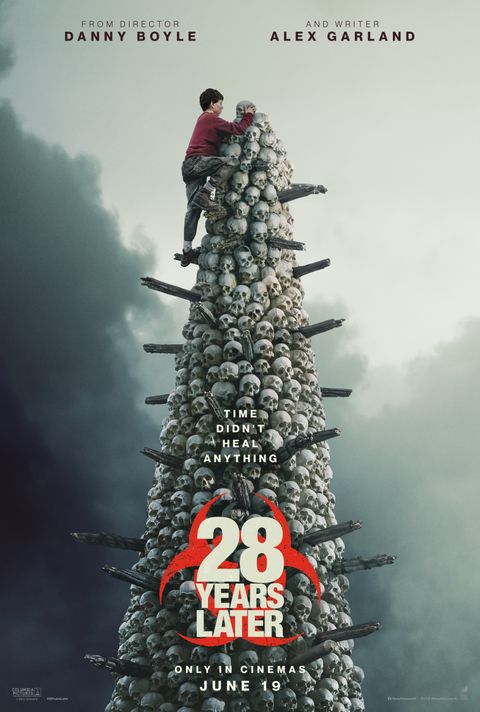
28 Years Later – Review

Cert – 15, Run-time – 1 hour 55 minutes, Director – Danny Boyle

Safe from those infected by the Rage Virus on his home island, 12-year-old Spike’s (Alfie Williams) first trip to the mainland leads him to search for a rumoured doctor (Ralph Fiennes) who could help his mum (Jodie Comer).

It’s been 28 years since the first wave of the Rage Virus hit the UK (although 23 in real world time since returning director Danny Boyle’s 28 Days Later). While mainland Europe has been able to tackle any outbreaks and move on with life Britain has been quarantined, nothing can leave and what gets in will never get out. There are few patches of safety such as Holy Island, the home of 12-year-old Spike (Alfie Williams) who is about to make his first hunting trip with his dad, Jamie (Aaron Taylor-Johnson) – despite reminders that 15 or 16 is usually the first age to go across the causeway to the mainland.

The trip seems to be to hunt infected – now largely living off of worms and animals – which raises the question of why risk it when you seem to be living a safe and quiet life where you are. Some have evolved into taller, stronger alphas while others have become fat, crawling creatures. Regardless, they’re now pretty much all in the buff and just as angry. Despite the dangers clearly shown and amount of times his life is on the edge during his visit Spike returns home and quickly wants to go back after hearing of a possible doctor (Ralph Fiennes) still living on the nearby mainland. Hoping that he can find help for his mum, Isla (Jodie Comer), who has been having increasingly frequent episodes and memory loss, the pair travel in search of a hopeful cure.


This journey is the core of 28 Years Later, written by original film writer Alex Garland who has penned this as a trilogy with the next instalment, The Bone Temple, due out in January and the third yet to be funded. And indeed the film feels like a first instalment. For the most part what we see is world building and a mass of glimpses of a world we’re eventually going to see more of with little narrative unfolding amongst it. Spike and Isla’s journey has the occasional moment of threat here and there but it seems brief and undetailed with the focus being more on what’s changed, and at times regressed, since the Rage Virus outbreak.

The knock-on effect of this ends up being that with so much wandering and world building when something does actually happen towards the end it feels a strange, sudden and rushed decision. One that seems to want an emotional response and yet is dealt with with such a dead-pan expression that there almost seems to be a slight disconnect in the world as it stands. It pushed me further away than I already had been by the thin narrative throughout the film. A narrative which could solidly construct a whole film but with all the build-up given and exploration presumably for events to come this all feels like a drawn out first act, or even just prologue, for what’s the come in a few months time.

There are likable moments and beats here and there, including some tense action involving the infected, especially the strongest leaders of the pack – who pull off a particularly cool kill part way through which has a strong effect when shown in full gory detail. But by the end that’s largely what 28 Years Later feels like, a selection of moments forming a thin narrative that I found little connection with as it clearly just wants to assemble points, or at least characters, for the next stage of the journey. Let’s hope that that journey actually pays off and Nia DaCosta’s The Bone Temple isn’t just more build-up to the as-yet-unfunded events of the final part of this trilogy.

A thin narrative with little emotional connection is squashed down by world building for the next chapter in the 28 Years Later trilogy, meaning this first instalment feels like a weak prologue more than anything else, despite some likable infected action here and there.

Rating: 2 out of 5.

Tornado – Review

Cert – 15, Run-time – 1 hour 31 minutes, Director – John Maclean

Caught up in a hunt for stolen gold, a young woman (Kōki) finds herself fleeing from, and facing off against, an angered criminal (Tim Roth) and his gang, none of whom can wield a samurai sword like she can.

Tornado has somewhat been sold as a bloody, action-packed samurai flick. And while it certainly has some good action sequences they feel more subdued, as does the film as a whole. Much of the 91-minute run-time is spent in quieter scenes of upfront threat, largely from Tim Roth’s gang leader Sugarman, focusing on the dialogue of character’s processing events.

The titular Tornado (Kōki) finds herself caught up in Sugarman’s hunt for gold when fortunes that he obtained in a heist are subsequently stolen from him. While uninvolved, tracks lead back to Tornado and her puppeteer father (Takehiro Hira), leading to them being followed by Roth and co across the 1790s Scottish landscape, with the action eventually following; mostly in a well-executed, and effectively timed finale which really builds up its stages.


The cat-and-mouse journey which plays out for some of the film calls back to a number of classic western genre influences. Throughout the short 91-minute run-time we see the central character build up and realise her confidence and skills with a sword, even amongst the non-linear narrative. Writer-director John Maclean is just as interested in the drama, perhaps even more so, as he is with the swift bursts of action. He certainly frames them in much the same way in terms of Tornado’s development, with Kōki bringing a compelling nature to the different examples of quietness she carries herself with from the start.

Both quietly engaging and entertaining there’s a confidence in Tornado from the very start, but as that becomes more evident in the character of the same name that comes through with more style as things progress. Things are kept fairly simple, but there’s an effect to be found from there considering the time period things are set in and just how Maclean captures things; and indeed the threat that Roth poses.

He gives an enjoyable performance which captures the antagonist’s sneering greed and contempt; while acknowledging this is a supporting role and not upstaging Kōki. Sugarman and his gang help to bring in a tension when hot on Torando’s tail, or in the duels of the climactic stages. As a whole this is an effectively considered and restrained film that uses both of those elements to push character, confidence and engagement factor.

Slowly-paced yet short, Torando is a subdued samurai western featuring likable bursts of action which fit right into the tone and pacing, as tension is quietly built up throughout the central character’s battles and escapes.

Rating: 4 out of 5.

How To Train Your Dragon (2025) – Review

Cert – PG, Run-time – 2 hours 5 minutes, Director – Dean DeBlois

Young Viking Hiccup (Mason Thames) is the son of the chief (Gerard Butler) and expected to one day be a great dragon slayer, however when he discovers an injured night fury he realises that maybe the creatures aren’t as dangerous as they’re made out to be.

Apparently when starting to put together a film Pixar used to, and perhaps still do, ask why the film was being made in the animated form. What was being done that couldn’t be done in live-action? Sometimes we can be more forgiving towards ideas in animation. In Lilo And Stitch, also recently given the live-action treatment, Stitch doesn’t really look anything like a dog, but we don’t really stop to think about that. In Dreamworks new take on How To Train Your Dragon, six years after the close of the animated trilogy and fifteen years after the first entry (with a remake of the second already greenlit months before the release of this instalment), the opening sequence centres around a night-time dragon attack on the island of Berk.

As characters run around shouting for different weapons to attack the creatures with, and protagonist Hiccup (Mason Thames – who seems to be trying to bring elements of the animated physicality into this film) tries to prove his skills with inventions to take down the dragons rather than dealing with them upfront, I sat thinking about the poor design of the various buildings throughout Berk. If you live near dragons who frequently attack, breathe fire and set your buildings alight, why would you make all of your buildings out of wood? And how are they all rebuilt and perfectly fine by the next morning?


In addition to these questions there’s also the point of what is the live-action bringing to this particular film? And the answer seems to be very little. Written and directed by the original film’s co-writer-director Dean DeBlois the exact same beats are here, just without the same visual flair. The animated films had Roger Deakins as a visual consultant, and so of course had some great shots, but this film feels weighed down by the CGI. There are some good shots here and there, courtesy of Bill Pope, and flight sequences manage to capture some imagination as Hiccup connects with injured night fury dragon Toothless – learning that while he’s being trained to be a dragon slayer maybe the creatures aren’t as dangerous as legend, and his father (Gerard Butler, returning form his voice role), says.

Multiple shots and jokes are repeated without the same impact. There’s enough here that still manages to work and move things along but it still feels very familiar and like there’s very little new brought to this film. As if things are in some form of safe cruise control. But by not wanting to change too much almost nothing is changed. John Powell returns to do the score and on a number of occasions its his music which helps to lift things and bring more of an effect to them, making it perhaps the strongest player in the film; especially considering the lack of detail given to a number of supporting characters, including Toothless. Even love-interest and presumed-future-dragon-slater Astrid (Nico Parker) comes across as one of the most wholly unlikable figures I’ve seen for quite some time, with a complete 180-degree flip which just makes her feel like a narcissist.

Yet, even amongst all of this there’s still an adequate film at hand. And likely that’s because of just how little has been changed, and so for the most part the remake is playing along lines that it knows works, or at least have worked in the past. But, it’s not enough to create anything other than a generally fine, if patchy, film. For when the sequel inevitably comes round, I hope it takes a few more swings towards originality and doing something different.

Perfectly fine, but largely because it relies too much on being a near copy of the original animated film, this live-action take on How To Train Your Dragon is watchable but has a number of bumps along the way as it struggles to find its own identity.

Rating: 3 out of 5.

Predator: Killer Of Killers – Review

Cert – 18, Run-time – 1 hour 26 minutes, Director – Dan Trachtenberg

Three fighters in different ages find themselves facing an advanced alien hunter, but what happens after it’s defeated?

While I may have been lukewarm on it, there’s no denying that with 2022’s Prey director Dan Trachtenberg brought new life into the Predator franchise. The prequel, focusing on a Comanche warrior, and upcoming future-set Predator: Badlands explore newer territory for the franchise in their settings and the opportunities they create. Seemingly inspired by these and Dark Horse comics which did much the same, animated Predator: Killer Of Killers has been quietly released on Disney+.

Following Viking (Lindsay LaVanchy) and samurai (Louis Ozawa) warriors, and a World War II fighter pilot (Rick Gonzalez), the animation allows for the film’s segments to explore bloodier territory than they perhaps would in live-action; and indeed develop ideas they perhaps couldn’t with this budget in that form. The fates and consequences that certain characters face fit right in with the animation style, which feels like an upgraded continuation of classic adult animation fantasy styles.

It’s the second of these stories which truly brought me into the unfolding events. Almost entirely dialogue free the central fight grows into battle as samurai warriors face an invisible enemy, in slightly more advanced form since the previous Viking-era segment. The action spreads through different locations, effectively tracked and paced so that the characters’ desperation to survive against the mysterious force, and the ways in which they fight, match the growth of the location and environment.


This is something which is caught in each segment, which eventually come together for an exciting finale involving the three central weapons the film bases itself around (shield, sword and bullet). The more the short run-time moves along the more thrilling it becomes, especially in the directions it takes the action. Using the animation the propel that without ever allowing for a sense of disbelief or ridiculousness to override the tension.

While dropping onto Disney+, intended as a largely secret film, there’s hope that Killer Of Killers will allow for further exploration into the worlds of the Predator and those who face it. Such ideas have fuelled multiple fan films and comics over the years, and now finally being embraced on screen; so far under the watchful eye of Dan Trachtenberg who clearly has a knack for bringing something new to franchises while keeping key elements in place so they feel at home – see 10 Cloverfield Lane. And perhaps it could show a want for more dramatic adult animation; as Arcane on Netflix has apparently been doing recently.

There’s certainly something brought out by it in the action. The style that the film carries itself with in a bright yet deadly world which feels layered and detailed while still largely based around the central fights faced against a threatening, in skills and design, evolving Predator. I didn’t know what to expect going in, but was more than pleasantly surprised by the level of tense and bloody thrills throughout.

Holding plenty of layered and well-developed action, Predator: Killer Of Killers is a bloody expansion of the creature’s evolution, slotting it into different time periods with thrilling effect.

Rating: 4 out of 5.

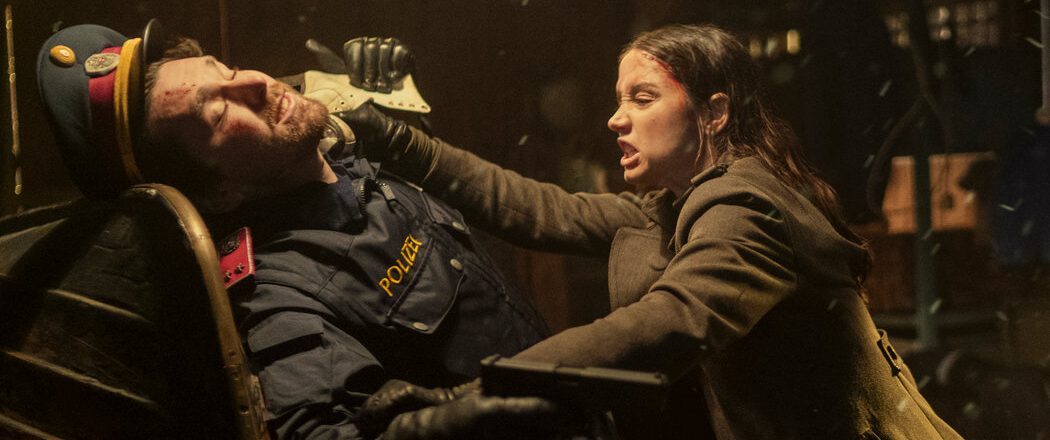
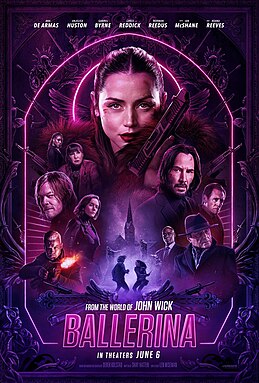
Ballerina – Review

Cert – 15, Run-time – 2 hours 5 minutes, Director – Len Wiseman

After being attacked by a member of the cult who killed her father (David Castañeda), Eve Macarro (Ana de Armas) sets out to finally find and kill the leader (Gabriel Byrne), however multiple forces may be on her tail.

In its later stages Ballerina manages to one up one of the coolest things I’ll see in a cinema this year with something even more cool and ridiculous. As an underground flamethrower fight turns into a flamethrower vs firehose duel in the middle of a street I felt the urge to applaud alongside laughter at what was unfolding on screen. Yes, there’s a ridiculousness to it, but the moment is worn with such style that the intensity and coolness outweighs that, whilst also working with it, to make for a more entertaining moment.

While the action of this spin-off to the John Wick franchise – largely set between the third and fourth instalment – might not always have the same rapid nature to action sequences it does later show when Keanu Reeves briefly appears that only Wick can truly fight like that. Yet, there’s still plenty of great improvised and at-hand weapons to fuel the action when it arises; and it arises often.

After a somewhat overlong build-up, set in the underworld which brings so much personality to the Wick franchise when we glimpse more of it, but as a main basis doesn’t quite have the same effect, once the fights begin there’s almost non-stop action from then on. And there’s plenty to be thrilled by as it pushes things forward in the titular assassin’s (Ana de Armas’ Eve Macarro) search for the leader of the cult (Gabriel Byrne) who killed her father (David Castañeda) when she was a child. There’s a good deal of threat and narrative progression in each sequences once things kick in, with the odd bit of dialogue in-between, and sometimes during, to help move things along and bring in a sense of tension.


There have been frequent reports of reshoots, rewrites and setbacks for this spin-off, but in the final edit there’s a good sense of flow from one sequence to the next and there’s a generally fluid state to the run-time. Where the film is at its roughest is as it’s setting everything up and bringing in characters from The Continental and other John Wick locations for brief roles before de Armas is allowed to venture out on her own journey proper, and make for an engaging lead. Of course, it’s nice to see these characters, especially Lance Reddick in his final role as the consistently scene-stealing hotel receptionist Charon,

As things develop the action grows and steps away from more of a standard action into something more adjacent to what we’re familiar with from the Wick franchise – with Len Wiseman stepping into the director’s role, although it’s reported that producer and series-director Chad Stahelski oversaw the majority of reshoots. Pacey and exciting there’s still a difference in what we see without, eventually, feeling too plain and somewhat slow. It’s an effect that comes in when the underworld becomes a contributing element to the action, as different assassin tribes communicate with each other and consequences are discussed and faced, instead of the sole backdrop and upfront factor of the events.

But, when you eventually get a fight involving a flamethrower and a firehose, part of a slight sense of humour which crops up once or twice throughout the film including a perhaps unintended dad joke delivered by Reeves early on and a sequence involving two characters smashing plates over each others heads as they scramble for a gun, the wait is worth it. Especially when the wait develops a style which brings out the high entertainment factor and helps to speed things up with a fair deal of effective punches, shots, kicks, stabs, slashes and smashes along the way.

It might take some time to build things up, but as the assassin underworld moves more into intriguing background details Ballerina becomes less plain and more thrilling with each slickly-linked, entertaining action sequence.

Rating: 4 out of 5.

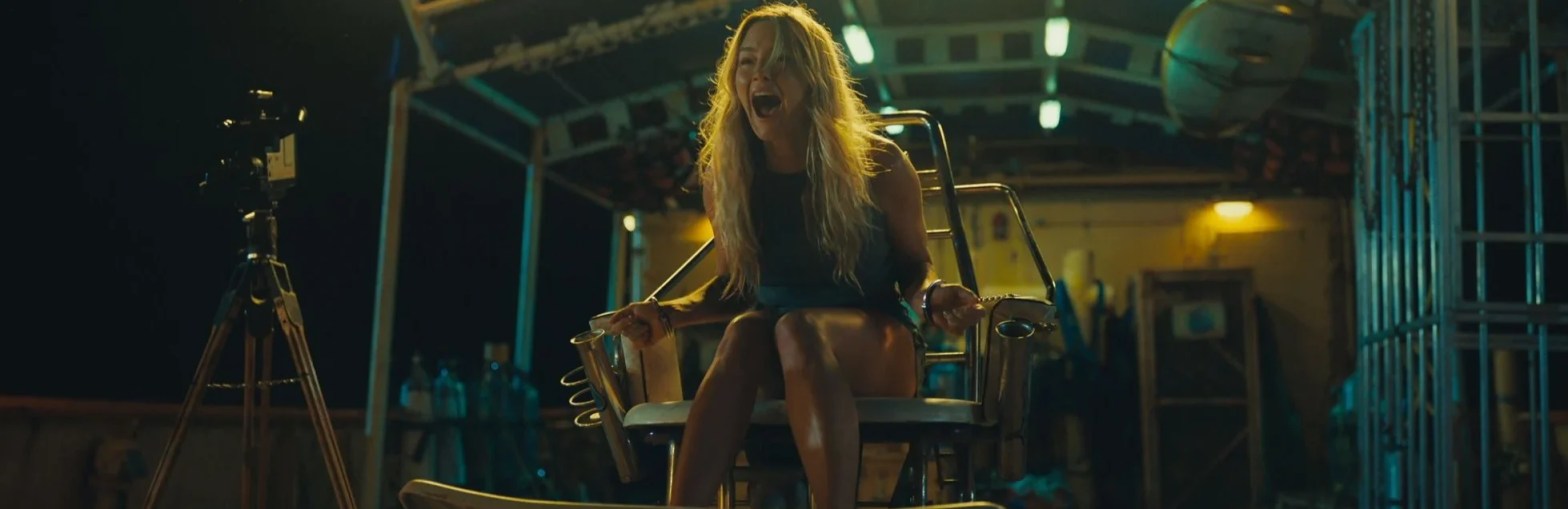
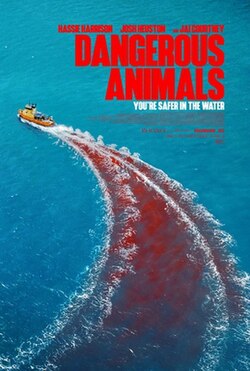
Dangerous Animals – Review

Release Date – 6th June 2025, Cert – 15, Run-time – 1 hour 38 minutes, Director – Sean Byrne

Surfer Zephyr (Hassie Harrison) wakes up trapped on a boat in the middle of the sea, having to fight for survival against a serial killer (Jai Courtney) who throws his victims to the sharks.

Dangerous Animals appears to jump straight into its main conceit as we see young acquaintances Greg (Liam Greinke) and Heather (Ella Newton) embark on a shark cage diving experience. Captain Tucker (Jai Courtenay) sets an unsteady tone from his first greeting, but the experience seems to go well until he brings them up, stabs Greg in the neck and pushes him into the water for the sharks. Whilst Heather screams the title card appears and we cut to our actual protagonist, Zephyr (Hassie Harrison). This is one of multiple deceptive set-ups for Dangerous Animals, however unlike this cold open the rest go almost nowhere.

Instead, after Zephyr is kidnapped by Tucker when planning to surf early one morning, and trapped on his boat in the middle of the sea – handcuffed to a bed in the same almost soundproof room as Heather – every time a new device or idea is introduced it’s simply looped back to more of the same of what we’ve seen before. A cycle forms of Tucker delivering increasingly tenuous monologues about sharks that loosely relate to the current situation, creating a threat for the characters, maybe with some bloodshed, before a last minute attempt at escape or fight for survival happens.


As the cycles repeated over and over again I found myself thinking, during the better moments where something new appeared to be happening before looping back once again, that the film would perhaps work better as a 30-minute short rather than an over 90-minute feature. Especially with how much the opening stages drag in introducing us to Zephyr and hook-up Moses (Josh Heuston), including completely unnecessary sex scene; there’s little that seems to come from this in terms of big developments for quite some time – and even then it simply comes back round to what we’ve already seen before.

There are some likable moments which provide some amusement amongst the poorly-blended shark sequences, but even these instances where Harrison plots or attempts her escape from Courtenay’s killer, although in actuality he gets little to do in comparison with how the film is trying to position him, begin to fall into overfamiliarity. What’s there that works certainly isn’t enough to lift the film as a whole, and simply points out the clear flaws which are present in the rest of the narrative structure. Making for a rather boring set of repetitive events which lack the bite wanted, and needed.

Feeling better suited to a short film rather than a feature, every time Dangerous Animals presents something new it uses it as a way to loop back to the start of the same cycle in a consistently lacking state of repetition.

Rating: 2 out of 5.

The Ballad Of Wallis Island – Review

Cert – 12, Run-time – 1 hour 40 minutes, Director – James Griffiths

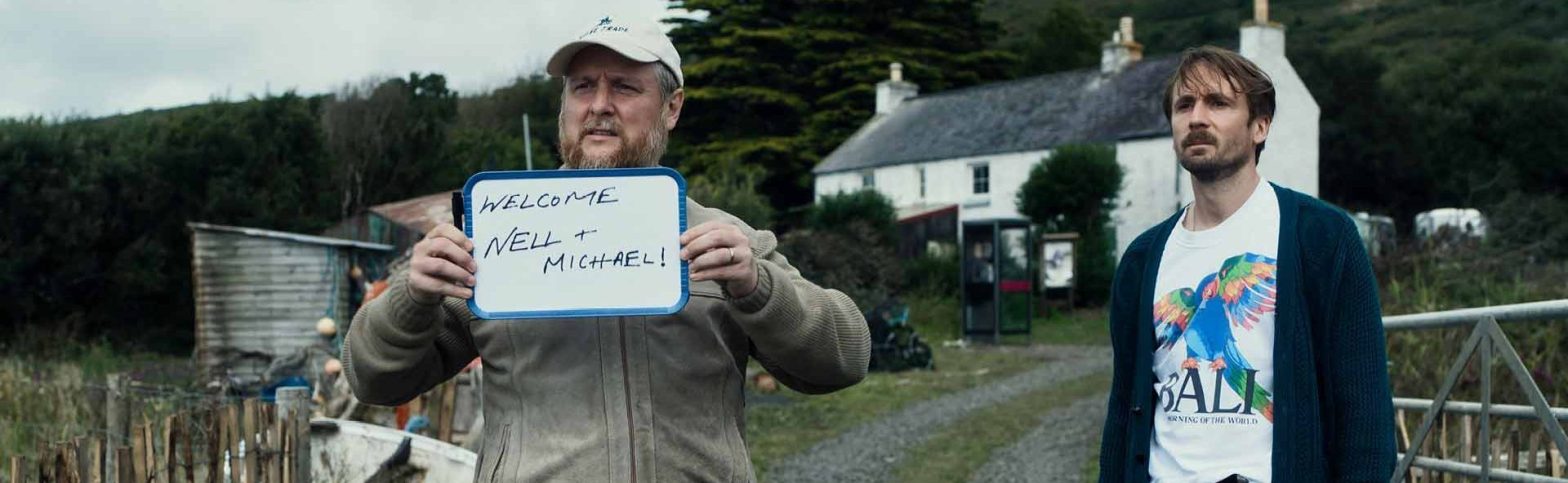
Folk musician Herb McGwyer (Tom Basden) arrives on a secluded island to perform an intimate gig, only to discover it’s to one person (Tim Key) and alongside his former musical and romantic partner (Carey Mulligan).

There’s an unassuming nature to The Ballad Of Wallis Island. The cast and crew are clearly trying to make something great, but in the moment they appear to not know just how great what they’re making is. It adds to the charm and heart that radiates from this gentle British indie which feels at home amongst the Paddingtons of this world.

Perhaps best summarised in the character of Charles Heath. Played by Tim Key with wonderful texture, he’s a buoyant character happy to crack jokes and wordplay at any opportunity, yet there’s a sorrow to him which is brought out as the film goes on and we learn what folk duo McGwyer Mortimer means to him. He’s paid for them both to come to the secluded location of Wallis Island, where he lives, to perform an intimate gig, although unknowing that it’s just to him. on the shorefront.

However, the pair haven’t seen each other for nine years and while Nell Mortimer (Carey Mulligan) has moved on, married (to Akemnji Ndifornyen’s Michael) and now makes a living selling homemade chutney at markets, Herb McGwyer (co-writer, alongside Key, Tom Basden) has struggled to move on. Reluctantly looking at a more commercial route with his solo career, he’s still hung up on the way things ended with Nell, who he was also romantically involved with alongside their musical partnership.


In a film that could so easily go for consistent awkward humour and play up the tension in each situation there’s a calmness to what unfolds. Yes, there are elements of uncertainty for Herb as to how to approach things, and old songs don’t quite seem appropriate for the pair to be singing anymore, but a feeling of friendship begins to form as they spend time on the island with few else around aside from Charles and shopkeeper Amanda (Sian Clifford), who gets an enjoyable running joke about not having heard of anything the musicians ask for.

The humour too could so easily go for awkwardness, and does so once or twice with effect. And while certain behaviours create a shuffling tone in a scene the humour which emits takes a step away from this, while also managing to be consistently funny throughout. Still leaving room for the growing drama which takes unexpected turns in what it’s depicting. Wallis Island acknowledges messy and broken up relationships, how some things are never truly directly resolved, but we can resolve them for ourselves. It does this gently and thoughtfully, and with help from the various folk tracks we hear being played and performed – all written by Basden.

There’s something transportive about each song, no matter how much we hear of them, believably coming from the characters who are singing them. And while conversations and actions play as much of a part in character developments and realisations the music plays just as much of a part, if a quieter one, in doing this. The film is much more about Herb than we may realise and where the narrative takes him, including into the credits, acts as the real core of the film. Although, Charles and Nell both act as catalysts and pushes with their own moments of effective emotion with different degrees of straightforwardness.

Everything we see is portrayed with a great deal of heart. You can see and feel the care that has gone into making this film, and the collaborative effort alongside it. All as things gently move along in a very funny, entertaining fashion with unexpected reveals as to where its course is going amongst the effective emotional beats surrounding different kinds of loss. Thoroughly heartfelt and thoroughly British, this is a real gem I’ll be fondly thinking about and wanting to revisit for quite some time.

A gentle, entertaining and very British gem, The Ballad Of Wallis Island overflows with heart both in its making and final film. An excellent set of performances and songs calmly convey the emotion and quiet sorrow amongst the many funny quips, and all done with heaps of charm and comfort.

Rating: 4 out of 5.