The Roses – Review

Cert – 15, Run-time – 1 hour 45 minutes, Director – Jay Roach

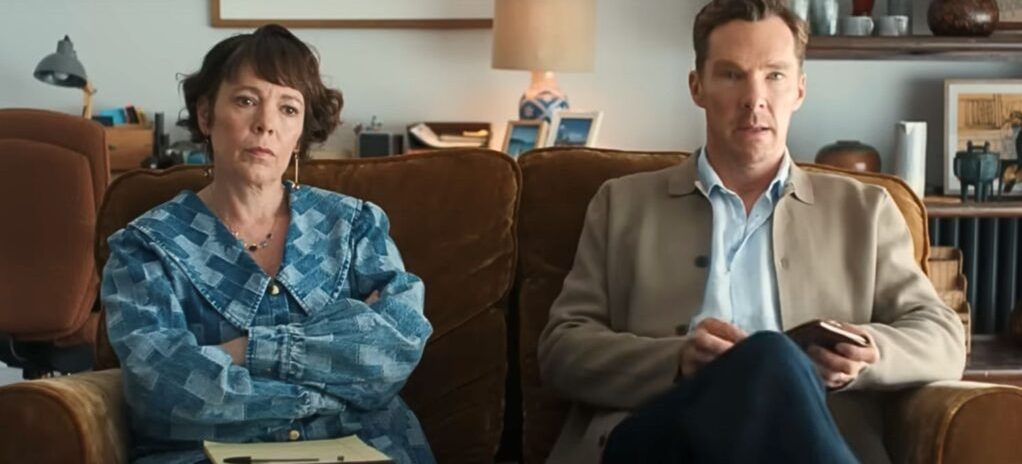
Architect Theo (Benedict Cumberbatch) and chef Ivy (Olivia Colman) have been known as a strong, supportive couple for years, however as their careers start to go in different directions tensions and arguments rise, leading to a messy, and perhaps deadly, divorce battle.

I’ve not read Warren Adler’s The War Of The Roses, but it seems from the two major film adaptations since its release in 1981 that it might be something of a difficult book to adapt. Or, perhaps, making a film about a married couple increasingly hating each other makes for something difficult to engage with. While the acknowledged biting British sarcasm delivered by Benedict Cumberbatch and Olivia Colman brings one or two light chuckles, as opposed to Michael Douglas and Kathleen Turner’s bitter jabs and jibes – playing off of their Romancing The Stone pairing, helped by the presence, and direction, of Danny DeVito – in the 1989 take, there’s still an eventual distance created by the characters and their feud.

Much of the marketing has revolved around the more heated arguments between the pair as they hurtle towards a messy divorce, however much of this is confined to the final 20 minutes. Beforehand we get a story of Theo (Cumberbatch) and Ivy (Olivia Colman) Rose trying to keep things intact despite their growing frustrations with each others lack of understanding about their careers going in very different directions. After a design goes wrong leading to a building collapse, architect Theo loses all work while Ivy’s part-time shift at her own seafood restaurant – amusingly titled We’ve Got Crabs – expands after a positive review from a major critic, eventually leading to mass PR and additional locations opening.

As comments start to bring different sparks to the relationship, as mentioned by friends such as Andy Samberg and Kate McKinnon’s Barry and Amy – the latter constantly trying to make unsubtle moves and flirtations on Theo, feeling taken from a film from almost 15-20 years ago – there are occasional chuckles from the central pairing. However, Tony McNamara’s screenplay is very hit or miss when it comes to the gags, and much of the time it misses.


The cast, which also includes the likes of Ncuti Gatwa and Allison Janney; in one all-in-the-marketing scene, all appear to be having a good time watching and making the escalating sparring, particularly the more sweary dialogue. However, the same feeling doesn’t always translate as the film takes its time building up to what it promises in both the advertising and suggestions of the eventual directions the narrative will take. As a whole, much like the ’89 take which felt like a re-edited sitcom in its overall tone and style that shifted every 20 minutes, The Roses feels overlong. The stages are clear with the occasional jumps in time and pushes as to where Theo and Ivy’s marriage is going.

Attempts are made to create a balance between the pair’s eventual back-and-forth behaviour and sabotage, largely in terms of both being as bad as each other; early on its the case of a lack of communication between them about how they’re feeling and coping with the ongoing changes in their lives and marriage. However, it’s very easy to pick a side when one character seems to be a good deal more stubborn and belligerent than the other, especially earlier on – perhaps stemmed from insecurity from having lost his job and not being the main breadwinner of the household, although this idea isn’t really delved into, or suggested, much.

As things get worse between Cumberbatch and Colman’s characters, leading to an awkward dinner party with their friends, the film begins to feel messier. While there are some chuckles at just how far they go with their efforts to get the other to give up their want for the house there comes a point where the aforementioned hate between the pair just stems to a point where there’s less and less humour. The characters almost seem to be unlikable, and therefore difficult to connect with and gain an emotional response from. It’s an issue which runs throughout The Roses, which consistently feels as if it has a foot slightly stuck in the past and never quite forms a proper connection with the central couple to truly see it through.

With more misses than hits The Roses struggles to create a proper connection with the central couple, only made worse by the lack of humour in their growing hate for each other across the overlong run-time.
Rating: 2 out of 5.

The Toxic Avenger – Review

Release Date – 29th August 2025, Cert – 18, Run-time – 1 hour 42 minutes, Director – Macon Blair

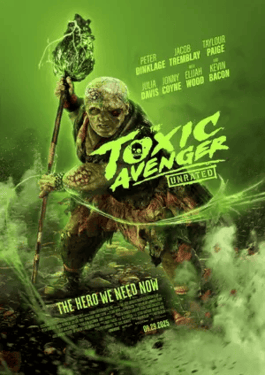
Seeking revenge for his boss (Kevin Bacon) not helping him with his healthcare, a terminally ill janitor (Peter Dinklage) is thrown into toxic waste, turning into a powerful new being.

The opening shots of this reboot of The Toxic Avenger give a glimpse of a film as pulpy, schlocky and gory as the two years it sat on a shelf unreleased would suggest. Images of what’s to come rapidly flash across the screen before Peter Dinklage’s voiceover tells us that there’s much more to the story before all of this.

Instead of an awkward, bullied teenager the protagonist in this reboot is Dinklage’s janitor Winston. A struggling single step-dad to Jacob Tremblay’s Wade, with whom he has an attempted yet distant relationship with, often brought down by his own mind, scared of trouble and the dangers of the outside world. There’s little humour at the character’s expense, although some from his interactions with the outside world. Before his trippy transformation into the titular being, having been thrown into a pool of radioactive waste, he’s a sympathetic figure, trying to deal with the fact that he’s been given 6-12 months to live. A point which comes together with Winston’s attempts to talk with Wade which brings in a sense of heart to the proceedings. He’s not a loser, but certainly struggling to put himself across and have his voice heard in the world.


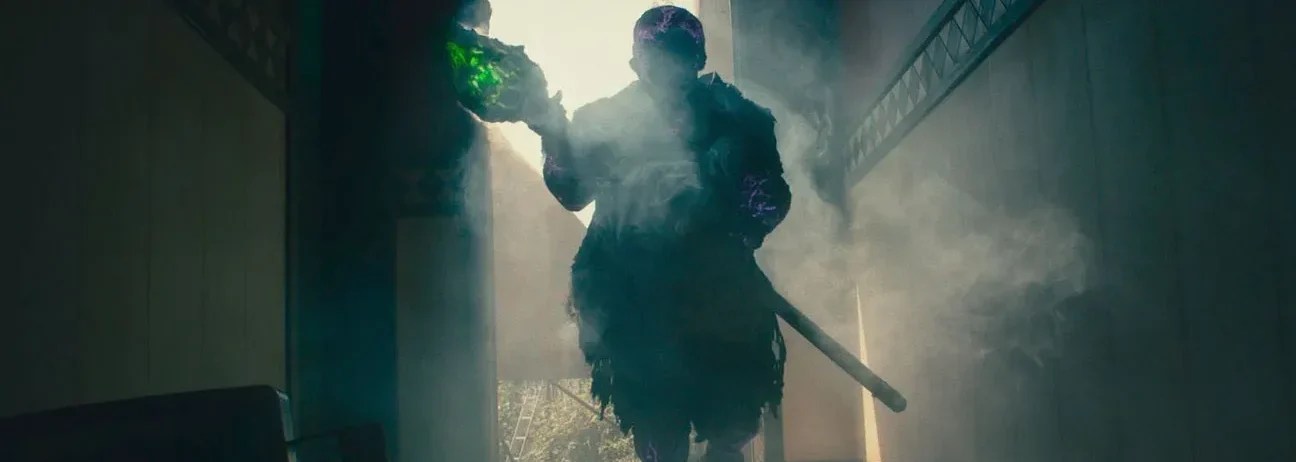
After the wealthy owner (Kevin Bacon) of the healthcare company he works for turns him away, Winston plots revenge. However, despite his hideous new green-skinned appearance (physically performed by Luisa Guerreiro in the full prosthetics, with Dinklage continuing to provide the character’s voice) – complete with large patches of lumpy purple burns – once granted super strength and a glowing and steaming radioactive mop to wield he’s fondly cheered on as ‘Toxie’ by crowds who learn of his heroism after stopping a hostage situation at a fast food restaurant. although flip-flopping on him throughout the film. There’s some likable, if brief, especially in comparison to the run-time, splatter here and there, but never quite anything that feels as pulpy as what this film could be.

As we go back and forth between Toxie and Taylour Paige’s J.J. Doherty trying to expose and take on healthcare company WHB, Bacon’s CEO, enlisting brother Fritz (Elijah Wood) and a loud techno-rap group as henchmen to sort out the man exposing their illegal activities and work with gangsters the overall narrative starts to almost feel tangled within itself. Less by complication more that the film appears to be caught up within itself. There are still occasional patches of humour – a running gag involving opinionated location titles consistently raises chuckles – and bursts of action, but the film almost seems to slow down, with the tongue-in-cheek, spoof-adjacent build-up being more interesting and enjoyable. This first half hour, while having a couple of bumps, largely involving Tremblay’s character away from his step-father, sets up an enjoyable and self-aware time.

What follows is still enjoyable in parts, but the self-awareness somewhat seems to fade in exchange for moments that are more in the realms of silliness, whilst still fitting into the world. The schlock and pulp hoped for isn’t quite present and it does cause the film to somewhat falter, especially as it seems to embrace its plot perhaps more than viewers might, or at least I did. Gore appears to be present to some degree to make up for the lack of stronger B-movie vibes, which are present in the opening stages and some of the visual aspects which appear, but this Toxic Avenger appears to waver with the crowds watching the film as much as he does with those in it.

Not as pulpy or schlocky as perhaps liked, brief but likable splatter doesn’t quite make up for this but there’s still enough to enjoy and raise a chuckle in The Toxic Avenger to help move it along, even as it gets caught up in its own narrative.

Rating: 3 out of 5.

Eddington – Review

Cert – 15, Run-time – 2 hours 29 minutes, Director – Ari Aster

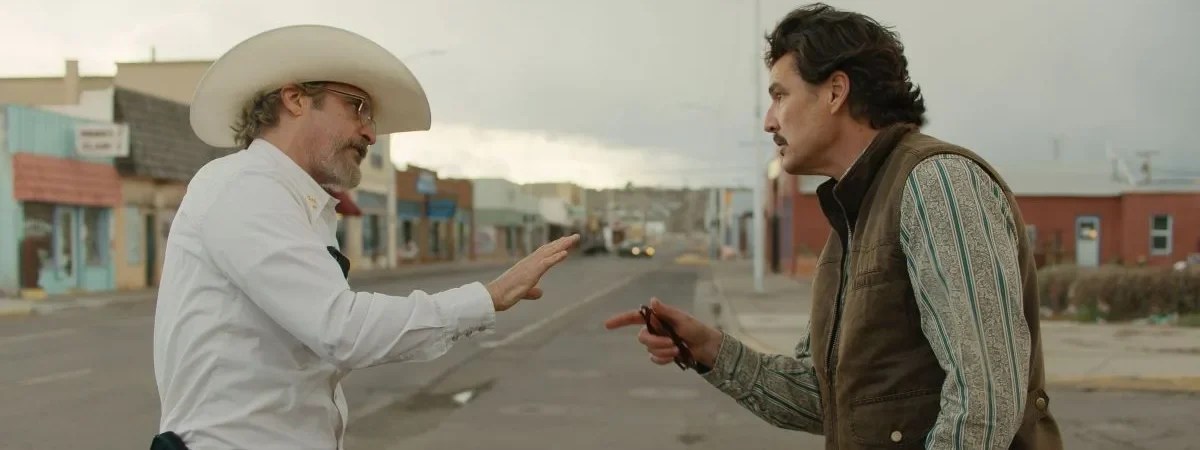
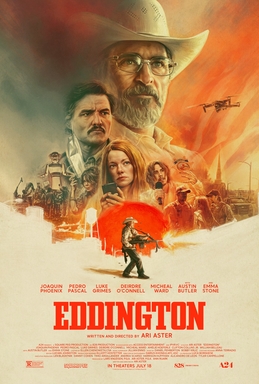
May 2020, COVID restrictions are in place, Black Lives Matter protests are growing, riots are spreading and the sheriff of Eddington (Joaquin Phoenix) runs against the incumbent mayor (Pedro Pascal) in the upcoming election.

Eddington feels like a victim of its own release date. During the pandemic writer-director Ari Aster was working on his three-hour anxiety attack Beau Is Afraid, eventually released in 2023. Now, he releases a film which feels as if it would have been more timely released then, or even worked better if released five years from now. While certainly most of what we see still resonates and feels relevant today, there’s something overhanging the film that feels slightly odd released at this particular moment in time.

Joaquin Phoenix’s sheriff Joe Cross is fed up of the restrictions put in place by the COVID pandemic, it’s May 2020 and he insists that the virus doesn’t exist in the town of Eddington. When enough is enough he challenges incumbent mayor Ted Garcia (Pedro Pascal) – pitching himself as being able to bring new jobs to the quiet, New Mexico by welcoming in a building for a big tech company – in the upcoming election. From there sparks begin to fly across the desert environment as campaigns heat up alongside various social tensions.

Alongside the pandemic, Aster also attempts to capture the rising Black Lives Matter movement, to some extent satirising both sides, although for the frequently white figures leading the protests in Eddington largely through the language they use – sometimes feeling as if it would be better suited in South Park – and the wider political tensions of the time, including online conspiracy theorists (played by Austin Butler, and bought into by Joe’s wife (a strange-sitting role for Emma Stone)) and mentions and possible appearances of Antifa. It’s a lot to cover, and the two-and-a-half hour run-time suggests that. Even with that much time there’s still the feeling that a number of the ideas being played with are rubbing up against each other and creating a different kind of conflict to the one intended.


While the film is undoubtedly satirical, how comedic that’s meant to be at time is a different matter. Certainly, there’s a drama that plays out well when it comes to the central election theme, with Phoenix and Pascal debating both online and in the streets with a sense of suspense when face-to-face. Phoenix’s much more accusatory and seemingly intentionally agitating style against the more relaxed, trying-to-reason conversational tone of Pascal’s character. Yet, the more the film goes on the more this seems to be pushed away as supporting characters start to be given more to do in regards to the other events happening throughout the town, especially with how various relationships cross over each other. However, there are other moments that feel like the dialogue, or at least the somewhat heightened situation, is meant to be comedic, yet the uneasy styling prevents a laugh.

About halfway through Aster makes the decision to really switch things up, and initially does so quite effectively. There’s a boost of intrigue as more thriller-like tones begin to emerge after a sudden and surprising shift in events. However, as the ending gets closer there’s still multiple other characters and themes at play which means that things start to pile up again, and while these are attempted to be largely brought together for the final stages Aster doesn’t quite stick the landing as he starts to bring in further tones and directions almost as a way of wrapping things up.

While certainly capturing a slice of just what was happening in America at the time, Eddington feels weighed down by just how much it tries to capture, especially with so many characters playing a part. With a tone and satire that feels as if it could be more searing, the overall film has its moments – especially when focusing on the rival campaigns of Phoenix and Pascal, where much of the drama and tension is centralised – but struggles to create a bigger impact than simple engagement for much of the run-time. Before starting to feel like, as it depicts, multiple voices speaking over each other in the middle of the desert.

While it may work better if revisiting in a couple of years, Eddington tries to capture a very busy and chaotic time in America but ends up feeling somewhat overstuffed, and far from as searing as it probably should be. While the central election thread works well, everything else struggles to have a similar impact.

Rating: 3 out of 5.

Sorry, Baby – Review

Cert – 15, Run-time – 1 hour 43 minutes, Director – Eva Victor

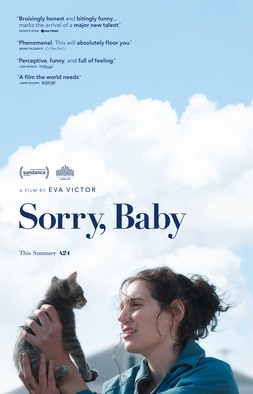
College professor Agnes (Eva Victor) deals with the trauma of being sexually assaulted by her former advisor (Louis Cancelmi), learning to do so at her own pace.

Agnes (Eva Victor) hugs her best friend Lydie (Naomi Ackie) goodbye. Sitting in her car, just about to drive off, Lydie checks that her friend is going to be alright. Hugging herself, not just because of the cold, Agnes assures her that she’ll be fine, promising that she’s not going to die. She doesn’t entirely believe herself.

She gives a similar hesitant look at a reunion dinner of old college friends, when their advisor Preston Decker (Louis Cancelmi) is brought up. It’s clear that something bad happened in her past, but nothing is explicitly mentioned. As we flashback in time to a couple of years prior Agnes is an English student at college, living in a small house with Lydie – the same house she lives in alone years later, now with a number of window panels covered up with bits of paper. Each scene involving Decker is one of unease and tension, we know something is coming and when it does we don’t see it. The camera simply sits outside his house as day shifts to night in sudden jolts of time and fading light before a shaky tracking shot follows Agnes pacing to her car, scared and trying to comprehend what’s happened.

From there, as chapter titles introduce us to the events of the following years, the film follows Agnes as she continues to try and comprehend and come to terms with what happened – the title of the year of the assault being ‘the year with the bad thing’. Victor, who also makes her feature debut as writer and director, is sensational in the lead role. So much of the confusion, fear, discomfort, pain and more is hidden behind their eyes as they try to move forward in a world where little empathy is displayed by officials, particularly the heads of the college.


Yet, there’s a consistent sense of hope on display, too. Not just in her adoption of a kitten but in my personal favourite chapter, ‘the year with the good sandwich’ – a name which already inspires a glimmer of optimism – a brief turn from John Carroll Lynch provides one of the biggest pushes of understanding. By this point it’s been three years since the bad thing. It seems like a long time but at the same time it’s not a lot of time. There’s a warmth to the moment that’s allowed to be dwelled rather than basked in. A moment of comfort that works well alongside the chuckles which crop up along the way.

Victor has ensured that there are moments of lightness levity throughout their film, each in naturalistic fashion. There are moments of amusing awkwardness as Agnes anxiously approaches her neighbour, Gavin (Lucas Hedges), asking if he has any lighter fluid. There are more similarly-toned encounters between the pair as a relationship of sorts begins to form between them. Yet, the events are still wrapped up in a sense of mixed negative emotions spawned from the tragedy. It helps to keep a consistency even with the various tones at play as Agnes tries to look after herself while keeping a number of things internalised, a scene involving being asked questions about being the victim of a crime after being called for jury duty is filled with empathy and multiple forms of restraint. Building up to create something all the more powerful.

As Agnes and Lydie laugh, joke and reminisce for the opening few minutes of the film I wasn’t entirely sure what to expect. Then, once the first signs of discomfort in the face of remembering tragedy appear everything properly kicks off. By the end of the film I was forced to sit throughout the credits and for a moment or two beyond, in silence, just to think about what I’d just seen and give it the time it needed and deserved to sink in.

A few days later and I’m still allowing it to do so. Sorry, Baby is a complex, layered and empathetic film about coming to terms with tragedy at your own pace. Allowing forms of self care, acknowledging points of comfort and kindness. So much of which is conveyed alongside the trauma and struggle conveyed in Eva Victor’s stunning leading performance, alongside strong direction and screenplay equally filled with quieter moments which let the hidden emotions speak for themselves. Whether viewed as a debut or not, this is a wonderfully impactful look at coming to terms with tragedy, and the barriers and understanding that appear along the way.

One of the best films of the year, Sorry, Baby features a naturalistic blend of stirring emotions with occasional chuckles as Eva Victor’s stunningly performed central character comes to terms with tragedy at her own pace. Allow time afterwards for it to sink in, like the film it’ll have just as much of a profoundly emotional push.

Rating: 5 out of 5.

Together – Review

Cert – 15, Run-time – 1 hour 42 minutes, Director – Michael Shanks

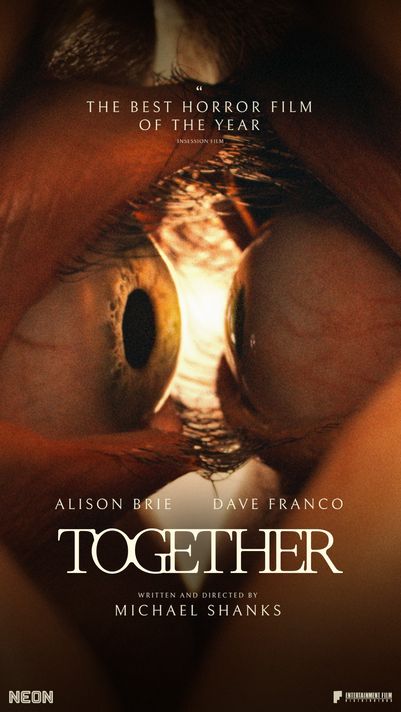
Moving from the city to a quiet town Tim (Dave Franco) and Millie’s (Alison Brie) relationship has fractured, however after lost whilst hiking the pair find themselves being at threat of being literally inseparable.

Perhaps the highest compliment that you could pay a body horror film is that some of the images in it will stay with and haunt you for a good time after. If that is the case then Together deserves high praise indeed for its freaky, squirm-inducing images, one instance involving an electric saw not even properly shown, as couple Tim (Dave Franco) and Millie (Alison Brie) fight to stop their bodies from fusing together.

With spells of prolonged dizziness when separated, before they start to be pulled by invisible forces towards each other as they start to almost combine, there’s a good deal to be creeped out by on-screen. Yet, writer-director Michael Shanks still manages to bring in an effective humour to the proceedings. There are a good number of laughs throughout Together, which I found to be funnier than Weapons which has been acclaimed for is comedic angles which I didn’t seem to find, including at the same time as being grossed out by the grislier suggestions and images. All brought about after the couple get lost whilst hiking in the woods around their new out-of-the-way home. Having fallen into a cave and being forced to stay there overnight there may literally have been something in the water that kicks everything off for them.


Beforehand we see tensions in their relationship. At a goodbye party before they leave the city, in front of all their friends, Millie proposes to Tim with the response being extended confusion, although instead of as what to say it seems to be more as to how to say no. The fractures only continue to grow throughout the film, before an acknowledgement from both that something is clearly wrong, making for an effective horror about co-dependency. One that perhaps works better through its appearing knowledge that it doesn’t have to be subtle, and at times almost throws itself towards the opposite. Although, decisions made in the final stages may lead to the ending, in terms of how it relates to the themes at play, being divisive.

Brie and Franco both put in solid performances, assisted by Shanks’ direction, especially in the moments focusing on the body horror and threat at hand, and get across the push-and-pull of both the central relationship and the mysterious force that’s committing them to the former. It makes for an entertaining and unsettling body horror, images from which are still causing me to shudder a couple of days after.

A funny and squirm-inducing look at co-dependency, Together’s body horror will hang around the mind for a good while after, with the unsettling nature in the moment pushed by Michael Shanks’ direction and the performances of Brie and Franco.

Rating: 4 out of 5.

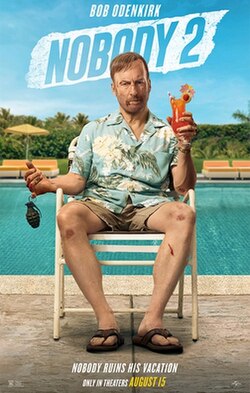
Nobody 2 – Review

Cert – 15, Run-time – 1 hour 29 minutes, Director – Timo Tjahjanto

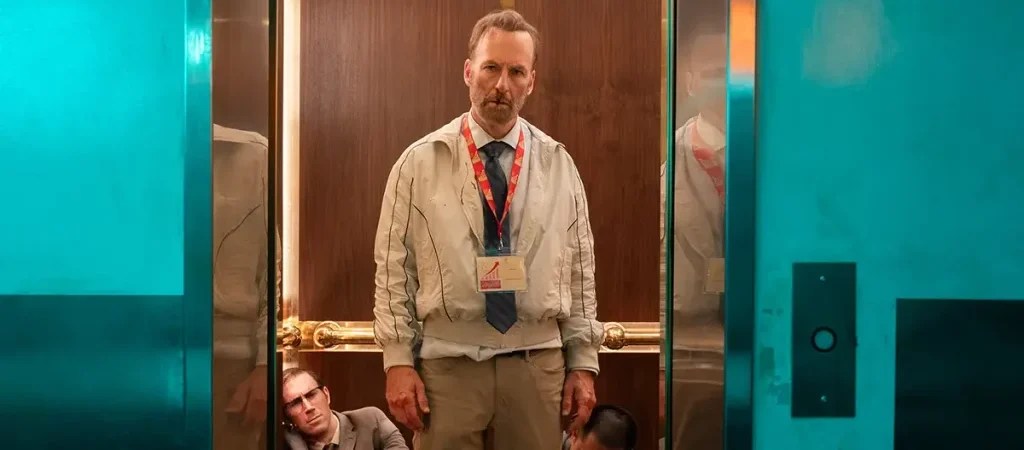
Needing a break from his life of high-action ‘auditing’, Hutch Mansell (Bob Odenkirk) takes his family on vacation, only to discover the town is overseen by a major crime boss (Sharon Stone).

Nobody 2 isn’t quite a film you go to for the story. You largely go for a few laughs as Bob Odenkirk mixes John Wick with the Equalizer and pummels some bad guys. Yet, you still need something of a story to bring these sequences together, and sometimes give them more of a push. Nobody 2 lacks the zippy nature of the first film as it builds up tired military ‘auditor’ Hutch Mansell (Odenkirk) taking a break from repaying his debts by setting off with his family on vacation to the theme park he went on his one childhood holiday to.

However, the town which the park sits in is overseen by a wealthy crime boss (Sharon Stone) with influence over the police and numerous locals. After an incident in an arcade sees Hutch losing his temper with park employees after one hits his daughter on the head, the crime ring is uncovered and things properly kick off for the rest of the film. There are action sequences before this with amusing moments and swift attitudes, but as a whack-a-mole hammer and prize machine claw are used to attack others with the feeling of letting loose and having fun with the surroundings is truly on display.


It’s why these action sequences are the highlights of the film, as they were with the first instalment, which for my money was one of the best films of that year. The third act, set across the Plummerville amusement park, may show the weakness of a villain who genuinely feels like they’re on screen for less than five minutes – Stone tries to create a big, campy villain but struggles with how little the script gives her – but when it comes to the creative uses of the attractions and scenery there’s a good deal of enjoyably bloody violence unfolding. Not to mention a fight on a duck boat where the film truly finds its spark, and smirk.

Albeit violence which still has to cut back and forth to other characters as the film feels the need to push a ‘the band’s all here’ feeling that it doesn’t really need. Of course, Connie Nielsen returns as Hutch’s wife Becca – with the script trying to give her more of a past but the details feeling like much of an afterthought – and Christopher Lloyd making an enjoyable return as his father David. But, the inclusion of RZA as brother Harry and Colin Salmon’s The Barber – pushing the John Wick elements with his underworld stylings which don’t entirely fit into the world of Nobody – feel like screenwriters Derek Kolstad and Aaron Rabin saw them as necessary inclusions but had no clue as to how to comfortably slot them in.

Nobody 2 isn’t a disappointment as such. While providing some entertaining action sequences where it allows a messy precision to reign over the explosions and punches, sometimes only the details are heard. One instance takes place with the camera staying outside of the building in which everything takes place before seeing glimpses of the aftermath. There’s a good film in this sequel, and it’s helped by the short 89-minute run-time, it just feels somewhat weighed down by bringing its elements together and a reliance on the characters and elements of the first film rather than a stronger story.

Somewhat bound to the characters and details of the first film, Nobody 2’s story falters meaning that other key details, including a barely seen villain, feel pushed aside. However, there’s still an enjoyable nature, especially in the action scenes which get more creative as they go on.

Rating: 3 out of 5.

Materialists – Review

Cert – 15, Run-time – 1 hour 57 minutes, Director – Celine Song

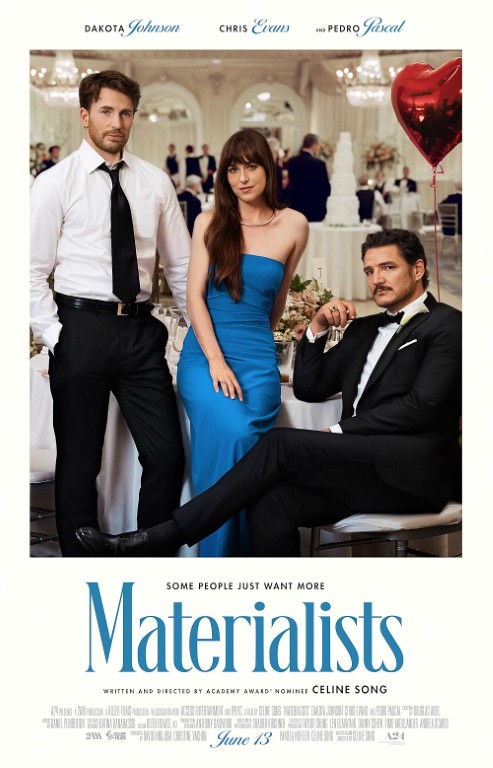
Matchmaker Lucy (Dakota Johnson) is adamant she’ll marry the next person she dates, but when wealthy Harry (Pedro Pascal) enters her life ex John (Chris Evans) comes back re-enters.

When did dating become business, and how long will it continue to be? It’s the core question running throughout the opening stages of Celine Song’s Materialists. While her directorial debut Past Lives – one of the best films of that year – was a thoughtful reflection on how people, and relationships, change the opening 40 minutes of her follow-up are among the most cynical I’ve seen in years.

Song herself isn’t cynical, with a snap flashback to the ending of New York City matchmaker Lucy’s (Dakota Johnson) relationship with aspiring actor John (Chris Evans), their lack of money being the reason, the human emotions shatter the blunt demands of the world of dating. Lucy discusses her, quite often wealthy, clients and their possible matches with a straightforward business-like manner, she knows that dating and love are very different things. Her view of dating, and the sometimes endless ideals of her clients, brings about an almost painfully sharp satire.

Cue an eventual relationship with wealthy financier Harry (Pedro Pascal), despite the fact he goes against what Lucy is looking for. However, at the wedding which the pair meet at is John, working the tables to make some money before rehearsals for a small play he’s been cast in. Materialists has been widely discussed as a love triangle, yet if there is one here it’s not one of fierce competition. Instead, Johnson’s character finds herself torn between different views of perfection, the wants from her job and her own. 


A rom-com starts to play out, yet one where laughs aren’t quite the priority. There are certainly a good number throughout as the world of modern dating, and the various confusions and false standards it can create, is poked at. And the story is very much Lucy’s. Pascal and Evans are certainly key, but they know they’re roles are supporting ones, and indeed just how non-leading they are.

By casting the trio of stars in the central roles, Song emphasises the world and themes playing out, with each putting in a good turn. Yet, Materialists is perhaps a harder sell, at least while viewing, than Past Lives – largely due to the initial cynicism and the tones it strikes throughout. The general consensus may well be that it’s just fine, but there will be plenty of people who strongly dislike it – in the room I saw it in I could certainly feel one or two members of the audience hating it.

However, I think there’s an understated sharpness to Song’s film. It may not quite have the emotional impact of her former film, but it’s also a very different piece tackling almost opposing ideas. The sudden burst of emotions and displays of a tested connection brings in a bigger emotional connection beyond that of the well-pitched cynical satire which opens things. Materialists is a bold satirical rom-com.

Bringing in chuckles as it highlights the cynicism of modern dating, Materialists moves on with further effective satire, helped by the three lead performances, as Celine Song makes a bold follow-up with effective use and reminders of human emotions in the relationships on display.

Rating: 4 out of 5.

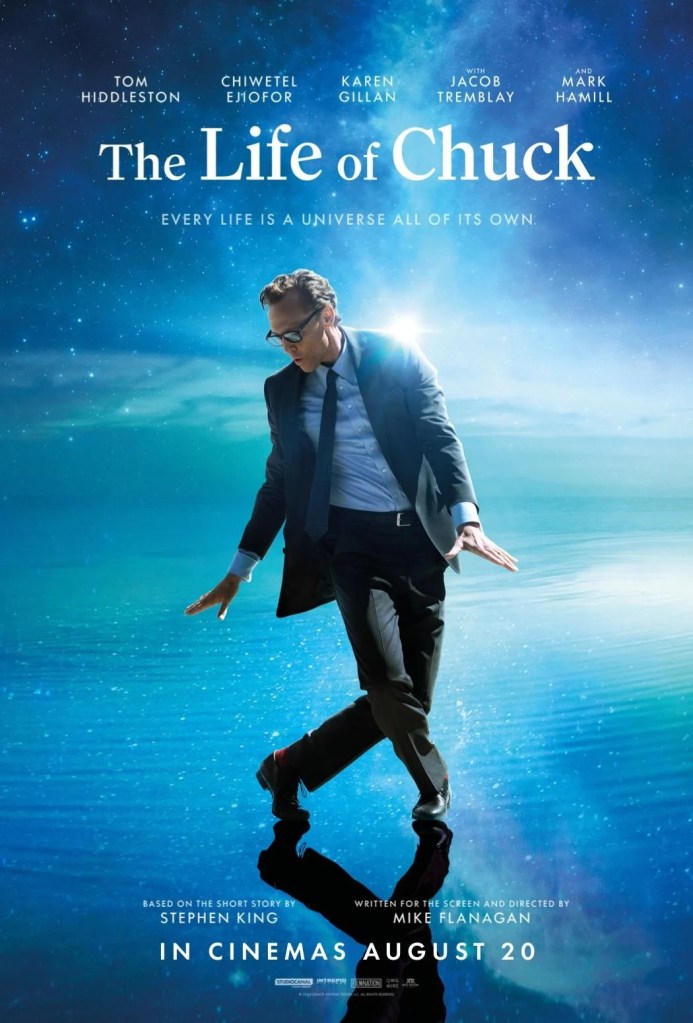
The Life Of Chuck – Review

Release Date – 20th August 2025, Cert – 15, Run-time – 1 hour 50 minutes, Director – Mike Flanagan

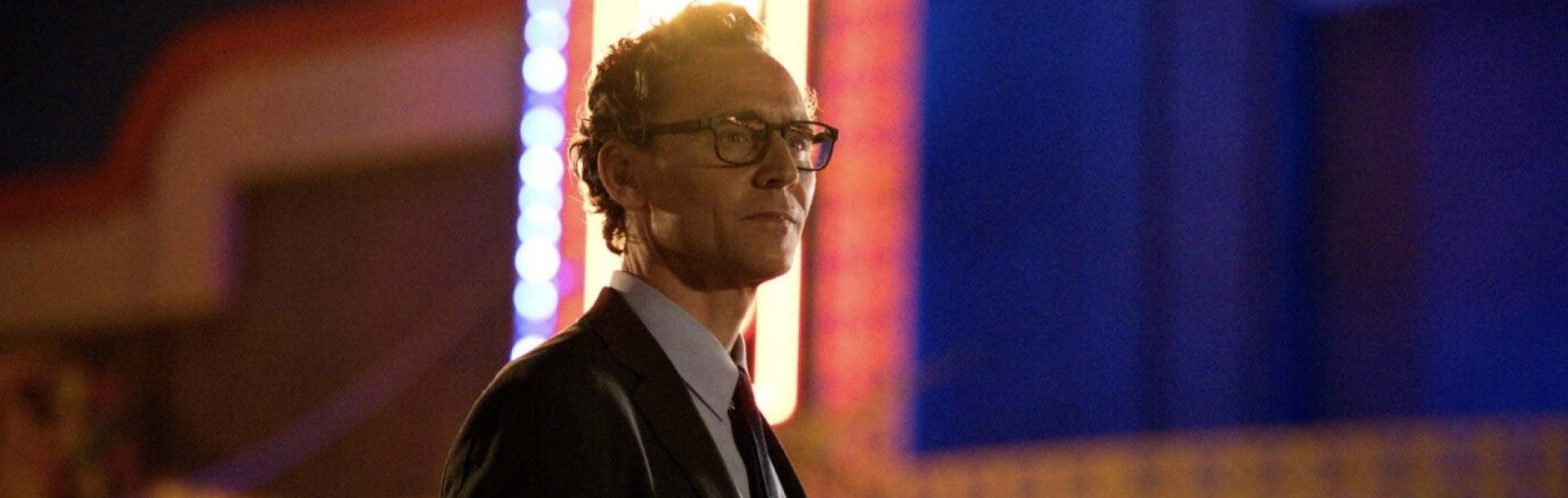
Who is Charles Krantz (Tom Hiddleston), and how has his life led to his face appearing everywhere as the world comes to an end?

One of the big questions asked throughout the opening act of Mike Flanagan’s latest Stephen King adaptation is ‘who is Charles Krantz?’ His face (Tom Hiddelston) appears on posters and adverts all across town as at first the internet goes down and the end times appear to be getting closer. However, as his life, or rather three stages, one, or two, of which are more particularly moments, plays out in reverse it’s made clear that he’s very much an ordinary man. An accountant walking down the street who one day finds the confidence to drop his briefcase and dance along to the busking drummer (The Pocket Queen).

It’s a moment of catharsis in the middle of the street as the sun beats down on the everyday, especially as he ropes in a complete stranger (Annalise Basso’s just broken up with Janice) to join in on the display for the growing crowd of onlookers. As the chapter’s of Charles’, nicknamed Chuck, life play out Nick Offerman provides occasional narration, emphasising the normality but perhaps spectacular nature of his life. One which has faced tragedy and uplift, love and loss. Not all of which is seen, and entirely felt, but manages to come across in some way in the story.


Not one of King’s horror stories, Flanagan still manages to bring in a sense of fear to the proceedings. It’s light and infrequent but throughout his childhood Chuck (played here by Benjamin Pajak) is told by his grandparents (Mark Hamill and Mia Sara, both on excellent form and stealing the show despite brief screen-times) to never go into the mysterious room at the top of the house. Little is said about it apart from when Chuck’s grandfather is in a drunken state of grief, suggesting it has links to past deaths and tragedies. The treatment of this room has feelings of the Overlook Hotel without stretching into pure horror, only the aforementioned fear, perhaps spurred by the mystery.

This latter chapter, providing answers and context for what has come beforehand, is perhaps the best of the film. As a whole, there are good moments throughout The Life Of Chuck, including some wonderful conversations between characters pondering life for an individual scene – moments including Matthew Lillard and Carl Lumbly come to mind – but there can sometimes feel a slightly drawn out feeling to some points. Particularly in the first chapter where many of the questions are built up and pondered before moving on to focus more directly on Chuck’s life. With this in mind, while the final stages tie things together rather well and provide some effective context there’s still the feeling of watching three, albeit linked, short films rather than more tied together chapters.

Where things work best are where Chuck is most directly involved. Hiddelston may not have a great deal of lines, but he certainly gives it his all when it comes to the dance that he gets to do, and the following thoughts going through his character’s mind about what compelled him to do it in the first place. There’s a thoughtfulness to Flanagan’s film, and the story which unfolds. It may not always boost things in the way that might be hoped for as there can be spaces between the most effective and enjoyable moments propelled by a real connection to the thoughts of life and humanity. They’re well done, but can sometimes feel slightly conflicted with the more drawn out details trying to approach these moments.

There’s a thoughtful film within The Life Of Chuck, one sold by a handful of the supporting characters and moments of the title character seizing life. However, it’s pondering can sometimes feel drawn out with the feeling of three short films.

Rating: 3 out of 5.

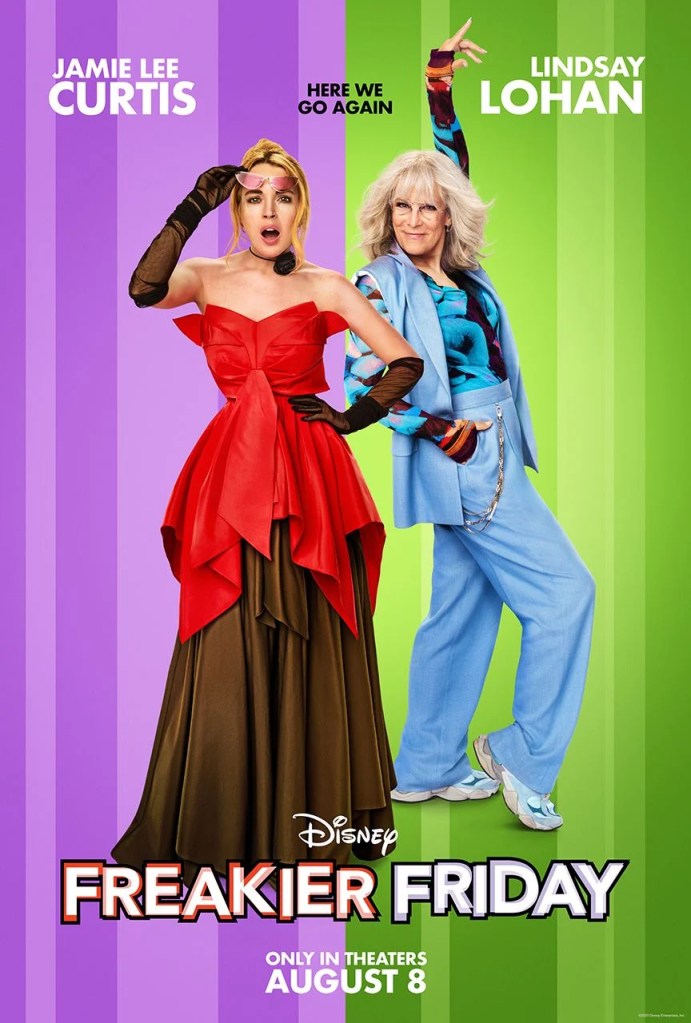
Freakier Friday – Review

Cert – PG, Run-time – 1 hour 51 minutes, Director – Nisha Ganatra

Mother and daughter Tess (Jamie Lee Curtis) and Anna (Lindsay Lohan) find themselves in another pre-wedding body swap situation, this time with Anna’s daughter Harper (Julia Butters) and step-daughter-to-be Lily (Sophia Hammons).

On the surface Freakier Friday strikes as the kind of film that Disney would normally reserve for direct placement on their streaming service. Another body swap situation just days before a wedding, this time between four people instead of two. Perhaps the returning forces of Jamie Lee Curtis and Lindsay Lohan as mother and daughter Tess and Anna are what have led this belated sequel to the big screen.

In fact, the pair are very much the forces which once again hold the film up and make it what it is. Much like the first film, the content of the sequel is generally fine. A functional, if predictable, plot with some decent gags thrown in here and there with the fun brought about by the lead performances – with Curtis and Lohan appearing to be having the time of their lives reuniting. 

This time instead of swapping bodies with each other they find themselves embodying Anna’s daughter, Harper (Julia Butters) and step-daughter-to-be Lily (Sophia Hammons), and vice versa. The teenagers have hated each other since before their parents met, Lily’s father Eric played by Manny Jacinto), one wants to leave LA while the other wants to go to fashion school in London. So, in adult form they plan to break up the wedding with less than 48 hours to go.


Successfully avoiding cliched and cringe-inducing lines about age differences there are plenty of funny instances of the quartet getting used to their hopefully temporary new bodies. Whilst Butters and Hammons gain chuckles whizzing around the city on e-scooters making the most of fast metabolism, Curtis and Lohan get the bigger laughs as they play teenagers trapped in bodies which feel tired or sometimes simply refuse to move.

There’s a constantly moving energy to their scenes which keeps up the pace of the almost two-hour run-time, and it’s clear that the film, and those behind it, want to focus on them as the returning characters. And, as mentioned, they bring about the biggest laughs with the physical elements of their gleefully chaotic performances.

Disney have taken something of a plunge for themselves in this current era by releasing the film in cinemas, and it’s all the better for that being the case, especially with an audience which lets loose just like the leads and laughs along with them. While not all of its emotional beats entirely land, although there is some effect amongst their slightly extended nature in the later stages of the film, there are plenty of chuckles to see things through in what ends up being a fun and enjoyable film which knows not to take itself too seriously, and just as importantly where its strengths lie. It’s rather infectious fun.

While the narrative of Freaky Friday might play familiarly safe it does so by leaning into the gleeful joy of Lindsay Lohan and Jamie Lee Curtis’ leading performances, raising a number of chuckles along the way.

Rating: 4 out of 5.

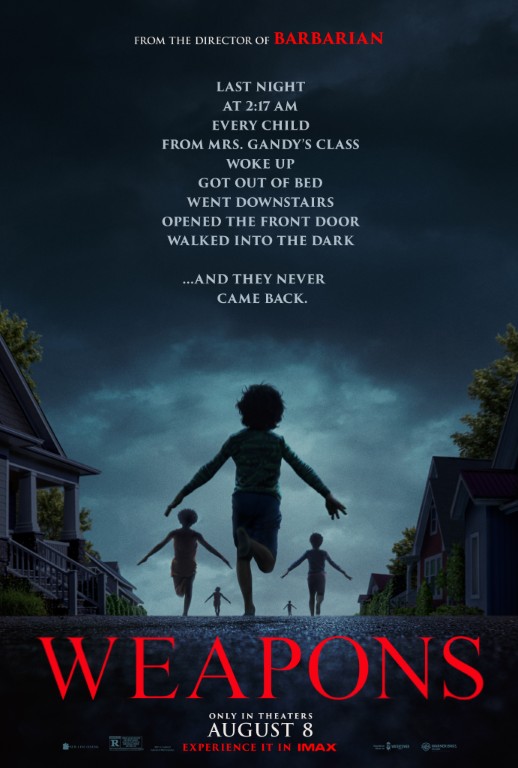
Weapons – Review

Cert – 18, Run-time – 2 hours 8 minutes, Director – Zach Cregger

2:17am, a class of children run out of their homes not to be seen again. A month later the town is still looking for answers, with the finger being pointed towards teacher Justine (Julia Garner).

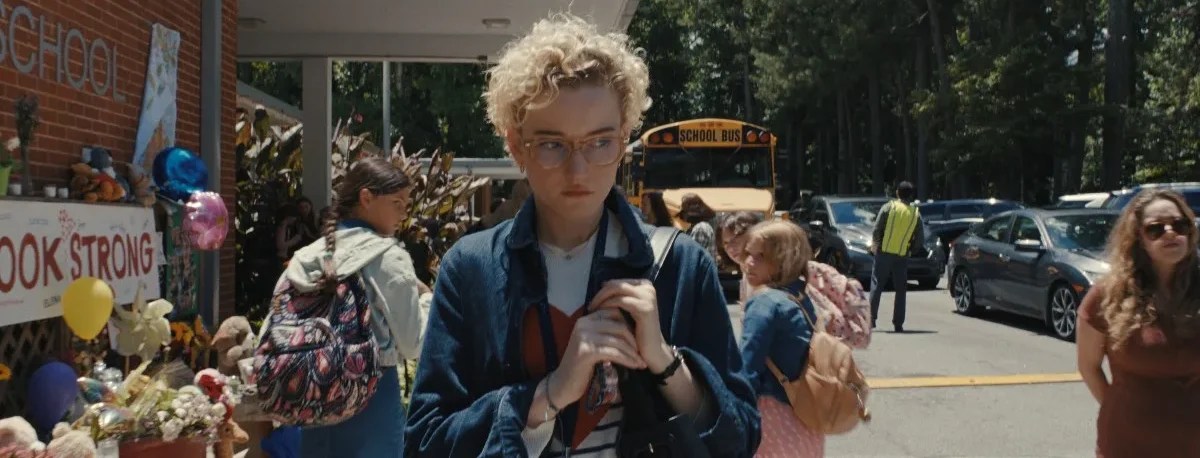
Writer-director Zach Cregger has claimed that his Barbarian follow-up is partly inspired by Paul Thomas Anderson’s Magnolia. The influence comes through in the separate chapters which play out as a community searches for answers a month after a class of third grade children go missing into the night. At 2:17am each one runs out of their homes, arms stretched out, with no trace of them beyond brief doorbell camera footage. Much of the blame is put on teacher Justine (Julia Garner), attacked and hounded by parents and other residents, particularly Josh Brolin’s heartbroken father Archer, spending each night sleeping in his missing son’s bed.

The pair make up the first two chapters of Weapons, following a prologue detailing the events that led to where we are now. The narrative from there jumps back and forth ever so slightly. Some showing events from different perspectives, others simply showing how the events have affected characters differently. It makes for a slow set of events in the first hour where while Cregger’s use of the camera has some solid effect the way he views the characters feels slightly out of reach from forming a full emotional connection, as if only just a step away.


Mystery should be the biggest draw. And while it has some impact, especially during some of the freakier moments – albeit much of what provides the 18 rating is saved for the later stages – I found myself enjoying the eventual reveals and explanations more than much of what came beforehand. It’s where some of the most twisted elements come to the fore and stretch beyond the more dramatic tones of the opening chapters where much of the push comes from the brief bursts of the horror and the instances where characters crossover in their search for answer, although not always a joint search as shown between Garner and Brolin’s characters, or even Alden Ehrenreich’s (always a welcome face, who I still hope to see in bigger, more central roles since Hail Caesar) troubled police officer and Austin Abrams in-need-of-cash drug addict James.

This latter pairing is where Cregger begins to explore the darker elements at play much more upfront, and becomes somewhat more concise. Luckily, as the film threatens to border on feeling overlong he brings out the most fun details and elements, and darkly comedic beats to wrap things up with. Turning something akin to a sequence in 28 Days Later on its head, seemingly having the most fun with what he’s given himself to play with after all the ambiguity in the approach. Ambiguity which while having some effect never quite creates the interest it perhaps hopes for, including creating an overhanging threat as Justine tries to find a way to talk to the only remaining student in her class (Cary Christopher’s Alex) or Archer’s grief sets him out on a personal investigation.

The ensemble cast each put in good performances, including a short turn from Benedict Wong as the elementary school’s headteacher. They help to lift the film up during the more drawn out moments, largely in the first hour where characters are generally left on their own in terms of both physicality and perspective. When bouncing off of each other the film is lifted up even more, alongside the push of things feeling more connected, Weapons is at its best. This is perhaps why the second half, where answers are explored more up until the final sequences with their own sense of dark fun that’s not entirely present in the rest of the film.

Weapons is a film where the answers are more satisfying and engaging than the mystery of the build-up. At its best during darker sequences and when crossing over its solid ensemble cast, there’s just enough here to stop it from outstaying its welcome.

Rating: 3 out of 5.