
Cert – 12, Run-time – 2 hours 3 minutes, Director – Kei Ishikawa
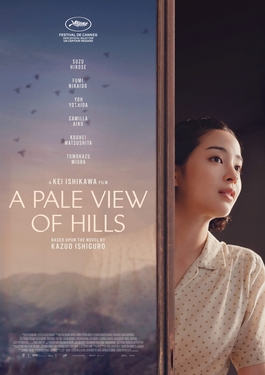
When her journalist daughter (Camilla Aiko) asks about her life in Nagasaki, Etsuko (Yoh Yoshida) revisits the tragedies of her past (Suzu Hirose) and the life she tried to leave behind.
There’s not so much two different films playing out in this adaptation of Kazuo Ishiguro’s debut novel, but more two different views of the world. They come from two distant ages and dealings with tragedy. 1980s England, Etsuko (Yoh Yoshida) is soon to move house and is getting some help from visiting daughter Niki (Camilla Aiko). Niki has dropped out of university, but is working as a journalist and begins to ask about her mother’s past in Nagasaki. It’s something Etsuko is reluctant to talk about, as much as her other daughter Keiko who we gather took her life years before – scenes showing even Nikki still dealing with this play out quietly as she herself seems to only reluctantly half-acknowledge this.
In flashback form, although making up most of the run-time, we see a young Etsuko (Suzu Hirose) in 1950s Nagasaki. A peaceful place populated by plenty of green scenery that’s veiling a community still recovering from atomic attack. Etsuko often finds herself looking out the window silently comparing her life, increasingly distant in her relationship with husband Jiro (Kôhei Matsushita) to that of those around her, particularly single-mum neighbour Sachiko (Fumi Nikaidô).
With the tragedies and lives that are being reflected on in both periods there’s a lightness to the overall impact of the film. It doesn’t quite feel to be as emotionally striking as it perhaps once to be, largely due to not entirely investigating the feelings of Etsuko. Things don’t feel as if they’re intentionally holding back, like the character who appears to have spent years living in the shadow of her past without actually mentioning anything about it in the hope that will help with moving away from it, but more that they never quite investigate the emotions at hand. There’s something of a surface feeling to the film as it moves from one moment to the next.
It all seems rather untroubling, and admittedly left me wanting something deeper. There’s a likable nature to the quiet moments, especially those dwelling on the characters restraining in emotion – Nikki standing in a dark corridor as an estate agent take pictures of Keiko’s room is a rare affecting moment from the film, and one of its best. However, sometimes quietness is exchanged for something sedate. Moving along easily and making for something lightly engaging, but not entirely affecting. Even as a film about holding on to emotion and the tragedies of the past.
While featuring some striking moments of silently withheld emotion, A Pale View Of Hills fails to properly get into the feelings of its characters beyond a lightly engaging surface.
 Just A Little Bit Random