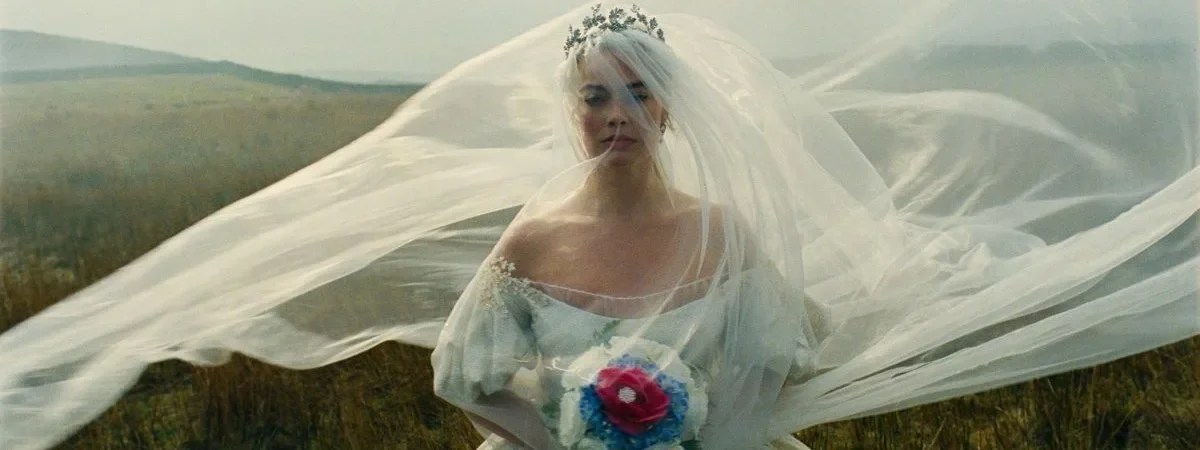
Cert – 15, Run-time – 2 hours 16 minutes, Director – Emerald Fennell
Class, ancestry and the future all create tensions in the passionate relationship between Cathy (Margot Robbie) and poor childhood friend Heathcliff (Jacob Elordi), especially in the wake of marriage and personal tragedy.
The quote marks around the title of Emerald Fennell’s adaptation of Emily Brontë’s much-adapted novel are there to show that this is an adaptation of the version of Wuthering Heights that her mind saw when she read the novel at age 14. It’s a film, despite the (rightful) 15 certificate and advertising of steamy wall-to-wall nookie, that’s in some ways primarily made for girls of the same age, to be caught in the mist of the romance in the 18th Century Yorkshire moors.
There’s certainly a sauciness to the film as passions erupt between Margot Robbie’s Cathy and childhood friend, who she names and claims as her own after her father (Martin Clunes) takes him in, Heathcliff (Jacob Elordi) – the young pair played by Charlotte Mellington and Owen Cooper respectively. After we see them grow up together Cathy’s sexual awakening – watching members of her father’s staff explore BDSM in the horse equipment shed – suggests that the film may well be nothing but sex, however Fennell avoids this temptation rather successfully and manages to focus on the relationship as part of the story being told.
A story which may be far from the most faithful adaptation, at least from what I’ve heard and seen of the response to the film; having not read (or knowing a great deal about) the novel myself, but creates plenty of detail in its landscapes and locations. Fennell’s film is visually brilliant. Capturing an old studio quality matched with almost theatrical, closed-in set design that’s opened out into the Yorkshire moors with considerable style by cinematographer Linus Sandgren.
When it comes to the thematic beats there’s a bite to the details of class and the futures the central lovers face, and try to achieve through other relationships, especially when passion turns into twisted desperation in Heathcliff’s case. Yet, it’s also at this point that the film finds itself caught between the bite and sauciness, sitting uncertainly between them as if hesitantly trying to bring them together when in actuality they’re consistently kept slightly apart. Something which becomes more the case as lives, marriage and rifts between the lead characters become more prominent, most of all in the third act which still manages to have its impacts.
Stylistically, Fennell is serving up a lot and while tonally and narratively it may well confirm that she’s one of the most divisive writer-directors working at the moment (although I’ve fallen into the camp who like her work so far) there’s still enough in “Wuthering Heights” to feel engaged by the ensuing romance, and indeed the locations it unfolds in. Robbie and Elordi serve solid performances in Fennell’s takes on the roles and while occasionally bumpy and conflicted, although generally getting through its run-time, there’s a take here that should work well for the target audience, especially in the emotional push of the closing stages. For others there’s undoubtedly another divisive feature here from Fennell, but another one that I largely got on with especially as she mixes location and visuals into the narrative and tone to lift them up.
While occasionally sitting uncertainly between its sex and bite Emerald Fennell’s take on “Wuthering Heights” still has enough happening in the romantic passions amongst the visually striking landscapes to help see it through with enough support and engagement.
 Just A Little Bit Random