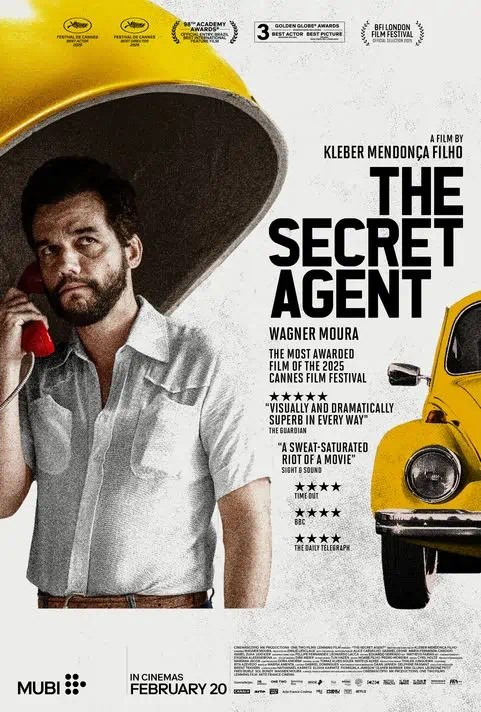
Release Date – 20th February 2026, Cert – 15, Run-time – 2 hours 41 minutes, Director – Kleber Mendonça Filho
Brazil, 1977. To escape his recent past, Marcelo (Wagner Moura) finds himself returning to his distant past in the city of Recife, where multiple lives and identities catch up to him with deadly intent.
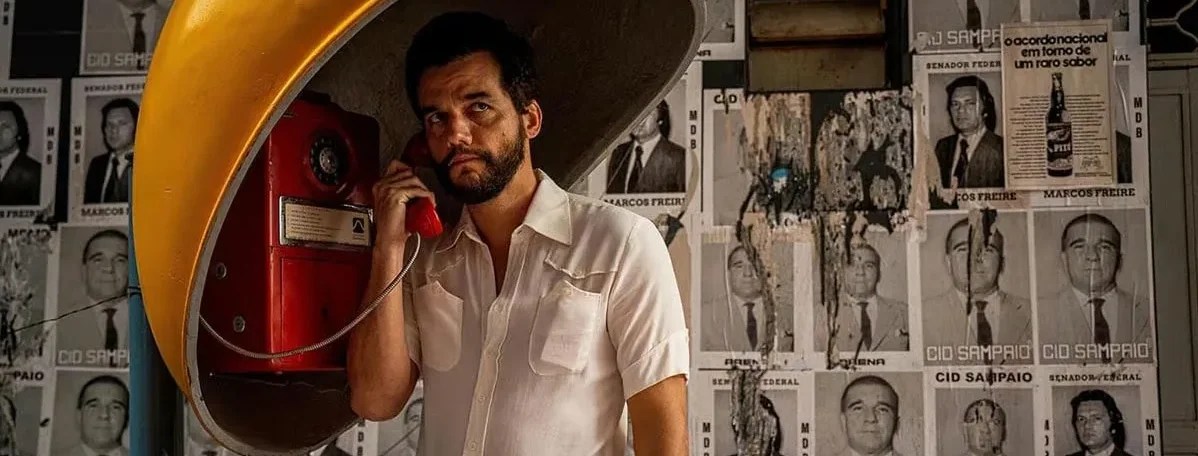
There’s a streak of dead-pan dark comedy in the extended opening scene of The Secret Agent. It could play out as its own short film, but opens the door to a world where murder is left out in the streets to be observed by everyone. Whether as a warning or reminder. Marcelo (Wagner Moura) has parked up at an out-of-the-way petrol station to fill up his bright yellow VW Beetle and sees a corpse covered by a not-big-enough piece of cardboard, the local dogs threatening to consume it before it’s taken away. Apparently a killing by the night shift worker stopping an attempted attack. The police turn up, ignore the body and scan Marcelo’s car inside and out before leading him on his way.
It’s a slow-burn opening but one rich with thematic detail for the lives that Marcelo finds himself caught between as the widower returns to his son (Enzo Nunes) in Recife. having been looked after by Marcelo’s in-laws. He appears to be returning in some ways to his somewhat distant past in order to escape his recent past, involving his work as a professor and the military dictatorship in Brazil, the film being set in 1977. With hitmen after him, seemingly the kind who will work for anyone who asks whether it be government or individual, he finds himself going undercover with quiet revolutionary action with those he lives near.
However, multiple paths start to close in and overlap. Marcelo, or as he becomes known Armando, is increasingly on edge as the overhanging threats that surround him, where anyone could be listening to a phone conversation, or observing it from just across the street, are clear in both his and the audience’s mind. While clocking in at 2-hours-and-40-minutes writer-director Kleber Mendonça Filho and editors Eduardo Serrano and Matheus Farias do an effective job of finding balance amongst the busyness of the gradual narrative. Both in terms of its intentionally slow pacing and the ways in which information is revealed about Marcelo, those he’s working alongside and those who are closing in on them.
Moura provides a quiet performance where the subtleties lie in what Marcelo doesn’t give away. The thoughts that are going through his mind rather than what he’s clearly saying. It’s a performance that lives in the pauses and layers of the character, even in the opening stages before the past that caused him to drive to Recife is uncovered. There are a lot of cogs moving in the background of The Secret Agent to both keep things moving and allow for the consistent revealing of both narrative and character-based details.
It’s a film where much of what is key works quietly to allow for things to move along smoothly, and without feeling overlong. Making for a drama that allows for its elements to come together, with characters and their paths threatening that along the way, with a layered sense of tension-tinged intrigue. Where attitudes to murder, what death can mean and how it’s all observed and depicted come to the fore with effectively internalised thought and emotion from Moura as the events of the film, like the blood and bodies, start to spill into the shakily watched and controlled streets.
Wagner Moura’s central performance is one of internalised subtlety where much of the effect, like the film, is working in the background to keep things consistently moving and engaging in the slow-burn layers of The Secret Agent’s overhanging threat and depictions of murder and secrets.
 Just A Little Bit Random