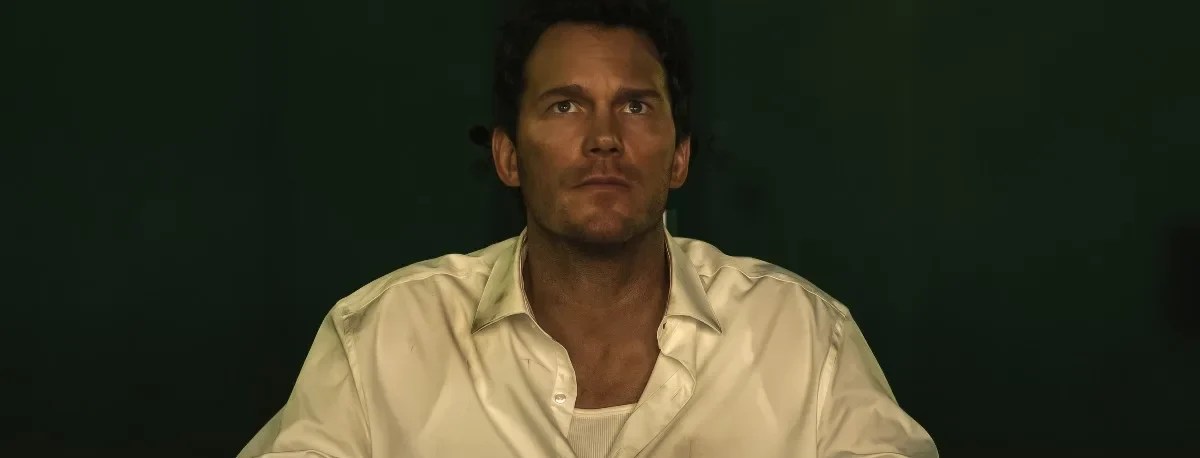
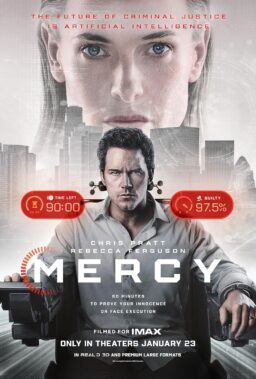
Cert – 12, Run-time – 1 hour 40 minutes, Director – Timur Bekmambetov
2029, LAPD detective Chris Raven (Chris Pratt) has 90 minutes to prove his innocence before an AI judge (Rebecca Ferguson) for the murder of his wife (Annabelle Wallis). If he fails, he’s executed.
The odds should really stacked against Mercy, in fact they pretty much are. How much excitement can you get out of a film that’s likely to be met with a great deal of cynicism from the basic details alone. Chris Pratt sat in a chair for 90 minutes as his character testifies before an AI judge (Rebecca Ferguson).
Yet, somehow I found myself quickly brought into the not-quite-screen-based trawl through phone and camera records as Pratt’s LAPD detective Chris Raven, a supporter of the near-future Mercy courts, attempts to prove he didn’t murder his wife, Nicole (Annabelle Wallis). However, this proves particularly difficult in a new court that has so far executed everyone put on one-on-one trial, where you’re considered guilty until proven innocence.
Yes, Pratt may often look like he’s trapped in the room with a bad fart, but luckily this isn’t the main focus of the film. It also doesn’t overly distract from the growing tension at hand. To include a gradually ticking clock throughout, consistently referred to to the point where it may as well appear in the corner of the screen instead of in the not-quite-background, is a bold move but it’s one that Mercy, alongside a number of elements, manages to just about get away with. In large part because of how the tension rises throughout. Creating a more and more gripping narrative as Raven attempts to track down the person who did kill his wife, whilst providing a consistent string of linked details to the judge before him (Ferguson does her best with a blunt and dry role – it is an AI figure, after all).
Events start to spill out into the streets as we see calls with fellow LAPD officers, and Chris’ daughter, Britt (Kylie Rogers). The calls can conflict, and more often than not make Chris seem even more guilty. Yet, after a short while the film isn’t quite so interested in asking whether he’s guilty or not and simply his race to prove that he isn’t. A strange kind of sci-fi mystery thriller plays out, largely from the one location, and I can’t say that I wasn’t compelled by it. I’ve seen the trouncing that this film has received from a number of critics, and I can understand some of the negative reviews and why some may have not got on with the film, but part way through I realised that after the build-up I had become very much engaged in what was happening. I was interested, and perhaps even invested.
Shown in the escalating tension that I felt during a number of key sequences as one thing effectively rolled into the next with a good deal of pace, and the race against time bring felt more and more the less it was reminded of and the more it was simply just allowed to be known about and remembered by the audience. From everything I had seen beforehand I had quite the opposite experience with Mercy to that which I was perhaps expecting going in. Once past the set-up and establishing of the ways in which the courtroom, its access to files and Pratt’s repeated shouting that his character is innocent and shouldn’t be in this situation, there’s a feeling that the gimmick-iness of the setting, and to some extent base of the narrative, fades away to allow for that tension of the situation to come through.
Whatever it was, there’s something about Mercy that clicked for me (maybe I just wasn’t smelling the same fart Pratt and many others were). Bringing out the gradually growing tension of the constantly moving and developing narrative for an interesting, engaging and entertaining sci-fi thriller.
Once past the gimmicks of the set-up, Mercy, albeit with a couple of bumps, manages to make for a sci-fi thriller with gradually growing tension and interest in the rolling screen-based narrative.
 Just A Little Bit Random