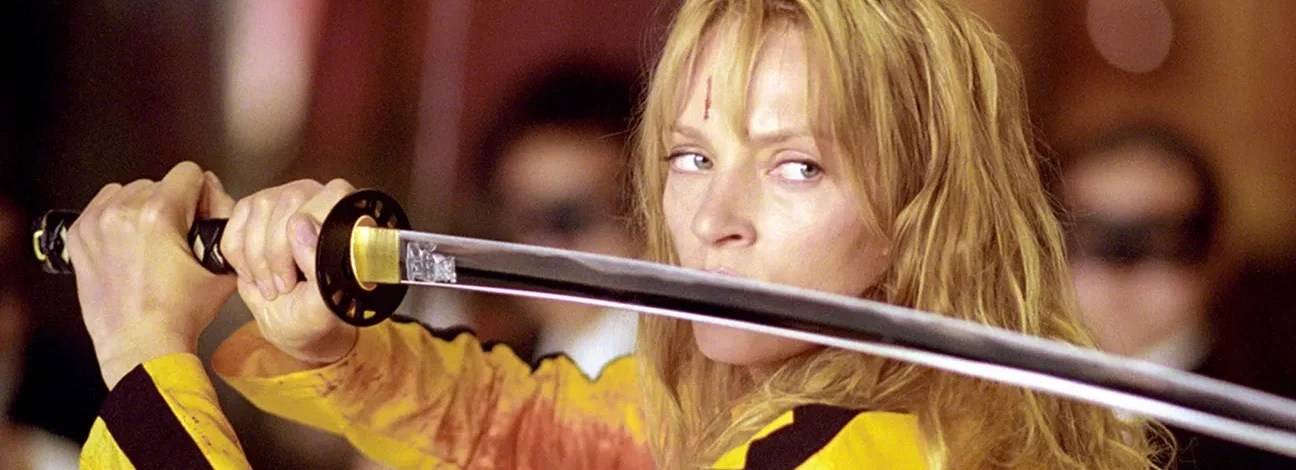
Cert – 18, Run-time – 4 hours 35 minutes, Director – Quentin Tarantino
After a massacre on her wedding day, including her unborn baby, The Bride (Uma Thurman) wakes up from a coma and immediately seeks revenge against the man (David Carradine) who tried to kill her, and his gang.
The delight of Kill Bill isn’t in the complexity or bloody intensity of its action sequences, but the few details we get of the world in which its set. Gangs are gangs, antagonists are antagonists and The Bride (Uma Thurman) is out for maximum revenge. Lucy Liu’s O-Ren Ishii leads a Japanese criminal gang, meeting with multiple major bosses, and the biggest draw of this insight into the criminal underworld is the simple style and flare of the club location in which the events take place. Tarantino’s camera tracks multiple bodies walking and dancing around to The 5,6,7,8s as The Bride preps her attack.
What ensues is perhaps the bloodiest sequence of the entire film – now released as one piece, as close to Tarantino’s original vision as possible, after having been cut into two on original release at the demand of producers claiming otherwise the film was too long. Bringing in entertainment value from its over-the-top blood-flow from cut limbs and homage to samurai and martial arts films. Boosted by the soundtrack, which helps a number of the action sequences throughout the run-time – itself assisted by an intermission – the action throughout often works best the less bogged down in replication it seems, a feeling which somewhat bookends the film, and the more interested it is in homage.
As The Bride whittles down the members of the Deadly Viper Assassination Squad, who attacked the church she was holding her wedding rehearsal at, killing all there including her unborn child. After waking up from a four-year coma after being shot in the head she sets out for revenge, working her way towards leader, and former lover, Bill (David Carradine). I’ve never exactly considered Kill Bill to be Tarantino’s best work, and always found Vol 2 to be weaker than the first half. On seeing the film as a whole while I still stand by both points I certainly see I’d underrated the film and also the second half works a good deal better, and without as much of a sense of build-up, as part of The Whole Bloody Affair. Yet, what I’ve truly failed to notice before is just how great David Carradine is as Bill.
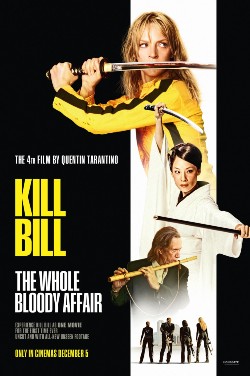
Carrardine brings a consistently sinister threat to any scene he’s in. Even during casual conversation – itself hinted with formal worry – or when appearing cheerful Bill’s opening insistence that he’s not a sadist, but a masochist, echoes into every word he utters. The different perspectives of the wedding massacre itself, never explicitly showing the events themselves, are easily associated with him and immediately show the threatening, merciless force he presents.
There are different sense of threat to a handful of the Deadly Viper Assassination Squad we see cropping up throughout. Whether separately or dealing with each other for the most part they successfully wind in to the revenge story at hand. Ishii’s backstory is seen in a new anime flashback which while perhaps unnecessary is nonetheless entertaining and could have stood alone as its own short, or even film, but holds its head up whilst sitting within this work. Meanwhile, an exchange between Darryl Hannah’s Elle and Michael Madsen’s Budd has plenty of bite and provides more entertaining detail into the workings of these characters in this world while never feeling the need to be weighed down or extended by context, everything we see is what we get, and all we need – and Tarantino understands this.
Thus, in his 4-and-a-half-hour-plus revenge story he largely only presents us with the story and all we need to help move it along. Detail comes from the exchanges throughout. And, often, the best scenes are those more focused on dialogue and interactions that show off character behaviour – The Bride arriving in Okinawa in search of the best sword she can find leads to plenty of seamlessly moved into ideas. Each with a familiar tone that fits right into the story that Tarantino is telling. Allowing for scenes and chapters to lead from one to the other with relative ease and little drop of engagement throughout – apart from, still, some of the opening stages of the second half as we focus on Budd’s life after the harsh glimpses of the wedding massacre. While still holding its moments and effect it seems to be generally slower than the rest of the piece as you wait for Thurman to creep up, sword in hand(s); ready to spill blood.
We’re constantly reminded in Thurman’s performance of her anger, determination and pain, all also helping to propel the film and her character’s mission forward. Forward through the long but well-maintained run-time that holds your engagement thanks to the pieced together details provided by the narrative and the world in which everything is set, naturally unfurling in a flow that occasionally matches that of the blood spraying from severed limbs.
Who would have thought that Tarantino’s fourth film would have worked best as intended? Kill Bill: The Whole Bloody Affair shines on the big screen both in and out of action as the world naturally grows and provides the needed details to keep The Bride and her revenge moving in entertaining, occasionally brutal, fashion.
 Just A Little Bit Random