Release Date – 27th February 2026, Cert – 15, Run-time – 2 hours 15 minutes, Director – Mona Fastvold
The 18th Century, after a life of tragedy Ann Lee (Amanda Seyfried) spreads her religious Shaker movement from England to America, becoming a figurehead for those who follow, and threaten, her.
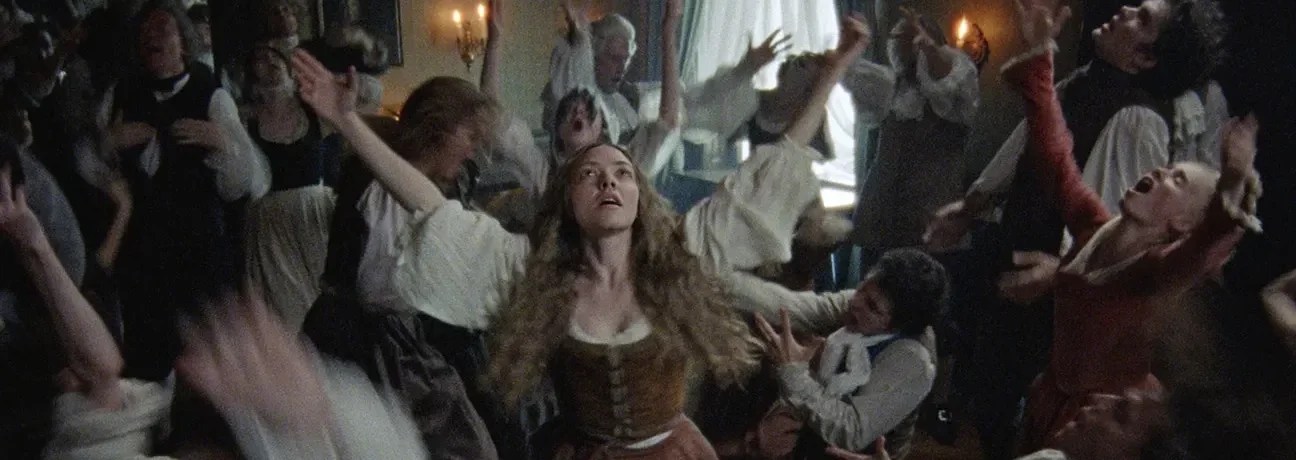
The Testament Of Ann Lee is a frustratingly restless film. The Shaker movement the titular character (played by Amanda Seyfried) spreads from the streets of Manchester to its own, God-directed land in pre-revolution America sees people overcome by God’s power and start shaking, convulsing in song and dance. Yet, even their jerkily waving movements feel more calm than the film they feature in. One which bursts into snippets of songs so brief that it feels as if this apparent musical has no proper musical numbers; making Joker 2 look like a wall-to-wall song-and-dance bash.
The longest track repeats the phrase “I love mother” over and over again, after having followed a conversation about false gods. The more it went on I found myself genuinely wondering if it was going to turn out that Ann Lee was a major cult leader. The more the film revolves around her and she becomes a noted leader – multiple synopses for the film have stated that her followers view her as a female incarnation of Christ – the more cultlike it all becomes, and I don’t entirely think that’s the intention. The voiceover throughout (courtesy of Thomasin McKenzie, who appears later in the film) is telling a grand, historical story, even if it occasionally sounds like it’s coming from Philomena Cunk; “they went in search of a wide avenue called Broad Street.”

It’s one of a couple of unintentionally humorous moments in the film, the other being an extended sequence which sees characters trying to find where to build the Shaker town – “paradise through toil and chastity” – guided by an index finger seemingly moved by God. But, aside from Mr Hucknall’s magic finger (gifted unto him by God) there’s little levity throughout this film – co-written by Brutalist writers Mona Fastvold (who also directs) and Brady Corbet, who both have slight musical experience having worked on 2018’s Vox Lux. The Testament Of Ann Lee simply falls flat and feels like a very slow trudge through each event. No matter how much is going on it all simply feels boring.
After being told about a series of births and subsequent bereavements we see a near-montage of this panning out, making it clear that this is going to be a downbeat film. Instances relating to Ann’s marriage to Christopher Abbott’s Abraham and abuse faced come into play, although feel somewhat brief when they are amongst everything else that’s thrown towards the titular character – who Seyfried does her best to keep determined and, more importantly, afloat for the sake of the film. With just how much is going on and what’s also thrown at the audience it’s difficult to work out who this film is for. It feels confused and directionless and rather than targeting a lot of people at once it doesn’t quite feel as if its targeting anyone.
The whole thing is all rather bland and dour. With the titular character seemingly coming out of it through how people seem to have viewed her rather than as herself, being caught up in the perfect image created by the Shaker following that we see grow over the long run-time. The Testament Of Ann Lee eventually feels less like Ann Lee’s personal testament and more it told through the eyes of the devout Shakers, meaning that a lot eventually gets caught in what’s attempted to be shown and in the end perhaps has the opposite depiction and impact. Either way, it all feels as cut up and conflicting as the bursts of song and the fact that this seems to want to be a musical.
Much like the bursts of song throughout, The Testament Of Ann Lee feels jumbled and detached. A long, boring slog where the Shakers feel increasingly cult-like it’s very difficult to know who this is really for.
 Just A Little Bit Random