
Release Date – 16th January 2025, Cert – 15, Run-time – 1 hour 29 minutes, Director – Kaouther Ben Hania
52 miles from Gaza, a group of call centre volunteers try to get an ambulance to a 6-year-old trapped in a car surrounded by IDF soldiers. Navigating an endless process of requests and approvals.
“This dramatisation is based on real events, and emergency calls recorded that day… The voices on the phone are real.” As the volunteers at a Red Crescent call centre 52 miles from Gaza talk to 6-year-old Hind Rajab, it feels as if they’re actually talking to a child. Perhaps because, in some ways, they are. There’s a shaking sense of false calmness to their voices as they try to keep the child, and in some ways themselves, calm whilst trapped in a car waiting for an ambulance to be given permission to reach the area.
Calls have been re-routed from the strip after communications there have been destroyed in mass bombings. All the action is contained within the call centre, our minds create images that fit right in alongside the fears we hold there, too. Although, after someone manages to find a picture, we see an image of Hind’s face, smiling, before the war (the events the film recreates happened in January 2024). Terrifying rumbles and gunshots in the background of Hind’s call are paired with the peaks and dips of the audio wave recording; like looking at a heart-rate monitor with the growing worry of seeing a straight line, although in this case without a constant beep.
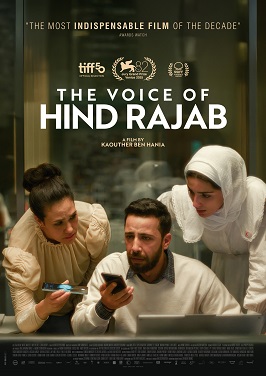
The route to get permission for an ambulance is endless with constant delays in communication with the relevant parties. On many occasions it seems as if it’s too late, with the volunteers struggling to hold back their tears of fear and worry. Motaz Malhees and Saja Kilani who we hear the most from give powerhouse performances overflowing with emotion, the kind that should be in the Lead Actor and Actress Oscar conversation! It’s through the performances of the small ensemble that much of the emotion of the film is conveyed, and exerted.
Yet, the tension continues to be ramped up as the hours go on and darkness starts to descend. Progress doesn’t feel like progress when there are so many hoops to be signed off before they can be jumped through. A moment of guided meditation is for the audience as much as it is those on-screen. It allows us to escape the glaring lights of the darkened call centre just for a moment and see some gentle sunlight. A glimmer of peace and hope, even if just to cling to to calm our minds amongst the tragedy at hand. A more prolonged moment compared to the very light, brief moments of natural, conversational humour more confined to the early stages before the intensity of the situation truly spreads and the gunfire appears to get closer to the other side of the phone, or the call is hung up.
I can imagine that few screenings of The Voice Of Hind Rajab will be met with sound. When I saw it it was one of the few films where people have sat through the credits in silence. Even those who shuffled out during them seemed to do so slowly, quietly and with their heads slightly down, and in this case not in their phones. In some ways it’s a very communal experience, as it is for those on screen. Although in this case one of helplessness, distance and tense fear. I went in not knowing the outcome of the events, but I believe had I gone in knowing there would have still been as much emotion, suspense and tragedy to be experienced. Because, the film is about the inhumanity raging against the attempts to keep the 6-year-old trapped in the car safe, and that leads her to be there in the first place.
An emotionally devastating experience, The Voice Of Hind Rajab is a magnificently performed work where all involved give everything they can to create a tense, fearful depiction of desperation in the wake of tragedy and inhumanity.
 Just A Little Bit Random