
Release Date – 9th January 2026, Cert – 12, Run-time – 2 hours 6 minutes, Director – Chloé Zhao
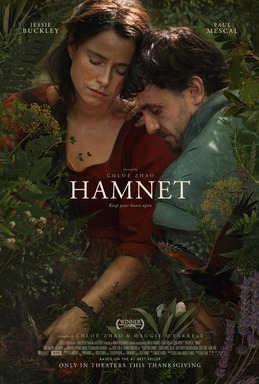
The marriage between William Shakespeare (Paul Mescal) and wife Agnes (Jessie Buckley) is put under consistent strain as he goes away to stage his plays, especially in the wake of familial tragedies where the pair struggle to communicate and express their grief with each other.
Jessie Buckley’s Agnes has pushed her way to the front of the audience at the Globe Theatre to watch the debut performance of her husband’s new play Hamlet. The pair have had little conversation for weeks as he flies to London to work on his latest production while she stays at home building up sadness, grief, anger and pain. As the performance begins we’re not watching Hamlet, or just Hamnet. We’re seeing Agnes relive the film’s events over again through a new lens.
While much of their relationship is seen as close, starting off with frequently running off into the woods, or nearest barn, together in the wake of familial struggles and tragedy communication begins to break down. Expression, especially loss and grief, isn’t present between the pair as Shakespeare (an excellent Paul Mescal, who could be a quiet threat in next year’s Supporting Actor Oscar race) consistently flies off to work – “that place in your head is now more real to you than anywhere else” – leaving Agnes even more alone to look after her children. Buckley’s overboiling emotion comes to the fore in an excellent turn that lands multiple punches. The biggest of which sees co-writer (alongside Maggie O’Farrell) and director Chloé Zhao use silence as extended and pronounced as Buckley’s traumatised scream that breaks it up.
After spending time seeing Will and Agnes’ relationship form and develop into a family over the years, once the most emotional course starts to be defined the film as a whole is better established and in turn more compelling. It allows for the subtleties in the performances, particularly Buckley’s quietly commanding turn, to land even more of an effect in just how personally rooted the characters are in everything that happens. The effect and communicative abilities of art is quietly explored through the lens of the couple’s reactions, and interactions, with it. Framed with equal strength from the various visual elements at play. It makes for the extended finale to surround you in the emotions on display – and translate the dialogue of Hamlet in multiple ways at once without having to change the words.
Emotions in Hamnet are given time and space, both to swell and be unfurled, and in the end confronted and experienced. Throughout the film is quietly engaging, and for a good while throughout and afterwards I couldn’t quite put my finger on why that was the case, but perhaps it is because of the emotions dwelling within the characters, hidden in the performances whilst going largely unspoken between the couple – although starting to overflow rather than leak out. There are many moments throughout which deliver an impactful punch, especially in the perfectly involved performances in the finale.
A film led by its overflowing emotions, with a brilliantly affecting conclusion, while gradually establishing itself Hamnet’s strong central performances shine.
 Just A Little Bit Random