Release Date – 26th December 2025, Cert – 15, Run-time – 2 hours 13 minutes, Director – Joachim Trier
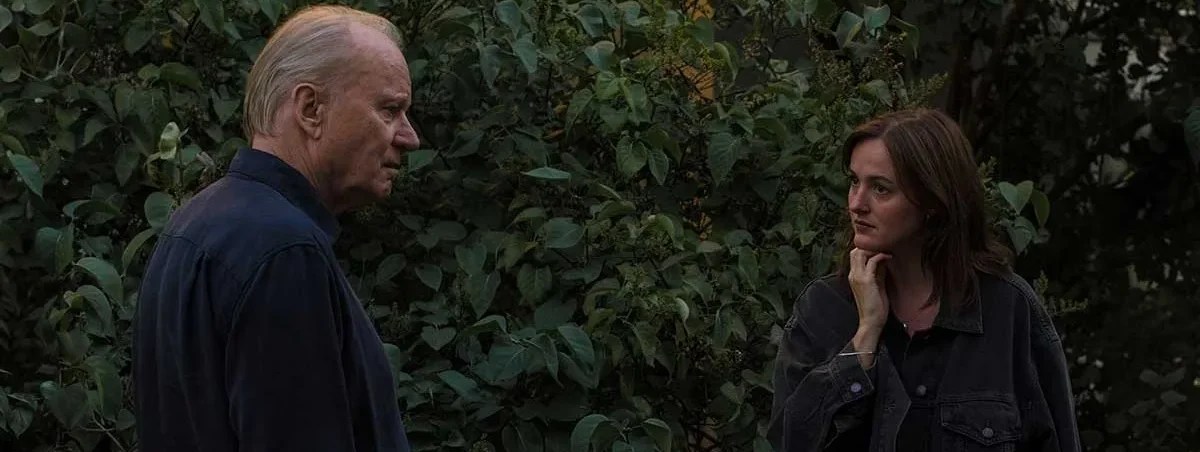
Gustav Borg (Stellan Skarsgård) returns to filmmaking after 20 years with a personal film based on his family’s life, wishing to re-establish ties with his daughters (Renate Reinsve, Inga Ibsdotter Lileaas) by involving them, however all live very different lives.
Filmmaker Gustav Borg (Stellan Skarsgård) is at his young grandson’s birthday party. There’s an awkwardness in the air before his present, including a DVD copy of The Piano Teacher, is unwrapped. While this particular moment is undoubtedly the funniest of Sentimental Value, which has a handful of good chuckles scattered throughout, behind the humour the views of daughter Nora (Renate Reinsve) are confirmed. She’s been long-distant from her father, as has her sister Agnes (Inga Ibsdotter Lileaas), after he left the family, and their home which holds generational traumas. In her view he has little understanding of how to be a father, or to communicate with his children.
Death and loss are key to the emotions at play in Sentimental Value. Gustav has returned whilst working on his first film in 20 years, inspired by his mother as a way to perhaps try to understand why she took her own life, hoping to involve his daughters in some way – particularly wanting to cast stage actress Nora in the lead role. There’s a stoic, straightforward way to which co-writer, alongside regular writing partner Eskil Vogt, and director Joachim Trier views the events and relationships throughout the film. Sometimes slightly pulling back on the possible impact, but at others allowing for a natural focus on outbursts and reveals – especially surrounding Nora’s own past experiences.
Moments where she talks to her sister are particularly effective as if bottled up emotion is finally burst out, even if in the most gentle or casual of ways. There’s a feeling of safety and security to their conversations, especially in the quietness that they’re often caught in, that allows them to properly be themselves and not conceal worries – particularly Nora – in the wake of their estranged father’s return.

The family are each living very different lives, trying to find contentment whilst still attempting to heal years-long fractures, or simply ignoring them. It can occasionally mean, with the different relationships seen, that there’s a lot happening in the film, and there are certainly patches will feel a good bit busier than others. However, as it moves along and Trier and Vogt start to bring their characters closer together, at least physically, and the emotions they’ve been holding in, or struggling to verbalise, come more to the fore things start to develop with more ease.
Of course, art as a form of communication and therapy is a key element of Sentimental Value. And the more personal and reflective the project becomes for Gustav, and mirrors things for Nora – whether coincidental or not – the more detailed the characters become and the performances are allowed to shine, especially in states of sustained emotion. A mirroring tracking shot is full of worrisome, breath-holding suspense as to where the character it focuses on will be at the end, with the camera’s distance pushing the feeling that the audience is helpless in this situation. Such moments build-up the larger impacts within the film, as if built-up to from the quieter moments which don’t entirely feel like build-up.
There’s certainly a consistency to the film and the way in which it tracks events, even if it can feel slightly busy with all the relationships it’s looking into throughout. When allowing the emotion to come more to the fore, although the performances do a good job of showing what’s being concealed by the characters, the film is at its best. It may not quite have a warmth to it, but by the end it certainly appears to have its own clear reflective sentimentality for its characters and what art, in whichever way you’re involved with it, can say and do.
While it might occasionally feel slightly busy and stoic, there are plenty of emotionally effective moments in Sentimental Value that come in naturally quiet and sustained scenes where the characters finally allow their emotions to come to the fore after being well-contained.
 Just A Little Bit Random