Release Date – 28th November 2025, Cert – 15, Run-time – 1 hour 40 minutes, Director – Richard Linklater
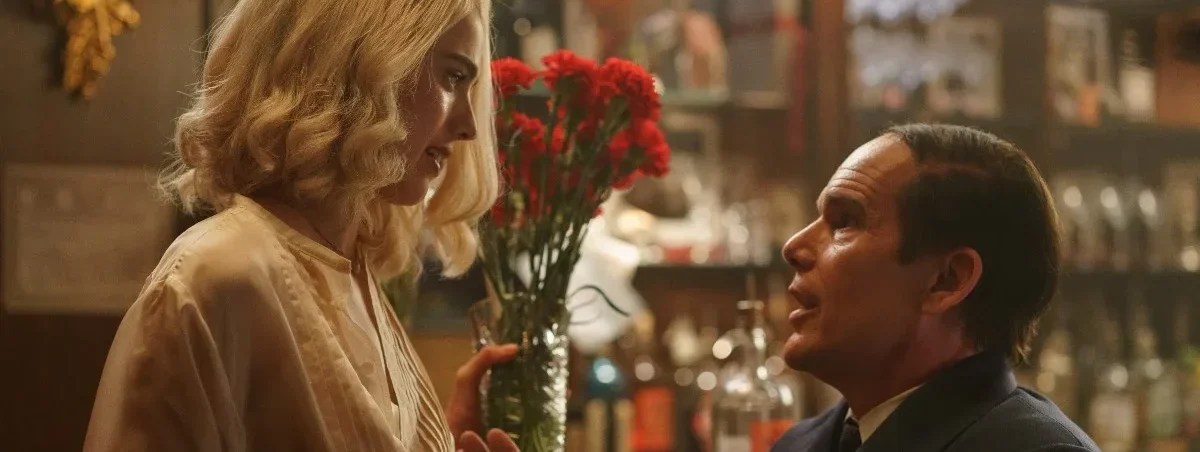
Lorenz Hart (Ethan Hawke) leaves the premiere of Oklahoma! to visit his trusted bar, knowing the afterparty is imminent there, alongside his former creative partner Richard Rodgers (Andrew Scott).
“Do you ever feel like you’re entire life is a play?” was the question Blue Moon asked after I’d already asked myself if it was based on a stage production. Songwriter Lorenz Hart’s (Ethan Hawke) life is condensed into a New York City bar as he escapes the Broadway premiere of Oklahoma! early. Hurt by his creative partner Richard Rodgers’ (Andrew Scott) decision to team-up with Oscar Hammerstein II (Simon Delaney) on the musical, he’s trying to find encouragement in alcohol and those who serve it. The bar is quiet and much of the conversation comes from Hawke, with occasional input from bartender Bobby Cannavale and pianist Morty (Jonah Lees).
The piano naturally accompanies the flow of Lorenz’s monologues as he looks back on what he views as a long and illustrious career where he, as a writer, is now an antique. Hawke perfectly sets the tone with his performance (even if occasionally the 5’10” actor’s performance does look like he’s walking with bent knees to play the 5’5″ central character), capturing a sentimentality in what his character says with a layer of tragedy to what it actually means, and where it comes from. He avoids bringing a sense of bitterness to Robert Kaplow’s dialogue, but a feeling of loss and uncertainty – someone desperate to prove himself to everyone around him and not be forgotten. The tragedy of his pursuits heightened by the fact that the film opens with him falling into a puddle, dead – “sometimes I think that even God is finished with me.” It all makes for an intimate opening 20 minutes.
As the Oklahoma! afterparty makes its way into the same bar Lorenz makes his way through a series of gradually repeating conversations – especially with Scott’s Rodgers. The cycles are emphasised by a feeling that when away from the bar the various scenes feel longer, in some instances more drawn out. The individual moments are more noticeable than when at the bar where things flow with more ease, and humour, due to simply feeling more alive as the elements work better together, and the central figure is in higher, more jubilant, spirits.
Blue Moon as a whole does feel overlong, not always helped by its pacing. And as additional characters, including Margaret Qualley as Elizabeth, the 20-year-old woman the 47-year-old Hart hopes to finally win the love of over the course of the night, pop in and out of the action the film proves the hit-and-miss nature of each conversation had. And when they don’t hit that’s when they truly feel drawn out. There are still retreats to the safety of the bar, for both Hart and the audience, there there’s less busyness, a more relaxed feeling although a line trod between acceptance and custom.
When straying away from the spirits of the bar there’s a hit-or-miss nature to the conversations and monologues which start to draw Blue Moon out, however there’s still a likable wit and flow to the sentimentality and tragedy of Hawke’s well-performed central character.
 Just A Little Bit Random