
Release Date – 24th October 2025, Cert – 15, Run-time – 1 hour 47 minutes, Director – Nia DaCosta
Hedda Gabler (Tessa Thompson) and her husband (Tom Bateman) are hosting a lavish party in the hope of persuading others into giving him a professorship, however an old face (Nina Hoss) from Hedda’s past, with an intimate manuscript, could derail the evening.
Mingling with guests, and trying to gently curry their favour into giving her husband (Tom Bateman) a professorship, Hedda Gabler (Tessa Thompson) is pulled in many different directions. Smiling, and often flirting, through her interactions she breezes through exchanges before moving to the next as if all one big conversation with a changing face. That is until the arrival of old face Eileen Lovborg (Nina Hoss) arrives. After learning that Eileen is in consideration for the same position, and has with her a manuscript of her life’s research – an intimate, and perhaps exposing, exploration of sex and humanity (a bold topic for 1950s upper-class Britain) – Hedda, alongside the narrative, starts to be pulled in multiple directions.
As Hedda’s early promise that “my whimsicality had its consequences” starts to unravel over the course of the night and she starts to multitask playing gracious host, old lover and competitor the faces and exchanges which crop up start to tangle. The overriding feeling for Thompson’s increasingly cracking composure is a need to have her dream life, by securing her husband the job. The way she glides around the halls decreases as things become less effortless for her, being told “everything that I have, everything that I am is because I’m f*cking brilliant!” in a heated exchange with Eileen.
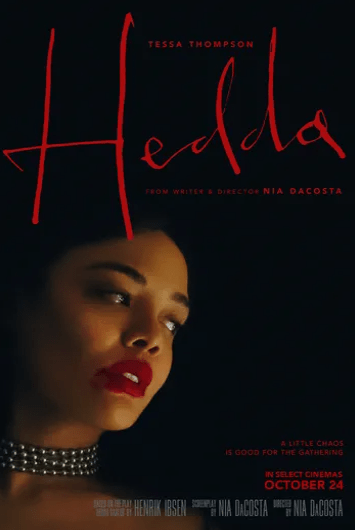
When playing host the unfolding events certainly have their quirks. Less instances of squandered wealth and more moments that bring to mind that the rich characters are just living in another world entirely. It’s a thought that crops up a handful of times once the staggered build-up of the various elements at play is finally moved on from, the more locations around the grounds we visit, or figures we see – one thing’s for certain the film manages to avoid feeling stage-like, it being based on Henrik Ibsen’s play Hedda Gabler. Yet, the feeling of moving around adds to the slightly busy feeling within the narrative, and emphasises the overlap-turned-tangle at hand.
As things start to play out more closely together the run-time begins to be felt, especially with the decision to announce each of the film’s chapters with Roman numerals. The dramatic tones are heightened as the sensuality which DaCosta, alongside Thompson and Hoss, brings in starts to decline to focus on the heated interactions and titular character’s loss of control. There’s an intriguing nature to the various beats when they’re properly brought together and treated less as separate elements, but it takes some time, and a slightly staggered path plated with occasionally baffling luxury, to get there.
Much like Tessa Thompson’s lead character, Hedda’s narrative finds itself pulled in different directions, occasionally pushing its run-time and diminishing the combined tones at play.
 Just A Little Bit Random