
Cert – 15, Run-time – 1 hour 49 minutes, Director – Kogonada
After meeting at a wedding, David (Colin Farrell) and Sarah’s (Margot Robbie) rental cars direct them to isolated doors which take them back to key moments in their lives and relationships, which have caused them to hold off on starting new ones.
There’s little lead in to the Charlie Kaufman-esque opening of A Big Bold Beautiful Journey. After finding his car clamped, David (Colin Farrell) travels to a barely decorated warehouse with only two cars, a desk and a banner in – signing The Car Rental Agency. The moment, jumped into from the bright city streets, is our main introduction to the fantastical ways of the next 90 minutes or so. Although, the dialogue, especially when mixed with Phoebe Waller-Bridge’s dipped-in-and-out-of German accent and strange set of randomly dropped f-bombs, feels more off-kilter than fantastical; and sits slightly at odds with the more whimsical implications of the opening scene’s tone.
After being pressured to also hire a sat-nav in case his phone “craps out” he ventures to a wedding and on the way back is asked by the system (voiced by Jodie Turner-Smith) if he would like to go on a big bold beautiful journey. Passionately he appears to shout yes – we see him accept from outside the car – and off to Burger King we go. It’s here we re-meet Margot Robbie’s Sarah. The pair met at the aforementioned wedding with mixed results from their handful of conversations, but after talking again there seems to have been something – not that either will commit. Both are hesitant to enter into another relationship for fear of hurting the other person or being hurt themselves.
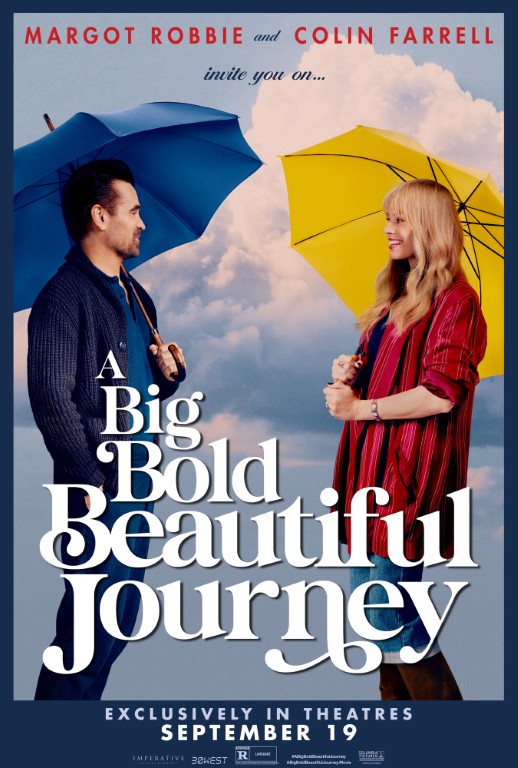
Over the course of their big bold beautiful journey together they are directed to multiple isolated doors which take them back to key moments in their lives and past relationships which have either not had the resolution or time with they would perhaps like or have made them who they are today. The vibrant colours of each location visited adds to the picturebook quality brought about by the mixture of cinematography, production and costume design. Visually the film is a consistent treat with many frames that I could gladly hang up and get lost in. However, it’s hard to get lost in the first few flashbacks as they seem to be dashed through with the main aim of these actually being the introduction to the film and its workings after the prologue.
When the flashbacks, largely to childhood in the first half, are given time and look more at the emotional side of things for the characters rather than just relationships – writer Seth Reiss appears to often split the two up, and finds the most success when focusing on the former or managing to combine the pair – there’s more to enjoy. A highlight involves Farrell reliving his high school production of How To Succeed In Business Without Really Trying, whilst also demanding that he be cast in a musical (I wouldn’t mind seeing him taking the lead in The Music Man), before trying to change how things went with the girl who turned him down. Meanwhile, Sarah frequently goes back to her relationship with her late mum (Lily Rabe), where emotions once again get prioritised, and the film comes closer to breaking her out of the manic pixie dream girl archetype.
As the delves, rather than flashes, of jumping into the past and finding some resolve with it is prioritised and given time the central journey, and its characters, strengthen. What starts off as a real jumble of tones and ideas starts to create engagement. It’s during the musical sequence that I started to sit up more and feel myself grabbed by the film and what it was doing, as if it had found its stride. Things might occasionally jump into feeling busy or focusing more on the less interesting points, or rather just thinking of relationships without the emotional aspects, but there’s still enough to help the film along and see it through. Plus, even during points where things dipped I found myself still having an admiration for the film as it was clearly trying something and making some swings, and even if they didn’t all pay off, especially to start with, there was still something to appreciate about that.
While it might occasionally seem a bit jumbled, A Big Bold Beautiful Journey works best when it taps into its characters emotions and the resolves they seek. Consistently trying something and visually brilliant even during moments that don’t quite get the time or spark they need there’s still something to appreciate.
 Just A Little Bit Random