
Cert – 15, Run-time – 2 hours 29 minutes, Director – Ari Aster
May 2020, COVID restrictions are in place, Black Lives Matter protests are growing, riots are spreading and the sheriff of Eddington (Joaquin Phoenix) runs against the incumbent mayor (Pedro Pascal) in the upcoming election.
Eddington feels like a victim of its own release date. During the pandemic writer-director Ari Aster was working on his three-hour anxiety attack Beau Is Afraid, eventually released in 2023. Now, he releases a film which feels as if it would have been more timely released then, or even worked better if released five years from now. While certainly most of what we see still resonates and feels relevant today, there’s something overhanging the film that feels slightly odd released at this particular moment in time.
Joaquin Phoenix’s sheriff Joe Cross is fed up of the restrictions put in place by the COVID pandemic, it’s May 2020 and he insists that the virus doesn’t exist in the town of Eddington. When enough is enough he challenges incumbent mayor Ted Garcia (Pedro Pascal) – pitching himself as being able to bring new jobs to the quiet, New Mexico by welcoming in a building for a big tech company – in the upcoming election. From there sparks begin to fly across the desert environment as campaigns heat up alongside various social tensions.
Alongside the pandemic, Aster also attempts to capture the rising Black Lives Matter movement, to some extent satirising both sides, although for the frequently white figures leading the protests in Eddington largely through the language they use – sometimes feeling as if it would be better suited in South Park – and the wider political tensions of the time, including online conspiracy theorists (played by Austin Butler, and bought into by Joe’s wife (a strange-sitting role for Emma Stone)) and mentions and possible appearances of Antifa. It’s a lot to cover, and the two-and-a-half hour run-time suggests that. Even with that much time there’s still the feeling that a number of the ideas being played with are rubbing up against each other and creating a different kind of conflict to the one intended.
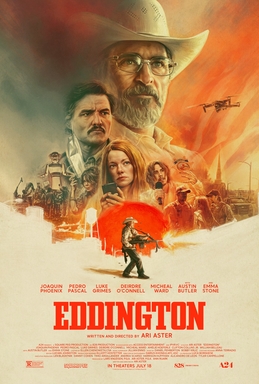
While the film is undoubtedly satirical, how comedic that’s meant to be at time is a different matter. Certainly, there’s a drama that plays out well when it comes to the central election theme, with Phoenix and Pascal debating both online and in the streets with a sense of suspense when face-to-face. Phoenix’s much more accusatory and seemingly intentionally agitating style against the more relaxed, trying-to-reason conversational tone of Pascal’s character. Yet, the more the film goes on the more this seems to be pushed away as supporting characters start to be given more to do in regards to the other events happening throughout the town, especially with how various relationships cross over each other. However, there are other moments that feel like the dialogue, or at least the somewhat heightened situation, is meant to be comedic, yet the uneasy styling prevents a laugh.
About halfway through Aster makes the decision to really switch things up, and initially does so quite effectively. There’s a boost of intrigue as more thriller-like tones begin to emerge after a sudden and surprising shift in events. However, as the ending gets closer there’s still multiple other characters and themes at play which means that things start to pile up again, and while these are attempted to be largely brought together for the final stages Aster doesn’t quite stick the landing as he starts to bring in further tones and directions almost as a way of wrapping things up.
While certainly capturing a slice of just what was happening in America at the time, Eddington feels weighed down by just how much it tries to capture, especially with so many characters playing a part. With a tone and satire that feels as if it could be more searing, the overall film has its moments – especially when focusing on the rival campaigns of Phoenix and Pascal, where much of the drama and tension is centralised – but struggles to create a bigger impact than simple engagement for much of the run-time. Before starting to feel like, as it depicts, multiple voices speaking over each other in the middle of the desert.
While it may work better if revisiting in a couple of years, Eddington tries to capture a very busy and chaotic time in America but ends up feeling somewhat overstuffed, and far from as searing as it probably should be. While the central election thread works well, everything else struggles to have a similar impact.
 Just A Little Bit Random