
Cert – 15, Run-time – 1 hour 55 minutes, Director – Danny Boyle
Safe from those infected by the Rage Virus on his home island, 12-year-old Spike’s (Alfie Williams) first trip to the mainland leads him to search for a rumoured doctor (Ralph Fiennes) who could help his mum (Jodie Comer).
It’s been 28 years since the first wave of the Rage Virus hit the UK (although 23 in real world time since returning director Danny Boyle’s 28 Days Later). While mainland Europe has been able to tackle any outbreaks and move on with life Britain has been quarantined, nothing can leave and what gets in will never get out. There are few patches of safety such as Holy Island, the home of 12-year-old Spike (Alfie Williams) who is about to make his first hunting trip with his dad, Jamie (Aaron Taylor-Johnson) – despite reminders that 15 or 16 is usually the first age to go across the causeway to the mainland.
The trip seems to be to hunt infected – now largely living off of worms and animals – which raises the question of why risk it when you seem to be living a safe and quiet life where you are. Some have evolved into taller, stronger alphas while others have become fat, crawling creatures. Regardless, they’re now pretty much all in the buff and just as angry. Despite the dangers clearly shown and amount of times his life is on the edge during his visit Spike returns home and quickly wants to go back after hearing of a possible doctor (Ralph Fiennes) still living on the nearby mainland. Hoping that he can find help for his mum, Isla (Jodie Comer), who has been having increasingly frequent episodes and memory loss, the pair travel in search of a hopeful cure.
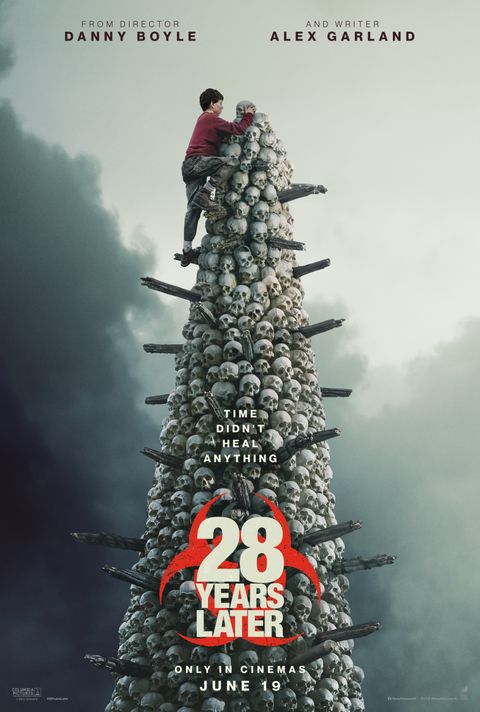
This journey is the core of 28 Years Later, written by original film writer Alex Garland who has penned this as a trilogy with the next instalment, The Bone Temple, due out in January and the third yet to be funded. And indeed the film feels like a first instalment. For the most part what we see is world building and a mass of glimpses of a world we’re eventually going to see more of with little narrative unfolding amongst it. Spike and Isla’s journey has the occasional moment of threat here and there but it seems brief and undetailed with the focus being more on what’s changed, and at times regressed, since the Rage Virus outbreak.
The knock-on effect of this ends up being that with so much wandering and world building when something does actually happen towards the end it feels a strange, sudden and rushed decision. One that seems to want an emotional response and yet is dealt with with such a dead-pan expression that there almost seems to be a slight disconnect in the world as it stands. It pushed me further away than I already had been by the thin narrative throughout the film. A narrative which could solidly construct a whole film but with all the build-up given and exploration presumably for events to come this all feels like a drawn out first act, or even just prologue, for what’s the come in a few months time.
There are likable moments and beats here and there, including some tense action involving the infected, especially the strongest leaders of the pack – who pull off a particularly cool kill part way through which has a strong effect when shown in full gory detail. But by the end that’s largely what 28 Years Later feels like, a selection of moments forming a thin narrative that I found little connection with as it clearly just wants to assemble points, or at least characters, for the next stage of the journey. Let’s hope that that journey actually pays off and Nia DaCosta’s The Bone Temple isn’t just more build-up to the as-yet-unfunded events of the final part of this trilogy.
A thin narrative with little emotional connection is squashed down by world building for the next chapter in the 28 Years Later trilogy, meaning this first instalment feels like a weak prologue more than anything else, despite some likable infected action here and there.
 Just A Little Bit Random