
Cert – 15, Run-time – 1 hour 43 minutes, Director – Emmanuel Courcol
After being diagnosed with leukaemia and searching for a bone marrow donor orchestra conductor Thibaut (Benjamin Lavernhe) discovers his birth family, leading him to work with his brother’s (Pierre Lottin) factory-worker brass brand.
At its heart, The Marching Band is a film about connections with music. Whatever the genre, whatever your class and whether you can or can’t read sheet music. For orchestra conductor Thibaut music is an escape, but a serious one of focus. His players need to be finely-tuned and in perfect harmony. However, after learning that he’s adopted and meeting with his birth family he discovers that his brother, Jimmy (Pierre Lottin) plays trombone in the brass band of the factory he works in the canteen of.
The reason for Thibault’s discovery of his adoption stems from his search for a bone marrow donor, in order to save his life after a leukaemia diagnosis. The initial exchange between the brothers is tense and distanced, a stranger has turned up to Jimmy’s home with a strange, and upfront, explanation and request, after all. However, after a successful transplant Thibault’s life is saved, a trip to say thanks leads him to discover the dysfunctional band. One where not all members can read music, and some simply play it by ear based on what everyone else is playing.
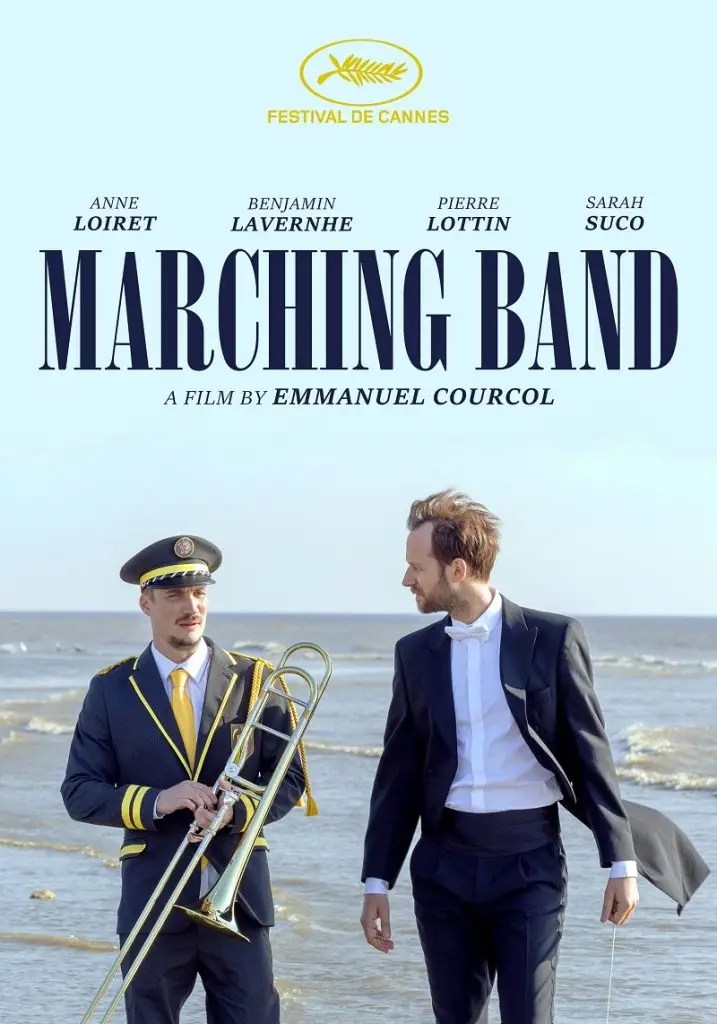
Practice is taken up more by duff notes and bickering, but there’s still a want to play and enjoy the music, and company, as the threat of the factory’s closure hangs over all involved. Seeing room for improvement, Thibault offers to help out and conduct the band and finds a bond with both them and Jimmy, taking the film in along a simpler and more direct line than the various points of the opening stages may suggest.
We’ve seen the general course of The Marching Band before, particularly in a number of notable 90s British films – Brassed Off of course comes to mind – but its tackled with a likability from both leads and director Emmanuel Courcol that the lightness on display makes for engaging viewing. Details relating to the class differences of the central characters, and indeed the musicians and pieces that Thibault is working with, float in and out from scene to scene. Such points certainly help when it comes to the more dramatic elements in the relationship between the central pair, even if at times the wider band and their future is more at focus rather than the brothers.
But, there’s enough present to make the payoff of the finale worthwhile. An effective sequence which summarises the more fore developments of the film rather well. Those linking to the music, and what the characters can find, and have found, in it, and how their views may have changed from each other. It works rather well and caps off a likable, if unchallenging – but that doesn’t have to be a negative point – drama.
A familiar drama that’s handled well with a likable nature to both the central performances and overall execution, some ideas might float in and out of focus but the music remains a consistent and quietly effective core.
 Just A Little Bit Random