Cert – 15, Run-time – 1 hour 41 minutes, Director – Wes Anderson
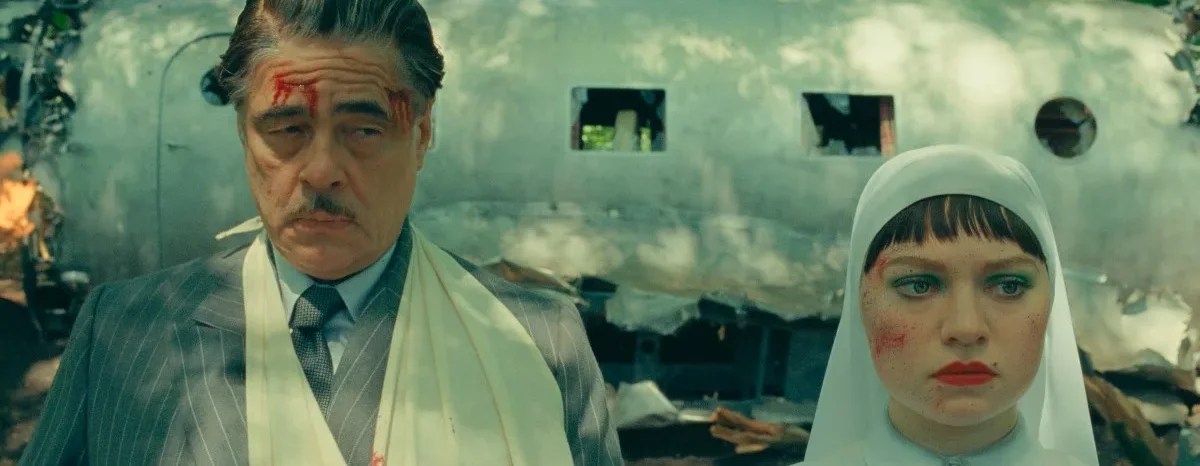
After a sixth assassination attempt, a wealthy businessman (Benicio Del Toro) seeks to make his distant daughter (Mia Threapleton) his heir before renegotiating funding for his grand vision to control a country’s core industries.
After a story about grief that needed less emotional distancing, Wes Anderson returns with perhaps his most emotionally engaged film since The Grand Budapest Hotel. The writer-director’s visual style is still very much present but with The Phoenician Scheme it feels as if Anderson is entering new thematic territory. Closest to The Royal Tenenbaums in comparison to his previous work, the central father-daughter relationship between Benicio Del Toro’s wealthy businessman Zsa-Zsa Kador and his distant, and only, daughter Liesl (Mia Threapleton), a nun preparing to take her vows.
After surviving a sixth assassination attempt Kador gets in contact with his daughter in the hopes of making her his sole heir, at least after a month’s trial period. A trial which involves showing her the ropes by travelling across the country of Phoenicia to convince fellow entrepreneurs, family members, royalty and industrialists to give up more money to fill a gap in a construction plan; the titular Phoenician Scheme. A plan which would allow Kador, and his investors, to control the core industries, and therefore economy, of the country through a complex system of mines, waterways and unethical practices.
As the pair go from place to place, investor to investor through a series of likable and amusing interactions – with more lightness and less coldness than the marketing or first 20 minutes may suggest, one situation featuring Tom Hanks and Bryan Cranston as a very funny double act involves a bickering-filled basketball shootout in a mine. The progression of investments are certainly tracked throughout but more as a key factor in Liesl’s ‘training’ in order to take over the family business. However, the core of the film relates to the different natures of the relationships she has with her father.

It’s mentioned that her mother was killed, but it’s not known by who. Her beliefs go against almost everything her father stands for, and wants her to inherit, and up until this point they haven’t spoken for six years. The chemistry between the pair brings a lot to the way Anderson moves the film along. Their behaviours both individually and bouncing off each other, helped by two great performances, particularly Del Toro on excellent from, create an engaging and funny dysfunctional relationship. One best summed up, as Anderson does so well, in a quiet exchange of one or two lines of dialogue – a key development here has a similar effect to Gene Hackman reassuring Ben Stiller’s “I’ve had a rough year, dad” with “I know you have, Chassie.”
The opening stages may feel conflicting as the verbose dialogue and fast-delivery tries to take place amongst longer scenes and set-up, but once things are established as the journeying across the country begins there’s a more relaxed film at hand. Even cuts to a black-and-white set of afterlife-based visions had by Korda throughout the film begin to settle in and have more poignancy as the film goes on, their meaning seemingly much more down to interpretation. For the rest of the narrative, the humour grows alongside the emotional journey at hand, with the connection/s being formed both felt and visible.
While handling likable zany elements – although not entering the territory of saccharine quirkiness – to add to both the humour and world at hand, one which is once again meticulously designed with excellent production design. There’s a lighter-than-expected tone here which still contains a good deal of heart amongst the deliberations and shouting matches which act as negotiations for the deal. Much of which is displayed in an, at least for Del Toro’s progressively bloodied and beaten character, increasingly dishevelled look.
It might take time to come together, but The Phoenician Scheme is Wes Anderson’s most emotionally engaged film since The Grand Budapest Hotel. Featuring a brilliantly performed core father-daughter relationship playing with new ideas, there’s a good deal of heart and humour amongst the quirky and amusing supporting characters in the quick-moving stages of the world.
 Just A Little Bit Random