Release Date – 24th January 2025, Cert – 15, Run-time – 1 hour 25 minutes, Director – Steven Soderbergh
In the hope of seeking peace and a close-to-fresh start a family move into a new house, however they may not be alone and the ghostly goings-on send mixed messages.
Presence appears to unconsciously stylistically acknowledge the limitations of its own central conceit. Told from the first-person perspective of the titular presence each scene is made to seem like a one-shot with the unseen figure gliding through the house in which all of the events take place. Each time a scene ends there’s a brief cut to black before things start back up again with the next set of events. While keeping the slow pacing consistent throughout it does create something of an overly slow feeling in the opening stages as scenes feel more like short bursts rather than fully contributing to the overall arc of the film which is being established. When longer sequences, at least a couple of minutes, are at play the elements have more room to breathe and have a better chance of forming a connection.
The cut-to-black device may push some people away with a stop-start feeling, but what comes through more is the fact that it shows the limitations of the film. Restricted to the one location, and needing the family at the centre of the events to be present, there’s a confined feeling to the action which has a knock-on effect on the film as a whole which while leaning into the central style with good effect also finds itself reined in by it.

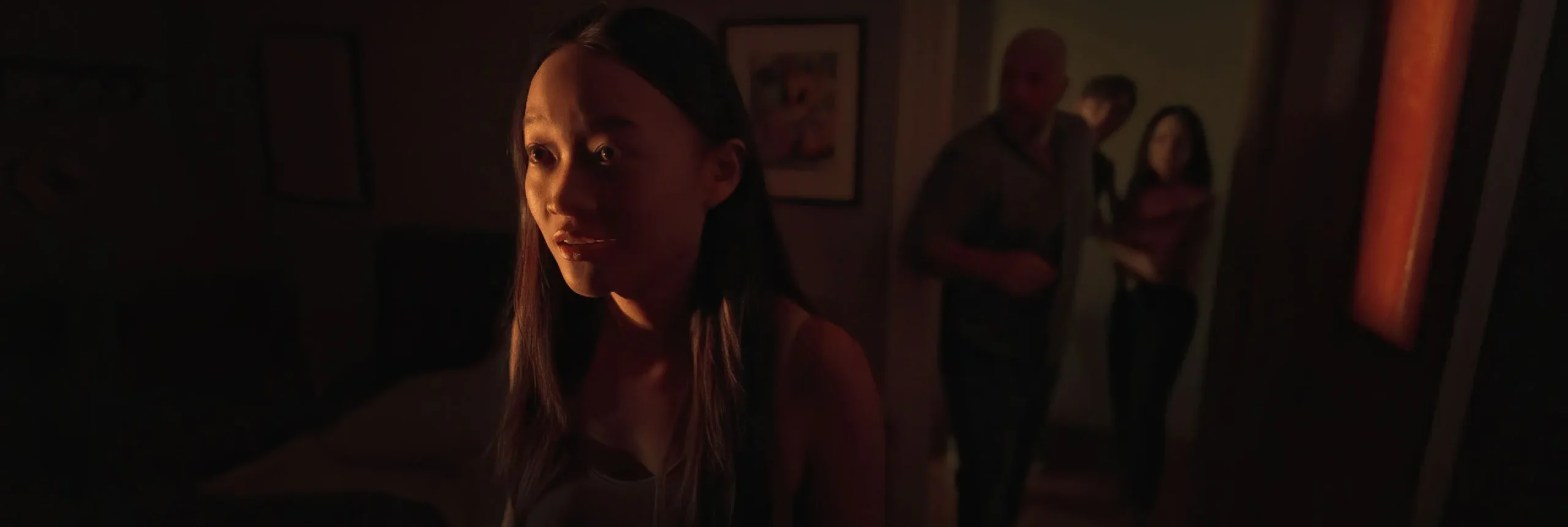
Mum and dad, Rebekah (Lucy Liu) and Chris (Chris Sullivan) have moved them and their two children, son Tyler (Eddy Maday) and younger daughter Chloe (Callina Liang), to a quieter area where they hope to find peace. Chloe is grieving the loss of two school friends who have taken their own lives, while her parents find themselves arguing constantly about their parenting, work stresses and matters of legalities within them. Tyler appears to be the only one cruising through life, although still finding himself in arguments with his family who he views as failing to move on.
While not a horror elements of the genre are still very much at play within the drama of Presence. It doesn’t go for scares, although prolonged developments in the climactic stages do reach very uncomfortable territory where one character’s actions really got under my skin. These closing stages make for some of the best stuff of the film, and indeed when using the ghostly viewpoint’s abilities instead of just having them wander through the house, as is often the case when observing the central family. Yet, with all the time spent watching them go about their lives, and question whether they’re alone in the house, there’s never a full connection formed with any of them during the short run-time, which for the most part, at 85-minutes, gets in and out just before things go on for too long.
As a whole, there’s little investment and involvement with the film beyond some interesting effect from the stylistic elements and the occasional impactful beat. For the most part I simply sat and watched it all unfolding on the screen in front of me. Presence moves along well enough and uses its style well, but it also unconsciously displays its flaws and hold backs, those which stop it from moving along with greater effect and engagement.
While there are interesting beats and elements courtesy of Presence’s central framing device, especially when at its most upfront, it also holds the film back as it shows the limitations and restrictions it brings to the narrative leading to a lack of full connection with the events as a whole.
 Just A Little Bit Random