
Cert – 15, Run-time – 1 hour 30 minutes, Director – Jesse Eisenberg
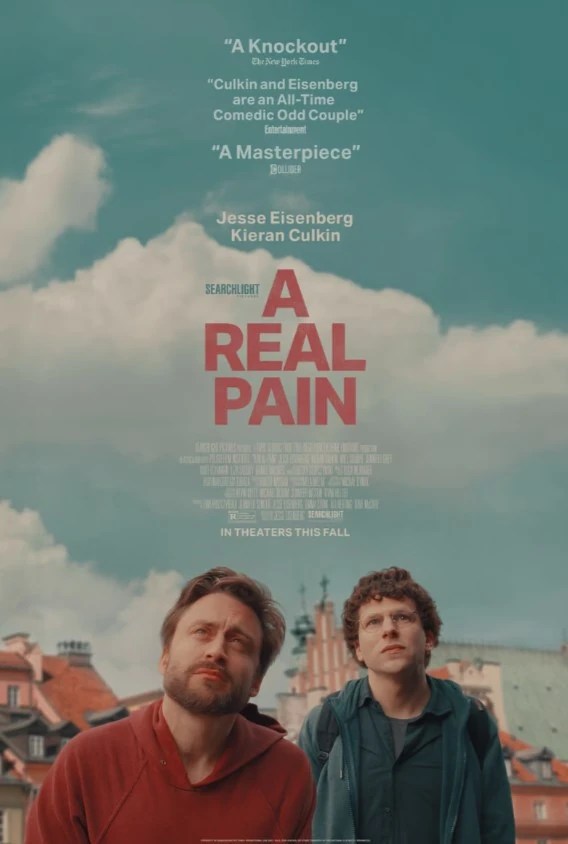
Cousins David (Jesse Eisenberg) and Benji (Kieran Culkin) embark on a week-long tour of Poland to learn about the country’s, and their Jewish family’s, history in the wake of their Holocaust survivor grandmother’s death.
There’s been praise directed towards A Real Pain for acknowledging the awkwardness that there can be around it subject matter. Tensions rise between ‘joined-at-the-hip’ cousins family-man David (Jesse Eisenberg – who also servers as writer, director and co-producer) and isolated Benji (Kieran Culkin) as they explore the past of their Jewish family through a tour of Poland in the wake of their grandmother’s death, herself a Holocaust survivor. As the pair join a small group of four other tourists, and their tour guide James (Will Sharpe), Benji’s emotional responses to the world around him vary strongly in the wake of possible depression and mental health issues. The film never outright says that this is the case and while at times dealing with them, and how David reacts to Benji’s behaviour, in a considered manner at other times feels as if it awkwardly dances around them.
Culkin’s performance has been much acclaimed, and he’s pitched as a likely Oscar frontrunner. His performance is quite a traditional one, it, alongside the film as a whole, feels as if it could have been sweeping the awards circuit in and around the 80s. This isn’t to say that either feel outdated, but there’s sometimes a lack of directness to Benji’s behaviour as it fluctuates throughout the tour. At one moment bubbly and energetic, eagerly socialising with the rest of the group; at another freaked out by the journey he’s on, suffering something close to an anxiety attack in the first class carriage of a train when reflecting how his family were herded into the backs to concentration camps almost 80 years before. Culkin does his best and indeed brings insightful layers to his character through a thoughtful performance, pushing through what the film doesn’t say.
It’s perfectly fine for things not to be said verbally, but sometimes it feels as if there’s a struggle for things to be said even in a look or air of understanding from at least the film, even if not David when explored over dinner one evening. As if the lightness of the film wants to stay on track as much as possible, even during more dramatic moments. Yet, perhaps the best sequence of the film is a directly serious, almost silent, one depicting the group’s respectful visit to Majdanek. Already during exposition shots of Poland Eisenberg’s camera captures a good deal of detail which brings you into the locations, but as it lingers throughout the concentration camp as it seems to dwarf the characters it pushes you back in your seat. Played out with little sound or dialogue as the return journey to the hotel begins you just want it to linger on to sustain the impact instead of going to another piece of Chopin.
Even after this moment there’s still room for humour. Before and after the visit there’s some well-balanced humour as the ‘more like brothers’ cousins, it’s noted that they were born three weeks apart, get reacquainted in the wake of their bereavement, taken particularly hard by Benji. While not everything quite gets a laugh this is less a film aiming for an out-and-out comedy, although it could fall into the comedy category, and more a light drama dealing with such serious themes. Perhaps to make them more accessible and highlight the continuing impact and different familial connections and lives lived because of it. Regardless, the laughs do manage to gently come in from the opening stages and help to move things along during the bumpier, more uncertain moments, only occasionally feeling as if they heighten or further show the uncertainty of how to deal with or present a certain idea or moment.
With everything contained within 90 minutes there’s a short journey yet one that gets a good deal in and manages to make the most of that time. Not outstaying its welcome and generally leaving some of the best moments towards the end of the film, where much of the most interesting details of the characters as individuals lies. While not everything entirely clicks during that short run-time there’s still enough to like and enjoy, particularly in regards to the humour and performances – there are some likable moments of conversation with other members of the tour group relating to identity and the various meanings of pain and what to do with it. Just sometimes its depictions of awkwardness come across as a general awkwardness from the film rather than in the situations its depicting.
Good humour and performances help A Real Pain to move along, at its best when it takes a moment to take in its characters behaviours and feelings, however it feels hampered by its own occasional awkwardness when approaching such matters creating something of a bumpy, if overall likable, ride.
 Just A Little Bit Random