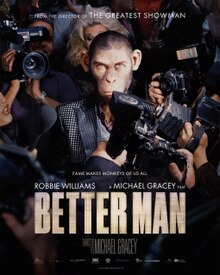
Cert – 15, Run-time – 2 hours 15 minutes, Director – Michael Gracey
Accepted into Britain’s next big boyband Take That at 15, Robbie Williams (Jonno Davies) finds himself launched into stardom and a spiral of addictions, as his bad-boy solo career takes off he can’t help but still feel like a performing monkey.
The emotion on the face of the young CG monkey Robbie Williams as he’s picked last to be on either team when playing football in an alley, put in goal and constantly missing, launches a character who perhaps displays more emotion than the human figures around him. The reason for Williams (who provides some of his own vocals alongside Adam Tucker while Jonno Davies provides the motion-capture performance and much of the dialogue) appearing this way is, as he says early on, for him feeling “less evolved” than other people, and in part for being treated like a performing monkey for much of the film.
Bursts into fantasy appear to go hand-in-hand with the design of the star at the centre of the film, still aware of a slight ego acknowledging that people are there to see him in concert, and the audience in this case to see a story about his life. Musical numbers from Williams’ catalogue construct a strong musical where the more the sequences lean into fantasy the stronger they are. Recklessly racing down the road after leaving Take That whilst singing Come Undone, the world outside the car begins to change colour beyond the surrounding headlights as disaster in the form of a crash threatens to appear around every overtake and corner. The sequence is undoubtedly one of the most terrifying of the year, having me sat in breathless fear and suspense for the entire song and the ensuing details and trapped-under-ice metaphors after.
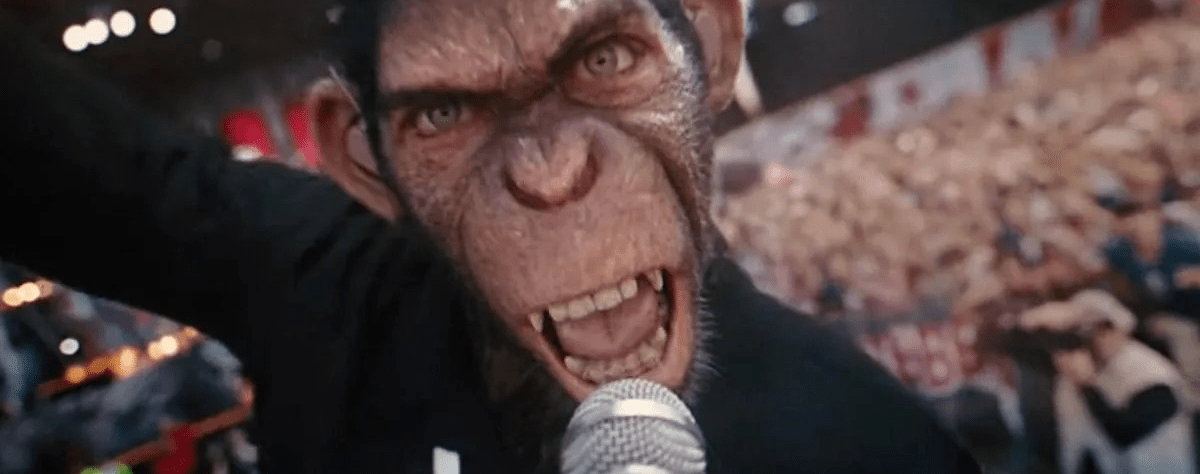
Similarly Williams’ 2003 Knebworth gig; which he sets his life on getting to to prove he’s the biggest star possible, takes a strong turn into fantasy with a truly bold sequence which appears to come from nowhere but is brilliantly tackled with plenty of visual and dramatic style by director Michael Gracey. Bringing some of his Greatest Showman style to some of the crowd-based musical numbers, Gracey follows characters running through the streets embracing their newfound fame and fortune in a Regent Street and Piccadilly Circus set performance of Rock DJ. Each time the film does this it manages to deepen and intensify the struggles and relationships he goes through over the course of the portion of his life we follow. The addictions – he acknowledges that he was always likely to be an alcoholic, but fame and money made it happen much quicker – and the image he presented to the public as a more rude than cheeky, egotistical bad-boy, pushing the point of being a performing monkey.
The intensity of some of the drama and how its conveyed in the musical numbers, and Davies’ central performance, acts as the biggest hook for the film and provides it with a good deal of weight, as well as the investing chimp. There might be points where time could be better established, Williams was in Take That for five years before he initially left but the film makes it feel as if it could have just been a couple of months, but reminders of just how young the star was throughout all of this, being accepted into the group at 15 we follow him mostly throughout his 20s, are consistent and further flesh out the spiralling chaos and tragedies which arise in a world of puppetmasters, from controlling Take That manager Nigel Martin Smith (Damon Herriman) to Robbie’s father (an excellent Steve Pemberton), idolising the likes of Sinatra and saying if you can’t make a name for yourself entertaining like that you’re a nobody.
And yet, the best way of telling the story is through the expressive face of the central chimp. Brilliantly detailed from the opening frames he perhaps tells the story and internal feelings more than if in human form, although here with the added voice performance, vocals and musical numbers to help push things. It’s a great force at the core of the film which is instantly accepted and allows for the more fantastical moments to fly as well, especially when it comes to darker beats truly highlighting the personal battle being experienced by the central figure.
While its sense of time might make everything feel somewhat compact, the personal battle within Better Man is brilliantly exemplified by the fantasy and musical numbers on bold display, with so much conveyed by the CG chimp at the centre. All done with an impactful punch and no hint of novelty.
 Just A Little Bit Random