Cert – PG, Run-time – 1 hour 59 minutes, Director – Barry Jenkins
Before becoming king of Pride Rock, lion Mufasa (Aaron Pierre) finds himself part of a group of fellow ‘strays’, being hunted down by a pride of lions vengeful lions.
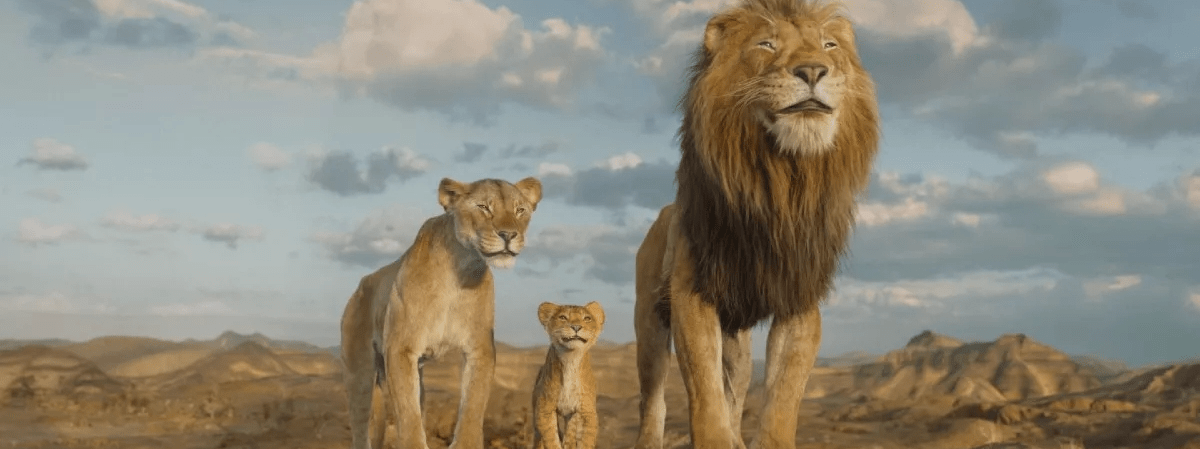
The photorealistic CG animation which makes up Disney’s prequel to their 2019 (non)live-action remake of The Lion King feels somewhat in two minds. On the one hand, they appear to have listened to audience reactions that the expressionless nature of the characters was an issue when it came to emotional impact, on the other they’re clearly aware that the remake made over $1.6 billion worldwide and is one of the highest grossing films of all time. The result is brief glimmers of emotion before going back to the largely blank, photoreal looks which create a wall for any feelings the animal characters might be feeling to run into.
One of my biggest issues with the remake, which generally I thought was fine, was the fact that the nature of the visuals meant that the film felt restricted. Big, colourful musicals numbers such as I Just Can’t Wait To Be King were limited to characters running around a watering hole for three minutes. This is a problem for Mufasa as most of the songs – which themselves are solid thanks to the involvement of Lin-Manuel Miranda – simply show multiple wide shots of characters walking and running across different landscapes while singing. The scenery itself looks good and there’s an undeniable strength to the quality of the animation, but it doesn’t make a proper platform for the musical numbers which feel held back by the visual environment.
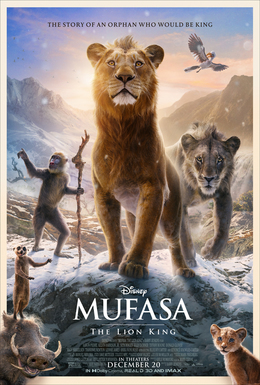
Throughout we see a young Mufasa (Braelyn Rankins) separated from his parents after a flood, saved by fellow cub, and future Scar, Taka (Theo Somolu). The two grow up together (now voiced by Aaron Pierre and Kelvin Harrison Jr respectively) and as calls for being the future king of the pride begin to properly enter their minds they must flee the pride after an attack by a group of white lions, seeking vengeance for the death of their leader’s (a very welcome appearance from Mads Mikkelson) son after an earlier attack. As they’re hunted down the pair of adoptive brothers come across fellow lion Sarabi (Tiffany Boone), separated from her own pride and father the king, who accompanying bird Zazu (a wobbly Preston Nyman) is meant to report back to if they can find their way back.
As a whole, the narrative feels occasionally familiar, largely when involved with more talky sequences trying to build-up character dynamics to where they are by the start of The Lion King. At times these moments can feel somewhat forceful, although nothing as clanging as the bordering on funny creation of Pride Rock, and disturb the steady flow of each sequence into the next as the cat-and-mouse (or lion-and-lion) chase through varying terrains plays out. While the villains, largely Mikkelson’s Kiros, might be somewhat plain there’s a clear villainous nature to them, and no other side to the coin. They also make for some of the best moments when simply engaging in confrontation and acting as a threat that you wish would sometimes be more upfront in a moment rather than pushed aside quickly as the central trio find a way to quickly escape.
It means that a number of moments come close to feeling repetitive, and the film slower than it perhaps should be at times. When dealing with its points upfront and moving things along Mufasa is at its best, when it stops to take in a moment it starts to falter – despite this so often being where director Barry Jenkins best succeeds. As a whole the narrative works and holds up, perhaps in part because of its relatively simplistic nature, and there’s enough within Mufasa to see it through, even if it does come across a few bumps along the way. The voice cast do a good job in helping with this, and after hearing that Jenkins directed recordings and assembled them as if they were a radio play I’d be interested in hearing that on its own, hearing the imagination and story, in comparison to what has been paired up with the chain of photorealistic animation.
Much like the 2019 remake, Mufasa: The Lion King suffers from the limiting photorealistic animation. Restricting emotional expression and freedom to drift into further fantasy, the film has its moments but falls flat trying to find itself in longer, dialogue-heavy scenes where the main points are less upfront.
 Just A Little Bit Random