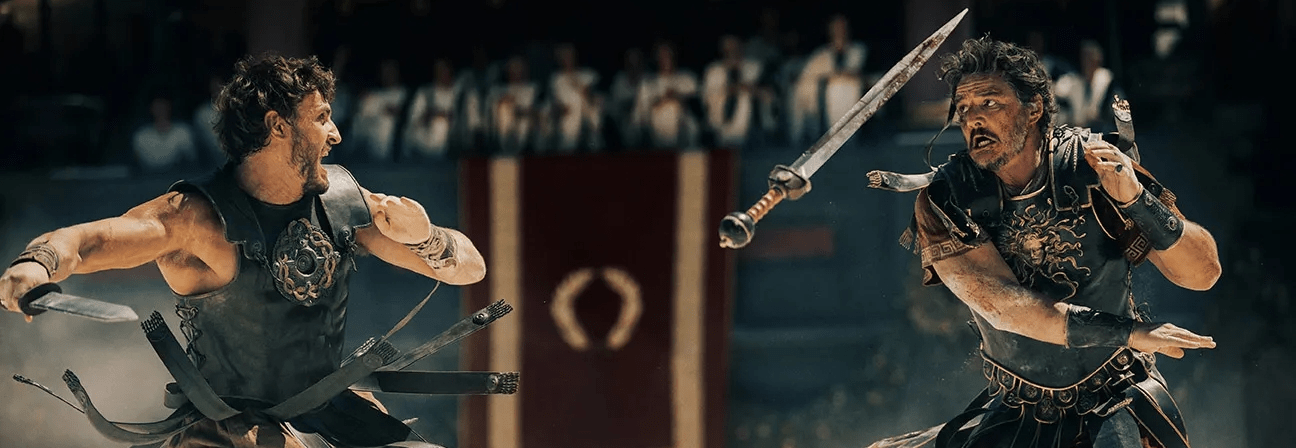
Cert – 15, Run-time – 2 hours 27 minutes, Director – Ridley Scott
Taken to Rome after his homeland is taken over, Lucius (Paul Mescal) is forced to become a gladiator, with his eyes set on vengeance he becomes a pawn in multiple attempts to take control of the empire.
There are two sides to Gladiator II. There’s the focal narrative side delving into the politics of a struggling Roman empire, where multiple forces are vying to take control from twin emperors Geta (Joseph Quinn) and Caracalla (Fred Heichinger), and there’s the action-based side of gladiatorial action, occasionally diving head-first in suspensions of disbelief as the coliseum is filled with water and sharks for a boat battle – although likely far from the fantasies of Nick Cave’s one-time script for the sequel subtitled Christ Killer. Undoubtedly the latter has more of a punch, particularly during the more up-close, personal battles which strip things down to swords and fists.
Paul Mescal undoubtedly sells these fights, alongside his stunt doubles, with a silently determined expression set on vengeance. Vengeance for his wife (Yuval Gonen) who was killed in the Roman invasion of his city. Taken to Rome to become a gladiator, under the grinning view of Denzel Washington’s Macrinus, his intent is to kill the man behind the attack; General Marcus Acacius (Pedro Pascal).
Mescal’s Lucius becomes unknowingly involved in multiple plans to take over, or keep control of, Rome, including Acacius’; who plans an uprising to overthrow the corrupt emperors. There are a lot of players involved in each plot and the film wants to give each of them time. While it doesn’t feel jumpy or choppy, the way it cuts back and forth between different schemes, alongside the action in the coliseum, when paired with the lengthy 2-and-a-half-hour run-time things feels better suited to a TV series. The film itself feels almost inspired by many big-budget, smash-hit pieces of cinematic television from the last decade and while there are certainly moments of cinematic spectacle here the political-leaning narrative feels as if it could work as a miniseries, especially if it gives certain moments a bit more time to breathe.

Yet, this may lean into one of the film’s biggest problems in the first hour which is that it failed to consistently grab my attention. For much of the early stages I simply sat bored as things were still being brought together, in the end it takes even longer for each strand to finally converge and unite for the dramas to play out together and the clashes to finally appear in a grander, more direct way. It certainly means that there are less characters in separate places and so confrontations begin to play out alongside multiple plans in action. The stakes finally begin to raise as they do and while eventually this might all seem brief and largely confined to the third act, there’s still some interest and effec to be found.
Although, much of the interest still lies within the action itself, and the tension that surrounds it and the threat that it has to sometimes jump out at any moment during a confrontation or conversation, the impact that it, or the decision to not choose it, can have. When these stakes are working together the film is at its most effective, when dealing with things separately there’s a bland nature which also perhaps comes down to a lack of full connection with the central character. This isn’t down to Mescal’s performance, which, like the whole cast, is rather good, but more down to what we see of his story.
There’s a grit to Russell Crowe’s Maximus and his story in the first film, indeed how it’s followed and the events we see him go through. The context for Lucius’ arrival into Rome doesn’t have the same effect, while the character has effect the same emotional connection isn’t there having an impact on the already uneven film as a whole. The action has an impact, even in its grander moments which Ridley Scott successfully avoids bringing a sense of silliness to which could so easily be present, and often acts as the returning point of engagement and drama as a longer, drier battle for power plays out in-between fights, eventually colliding into them. It takes some time for this to be the case but when it finally starts to happen the film as a whole opens up and Gladiator II becomes a more enjoyable film as it feels less constructed of separate pieces and instead becomes a bigger drama with the various plays for power playing alongside instead of against each other.
As the many separate characters and stories start to come together Gladiator II steps out of its boring state for a more effective, if still occasionally trudging, drama where the action does much of the lifting and connecting over the characters themselves.
 Just A Little Bit Random