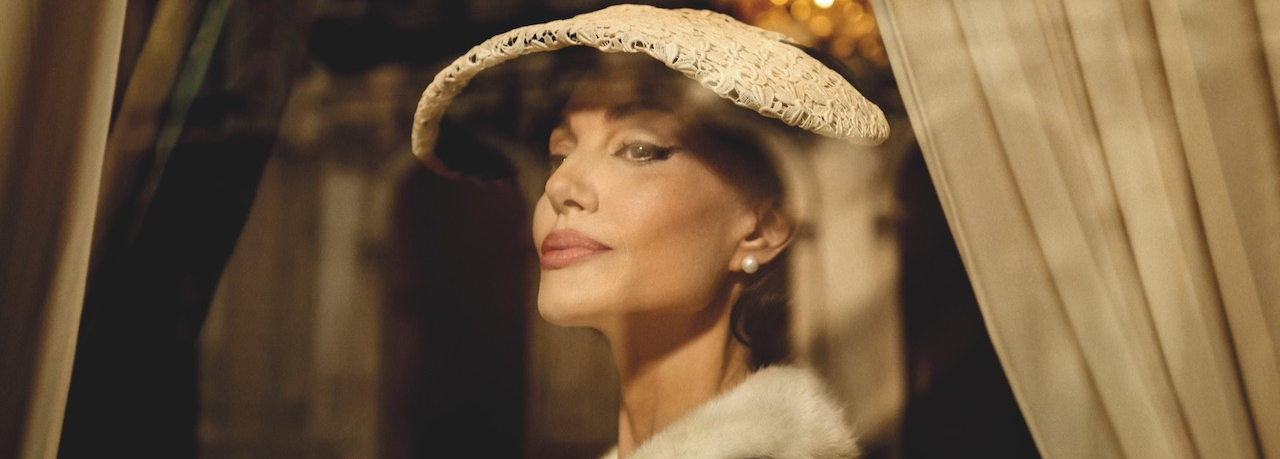
Release Date – 10th January 2025, Cert – 12, Run-time – 2 hours 2 minutes, Director – Pablo Larraín
As she tries to return to the operatic stage Maria Callas (Angelina Jolie) revisits her life with a journalist (Kodi Smit-McPhee) in Paris, where she has retreated to away from the public eye.
“Book me a table at a café where the waiters know who I am, I’m in the mood for adoration” Maria Callas (Angelina Jolie) requests of her butler (Pierfrancesco Favino). It’s the 1970s and she’s moved to Paris to get away from the public eye, however the occasional moment of recognition doesn’t go amiss, particular as she seeks a return to the operatic stage. Whilst going to rehearsals where her voice proves to not be what it once was she’s seen roaming the city, softly captured by cinematographer Edward Lachman, with a journalist played by Kodi Smit-McPhee questioning her about her life.
The three strands playing out intermittently create a choppy feeling to the overall structure of the film, but they’re held down by a fine, naturalistic performance from Angelina Jolie who acts as the key source of connection to the film as a whole. Callas is aware of her own ego, to some extent using it to push her forward in her strive to get back on the stage. There’s a slight humour to this side of her which makes for a more interesting and engaging character within a highly restrained film.

Maria marks the quietest of Pablo Larraín’s sort-of-trilogy of biopics, following Jackie and the excellent Spencer, and like those films the lead performance will likely receive awards attention. Yet, the quietness sometimes leaves the film lacking, as if needing a bit more substance to certain scenes to simply pick up the pace of scenes less interested in building up the central figure and more showing a near day-to-day style which contrasts with the flashbacks to her past. There are still elements of the woman who confidently states “to be a possession in a cabinet is not my ambition”, particularly as we see her trying to find her singing voice again.
Where things feel most uneven are in the interview segments. While initially acting as a way to give more information surrounding events in the past and how Callas views them later in life. However, as the character develops throughout the film more scratches of details come through for Smit-McPhee’s character and his views on, and relationship with, Maria. Sticking out due to occasionally coming from nowhere, and not really having room to breathe, such moments struggle and fail to land an impact as they simply lose their way halfway through the film amongst everything else that’s happening. Certain lines of dialogue, which with the brief nature of such moments is almost the majority of them as the film goes on, simply strike as odd, with a knock-on effect to the strand as a whole.
In general, Maria strikes as a film where the screenplay and aesthetics are constantly trying to add more detail to the titular figure, yet are trying to do it in multiple different ways which should combine but occasionally find themselves working separately. Jolie still manages to give a strong central performance, giving the most detail in the film as an openly flawed, sometimes wearing these with pride, yet defiant character. Larraín captures some of this but still keeps his film quiet without being entirely observant. There are likable beats and the key scenes certainly have an effect as they truly allow Jolie and Callas to flourish as they are put truly centre stage, but the construction of the film and slow pacing hinder it, stopping a proper emotional connection and effect from being created.
Angelina Jolie gives a great performance and brings most of the detail to Maria Callas as Pablo Larraín keeps a quiet, yet choppy, focus on the central character, occasionally feeling as if more detail could be given in less time and the film could between unify its strands to truly give the push it wants to give its title figure.
 Just A Little Bit Random