
Release Date – 15th November 2024, Cert – 12, Run-time – 1 hour 57 minutes, Director – Ben Taylor
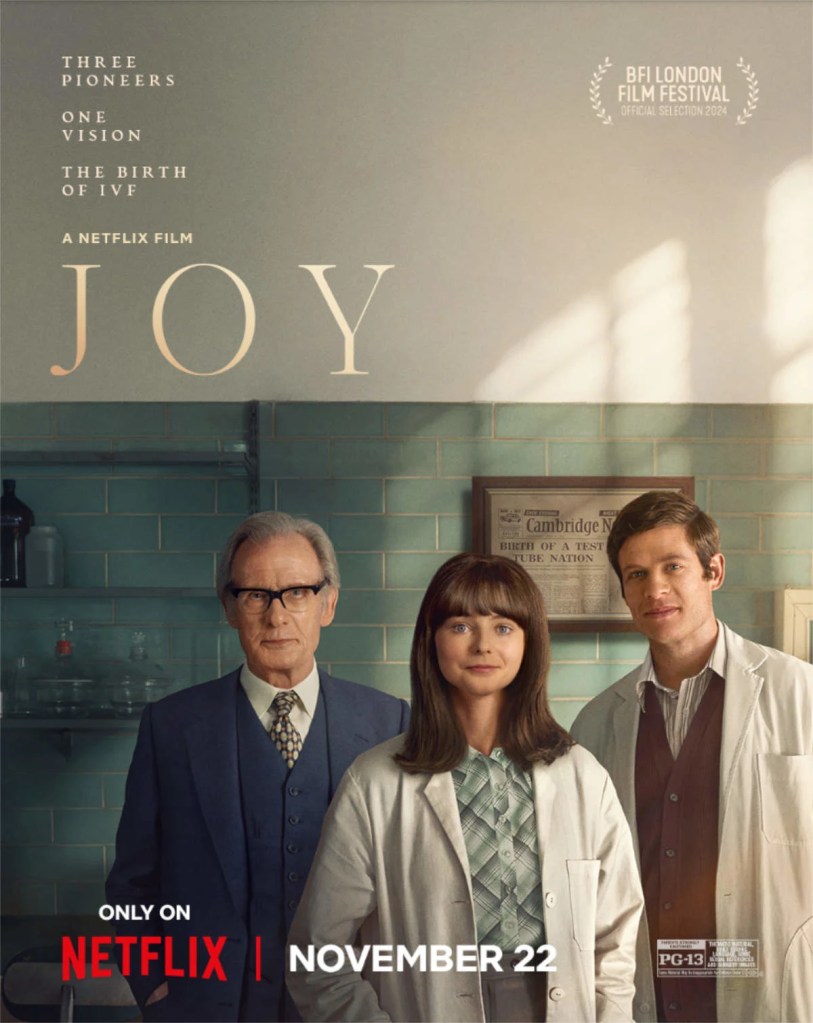
Through the 60s and 70s a scientist (James Norton), surgeon (Bill Nighy) and nurse (Thomasin McKenzie) battle infertility, the church and media in their attempts to create the first ‘test tube baby’.
For a straightforward, silver-cinema-leaning British drama Joy certainly makes a lot of noise. It’s largely the sound of lines of dialogue clanging and hammering the point in as they yet again explain everything down to the most basic of details. Very little is left for the audience to interpret or work out for themselves just in case anyone is left behind by the rather simple telling of this story.
The story at hand is that of the attempts throughout the 60s and 70s to help those who are infertile to have children via the creation of the first ‘test tube baby’. Young nurse Jean Purdy (Thomasin McKenzie) is recruited by medical scientist Robert Edwards (James Norton) to help him with his research and eventual tests, when surgeon Patrick Steptoe (Bill Nighy) enters the picture. However, as their research grows they’re met with more backlash from the media and church who believe that what they are doing is morally wrong and against the word of God. Amongst the clashes, and frequent sound of clunky dialogue, subtlety is lost – particularly early on when a church service which Jean attends with her mother (Joanna Scanlan) conveniently has everyone stand and sing All Things Bright And Beautiful.
Things may even out eventually to get to a familiar standard, light British drama feeling, but a bad screenplay occasionally gets in the way, feeling the need to explain everything and certain interactions feel unnatural – particularly between Jean and lab colleague Arun (Rush Shah), who respectively begin to view their relationship differently. The film instead begins to focus more on the actual matter at hand as the central trio get closer to success, and in turn meet even more outrage from those who are only hearing or reading about their work without being in the room. While it might eventually seem that this is the case to lead up to some clear bell-ringing, creating a parallel between the opening and closing scenes, there’s still a more even, generally calmer, nature to the film once the task at hand truly takes form.
When this is the case there’s a likable enough nature to the film as it takes the form of another celebratory, not-too-challenging drama. We may have seen the outline, and some of the content, before, but it manages to just about do the job and while sailing in with some issues it sails out with a handful fewer, making something watchable and likely to go down well with its intended audience. Helped by its central trio who capture just the right tone for the film with their performances and try their best to guide it through some of the more uneven moments, particularly Nighy who gives a good turn with his supporting role. There may be a good few bumps along the way in the build-up, but once the elements are in place, particularly in the second half, there’s a familiar yet watchable Sunday-afternoon-drama here which could get its fingers a bit more into its central debate but wants to avoid too much heaviness and so instead focuses on the responses of the solidly performed characters to their work and the reactions to it instead.
The dialogue in the first half relentlessly clangs and hammers with a lack of subtlety, but once Joy finally gets its elements together there’s a watchable yet familiar British drama at hand, maybe not entirely warranting its own bell ringing but still making for serviceable silver cinema fare which is helped along by its central performances.
 Just A Little Bit Random