
Cert – 18, Run-time – 1 hour 51 minutes, Director – Rupert Sanders
Eric (Bill Skarsgård) is brought back from the dead to avenge the murder of his partner, Shelly (FKA twigs), and her friends from a wealthy crime boss (Danny Huston) who may have links to the devil.
1994’s adaptation of The Crow is certainly a product of its decade. While mostly associated with the death of lead Brandon Lee during production the film’s dark tones and edges are helped by an element of campiness, particularly in regards to Michael Wincott’s villain, and how it leans into fantasy. A remake has been in the works for years, and has experienced multiple bouts of development hell since 2008. The one we eventually get finds itself trying to be more based in as recognisable a world as possible, trying not to alienate as mainstream an audience as possible.
Thus, instead of getting the the crow action and story of vengeance we spend time establishing a quasi-romantic drama between two self-confessed broken people. Having met in a strict rehab centre, silent-until-now Eric (Bill Skarsgård) and Shelly (FKA twigs) escape when figures who the latter was on the run from arrive just a matter of days after she’s arrived. The only logical place to stay is of course exactly where she was staying right before she found herself in rehab – there are multiple times where when something goes wrong, or they learn people are after them, the pair go straight back to where they’ve been staying. But why worry about that when we can see multiple instances of just how much these strangers with so much in common – after stepping into a circle during a group session every time they match a trait of trauma – love each other.
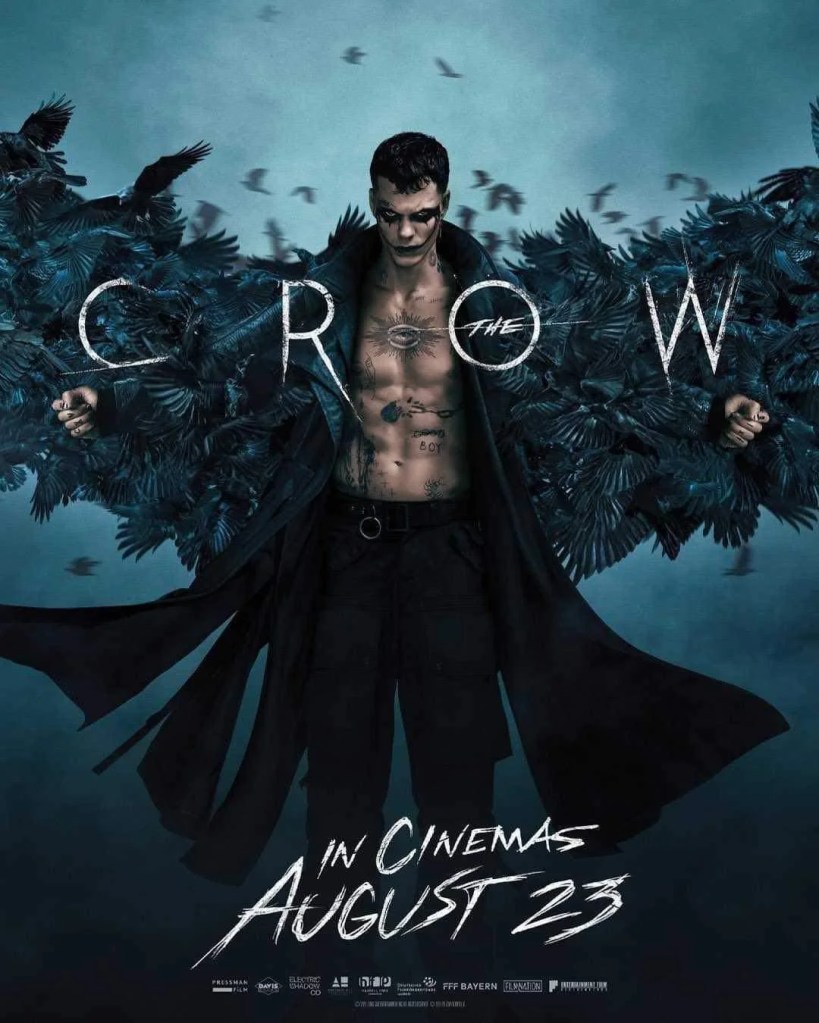
However, a chain of murders eventually leads to Shelly and after a few more acknowledgements of just how broken the central pair are they’re caught up with and murdered. Yet, while his partner’s soul is trapped in Hell, Eric finds himself stuck in the presumptive purgatory of an abandoned train station. Now with regenerative abilities he can travel from the land of the living to the dead, as long as his love remains pure, to track down the crime boss (Danny Huston) responsible for his death, not knowing he might have links to the devil.
Brooding appears to be the core personality trait that this iteration of The Crow wants to exemplify. It feels like a mask covering the feeling that not everyone’s hearts are truly invested in the project, as if thinking it would be cancelled at any time; despite this take having been in the works since around 2020. The vengeance arc, once finally established, plods along with little interest as signs of darkness feel largely performative rather than properly a part of the world. As we jump back and forth between the lands of the living and the dead, and indeed hero and villain, the film feels tonally inconsistent. Even the performances appear to change from scene to scene – Skarsgård’s character changes wildly throughout the film as if making up for the lack of emotional variety in twigs’ performance.
The most emotion comes through in an extended fight sequence where the blood flows down the stairs of a theatre as Skarsgård’s character makes his way closer to his targets. As an opera is performed in the background the action unfolds in an entertaining fashion as if being enjoyed by those who are a part of bringing it together, as if this has been the main focus all along – despite not even being the climax of the film. It’s a brief sequence in comparison to the rest of the film around it, but it has something of a lasting effect into the final stages of a largely murky and inconsistent run-time.
By not embracing its elements of fantasy The Crow instead chooses to focus on the term ‘broken’ without doing anything apart from repeat the word multiple times. Tonally inconsistent and lacking heart in a story of love-fuelled vengeance, the shades of entertainment are held to one very late scene.
 Just A Little Bit Random