
Release Date – 2nd February 2024, Cert – 15, Run-time – 1 hour 52 minutes, Director – Cord Jefferson
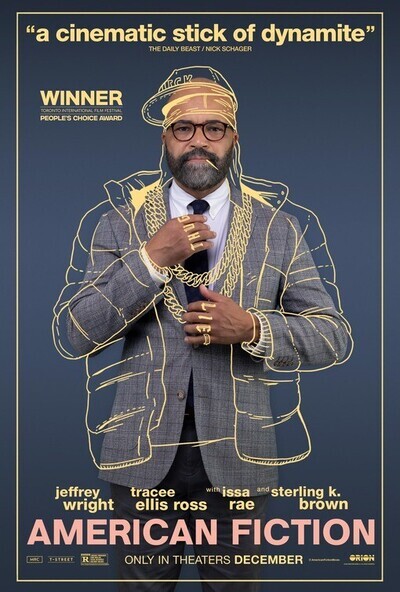
With no publishers accepting his work, and trying to pull money together to care for his mother (Leslie Uggams), writer Monk (Jeffrey Wright) writes a stereotypical Black novel in critique of what he views as the want from the industry, leading to acclaim for his pen name’s ‘essential’ story.
There’s a real sharpness to the layered satire and critique which American Fiction demonstrates. It cuts through the film’s initial veneer/s as what may initially seem like a nearly overflowing plate begins to be viewed as simply a full one. Writer-director Cord Jefferson is aware of his film and what it needs to do to not fall into some of the trappings it’s trying to point at, complimenting with connected parallel narrative strands.
Writer Thelonious ‘Monk’ Ellison (Jeffrey Wright) has received rejection after rejection from publishers to his work, the demand is for stories which he views as capturing a stereotypical view of Black life – giving white audiences the feeling that they’re helping by calling out for change by supporting such “essential” stories. Thus, when faced with needing to financially support his mother (Leslie Uggams) as her mind deteriorates with signs of Alzheimer’s, his mind gets to work one night with a critique of the culture as he sees it. Fugitive author Stagg R. Leigh is born, hammering away what Monk views as a cliched Black novel – the kind which reflects an advert he sees advertising a Black film season on TV, each clip featuring pain, gangs and slavery.
The novel takes off straight away, to Monk’s contempt and uncertainty – can he get away with presenting the character of Stagg R. Leigh? There’s plenty of well-pitched humour to be found within this upfront satire, yet the best comedy lies in that which is more subtle. The background details or moments which are less upfront in a scene, sparking the true push of the film. Gently working in the background of the more dramatic sequences as the Ellison family faces tragedy and simply deal with their own lives and bumpy relationships. The subtlety of the performances truly coming through in the second half as the true extent, and love, within the relationships are allowed to quietly come forward.
Not only Wright’s brilliantly restrained role, but also those which create some of the most affecting moments; particularly Sterling K. Brown (a truly excellent performance which appears to thankfully have gained deserved recognition so far this awards season) as Monk’s brother Clifford and long-time house maid and family friend Lorraine (Myra Lucretia Taylor) – bringing about two of the biggest moments of quiet emotion. Monk’s career may not always drip into these scenes, largely it seems intentionally so, and while occasionally it might help to bring things together that bit more for the most part it allows for the family drama at hand to unfold more naturally. Moving alongside the rising success of Monk’s reluctant not-quite-alter-ego the multi-layered criticism and satire is well handled by Jefferson to bring out the humour, but also bring a complex poignancy to a number of key moments, made truly effective by the performances.
Working in the moment, American Fiction is a film that waits until its final stages, and key conversations between Wright and Issa Rae’s bestselling author Sintara Golden, to truly unveil how clever it is. It does this almost unconsciously, naturally doing so as the discussions unfold and things begin to near rounding off. Effectively encapsulating the themes and what the film has been saying, with counters to create further interest, and also potentially back up the core themes of the film while also working on their own. This is a complex, layered and well-executed comedy-drama that observes its characters amongst the backdrop of the satire they witness and create. That’s where the real spark of American Fiction is, the characters see and create what we find humorous rather than it feeling like the film is drawing it from them.
The key to American Fiction’s brilliantly layered satire is how it comes from the characters observations rather than their actions. There’s plenty of laughs, and some affecting emotion thanks to the truly understated subtlety of the performances in the quietness of the family drama.
 Just A Little Bit Random