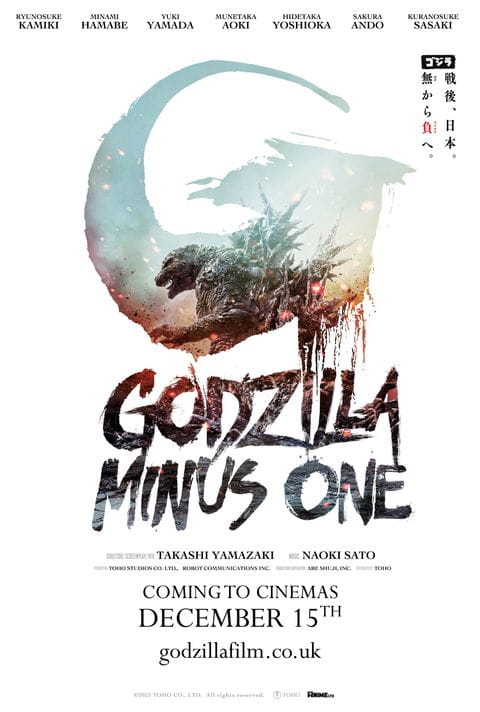
Cert – 12, Run-time – 2 hours 4 minutes, Director – Takashi Yamazaki
Kamikaze pilot Koichi (Ryunosuke Kamiki) finds himself re-encountering Godzilla, leading a battle against the regenerating monster alongside other survivors of World War II.
With 2016’s Shin Godzilla Japan took the iconic monster back to its war-inspired roots. A modern day take of human characters responding to tragedy, and a constantly evolving destructive force. It was one of the best Godzilla films in years, bringing us in to the human characters so that their response had an impact, while still pushing the grandness of the titular lizard. With Godzilla Minus One these feelings are continued, while also taking things back to post-war Japan in a more upfront way via a late-1940s setting.
Kamikaze pilot Koichi (Ryunosuke Kamiki) is recovering from World War II, grieving his family and being shunned by his neighbours for not properly doing his bit. Taking in homeless Noriko (Minami Hamabe) and orphaned child Akiko Koichi begins to find himself a part of a family unit, although his experiences during the war stop him from fully committing to them, at least when it comes to his external emotions. However, he’s truly tested when his traumas come back to attack all of Japan, when Godzilla resurfaces to devastate the country.
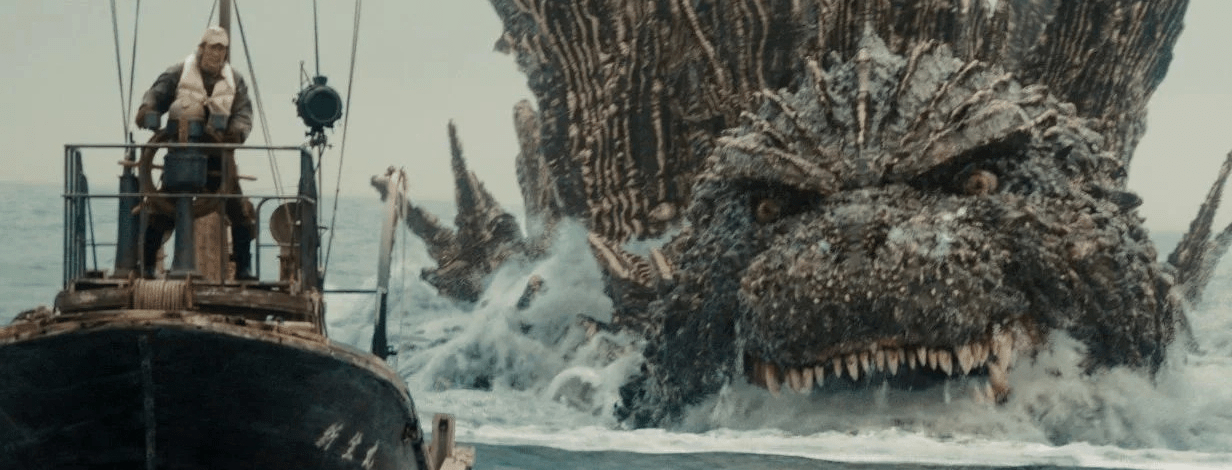
Godzilla is a terrifying force here, a genuinely scary creature who you feel the impact of because of the tension that’s created whenever the monster appears. Particularly in up-close encounters; chasing small boats, hunting for sea mines, through the sea as the crew, knowing they’re there as disposable figures, try their best to survive the seemingly impossible. As Godzilla regenerates, and becomes stronger, after each attempt to defend against him he simply becomes an even scarier force – the traditional city attack has a true tail-swipe effect as panic rushes through the streets of citizens racing to get away from flying debris and radioactive powers. Add that to the general design of this iteration of the almost 70-year-old monster and there’s a good deal to be creeped out and made tense by.
He fits right in to the story that responds to him. The plans at hand, forming over time with stages sometimes only becoming clear to characters in the moment – or as they come up with them – feel natural and engaging. Helping with the overall flow of the piece, going by very quickly over the course of just over 2 hours. With focus still on Koichi the emotional human connection, particularly in regards to his almost-family life, is also consistent throughout and helps to propel the action and drama – both of which are enhanced by the scope of the details and encounters with Godzilla.
As people come together, and sometimes not, and plans start to come together with clear thought and urgency it’s not difficult to also get behind the supporting cast who are given as much focus as the central figure. Putting Godzilla in clear sight but never centre stage, it’s about how people respond to the creature and its attacks. Capturing that original post-war feeling with plenty of modern styling and flair. It combines well and helps to form an actual story of responses to tragedy rather than something following Godzilla being a threat to people for two hours, in fact he’s lightly used throughout Minus One. There’s a lot to like here as Godzilla is taken back to his roots and allowed to re-grow in the modern day.
Allowing characters and plans to lead the story Godzilla Minus One creates a genuinely scary threat which takes the monster back to its post-war roots and provides a good deal of tense action.
 Just A Little Bit Random