
Release Date – 12th January 2024, Cert – 15, Run-time – 1 hour 47 minutes, Directors – Kibwe Tavaras, Daniel Kaluuya
Whilst planning to move to a better apartment, Izi (Kane Robinson) takes in a bereaved child (Jedaiah Bannerman) to his home in The Kitchen, a block of flats regularly attacked by police trying to evict the residents.
There’s a believable design to the world of The Kitchen. Both the titular block of flats and the landscape outside of it. It’s nice to know that no matter how run down the streets of London are, at least Poundland still exists. Yet, it’s a place that the residents of The Kitchen visit little. They largely spend as much time as close to their flats as possible. The small space outside of the building is full of vibrant shops and stalls, easy to close in case the police break in.
Orders have been in place for an extensive time for the demolition of The Kitchen, however the residents refuse to leave – in part for not being able to afford a new, modern flat. Therefore, the police frequently run in capturing as many people who don’t make it back to their flats in time in scenes which maintain a chaotic intensity. The one person with little plan to stay is Kane Robinson’s Izi, he’s saving up to move to one of the various high-tech apartments surrounding his current home. However, he experiences a setback when he takes in bereaved child Benji (Jedaiah Bannerman) after seeing him at the funeral home he works at – where the dead are allowed to move on by being used to grow trees.
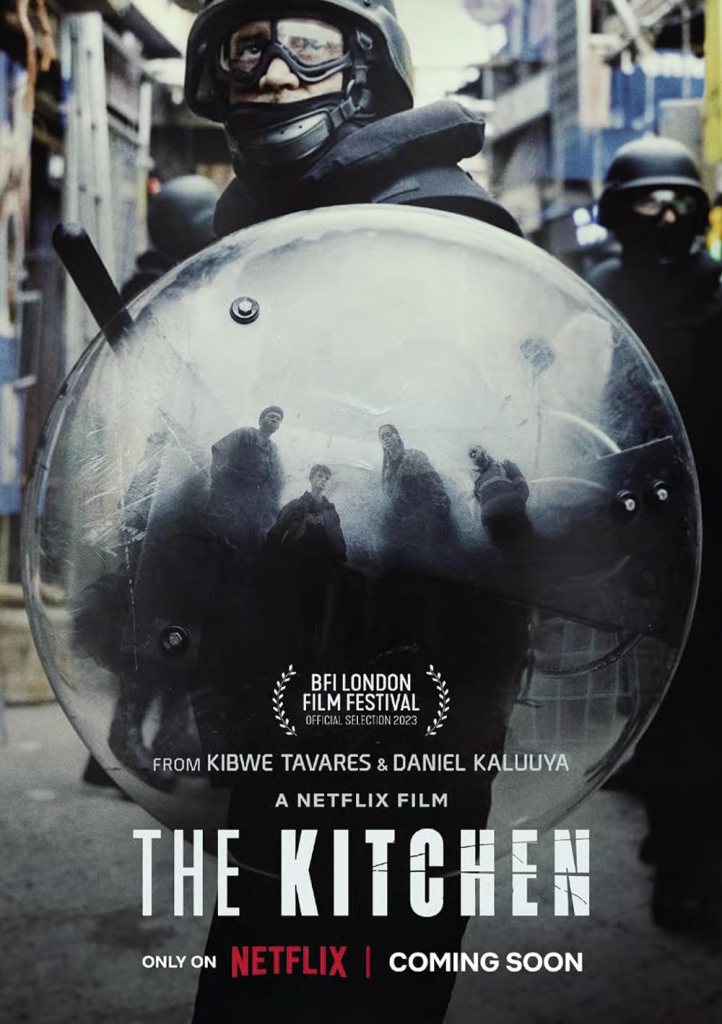
As the pair’s quiet and engaging relationship grows the raids on The Kitchen increase in frequency and brutality. It makes Izi even more intent on leaving, however Benji is making his plan more difficult: the flat he’s preparing to move into is only for one person and is strictly monitored. There’s a lot going on in the film in regards to its themes and the different strands that it follows for its central characters, and indeed the main location as we reach the halfway point it feels as if it starts to lose itself amongst them.
As things stretch on the various strands are kept in place, and as they continue it feels as if the story could be condensed into a short film, or as if it’s been adapted from one. Into the second half it starts to leave a somewhat cold feeling. Interest in the setting may be maintained, but with the way the themes are drawn out or tangled throughout the run-time means that things never quite have the same gripping nature as the occasional louder bursts. The themes and focuses shift from scene to scene and, again, almost bring a jumpy quality to the overall film, especially in the second half when the developments should be having more emotional impact.
While there’s interest in the world and engagement with the characters The Kitchen loses itself amongst its different strands, losing effect and feel as if it could be more condensed.
 Just A Little Bit Random