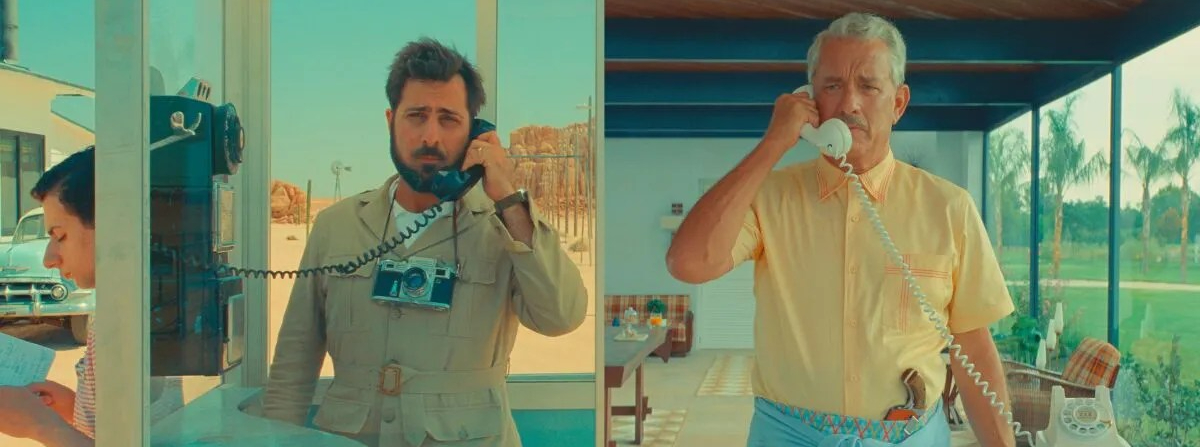
Cert – 12, Run-time – 1 hour 45 minutes, Director – Wes Anderson
The story of a play about a group of strangers quarantined in a small desert town after an alien encounter.
There’s been plenty of internet discussion around Wes Anderson in the last few months from TikTok trends to AI created trailers for ‘Star Wars if it were directed by Wes Anderson’. Some claim this has diminished the writer-director’s work showing that anyone can make one of his films. Yet, as Anderson opens up the first layer story of his latest film he demonstrates just why this isn’t the case, not just with him but for cinema and the creative arts as a whole. Television host Bryan Cranston details that we’re about to see a televised production of Conrad Earp’s (Edward Norton) stageplay Asteroid City, with details on the creation of the production scattered throughout. The ode to the creative process is passionate and caring and continues to show Anderson’s love of stories and storytelling.
His empathy shows, with particular emotional disconnect, to allow for feelings to be improperly shown. The characters within the play especially are unsure of how to express their true feelings, leading to a confused state of emotions, as if being experienced for the first time. Yet, with how much is going on within the film – a grieving father (Jason Schwartzman) telling his children they’re mother has passed away and them coping with the loss, an actress (Scarlett Johansson) wishing for more comedic roles yet constantly playing tragic alcoholic drug addicts, teenagers trying to work out their place in the universe – the emotional disconnect hinders a number of the themes. You can’t help but feel that there would be more effect during such moments of drama if there was more emotional expression and connection from and to the characters.
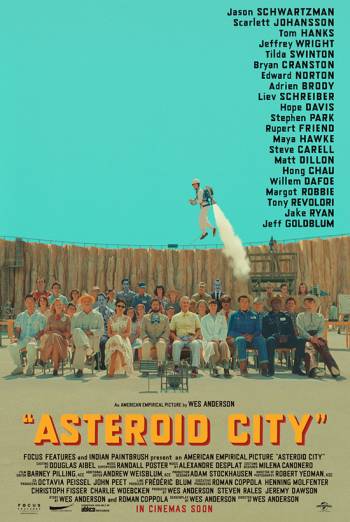
Even in regards to the central idea of a group of strangers trapped in a small quarantined desert town after a brief alien encounter. The surrounding environment is plainly laid out with some truly excellent production design, creating room for the camera and cinema audience while also reminding of the story-within-a-story nature and the fact that this is meant to be a play. The town, and indeed its temporary inhabitants, joined for the stargazer and space cadet camp, provide plenty of amusement against the backdrop of the circumstances. Plenty of traditional dead-pan Anderson chuckles are dotted throughout, alongside one or two slightly absurdist elements to provide some surprise.
However, while the core arc is engaging and provides good amusement perhaps the best moments lie in the black and white depiction of the play’s creation and performances. Somewhat breaking the barrier showing different angles of figures trying to find meaning within their life and work. It’s an interesting enhancement which works and helps to push the themes with a more engaging angle – particularly in the third act as the film develops and rebuilds some elements from the second act; more focused on the uncertainties of character emotions and reactions. Building back up it stops the viewer from disengaging and provides enough impact in each moment to make the themes and previous thoughts of those on-screen worthwhile.
When asked what his play is about Conrad Earp responds “it’s about infinity, and I don’t know what else”. Indeed Anderson’s film deals with a small group of characters struggling with the idea of infinity, how that places them now compared to how they were placed beforehand in perhaps already struggling lives. Some of this largely comes to the fore, or at least is only realised as at the fore, in the closing stages of the film – perhaps making for an interesting rewatch – yet it certainly leaves a good deal to reflect on in terms of the characters in Asteroid City itself and the effects a very brief alien encounter have on them. Not all may resonate due to Anderson’s emotional disconnect, but there’s still enough to create an interesting film which leaves plenty to think about, dwell on and grow on you, perhaps.
While the personal emotional strands of Asteroid City could do with more open expression from the characters there’s a good deal of interest within the themes brought to the fore in the third act and how they reflect on the humorous, finely-designed film beforehand.
 Just A Little Bit Random