
Cert – 12, Run-time – 1 hour 48 minutes, Director – Stephen Williams
Set on leading the Paris Opera Chevalier Joseph Bologne (Kelvin Harrison Jr.) finds himself in a contest to put together the best opera, however as talk of revolution rises in France his race and background are further discriminated against by his high-society peers.
Perhaps it’s down to my ignorance (I used to play percussion and would quite like to know how to play the banjo, and maybe the steel pan drums) but I never knew the violin could be so exciting. Yet, there’s a captivating nature to the musical duel between Chevalier Joseph Bologne (Kelvin Harrison Jr.) and the man he shows up in the middle of a concert, a praised foreigner called Wolfgang Amadeus Mozart (Joseph Prowen). Unknown to Mozart the Chevalier is a highly praised figure in Paris, known for his musical compositions, fencing skills and friendship with Queen Marie Antoinette (Lucy Boynton); and he’s certainly aware of his own talents. So much so that he’s determined to take over as leader of the Paris Opera.
However, it’s a highly sought after title, leading to a contest, suggested by Antoinette, to see who can produce the best opera, whoever succeeds claims the role. Yet, making the best opera possible isn’t the only thing that stands in the Chevalier’s way. As talk of revolution rises in the streets of France he finds that his race and background, not just as an illegitimate child, are frequently being brought up by his high-society peers. Despite his title has he ever truly been viewed as an equal in this society?
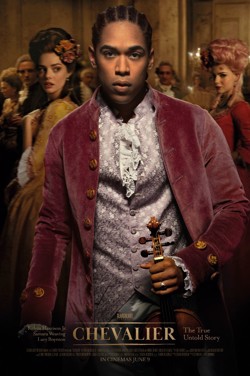
The core creation of the opera – which includes the Bologne’s affair with his lead actress Marie-Josephine (Samara Weaving), married to the famously ruthless Marquis de Montalembert (Marton Csokas) who forbids her from performing – makes for an admittedly conventional arc, however it’s surprising just how much you don’t notice it thanks to your engagement with the film. Perhaps it’s down to the attention to detail in the visual nature of the piece – the costume design is certainly one of the most striking elements of this period drama.
Elements such as the revolution or the protagonist’s mother (Ronke Adekoluejo) – now free from her son’s slaveowner father – residing in his home, offering occasional words of wisdom guiding her son to realise who he truly is are occasionally brought into the mix but only for a brief burst every now and then. While not quite disturbing the flow these points do create an occasional bump of cliché when brought back without bringing much more detail with them.
It’s in the final half an hour where such points are truly brought to the fore. This also happens to be when the convention is much more noticeable. There’s still a good film here, helped by the tone of the drama and the solid performances throughout – particularly Harrison Jr, Weaving and Boynton – it’s just more noticeably familiar with the elements that it switches to. During one sequence it almost feels as if you’re watching a different film due to a strong tonal change, almost exclusively for this one scene. It may be understandable in the moment but it still feels odd. Yet, there’s still an engaging piece of work to be found, although more so in the first hour where the core of the work and narrative appears to be held. Helped by the fact the film deals with what it claims is a little-known story without seeming to boast about it or treat everything with a sense of shaded mystery.
While it may tip into cliché there’s an engaging nature to the core of Chevalier’s narrative which, alongside Kelvin Harrison Jr’s lightly charming central performance, brings you in to the visually detailed world for most of the run-time.
 Just A Little Bit Random